To defend themselves, Pakistani planners long ago developed a doctrine of strategic depth. The idea had its origins in the debacle of 1971
According to the Pakistanis’ narrative, the dismemberment of their country—which they blame on India—made it all the more important to develop and maintain friendly relations with Afghanistan
The Afghan government be a close ally of Pakistan, and willing to help fight India. When the Taliban were in power, they were seen as the perfect partner for the Pakistani military
After the Taliban were ousted by the U.S after 9/11, a major strategic shift occurred: the government of Afghanistan became an ally of India's, thus fulfilling the Pakistanis’ worst fear
For the Pakistani military, the existential threat posed by India has taken precedence over all other geopolitical and economic goals
The Pakistani military has relied on asymmetric warfare— using jihadi fighters for its own ends
The Pakistanis have kept much of the Indian army bogged down in Kashmir ever since the separatist insurgency broke out in 1990
There are clearly those in the army who are now alarmed at the amount of sectarian and political violence the jihadis have brought to Pakistan
ISI continues to believe that the jihadis are a more practical defense against Indian hegemony than even nuclear weapons. For them, support for carefully chosen jihadis in Afghanistan is a vital survival strategy well worth the risk
The origins of the Indian-Pakistani rivalry in Afghanistan date back to Partition in 1947. As the British walked away from their Indian Empire in the aftermath of the Second World War, they divided up their former colony between Hindu-majority India and overwhelmingly Muslim Pakistan
It was in that context that Kashmir became a thorn in the side of both countries. The fate of what had been, under the Raj, the princely state of Kashmir, became an anomaly of Partition. With its large Muslim majority, Kashmir was an obvious candidate to join Pakistan. But the pro-Indian sympathies of both its Hindu maharajah and its pre-eminent Muslim politician, Sheikh Abdullah, as well as the Kashmiri origins of India's first prime minister, Jawaharlal Nehru, led to the state's remaining part of India, which Pakistan has always regarded as unacceptable
It was in Kashmir in 1947 that Pakistan first used irregular tribal fighters to try to get its way, sending Pashtun tribesmen over the border to march toward Srinagar
By the terms of a ceasefire signed on January 1, 1949, Kashmir was effectively divided between India and Pakistan. The two countries would go on to fight another war over Kashmir in 1965, and it has remained a cause of conflict ever since
Afghanistan also had an uneasy relationship with the Land of the Pure (Pakistan)
As with India, borders and territory were in dispute. Afghan leaders had never accepted the Durand line that the British drew in 1893 and, after Partition, Afghanistan was not about to recognize that line as its border with Pakistan. The Afghan king, Zahir Shah, was especially keen to regain Peshawar, in a valley at the eastern end of the Khyber Pass, which had once been the summer capital of the Afghan empire. It had been in British hands since 1845, and was now to become part of Pakistan. To this day most Afghans look on Peshawar as a lost Afghan city
It was only the pressure of growing Soviet influence in Afghanistan in the 1970s that forced the Afghan government to improve its relations with Pakistan
Throughout the 1980s India expanded its influence in Afghanistan, contributing to an ambitious series of development projects
Pakistan meanwhile began to arm the mujahedin who fought the Soviet occupation. Their recruitment was always controlled by the ISI, but was originally also funded by the Saudis and the CIA
ISI: The Kashmiri people have risen up in accordance with the UN charter, and it is the national purpose of Pakistan to help liberate them
India began its support of the Northern Alliance under the command of Ahmad Shah Massoud
Taliban rule (1994 - 2001) –– Afghanistan quickly became the base for a whole spectrum of anti-Indian groups
Musharraf's support for the U.S. reversed a decade of Pakistani foreign policy. He embraced President George W. Bush's Global War on Terror
Only months after 9/11, the ISI was providing refuge to the entire Taliban leadership
India made wise use of its opportunity to forge a close partnership with Afghanistan
India has built roads linking Afghanistan with Iran so that Afghanistan's trade can reach the Persian Gulf at the port of Chabahar
Many have come to believe India is using its Afghan consulates to foment insurgency in Baluchistan
The danger posed by the jihadis—not just to India, but to Pakistan as well—is increasingly clear to all
British diplomats in Islamabad take the view that because the Pakistani army now fears jihadi-generated instability more than it fears India it really has changed its attitude toward the jihadis
General Kayani told American military officer that if Afghanistan deteriorated into chaotic civil war after the Americans leave, it would be bad for Afghanistan but a disaster for Pakistan
China now has very considerable mineral assets in Afghanistan
It will expect Pakistan to protect its interests and not allow the Taliban to disrupt these operations in Afghanistan
Nawaz Sharif has the clarity of vision but the political will and the room to maneuver in that direction is an open question
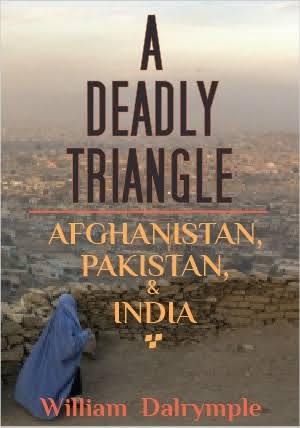
The future will be brighter for all three countries caught in a deadly triangle of mutual mistrust and competition if Pakistan and India can come to see the instability of Afghanistan as a common challenge to be jointly managed