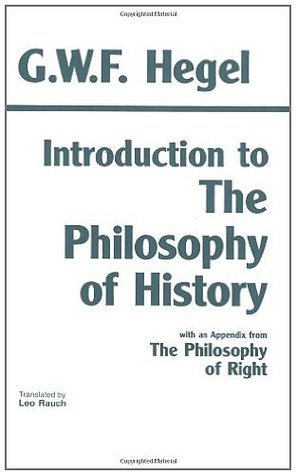
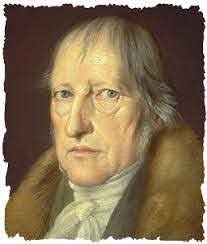
Who said Hegel was difficult?
Well, me, actually. And I stand by it. I think Hegel is the hardest philosopher that I've ever read.
However, this was a lot easier than I expected. I've read a lot more secondary sources on Hegel since I last attempted reading one of his books, and they've made it a lot easier to follow his logic. Honestly, I think that doing so is the best way to tackle Hegel. I've been floating around Hegel for years, reading his predecessors (Kant, Hume, etc.) and those that he influenced (Kierkegaard, Marx, etc.), and every one of those books has made Hegel easier. But the real key has been just surfing the web. It's probably unfashionable to say so, but Wikipedia really is your friend in the reading of Hegel.
This is the first time that I've actually finished one of Hegel's books, and I honestly think that I understood almost all of what he was getting at. Of course, it took a lot longer than any other one hundred page book that I've read before, but it was definitely worth it. Hegel was an incredible thinker. His ideas can be kind of overwhelming in their complexity, but when you grasp them, they have the potential to be mind-expanding. Their difficulty stems mostly from how totally foreign they are to more conventional thinking.
To better understand what I had read, I took notes throughout the whole volume. They're quite disorganised, but they may help future readers, so I've included them below. I can't guarantee that all of my interpretations are strictly right (it is Hegel, afterall!), but they at least represent what I understood Hegel to be getting at. Hopefully they might be of use to somebody.
---
Reason is the substance of the world, in that it is the main driver of history. Reason is a personal manifestation of the will of the universal spirit, which strives towards freedom. What I mean is that the universal spirit wants freedom to act out its own self. The universal spirit is inside all of us as the ‘thesis’ of the self, although the personal self is largely defined by its relation to this thesis. This relation is the antithesis, and the thesis and the antithesis desire to harmonise, however if they do harmonise there is no more meaningful history.
The state is the culmination of the collective action of individuals attempting to realise the thesis or their relation to the thesis. The state is, as such, a form of collective action which is driven either by the universal spirit, relation to the universal spirit, or a combination of both. The goal of the state is to realise the freedom of man, which is itself the freedom of reason, which by extension is the freedom of the universal spirit.
As such, the ultimate goal of history is to realise the union of the subjective and the universal, such that the subjective will of man is harmonised with the actual reality of the social order. If this were to occur, the state would have become the tool of reason, and by extension of universal spirit. At this time, man would no longer be defined by his relation to the spirit, but by the spirit itself, as the state would have ceased to struggle towards freedom of expression of the spirit, but rather would have permitted the spirit to act out its will freely.
However, this cannot be easily realised because human passion in attempting to express itself inclines in actuality towards producing structures which restrains itself. In attempting to fulfil its own interests, the will of man necessarily creates barriers to acting out this will. For example, in the creation of the state the desire to exact revenge through violence must be restrained. When somebody exacts revenge through violence, the action itself necessarily turns against the agent through the necessary application of law. The state by necessity must restrain these passions. Sometimes, these passions become manifest in the form of an individual which is able to give them expression in such a manner that permits them to undermine the established order to create a new order. These men are ‘the great men of history’ and they express a universal concept which is in opposition to the established concept of a people or place. These people give expression to the universal spirit.
Universal spirit has the power to realise itself and the end of a human is the realisation of the universal spirit in the form of reason, and all other intellectual matters, including religiosity, morality and ethics are subordinate to this. Religiosity, morality and ethics are eternal and infinite but only in their absolute form. When they are manifest in the world, through relation of the self to their infinitude and eternity, they are necessarily limited and transitory. As such, sometimes in the realisation of reason, the others are often sidelined, as in the case of Caesar. Only the intellectual matters which are fulfilled in the actualisation of this form of reason are ‘real’ in the sense of being ‘true’. Other conceptual ideas which are not realised by it, are not ‘true’ in the same sense. Philosophy is the study of the content / actuality of the divine idea of the universal spirit.
Passion is the actuating element (the realising force) of reason. The state attempts to harmonise the universal spirit with the subjective will, and as such becomes ethics. All spiritual reality is the state. Without the state, human beings have access to the universal spirit and can create their own relation to it, but are fundamentally unable to actualise it. Actualisation of the universal spirit’s reason and desire for freedom is always in the form of the state. The actualisation of the ideal state is the objective of history.
The state of nature does not exist as a distinct thing from the basic human condition. By this I mean that the will to a state is a fundamental part of humanity. The state of nature is ahistorical.
If freedom is consent, then only the subjective element is realised. If the minority yields to the majority, freedom is not realised. The actual constitution of a properly realised state is intelligence, not ‘rule of the people’. If everyone must consent, then the government is not autonomous. The government must be autonomous but as few people as possible (ideally none) should be merely obeying. The ideal form of government will have little or no room for arbitrary expression, and will act out the will of all of the citizens.
The earliest states are authoritarian and instinctive, but even these states involve some degree of harmonisation of will (at least a greater harmonisation than among a people without a state). This is because the subjective will is subordinated to the subjective will of another, and in doing so a collective will is established, and in doing so is moved closer towards the universal will. From here, the centre of gravity is towards the realisation of a state based on the reason of the universal spirit.
Worship is meditation externalised. Art allows the divine to become visible. Art is a more sensually direct form of worship. However, the highest expression of spirit is philosophy. They have the same fundamental source as the state, i.e. reason as expression of the universal spirit. The consciousness of the union of the subjective and universal is religion (although the manifestation is the state as previously mentioned). Art and philosophy are different forms of this consciousness. Representation of God is the general foundation of the unity of a people. Religion being itself not the manifestation of ethics itself does have the potential, through becoming fanatical, of turning against ethics (the state). Religion is only one form of relation to the universal spirit, and is not (of course!) the universal spirit itself. The state and religion must be in agreement.
Nature is an eternally repeated cycle. Humanity has actual capacity for change and a drive towards ‘perfectibility’. Development is the spirit, which determines history absolutely. The actualisation of spirit is mediated by consciousness and will. The spirit both animates the will and is the product of the will. As such, the spirit must overcome itself on the path to actualisation.
World history exists in stages of development of a principle whose content is the consciousness of freedom. History (which is manifestation of spirit) strives to move from the imperfect to the perfect, but contains the perfect inside of itself. It is opposed by itself. The imperfect opposes the perfect, even as it has knowledge of the perfect, which is itself the source of its drive for perfection.
We often imagine that man, in a state of nature, had true freedom at the dawn of history, but this is not the case. History must begin not with this imagined state, but with the entry of rationality into decision making. The state is the first true ‘prose’ is this actualisation of spirit. True narrative begins with the state.
Language is the essential medium of recollection and imagination.
The spirit of world history is self-determining. It posits determinations in itself, negates them, and in doing so gains a more concrete determination. Every stage in this process has its own principle. Through these stages, spirit is able to express its will. The culmination of a people’s culture is the character of a people, and each unique totality is itself a principle. Humanity is separated from nature in that it is able to organise in this manner.
The deeds of great men which violate the law are often more moral than those of people with the potential for greatness who choose not to violate the law, because these great men have ‘inner significance’ in acting out the will of the spirit (although they are unaware of this). It will only be clear that they are of this category in hindsight.
A consciousness which attempts to break down elements of the world (often in the form of vague conceptions), into smaller and more manageable constituent parts, is philosophy. Culture is a precondition for the existence of philosophy, but this philosophy can then be reflected back to the culture which has the power to endow it with universality, at which point the philosophy has both ‘content’ and ‘form’. Philosophy inevitably arises in the development of the state. Philosophers arise as they try to devise an intellectual path to unity in a divided world. The state in bringing together diverse consciousnesses into a whole necessarily includes some division, and the intellectual need is present to resolve these division into a coherent whole. The arts arise also to bridge these divides.
The animal does not have freedom because it does not meaningfully think. Because it does not meaningfully think, it cannot organise into a state. The human can sense itself as an individual and is capable of abstraction, and through this abstraction can ‘renounce particularity’ and hence conceive of the infinite. As this experience is common to all humans, a collective consciousness is capable of emerging (because the abstractions incline together socially). As such, a culture is formed and this culture is spirit (geist), which is ‘concerned with the production of itself’. Its highest aim is knowledge of itself - sight and thought - this is inevitable, but this also begins the decline of the spirit, to make way for a new one.
Interests are constantly changing and shifting, and this is the primary mover of ‘change’. Change ultimately brings these cultures to an end, whereupon a new one rises in its place (like a phoenix).
A people is ‘ethical virtuous and strong, insofar as it brings forth what it wills, defending what it does against external force in the work of objectifying itself’. When these two are in harmony, there is no difference between the people’s objective and subjective existence. The spirit becomes inactive when these two become one. At this point, the culture enters a state of ‘habit’ and begins what Hegel terms ‘national suicide’. This ending is part preservation and part transfiguration, as the former culture is not so much recycled, as negated by a self-activating consciousness. What occurs on a smaller level: negation and synthesis, here occurs on a macro level. The final stage defines a people.
Substansive freedom vs subjective freedom. In the former we see conventional law, in which laws are followed as matter of course. In the latter, we see personal will and individual insight which inform an individual’s relation to law, and guides their morality.
The spirit has four observable degrees of development, typified by Hegel as Oriental, Greek, Roman and Germanic. The oriental degree is immediate revelation, in which substantial spirit is sensed (see above). The second is is when ‘being-for-itself’ is sensed, and ethical individuality is discovered. The third (Roman) degree is when abstract universality is discovered, and people live collectively for the state. However, it is not until the fourth that this is reversed, and spirit ‘creates and knows its truth as its own thought, and as a world of lawlike actuality’. In the last state, divine and human natures are made one. Church and 'empire' are different institutions but they are rooted in a single unity.