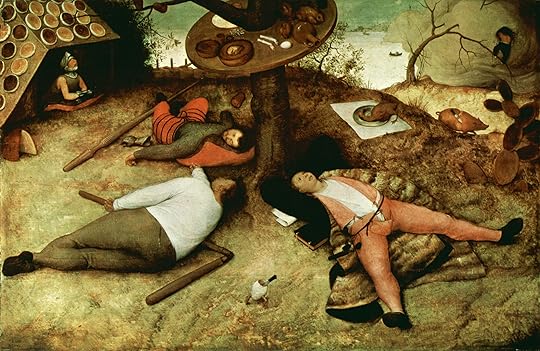
Imagine a dreamland where roasted pigs wander about with knives in their backs to make carving easy, where grilled geese fly directly into one's mouth, where cooked fish jump out of the water and land at one's feet. The weather is always mild, the wine flows freely, sex is readily available, and all people enjoy eternal youth.Such is Cockaigne. Portrayed in legend, oral history, and art, this imaginary land became the most pervasive collective dream of medieval times-an earthly paradise that served to counter the suffering and frustration of daily existence and to allay anxieties about an increasingly elusive heavenly paradise.Illustrated with extraordinary artwork from the Middle Ages, Herman Pleij's Dreaming of Cockaigne is a spirited account of this lost paradise and the world that brought it to life. Pleij takes three important texts as his starting points for an inspired of the panorama of ideas, dreams, popular religion, and literary and artistic creation present in the late Middle Ages. What emerges is a well-defined picture of the era, furnished with a wealth of detail from all of Europe, as well as Asia and America.Pleij draws upon his thorough knowledge of medieval European literature, art, history, and folklore to describe the fantasies that fed the tales of Cockaigne and their connections to the central obsessions of medieval life.
Whole battles, abductions, sieges, hunting parties, and shipwrecks were portrayed in, through, between, and with the help of food. A special form of table humor consisted in rendering the ingredients unrecognizable, masking tastes, and molding meat to look like fish, fish like fowl, and fowl like meat. Surprise courses and disguised dishes were among the high points of aristocratic dining pleasure. What could be more fun than a rabbit made of dough, especially when a hungry knight bit into it? Serving up a giant egg made of a pig’s bladder could also do a lot to raise the guests’ spirits.
Dreaming of paradise on earth is of all times and regions. In this book the Dutch medievalist Herman Pleij evocatively conveys which form these dream images took in the Low Countries during the late Middle Ages in tales on the legendary Cockaigne as the imaginary dreamland with an abundance of delights, dipped in eternal laziness. By analysing three Middle Dutch literary texts and artwork from the late Middle Ages, Pleij illustrates the socio-cultural functions of these stories and probes their origins. Cockaigne is an outlet for the permanent fear of hunger, a compensation for the daily struggle for existence. Cockaigne is also a literature of lies, a 'parade of anti-models'. While some tighter editing would not have been out of place for this amply detailed and illustrated study, I still enjoyed devouring it.
The book was originally published in Dutch in 1997 and was translated into English in 2001.
(Pieter Bruegel the Elder, The land of Cockaigne, 1567)
Verrassingsgerechten en vermomd eten behoorden tot de hoogtepunten van het adellijke tafelgenot. Wat was er leuker dan een konijn van deeg, zeker als een hongerige ridder daarin beet? Ook het koken van een reuzenei dat gemaakt was van een varkensblaas kon de stemming er danig in brengen.
Dromen over het paradijs op aarde is van alle tijden en streken. Welke vorm die droombeelden in de Lage Landen tijdens de late Middeleeuwen aannamen, vertelt Herman Pleij in dit boek. Het gaat over ‘droomlanden met een overvloed aan lekkernijen, gedompeld in eeuwig geluier’. Aan de hand van drie Middelnederlandse literaire teksten en de contemporaine schilderkunst illustreert Pleij de sociaal-culturele functies van deze verhalen en peilt naar de herkomst ervan. Cocagne is een uitlaatklep voor de permanente angst voor honger, een compensatie voor de dagelijkse strijd om het bestaan. Cocagne is ook leugenliteratuur, een ‘parade van antimodellen’. Een strakkere redactie had deze studie weliswaar niet misstaan, maar ik heb ze toch met veel plezier verslonden.
Een middeleeuwen-klassieker die voor mij plat op z'n gezicht viel. Op basis van (maar) 3 teksten over Cocagne probeert Pleij een hele analyse over droomfantasieën, paradijsverbeelding of reisverhalen te maken. De manier waarop hij dat doet is vooral door (heel) losse associaties te maken naar vaak dezelfde middeleeuwse teksten, maar zonder een concreet resultaat of "punt" dat hij maakt. Soms zijn die associaties interessant (bv. monnik Brandaan), meestal zijn ze voor mij puur suggestief of vergezocht.
Bijna 500 pagina's aan probeersels en hersenspinsels is echt niet aangenaam om te lezen, zeker in een academisch taaltje dat ik beu was na p. 30. Nog een minpuntje voor de bladspiegel die ook niet erg uitnodigend is: een muur van kleine letters, weinig witruimte en veel te lange zinnen.
2 maand geploeterd en blij dat ik er klaar mee ben
A fascinating exploration of the legend of Cockaigne through various perspectives: historical, linguistic, psychological, religious, and last but not least—culinary :)