Born in 1901, Barbara Cartland started her writing career in journalism and completed her first book, Jigsaw, when she was just 24. An immediate success, it was the start of her journey to becoming the world’s most famous and most read romantic novelist of all time. Inspiring a whole generation of readers around the globe with her exciting tales of adventure, love and intrigue, she became synonymous with the Romance genre. And she still is to this day, having written over 644 romantic fiction books. As well as romantic novels, she wrote historical biographies, 6 autobiographies, plays, music, poetry and several advice books on life, love, health and cookery – totalling an incredible 723 books in all, with over 1 billion in sales. Awarded the DBE by Queen Elizabeth II in 1991 in honour of her literary, political and social contributions, she was President of the Hertfordshire branch of the Royal College of Midwives as well as a Dame of Grace of the Order of St John of Jerusalem and Deputy President of the St John Ambulance Brigade. Always a passionate advocate of woman’s health and beauty, she was dubbed ‘the true Queen of Romance’ by Vogue magazine in her lifetime. Her legend continues today through her wonderfully vivid romantic tales, stories that help you escape from the day to day into the dramatic adventures of strong, beautiful women who battle, often against the odds, eventually to find that love conquers all. Find out more about the incredible life and works of Dame Barbara Cartland at www.barbaracartland.com
Peeps may think of Barbara Cartland as a romance relic of the past, and they could not be more wrong. She is one of the Grand Dames of Romantic lit along with Victoria Holt, Georgette Heyer, Barbara Metzger and the like. Ms. Cartland precedes the bodice rippers that later followed in the forms of Natasha Peters, Kathleen E. Woodiwiss, Susan Johnson and Johanna Lindsey.
Dame Cartland knows her business when it comes to romance and Love in all its purity with human beings at their finest. Her most dastardly heroes are transformed into chivalrous beaus willing to post the banns with a virginal waif or feisty heiress who has suffered enough to make her far more fascinating than the mindless debutantes of the Season.
Yes, yes, I know what you are thinking. It's the Man of the World and the Sweet Innocent, how cliched. How limiting, boring, old-fashioned, what dross. But for me, the H/h of these tales represent what is the most noble and ideal of Love in its various progression. And not go all Greco-Christian philosophical on ya,--so what if I am?--but I like to believe that the study of the four definitions of Love are always underlined in Dame Cartland's books-
1. Storge- empathy for others
2. Philia- friendship
3. Eros- sexual passion
4. Agape- all consuming love without limits
In Alone in Paris the very snobbish and world-weary Duke meets the convent educated and extremely sheltered Una, who is naive, selfless and intelligent. Sadly, her inexperience makes her a target for unscrupulous types whose hearts are filled with avarice, lust and immorality. At first, the H believes she is too good to be true. This paragon is a well-trained actress to entice him. He has been played the fool before! So I was able to cut him some slack when he was being very stupid at times. The beauty of this story is when his transformation is completed, how the Four Loves are brilliantly revealed in his actions, thoughts and words. He learns to feel empathy for this young girl and eventually is willing to make a true sacrifice on behalf of Una by doing what is right.
Peeps may feel that Dame Cartland's works or from a distant time and place but I disagree. If you look at her life's achievements and what she stood for, along with her various charities and causes--including creating a safe-haven for the Rom people--then you will agree that she understood Love. Which is why, her works are immortal and are still very valid today.
Ridiculous and corny and implausible and adorable, just like Barbara Cartland herself lol. If you want a better version of a Paris turn of the century love story between a wide-eyed innocent and a charming, older roué, may I suggest the works of Colette?
Once upon a time there was a young eighteen year old girl who left the convent school in Italy and went to Paris, France to see her father. Unfortunately, once she arrived, she discovered her father died and she has nowhere to go. Thank goodness she meets the Duke of Walstanton through her father's art dealer.
Okay it's Barbara Cartland! I read gobs of her books back when I was a young teen in the 70s. They are all pretty much formulaic in basic plot and characterization. Young, helpless, virgin female meets older wiser, stronger, titled, often rakish gentleman. Still, they are fun to read at times when you want a quick read or just something light and easy..
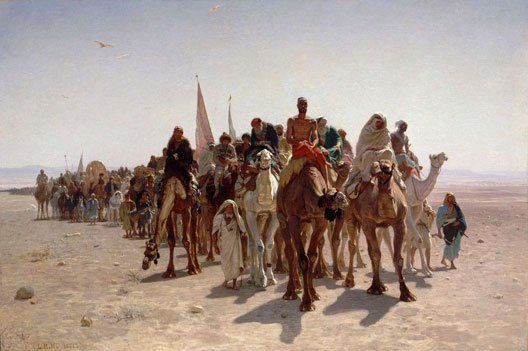
Léon Belly (1827-1877) Pélerins allant à La Mecque 1861 Pèlerins allant à la Mecque
Pour ce tableau, considéré dès sa présentation comme un chef-d'oeuvre de la peinture orientaliste, Belly choisit de traduire sur une toile d'un format particulièrement imposant un sujet ambitieux. Il s'agit de l'avancée d'une longue caravane dans le désert, se dirigeant vers la Mecque, la ville la plus sainte de l'Islam et lieu de pèlerinage des musulmans.
De manière très discrète, l'artiste donne une portée oecuménique à son oeuvre. Sur la gauche de la composition, il représente un groupe de trois personnages : un homme à pied accompagnant une femme avec son enfant sur un âne. Il s'agit d'un rappel frappant du motif, si courant dans la peinture, de la "fuite en Egypte" de Marie, Joseph et Jésus. Par cette association, Belly montre son attachement à l'idée qu'au-delà des divisions, il existe une religion universelle, une foi en un Dieu unique.
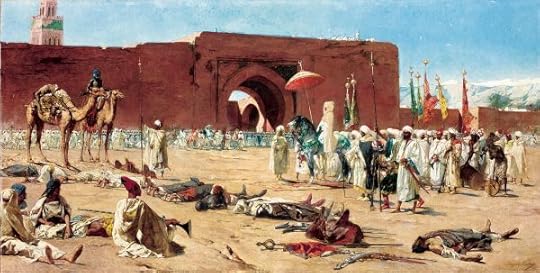
Les têtes coupées des Derniers rebelles dont les corps gisent au pied des remparts de Marrakech (Besançon, dépôt du Musée d'Orsay) pendent en trophées aux flancs d'un dromadaire. Les Prisonniers marocains(Bordeaux), avec gisant inspiré du Christ mort d'Holbein, endurent des supplices significativement cruels. Qui justifient la «civilisation» contre la «barbarie».
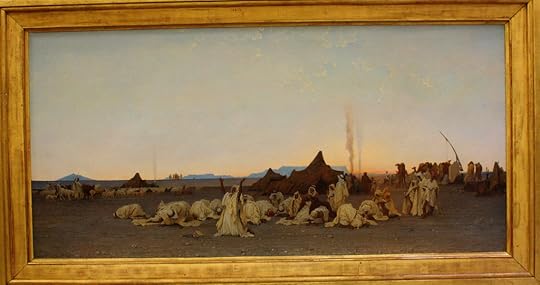
Gustave GUILLAUMET, Prière du soir dans le Sahara, en 1863
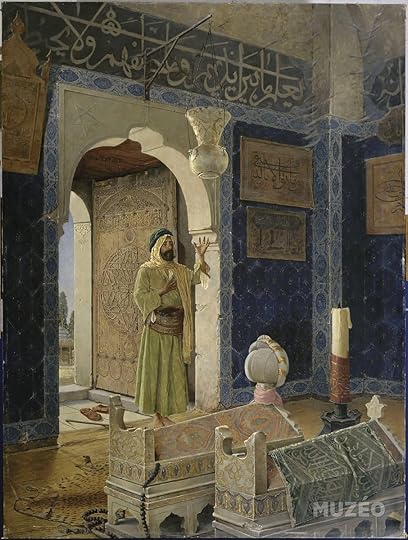
Hamdy Bey, Osman. Vieil homme devant des tombeaux d'enfants
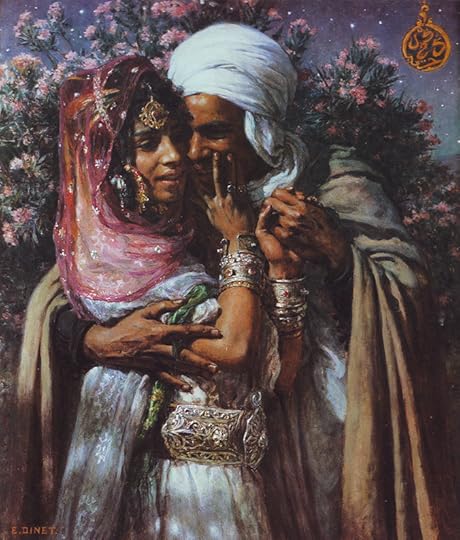
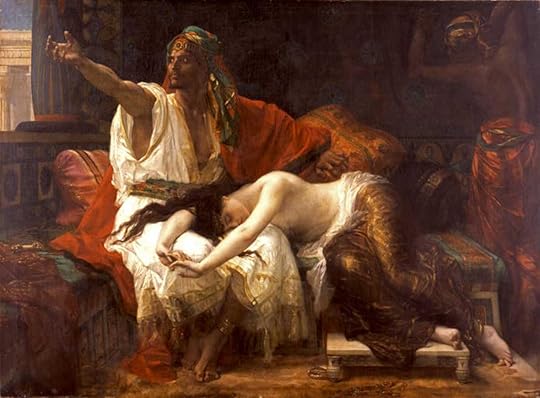
Esclave d'amour et Lumière des yeux : Abd-el-Gheram et Nouriel-Aîn, Légende arabe
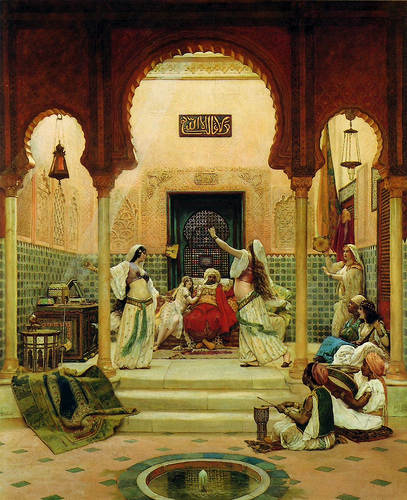
Pierre-Louis Bouchard, Les Almées, 1893, Musée d'Orsay
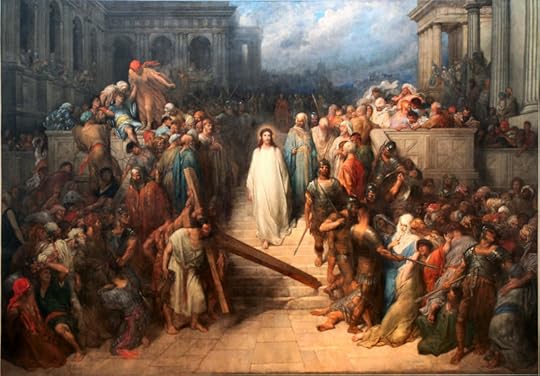
Cristo saliendo del pretorio de Gustave Doré Cristo en el pretorio es sin duda una de las obras más ejemplares de Doré que la consideró como su obra maestra. El lienzo fue enrollado y enterrado durante la guerra de 1870, y posteriormente retrabajado hasta abril de 1872. Prueba del éxito del cuadro (reproducido en grabado sobre acero), Doré ejecuta nada menos que seis copias, la primera versión se encuentra actualmente en el museo de Estrasburgo.
El episodio se radica al final del proceso de Jesús, entre la presentación de Cristo al pueblo (Ecce homo) y con la cruz a cuestas. Jesús baja los escalones, dejando en la lejanía a Pilato y a los sacerdotes, mientras que una muchedumbre compasiva, recelosa o vindicativa, verdadero estudio de “tipos” humanos, le rodea de cada lado. Judas, a su derecha, gira la mirada hacia el espectador. Las mujeres santas se lamentan alrededor de la Virgen, vestida de azul, en la derecha. El arte espectacular de Doré accede aquí a toda su amplitud, debido al formato colosal de la pintura y a la abundancia de las figuras.
Esta “hazaña”, de la que nos podríamos preguntar si tendría su lugar en una iglesia, tiene por fuente las Bodas de Caná de Veronese (museo del Louvre) pero también se inspira de la función teatral de la arquitectura de La Escuela de Atenas de Rafael y de los Romanos de la decadencia de Thomas Couture (Salón de 1847).
Obra expuesta al museo de Orsay, sala 7, hasta finales de 2016.
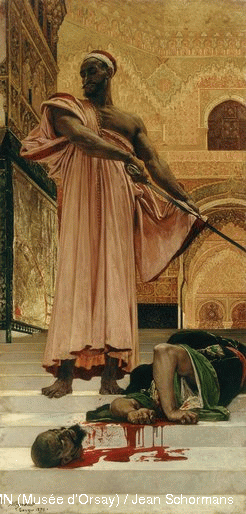
Henri Regnault (1849-1871 Exécution sans jugement sous les rois maures de Grenade [Ejecución sin juicio, bajo los reyes moros de Granada]
Nacido en París en 1843, Henri Regnault fue matado en 1871, en los últimos combates de la guerra franco-prusiana. Este joven sin embargo ya supo imponerse en el escenario artístico parisino. Tras ser galardonado con el Premio de Roma en 1868, es el primero en no pasar los tres años obligatorios en la capital italiana, en contrapartida de su éxito a dicho concurso, sino que estuvo autorizado a irse en búsqueda de demás culturas. Se va a España, desde donde envía al Salón de 1869 el gigantesco General Juan Prim, también visible en el museo de Orsay, y luego brevemente a África del Norte, de donde trae algunos sorprendentes lienzos saturados de luz.
Inspirándose de leyendas locales, pinta esta Ejecución sin juicio bajo los reyes moros de Granada en 1870. Sobre un fondo arquitectónico inspirado por la Alhambra de Granada, invadido por tonalidades anaranjadas, en una vigorosa composición ascendente, Regnault, fija en contrapicado una escena de decapitación, otorgándole de este modo un aspecto imponente a su principal personaje.
La postura suelta y el gesto trivializado del verdugo, contrastan con el primer plano en el que la sangre, goteando sobre las marchas, reúne el cuerpo y la cabeza, separados. Los colores empleados participan también en esta oposición, ya que a la gandura, que reutiliza las tonalidades anaranjadas, del fondo, se opone la indumentaria negra y verde de la víctima. Celebrado por la crítica, este cuadro fue adquirido por el Estado, acerca de los herederos del artista en 1872, con el fin de honrar la memoria del pintor, demasiado pronto desaparecido, en las salas del museo parisino del Luxemburgo.
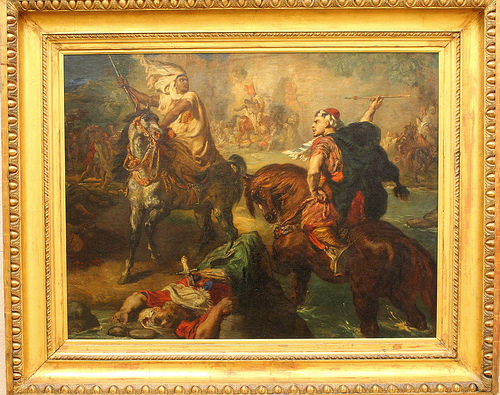
Théodore Chassériau (1819-1856) Chefs de tribus arabes se défiant au combat singulier, sous les remparts d'une ville 1852
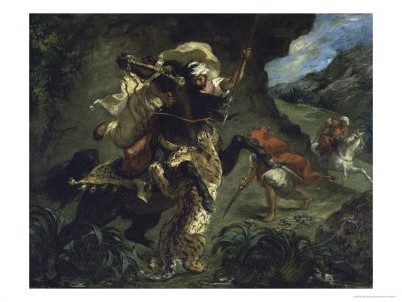
Eugène Delacroix (1798-1863) Chasse au tigre 1854 Cette Chasse au tigre se rapproche en bien des points de l'esquisse d'un autre tableau conservé au musée d'Orsay : la Chasse aux lions. Les deux toiles ont été peintes à la même période, et la première peut apparaître comme un équivalent achevé de la seconde. La représentation du mouvement et de la violence est ici renforcée par l'éclairage vif et intense dirigé sur quelques détails choisis de manière significative, en particulier le tigre et les étoffes des vêtements animées par les gestes rapides des hommes qui s'apprêtent à attaquer le fauve. La détermination du cavalier, la terreur du cheval, l'agressivité du félin portent à son paroxysme le jeu cruel de la chasse. Ce tableau fait partie de la rétrospective du peintre à l'Exposition universelle de 1889. Il condense tout ce qui fait le génie de Delacroix, sa science des couleurs, la liberté de son dessin, le romantisme exalté de ses scènes de combat.
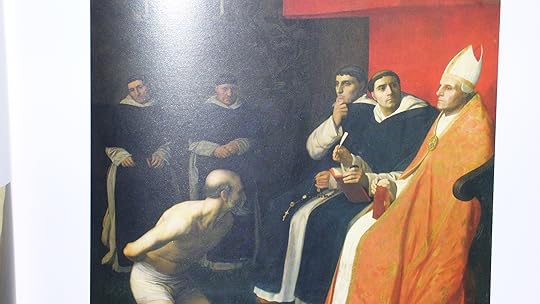
Alphonse Legros (1837-1911) Una confesión Hacia 1868 Une amende honorable [Una confesión]
Ferviente visitante del Louvre, Alphonse Legros estuvo muy marcado por dos lienzos de Zurbarán, pintor del Siglo de Oro español, procedentes de la antigua colección del mariscal de Napoleón Soult. Uno de entre ellos, el gran cuadro cuadrado San Buenaventura en el concilio de Lyon fija particularmente su atención. Propone una bella interpretación de este con Una confesión por el que fue galardonado con una medalla en el Salón de 1868.
De la pintura de Zurbarán, Legros reutiliza fielmente el formato cuadrado, el estilo y la actitud de los monjes y del obispo. Sin embargo, la escena está simplificada y cuenta con un número reducido de personajes. El tema también evoluciona. En los años 1860, el cuadro del Louvre fue titulado erróneamente San Pedro Nolasco y san Ramón de Peñafort y debía presuntamente representar una asamblea eclesiástica en Barcelona. Sabemos en la actualidad que se trata de hecho de un encuentro entre los emisarios de la Iglesia griega y de la Iglesia romana. En Una confesión, Legros elige por su parte, representar a un tribunal religioso de la época de la Inquisición. La inspiración española aparece como uno de los componentes esenciales del realismo de los años 1860, las obras de Manet o de Ribot también lo demuestran.
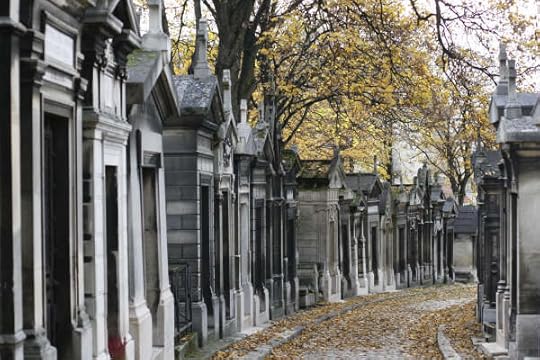
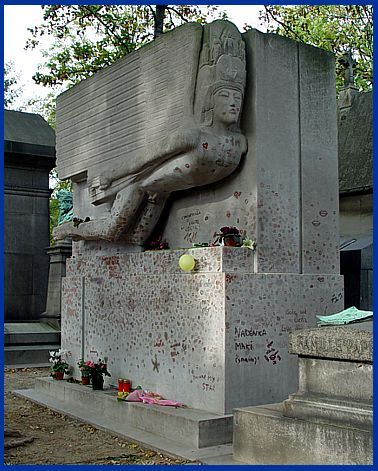
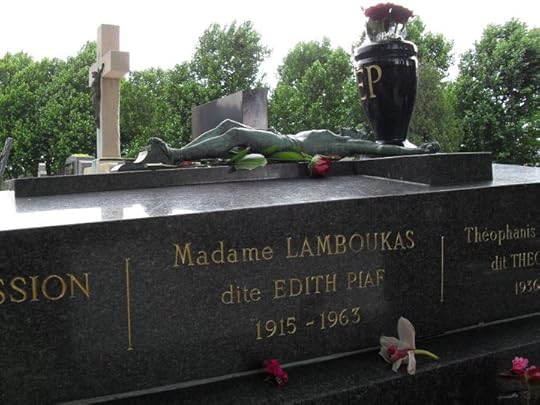
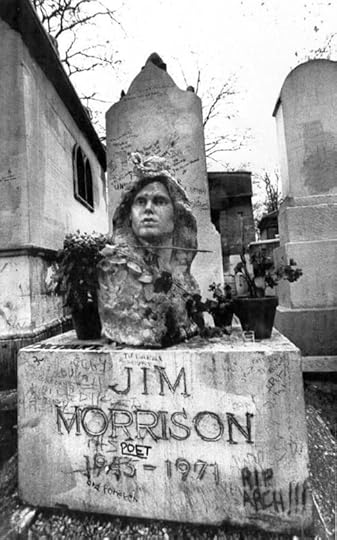
En el terreno de la literatura destacan: Cyrano de Bergerac, Molière, Marcel Proust, Oscar Wilde, Apollinaire y Honoré de Balzac. En el terreno de la música destacan Rossini y Chopin, dos grandes compositores. Y tanto o más famosas son las tumbas de la soprano María Callas o la de Édith Piaf. Pero si hay un personaje en el mundo de la música cuya tumba atrae a miles de admiradores y curiosos, ése es Jim Morrison. Infinidad de webs en internet consideran su sepulcro como uno de los 5 más visitados del mundo, sólo por detrás de las de Marilyn Monroe, Michael Jackson, William Shakespeare y Elvis Presley.
En cuanto a la pintura y la escultura, los más celebres artistas cuyas tumbas podemos visitar son: Géricault, Modigliani (y su amada Jeanne Hébuterne, que se suicidó tras el entierro del pintor), Camille Pissarro, Delacroix y Jacques-Louis David. Otros grandes personajes enterrados en el Père-Lachaise fueron: Manuel Godoy (político español), Georges Méliès (director pionero del cine), Yves Montand (actor) y Jean Moulin (héroe de la Resistencia durante la II Guerra Mundial). Uno de los sepulcros más famosos (y bellos) es el de Abelardo y Eloísa, conocidos por su trágica historia de amor. Otra zona importante del cementerio es el Muro de los Federados, escenario del fusilamiento de 147 comunistas en mayo de 1871.
3.5 stars. I liked the premise of this book. But it was executed very simplistically, with little depth of character. I think it could have been much better with more detail and more escapades. The ending was rather abrupt too. I would have liked to hear about
Maybe I am past the age for these to appeal, but I found it overdone, unbelievable and the characters kind of insipid. No more Barbara Cartland for me.
I've read the sinhala translation of this book and it didn't hit me so much. I think the original version or the English book is much better. However the story is pretty good.