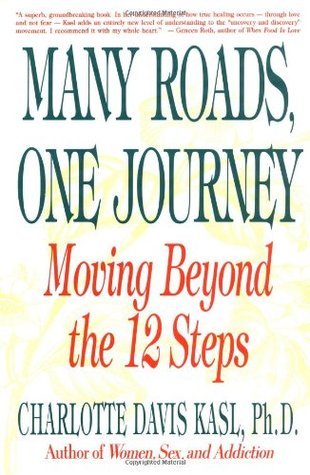
From the author of Women, Sex, and Addiction, a timely and controversial second look at 12-Step programs, helping all readers to draw on the steps' underlying wisdom, adapting them to their own experiences, beliefs, and sources of strength.
Charlotte Sophia Kasl, PhD, is a U.S. psychologist and author.
She pioneered the 16-Steps for Discovery and Empowerment as an alternative to the Twelve-step program for recovery from addiction, compulsion, or other behavioral problems.
She wrote several books based on some aspects of Sufi, Quaker, and Buddhist spiritual beliefs and traditions.
This book is a life saver for those of us in recovery who don't fit into the typical 12-step Alcoholics Annonymous model. Teh author validates other paths to healing and recovery and explains the problems many people face in 12-step groups. She also outlines her own more empowering steps- 16 in all- that take into account the need to explore how oppressions such as racism, sexism, and homophobia play into addiction and recovery. Completely wonderful- I only wish there were 16 step groups everywhere!
Highly reccommend this book. Kasl understands the patriarchal repression of AA and strikes out on her own in full force, after 23 years. The book speaks well for honesty in recovery, (not the norm). How to build healthy groups, acknowledgement of alternate recovery's and success, eg, Women for Sobriety, SMART Recovery, Secular Organizations for Sobriety. I consider this both a primer and a keeper.
An alternate look at not just addictions, but pathways to healing, with thoughtful critique of AA. Opens with a questioning/evaluative stance and maintains the stance "look at this and see for yourself" throughout.
An in-depth look at the 12-step Program, how elements of the Program fail to take into account social and structural issues related to "codependency," specifically looking at ways that internalized oppression looks a lot like co-dependency. "One of the tenets of Al-Anon...let me be patient a little longer...is a way I con myself into staying in terrible relationships. I need to learn to be impatient, to stop putting up with so much crap and take action" (276)
Also explores a number of alternatives to AA, a few I have never heard before, such as WFS.
Written in 1992, but highly relevant, and a nice addition to any type of anti-oppressive psychological practice. Also chapter titles are well-written so it was easy to move between chapters specific to what I was looking for.
This was a good one -- even though I expected to hate it. C'mon, making the Twelve Steps into the Sixteen Steps is not an appetizing prospect. But it turned out to be a very positive read, focused on social justice, inclusiveness extended to both sexes and all the shades of brown as well as non-monotheistic belief systems. But she cheesed me off completely by making the usual mistake of confusing "dependency" and "co-dependency." Am I the only one on the face of the green earth that knows the difference????
so far i am learning a lot. mostly i just don't understand how there are so many recovery people in this town and so many are "progressive" and no one has started a 16 step group yet. hmmm. stay tuned... i really appreciate the point of view that this book takes with 12 step work as being not acknowledging of many people's experience and needs.
I read this book when I was on a search to un-learn some "co-dependency" patterns and was frustrated at how AA all the literature was. Really, this book IS about Alcoholism so it did not really apply for what I was going through in the moment, but has great alternative ideas and way open approaches to healing. Recently some issues around addiction have come up in the lives of folks I love and I find it applicable and hella useful. I have gifted it to folks yearning to quit drinking, but found themselves frustrated at the "recovery" options. I received fabulous feedback. Check it out- if it at all applies.
This book was difficult to get into at first, I continued reading and it grabbed hold of me about 1/4 of the way through. I learned so much, was inspired to stop drinking and found that even though I don't consider myself alcohol-dependent, my life has become more content, energetic and alert. I really liked her stages of faithing also. Highly recommend to everyone!
There are so many step programs now for so many issues...it was great to see them all researched and to get the feminine perspective....this work is amazing...but again comes from one woman's years of learning, experience and perspectives...still a great book.
Many Roads, One Journey was written in 1992 and is quite typical of books written during that time. It is essentially a feminist rant against the hierarchical and patriarchal nature of 12-Step programs. Kasl references Riane Eisler, who I cannot tolerate, to support her "thesis" that 12-Step programs are bastions of privilege for upper-class religious white men. My take on Eisler is that she is a male-basher. Eisler thinks that if only women ran the world, everything would just be peachy keen. Kasl also rails against the Christian dogma that permeates 12-Step programs. And she simplifies complex issues and blames men and women for subjecting themselves to recovery in the 12-Step model.
Full disclaimer: I've been a member of Al-Anon for 8 years. Have I found Al-Anon helpful? Yep. Is it perfect? Nope. No group of non-professionals, including groups endorsed by Kasl, are perfect. Humans aren't perfect, including university-degree-bearing professionals like Kasl.
I got very tired of reading her rants about the hierarchical and patriarchal society we live in and her wishes for a fantasy land future where everyone respected the Earth and worshipped the Goddess. Kasl has no grounding in Marx and has no understanding of capitalism, which is what she is really railing against. Do I have a high opinion of capitalism? Nope. Is capitalism the reality we live in? Yep. Can I do anything about it? Not really. I can live lower on the economic scale than others by choice but that really doesn't solve anything. Is there injustice in the world? You bet. Are women and people of color exploited? Sure. Were they exploited 200 years ago? Yes. 500 years ago? Yes. 1,000 years ago? Yes.
I really can't recommend this book. The only take-away I got from the book were the 7 stages of human development created by James Fowler. His stages are similar to those of Erikson and a couple of other psychologists which I found interesting. But the rest of the book is just a tirade against oppression and 12-Step programs, which Kasl thinks are in cahoots with capitalism. She may well be right but she doesn't present any decent alternatives. Her 16-Step program doesn't really improve on the 12 Steps.
I don't agree with a lot of what goes on in 12-Step programs. But I'm not ready to throw out the baby with the bathwater. Humans are not perfect. Men are not perfect. Women are not perfect. There is injustice and suffering in the world. Yes to all of the above. But Kasl has no answers, just wishful thinking.
Absolutely brilliant for anyone and everyone, has such a message of strength and hope and an understanding of society at large and how it can impact our very nature as men, women, children, LGBT. A lot of work went in to this book and it reiterates a lot of points from Miss Interpretation and The Masks We Live in documentaries... Eye opening, awakening, a mix of science and spirituality, fantastic from cover to cover.
Kasl, you are undeniably a genius, I wish this book was marketed and reprinted without the aspect of addiction and 12 steps so that anyone could realise the benefits of this book and that we all have our ways of coping with life. This shows a unique path to discovery and is fantastic for any woman or man who has felt emotionally or physically abused in anyway during their lifespan too.
It really is a life bible... Basic Instructions Before Leaving Earth...
Why write a book that examines 12-step programs but not give them a real examination? I’ve been in 12-step programs for 12 years and the author uses the same rigidity in describing the programs that she claims come from the programs. She picks and chooses quotes from various pages of literature to make her points that don’t make sense used together (unless of course you’re trying to cherry pick a few words from here and there to make your point). The author went into this writing with a clear agenda and was unwilling to open her mind to a new way of thinking. Sad.
This book has given me a refreshing look at addiction. I found the different steps to be empowering and I felt the author did a good job of highlighting positivity and hope in treating substance use. I will defiantly use what I have read in my work with addicts. The biggest problem I had was how outdated it is. It was writing in 1992 so there is nothing about how the internet and social media have influenced substance use.
Very very interesting, from a feminist point of view. Great ideas on how to do things a little differently if u have had any problems accepting the AA program and it's principles. This book does not put down AA, in any way, just gives u a new way to look at things, from a feminine point of view.
Release from the bondage of a self imposed wannabe definition of self. To be as I am rather than some false unrealistic projection of how I wish to be perceived.