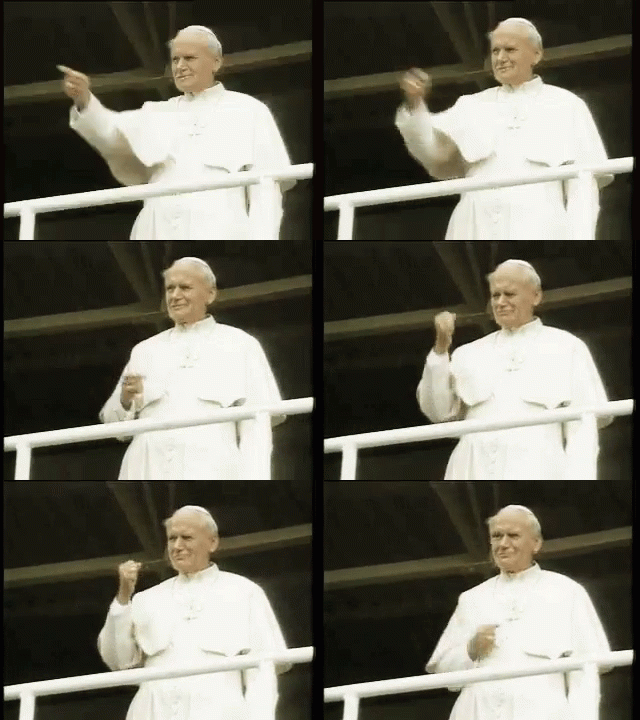
“Simply brilliant” essays on the leaders who have most powerfully shaped not just the Church itself, but the course of human history (Catholic Library World). The Bishops of Rome have been Christianity’s most powerful leaders for nearly two millennia, and their influence has extended far beyond the purely spiritual. The popes have played a central role in the history of Europe and the wider world, not only shouldering the spiritual burdens of their ancient office, but also contending with—and sometimes precipitating—the cultural and political crises of their times. In an acclaimed series of BBC radio broadcasts, Eamon Duffy explored the impact of ten popes he judged to be among the most influential in history. With this “enlightening” book (Booklist), readers may now also enjoy Duffy’s portraits of these ten exceptional men who shook the world. Beginning with St. Peter, the Rock upon whom the Catholic Church was built, he follows with Leo the Great (fifth century), Gregory the Great (sixth century), Gregory VII (eleventh century), Innocent III (thirteenth century), Paul III (sixteenth century), and Pius IX (nineteenth century). Among twentieth-century popes, Duffy examines the lives and contributions of Pius XII, who was elected on the eve of the Second World War, the kindly John XXIII, who captured the world’s imagination, and John Paul II, the first non-Italian pope in 450 years. Each of these ten extraordinary individuals, Duffy shows, shaped their own worlds—and in the process, helped to create ours. “The author is an accomplished writer who is able to make history read like a dramatic novel…Those looking for a concise and even entertaining primer to the papacy will find this collection, if not infallible, at least very worthwhile.”—Publishers Weekly
Eamon Duffy is Professor of the History of Christianity at the University of Cambridge, and former President of Magdalene College.
He describes himself as a "cradle Catholic" and specializes in 15th to 17th century religious history of Britain. His work has done much to overturn the popular image of late-medieval Catholicism in England as moribund, and instead presents it as a vibrant cultural force. On weekdays from 22nd October to 2nd November 2007, he presented the BBC Radio 4 series "10 Popes Who Shook the World" - those popes featured were Peter, Leo I, Gregory I, Gregory VII, Innocent III, Paul III, Pius IX, Pius XII, John XXIII, and John Paul II.
This is a collection of short articles on 10 popes selected for their impact. The author, Eamon Duffy, did not select them because they were the "best", "worst" or "most" but because they changed or started something big. In some cases it was more the times than the pope forced the starting or changing.
For readers like me with little knowledge of papal history, this is an ideal introduction to some the leaders of this institution. The chapters are pithy; they come from a series of BBC radio broadcasts. The first is Peter, not actually a Pope, but through his words created the Apostolic Succession that created this institution. The next is Leo the Great who set down the basic doctrinal and governance foundations. The others are:
Gregory the Great 590-604 - Sent missionaries to England, which later sent missionaries to Germany and Holland.
Gregory VII 1073-1085 - Important figure in determining the balance of the respective roles of church and state.
Innocent III - 1198-1216 - The Fourth Crusade. Founding of orders: Dominican and Franciscan.
Paul III - 1534-1549 - In the midst of the Reformation, invited a dialog which after his death unleashed a long lasting conservative backlash. Founding of the Jesuits.
Pio Nomo (Pius IX) - 1846 - 1878- Served after the French Revolutionary armies invaded Italy and kidnapped Pope Pius VI and stole Vatican treasures and during the unification of Italy into which the Papal States were absorbed. An institutional skepticism of democracy grew in the Vatican. While the church lost property and lands, papal authority increased.
Pius XII - 1939 - 1958 -Tainted for not wielding moral authority regarding Hitler. Duffy explains what may be Pius XII's point of view on this.
John XXII - 1958 - 1963 - Tried to "melt the ice" of the cold war. Convened Vatican II, which made worship more accessible.
John Paul II - 1978 - 2005 - doctrinaire but used modern methods. Gave heart to the anti-communists of Poland and worked to bring Christians, Jews and other religions together. Immensely popular world-wide.
Each Pope has a personal story to go along with this. There is an appraisal of the pros and cons of each administration.
If you know are knowledgeable about the popes above, this book is not for you. If you are interested but not knowledgeable, you will find this quick read informative. I see it, though, as a gift book, perfect for some graduations, teen age and older communions, Christmas or birthdays.
Taken as what it is (more or less notes for a radio show) this is really great. It's kind of a tasting menu of Papal history- not much depth, it won't fill you with Papal knowledge, and sometimes the chapters seem a little free-floating. But then if you want all that, you can read his 'Saints and Sinners' instead. Here Duffy does a good job showing you the pros and cons of most of the popes, although there aren't many cons for John XIII, and you can see he's working really hard to find nice things to say about Pius IX. Method is radio friendly: he takes the one thing a given pope is best known for, tells that story, and moves on. Very well written; it makes me want to re-read S&S, which I probably didn't spend enough time on the first time around.
This book by the renowned English historian, Eamon Duffy, is a text-version of a BBC Radio Series. It is a short read and one of the features of this nightstand book is that you will be able to finish a pope in one reading before you fall asleep!
The other benefit of a short read is that it causes Duffy to focus on the main historical points for each Pope.
I liked the English perspective provided by Duffy on a few of the Popes like Gregory the Great and Pio Nono.
I also liked the illustrations that Duffy provided in the book. A number of these I had not seen before, especially the one of Angelo Roncalli (John XXIII) in his walrus mustache during his days as an ambulance driver during World War I.
Of concern about a "Catholic" book about the popes might be its critical nature. Duffy writes this book mainly as a historian and doesn't pull any punches - especially in the pages about Pius XII. But he also doesn't gravitate towards the other end. But he also understands the complexity of the papacy - or that of any leader - in trying to manage multiple facets of an issue or multiple factions while at the same time being true to the Petrine role.
So it was a pleasure to lie in bed and pretend to be pope for just a few minutes each night.
An excellent overview and insight into the lives of some of the most prominent popes. Picking 10 popes is tricky, especially when we’ve had over 260 of them. This book obviously just about scrapes the surface, but as for someone like me who knows very little about the papacy and hasn’t studied the subject in any depth, this is a great and very readable introduction.
A perfectly readable historical sampler, adapted from a BBC Radio series of the same name. Don't go looking for immense detail in this slim volume, but you will find some solid, concise arguments for each Pope's impact on their time and on the Roman Catholic Church, for better and for worse.
A HISTORY OF THE CATHOLIC CHURCH THROUGH THE LIVES OF TEN POWERFUL POPES
One-fifth of the world’s eight billion people profess Roman Catholicism, giving the impression they all share same faith. But of course that’s far from the truth. With 1.4 billion adherents today sprawled across six continents, the Catholic Church encompasses millions who subscribe to its most austere and abstract beliefs to hundreds of millions more who worship saints like Hindus with their gods and goddesses. And somehow one man, sitting in a palace in Vatican City, must govern them all.
The Argentinian Jesuit priest Jorge Mario Bergoglio, ruling now as Pope Francis, is the 266th occupant of the office. Like so many of his predecessors, he struggles to corral this unruly flock. His challenge comes into high focus in Eamon Duffy’s brief account of ten of the men who went before him in the office, Ten Popes Who Shook the World. This is Catholic Church history in a nutshell.
2,000 YEARS OF TUMULTUOUS CHANGE
At the outset Duffy asks, “Is the papacy a coherent project, or an historical conglomerate whose only consistency lies in its protean capacity for survival by adaptation?” And he proceeds to demonstrate through the lives and work of the ten men he singles out for attention that, yes, indeed, they may have pushed and shoved the Church in one direction or another. But the mass of believers has continued to defy their attempts to crowd them all into a single corner of the Christian faith. And how could it be otherwise?
Every institution, and every belief system, is subject to relentless buffeting by the forces of change. In 2,000 years, we have transitioned from an agricultural era of villages and peasants to a post-industrial world of instant global communications and cities topping twenty million population. It’s inevitable, then, that the ten Popes profiled here would be radically different from one another. Duffy is hard-pressed to find anything but superficial commonalities.
THE POWER TO CHANGE THE WORLD
Duffy’s theme, however, is not the Church’s diversity but the vast temporal as well as spiritual power wielded by the most assertive of Francis’s forebears.The men he includes range from the Apostle Peter (?-64 CE) to John Paul II (1920-2005). Peter confronted the Roman Empire. John Paul II tangled with the Soviet Union. Peter was a Jew who was born Simon Bar Jonah and is recognized as Pope only by rewriting history, while Karol Józef Wojtyła was a brilliant former actor and theologian from Communist-ruled Poland. About the only thing that can be said in common about the ten men in Duffy’s account is that the power they wielded as spiritual (and often temporal) leaders truly did have widespread impact on the world around them. For hundreds of years, the Roman Church, personified in the reigning Pope, was the most powerful institution in Europe. Rulers rose and fell on the strength of their relationships with him.
Ten Popes Who Changed the World is an insightful though all-too-brief study of the papacy. Although Duffy’s selection of just ten men, when he might well have picked a slightly different list, is an instructive guide to the forces that have shaped Roman Catholicism over its 2,000-year history.
ABOUT THE AUTHOR
Eamon Duffy was born Catholic in 1947—”cradle Catholic,” as he puts it—in Ireland in 1947 but educated largely in England. He is Emeritus Professor of the History of Christianity at the University of Cambridge. He specializes in the history of Catholicism in Britain in the 15th to 17th centuries. Four years before writing this book, he presented a series on BBC Radio with the same title. He has written numerous books in his field and won literary and academic honors for his work.
With a history spanning two centuries, many books written about the papacy are dense volumes that don’t always lend themselves to a pleasurable reading experience. Eamon Duffy has deftly winnowed this history into a nimble narrative of a select group of popes in Ten Popes who Shook the World. The men discussed in this work were in office from AD 64 through 2005, and in addition to shaking the world, they also shaped history, and not always in a religious context. Duffy asks the question in his introduction whether or not “the papacy is a coherent project, or an historical conglomerate…” (p. 10). Regardless of the answer to this question, Duffy has written a cohesive and accessible account of ten popes beginning with St. Peter through the papacy of John Paul II. (John T. Richardson Library, Call Number: 282.0922 D858T)
--Sue S.
(Originally posted in the DePaul University Library "The Full Text" blog: http://bit.ly/16FahIq)
Is what the title says it is, ten short chapters on popes who made a difference in world history. Details the popes from St. Peter to John Paul II. Offers great snapshots of complicated periods of history without getting to in-depth or bogged down in unnecessary information. I enjoyed the book because it was light and gave insights into some really interesting personalities that have become the Holy See. At a brief 136 pages, the book will have you wanting more. But overall I thought it gave great insight into Papal History specifically the twentieth century pontiffs. Short and sweet, but contains both the negative and positive decisions of these ten popes. One last bit of wisdom coming from Gregory VII who fought against the divine right of kings: "Who does not know, that kings and rulers are sprung from men...who by pride, robbery, and murder...have striven with blind greed to dominate over their equals, that is mankind?"
This is a series of small essays on 10 popes that really shaped the Catholic Church over its 2000 year history, and thus the world. If you're looking for a deep dive into the history of the papacy this isn't it, but if you're looking for some highlights this will be just your cup of tea. Based on a series of TED type talks by this Cambridge professor, I thought the essays were easy to read and just the right length to give me a flavor of the different popes. I just wish my memory was better so I could hang on to the information I learned! I believe there have been over 250 popes, and only 5 during my lifetime, so it was interesting to see how the modern popes have really shaped the papacy into what it is today. It was also interesting to see how one of Catholicism's (and all religions in general) biggest challenges have stemmed from fighting corruption within the leadership of the church itself, whether at the highest levels or at local levels.
l papado es una institución importante, sea uno creyente no. La sucesión de los Papas, los 262 de ellos, conforma la dinastía más antigua del mundo. Este librito habla sobre diez de estos Papas cuyas decisiones, buenas o malas influyeron en la historia del mundo: Desde la verdadera búsqueda de una vida basada en el evangelio, hasta los silencios monstruosos de la iglesia en la Segunda y la Primera Guerra mundial, y aquellos Papas que buscaron convertir a la iglesia en una agrupación digna, ante los que convirtieron a la iglesia en un verdadero imperio político. Esta bastante bueno y es una buena introducción a todos aquellos que critican sin saber. Aquí tendrán más detalles para criticar pero ahora si, con fundamento y una amplia bibliografía. Ah, un detalle: El libro solo se puede conseguir en Samborns.
This book is effectively the transcript of ten talks the author gave on the BBC in 2007; and the slender volume serves perfectly so long as the reader understands that Duffy is attempting to be broadly suggestive rather than in any way comprehensive. An overview such as this can be especially helpful in grasping that, say, the medieval Innocent III, probably best known for his temporal power and for promoting the brutal crusade against the Cathars, was also the pope who approved the “lay Christianity” of the Dominicans and Franciscans. Likewise, the nineteenth-century Pius IX, often remembered as a stalwart of Catholic reaction, was chosen by the cardinals because he seemed a less determined opponent of modernity than his predecessor and was also one of “the most likable popes ever elected.”
An Excellent Introduction to Some of the Most Important Popes in Catholic History
This short book does an excellent job of introducing ten different Popes who have played important roles in the history of the Catholic Church. The author plainly admits that there are other Popes whom he could have chosen, but I still think he made excellent choices for this book. This book also offers insight into Catholic history, and the author’s descriptions of the historical events and climates that surrounded each papacy provides the reader with greater context to help him/her better understand how and why each Pope in this book acted the way he did. This author is certainly sympathetic toward the Catholic Church, yet this book is no hagiography. If you’re looking for a good introduction to some of the most important Popes in Catholic history, this book is a great place to start!
This book is so focused on the political, public relations, and organizational aspects of papal history that it gives a very distorted impression. I wasn't expecting "Lives of the Saints" but there is virtually nothing here about the Catholic faith. Seriously, it is like reading a history of General Motors. The author understands power and politics and hierarchy and the outward trappings but nothing about the heart of it. It is like he was trying to write about something without ever mentioning the most significant aspect of that thing!
The book is light reading and factually correct and it has interesting background information about the Popes and the times they lived in. But it comes across as very dry because it works so hard to avoid the essence of the passion of the Catholic Church and the papacy.
🟡📙 کتاب «ده پاپ که جهان را به لرزه انداختند» را خواندم. در تاریخ دوهزارساله پاپی، انتخاب ده نفر متفاوت کار سختی بوده است. اما ایمون دافی (ایرلندی. متولد ١٩۴٧ و استاد تاریخ مسیحیت) به خوبی این کار را کردهاست. 🔸نقطهی مشترک همه این ده نفر تحولخواهی و جسارت و شجاعت است. چه در رشد فضای مدارا و چه در ایجاد فضای اختناق دینی. 🔹در میان این ده نفر ژان بیستوسوم که شورای واتیکان ۲ را برگزار کرد، توجهبرانگیز تر بود. وقتی دید مدرنیته در حال بلعیدن کلیساست از سراسر دتیا اسقف ها را جمع کرد و به استناد آیهای که هرجا اجتماعی بنام مسیح باشد مسیح هم آن جاست، کلی اصلاحات در مبانی مسیحیت ایجاد کرد. نو شدن ادیان به تناسب زمان و تغییر موضوعات.!!!! 🔸اگر چنین نمیکرد نامی از مسیحیت نبود. این کتاب را نشرثالث منتشر کرده و آقایان محمدجلال و سعیدماخانی ترجمه کرده ابطحی
This book is essentially the transcript of a series of talks that English historian Duffy gave for the BBC. As a result, each entry is short (less than 10 pages with images)and there is no claim that these are comprehensive. They do contextualize and highlight some of the contributions of the ten popes that he selected and speak to the challenges of the papal office. Duffy's writing, as always, is entertaining. This book would serve as a good introduction to someone who knows little about papacy or for someone who is interested but doesn't necessarily want to get bogged down in the details of an academic text.
A very interesting and informative book on ten of the most influetial popes through time. would have loved to have read more about some of the more infamous and corrupt popes, but that's for another book. I still really enjoyed this book, and learned a lot I didn't already know, and understand why the author chose the ten popes he did. I recommend this book!
Not a bad quick read on a few of the more influential popes. If you're wanting a large, scholarly work you'll be disappointed, but if you're just looking to familiarize yourself with the topic it's not too bad.
This was probably one of those 99 cent offers for my Kindle and I am glad I took advantage of this bargain. I would like to read more about several of these popes--from the 4th century to John Paul II of recent years. I did not know that one could become a cardinal without being a priest first.
nicely written, but not particularly impactful — i can't remember any particularly new pieces of info about these popes that i've read here, and not that much time has passed since i finished it