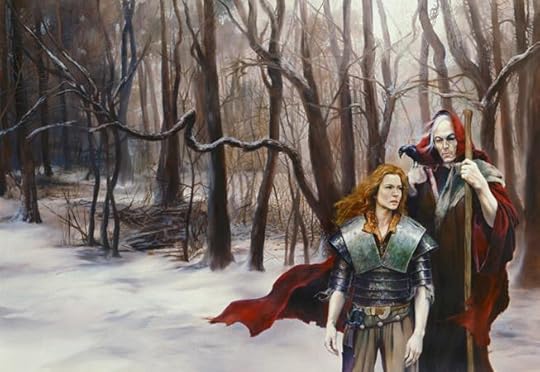
Years have passed since the Jarnish invasion, and Sulien ap Gwien has worked tirelessly alongside her lord, King Urdo, to restore the King's Peace to Tir Tanagiri. But the man Sulien believes to be the greatest of his time is seen by others as a potential tyrant. Urdo's vision of a nation of citizens bound by a single code of law is viewed with increasing mistrust, and this soon gives way to civil war.
Sulien must take up arms again. But where once her enemies were barbarian invaders, now they are former comrades and loved ones. As the conflict tears her country and her family apart, Sulien must fight harder and harder to hold onto Urdo's vision of the future.
Praise for the Trilogy
'Walton writes with an authenticity that never loses heart, a rare combination . . . She can dig down to a true vein of legend and hammer out gold.' Robin Hobb
'The people, the politics, the details of warfare and daily life, all ring as true as the steel sword the heroine wields so doughtily. This is much more than a retooling of the Matter of it is a fully imagined, living, magical world.' Delia Sherman
'Beautiful and thought-provoking. Walton tells a story set in a world and a history almost like ours, but different enough to be in itself a kind of elvenland.' Poul Anderson
'Head and shoulders and sword-arm above most fantasy. Like a lost memoir from the Dark Age of a subtly different history, tough and unsentimental and all the more touching for that.' Ken MacLeod
Jo Walton writes science fiction and fantasy novels and reads a lot and eats great food. It worries her slightly that this is so exactly what she always wanted to do when she grew up. She comes from Wales, but lives in Montreal.
A fantastic sequel to The King's Peace. In my eyes, these two books are the first to rehabilitate King Arthur and his knights. The Victorians (I spit on their graves) twisted Arthurian myth into a high-strung, overwrought, completely-disconnnected-from-reality farce. Walton brings the myth back to earth. The first book follows Sulien as she fights along side the High King Urdo. Years of battles, strategic marriages, and negotiation later, the island is united under his rule and his Peace. The disconnected tribes, villages and kingdoms of Tir Tinagri are finally recovering from the years of barbarism and regaining civilization--but as peace spreads, so too does discontent and distrust. Sulien and her allies must once more ride into battle to protect the Peace.
I had trouble keeping all the characters straight (they generally appear once or twice and then, a hundred pages later, I have to remember who they are once more), but the battles are well written, the characters finely wrought, and the overarching plot enthralling. I highly recommend this book to anyone who is interested in medieval Europe or Arthurian tales.
I mean, it's still early work from Walton, and not as amazing as some of her later books, but I was just fully enthralled, couldn't put it down and cried when I finished. Walton can be so utterly life-affirming and kind in her writing, and that part shone through. And such an improvement over the previous volume, too.
Now I'm sad to think there's hardly anything more by this author that I've not read. I just hope she's cooking something new up.
The King's Name is a direct sequel to The King's Peace. It follows some forms of the Arthurian legend fairly closely, in terms of Mordred, Arthur and Guinevere, anyway, but of course Sulien is something entirely new. It's still fairly predictable to anyone who knows the Arthurian canon quite well -- in the way that Arthurian stories are: heartbreaking in their inevitability.
Everything comes together very well: I believe in the characters' motivations and their ends. I loved the confusion between Darien, Sulien and Urdo, the tangled-up feelings, the platonic love between Sulien and her lord. I made a comparison to Guy Gavriel Kay in my first review. That does stand, but I do have one caveat: I didn't cry at these books. I gasped and yelled that people were idiots and caused my girlfriend to look up in consternation more than once, but I didn't cry.
I found The King's Name a faster read than The King's Peace -- yes, it's shorter, but I also read it faster. I think that comes with already knowing the characters and the politics and such.
In The King's Name, the rule of law established in The King's Peace is threatened by civil war. The kings of Tir Tanagiri have become comfortable in the peace, and are starting to get cranky about having to report to a High King. Morthu, son of the sorceress Sulien killed in the first book, is whispering in everyone's ear, dredging up resentment towards King Urdo and twisting minds with his own sorcery. Before Sulien knows what's going on, her sister tries to poison her and suddenly no one can be trusted.
Most of the book takes place outside Caer Tanaga, King Urdo's home base. It has been taken by the rebels and all peace talks and battles take place outside of it. Sulien finds herself seated across from her old friends, trying to make them see sense while Morthu does everything possible to disrupt the peace process.
A lot of the content in these books is about strategy and tactics, which I didn't think I could enjoy. Walton writes about some pretty common fantasy tropes, but her prose is clear as a bell and her characters jump off the page. Sulien's relationship with Urdo is probably my favorite part - although they let people believe, for political reasons, that they slept together, their friendship is entirely platonic. She loves Urdo deeply and there are no romantic subplots to complicate that story. This lack of romance doesn't mean Sulien has no complex relationships - she is just incredibly pragmatic and always returns to the notion that the King's Peace must be upheld. I find it refreshing that an author wrote two books about a woman who has no interest in romance, but remains riveting all the same.
In The King’s Peace, warrior Sulien ap Gwien and her lord King Urdo have finally united the land of Tir Tanagiri into a kingdom ruled by justice under a single code of law. Many years of peace and prosperity followed, but now in The King’s Name some are saying that King Urdo is a tyrant riding roughshod over the authority of the other leaders of the land and must be put down. Tir Tanagiri faces the blight of civil war, and Sulien ap Gwien must face betrayals she never expected and take up arms against former comrades and loved ones to keep Urdo’s dream alive. Sulien doesn't even have an inkling of what's going on until her own sister tries to poison her....
The King’s Name is a fast-moving, gripping story that really makes you feel the pain of facing family and comrades on the other side, where no matter which side wins you'll lose people you care about. It's great to have a novel not only featuring a badass woman but a badass older woman. The pagan magic is interesting, as is the portrayal of lords who really are connected to their land. There's also the tension of wondering how and if someone will finally see through and put an end to Morthu.
That said, I find it kind of lazy when authors "strips the serial numbers" off the names of actual places and events to populate their fantasy world. The countries and peoples here have obvious analogues to our own world, and this is a kind of retelling of Arthurian myth, something there's already no shortage of.
Since the earlier book takes place immediately before this one, I knew what I was in for. I like King Arthur retellings, especially when I know what I’m reading. Sulien, the main character here, is a female Lancelot. The queen thinks she is sleeping with the king, when she is asexual. She is the king’s greatest knight, though this book doesn’t use that kind of language. Her son is the king’s heir, which make people think he is the king’s son.
Like Paula Volsky's books (especially Illusion) this is a fantasy take, in another world, of historical events. Kinda :-)
The first book in this trilogy, The King's Peace, had a beautiful Julie Bell cover. This book (there's a kinda-prequel, too) has a cover by Julie Bell, but IMHO it's probably the worst painting of hers I've seen.
Jo Walton is the nicest lady, too... I met her at the World Fantasy Convention in Mesa couple years ago and she and I sat down and had a nice long chat.
Every once in a while, my habit of picking books just because they have beautiful covers pays out!
it took me awhile to get into this sequel to "the king's peace," probably because of the inevitability of the ending (as w/all king arthur stories). but by the end i was very moved and found the last battle and aftermath very exciting. in fact, the battle scenes are extremely well done and they could easily have been the parts i skimmed (not being a huge war/battle fan). it is a little hard to keep track of all the characters but in the end, it kind of doesn't matter. the main ones are distinct enough, and the others can be somewhat interchangeable (all those rebel kings). sulien is a wonderful, original character--even among "strong women characters in fantasy." i also really liked the way magic and the gods, including the white god (jesus), was handled. not necessarily an easy read, but if you're a king arthur fan i highly recommend it.
I am a sucker for all things Arthurian, and this is a relatively distant relative to such things; dealing as it does with a High King seeking national unity and peace. It has a few firm clues as to the link, a Mordred like character (not related to Urdo, the king); throwing his sword into the lake after his death; the mobile cavalry based army; but the story is different. This is book two of Jo Walton's debut work and my only real criticism is that I think she tries to hard to show us how she can populate a novel with lots of different characters, different races and different lands within a coherent fantasy framework. You may find you need a checklist of characters to keep track of everything that is happening. This is a clear sign of Walton's early talent and whilst good , there is better to come.
I enjoyed this one better than the first one, although it did tend to drag in a place or two. There wasn't as many characters introduced this time. But she still failed to build on a few of the more interesting characters. She killed off some really good ones as well. All and all it was a good story. Alot more magic in this one, great battles (she really did her research on those). If your looking for any type of love story, you'll be dissappointed. There are a few mentioned but none are elaborated on. This story is strictly about war, the effects of war, the bonds that are made in war, betrayals and politics. All and all a pretty good read.
I actually liked this book better than The King's Peace. There were still a lot of characters to keep track of, but it was a little easier since we had been introduced to them before and several are killed off throughout the book (it is a civil war after all). The action is more war-oriented and less magic-oriented in this book though the magic is still very present. It's not as Arthurian as the first book and I think that helps the story.
Sequel to "The King's Peace". If you liked that, you'll like this. I do recommend reading "Peace" first, though. She puts a fictional foreward in this book that I don't get the point of (this device can work well. See Norman Spinrad's "The Iron Dream", where the foreward and afterward are integral and vital parts of the work) and don't appear in either "Peace" or the prequel "The Prize in the Game".
A lot faster paced than The King's Peace, I really liked it. The book mostly takes place in only a few months which definitely helps the pace. And the supernatural elements were handled quite deftly. Even if you don't like historical novels, the character of Sulien and her struggle for the cause of peace is compelling and worth the time.
Pretty good adventure fantasy but would have been better if a glossary, maps, and family trees were included. Because of this, and the ways the names were formed/ similarities in names it was difficult to follow even though the main characters were interesting and fairly fleshed-out for one of this genre. (same comments as I had for the first book, The King's Peace.)
The follow-up to The King's Peace, this book does a decent job of maintaining the almost-historical tone and Arthurian themes. It's not quite as strong a narrative as its predecessor, but all in all a good way to finish the story.
Starts up 5 years after The King's Peace with a civil war. I'd guess it takes place within a month's time, start to finish. Fast and furious, nowhere near as jerky as the first book. Definitely enjoyed this one, even with the deaths of well-known characters.
This is a sequel to The King's Peace, which I loved. I spent a lot of time on The King's Peace learning name places etc in this alternative world telling of the King Arthur legend. More of the same. Again, if you loved Braveheart and gore doesn't bother you much, you might like this book...
I enjoyed this book, but didn't find it quite as good start to finish as The King's Peace, although the last few chapters were very moving. Loved Sulien's concept of 'darkness' opposed to that of Morthu; in this mortal world, light needs the contrast to be beautiful.
This book and its prequel (The King's Peace) are my favorite take on an Arthurian setting that I've read in a long time. The first-person narrative in a setting that is so recognizable as a mix of history and myth - but a separate history and a separate myth than our own - is enthralling.
Very glad I read this pair of novels. While the strategy could be slow going, the gods and the mystery of this alternate world were heartbreakingly beautiful, subtle, dense, delicious. Worth the work.
Very good series. I am very choosy with series books and I loved this. Especially because it had the influence of God in each book with Good over coming evil in the end.