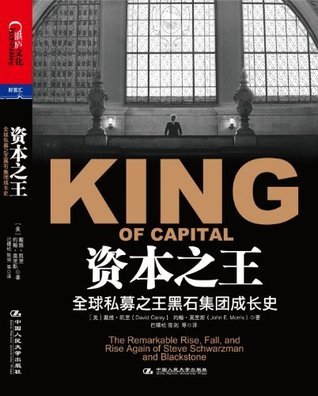
The reading can get laborious at times, but it is very well-written and detail-oriented. It is NOT focused on Steve Schwarzman as much as I thought. I was expecting a little bit more of a biography of him as well as Blackstone. However, it's really about the the origination and growth of Blackstone. For anyone interested in private equity, this is a must-read because it gives a fantastic overview and history of the industry. Also, if you want to build the next Blackstone (*cough* like me *cough*), then you better get on it.
How rich people and companies they form can gamble with global economy. Always with the help of financial institutions and banks. While adding millions to their bank accounts, little people not only lose their jobs, their retirement savings. How they manipulate each other and tax laws. Always finding a way to get around the laws to keep them straight.
I knew little about the subject. It's a compelling book to read for someone like that and who has an interest in finance. The narrative though is very prosaic and not laid out very well. Paragraphs are not logical extensions. There is lack of continuity. Information can be communicated better in a tabular format with some charts in some cases; here the author just seems to go on and on. Puke-out-as-it-comes kind of writing style. I learnt a lot though. My biggest takeaway is the scale of it all in sheer dollar terms. The PE game is sooo huge!
История Петерсона, Шварцмана и Блэкстоун Кэпитал. Большая часть - собрание анекдотов и занимательных историй, писали журналисты. Не хватает бизнес инсайтов, практик и идей
The King of Capital chronicles the business career of one man and his company in the context of a variety of developments in the financial world over the past 30 years. For me as a novice to this topic, this book was mostly informative. Occasionally, I found myself unable to process the nuances of different financial trends, but generally it was good to come to gain a basic understanding of the pros and cons of private equity and leveraged buyouts, and to recognize what is going on at the high money levels that most of us cannot begin to fathom.
The book is not an expose nor does it have an axe to grind. It almost completely avoids talking about the personal lives of Schwarzman and others, except as it directly influences the story, and in the end, I came away with a basic level of respect for the primary subject. The author does not seem sympathetic to Schwarzman, but he also does not try to make Schwarzman into anything more than an incredibly successful private equity financier. While talking about the bank crashes of 2008-09, the author stays on a neutral footing, and resists the temptation to launch into any attacks or diversions from his main story.
That main story is this, how starting in the 1980s, several companies began to use private equity to engineer humongous mergers and buyouts of company after company, producing gargantuan levels of profit for the investors, which in some cases probably included my own state pension plan. The story is told that again and again these buyouts had good results for the companies that were overtaken, and that while jobs were almost always lost in the short term, new jobs were usually created in the long term. Private equity was able to infuse capital into companies in a way that allowed the company to reorganize and attain financial viability.
Learning of these realities makes it clear why financial giants who makes hundreds of millions of dollars a year are able to influence American politics with that money.
There is a theme of greed here, but because the author stays factual, it doesn't take a front seat.
I would recommend this book to someone who wants to understand a bit more about the American financial/business world of the last 30 years.
More interesting to read this as the story about founding a new enterprise. Lots of cold calls and unsuccessful meetings at the beginning - just like any other venture, followed by 20 years of hard work. After two decades of working hard, you get "discovered" by the media, and you are an "overnight success" (20 years in the making).
In that way, basically the same as WalMart, McDonalds, or any other non-VC funded entrepreneurial venture.
Interesting history. Interesting analysis.
The weakest part of the book is the conclusion, where Morris defers to a bunch of studies by the "experts" that LBO/Private Capital do no damage, and under certain circumstances, help the businesses that they buy. I would reminder Mr. Morris that those same "experts" also rated the "top tranche" of sub-prime mortgage debt, AAA... They also said "it's a new economy". They're never right about anything, so don't bother deferring to them. Just reason through with your own logic and analysis.
The problem with LBO structures is the L - leverage. If they can come up with the investment money on their own, then so be it, but leveraging up to purchase a business, which they take control of, refinance, and have the business pay off their leverage --- that's not "creative destruction", it's just "destruction".
If they can raise the money to buy the companies, then go for it! More power too them.
If they want to take on leverage, it should be on their own balance sheet, not on the company that they're taking over.
Wish the author went into more detail about their investments. He just kinda gives it a cursory mention and some global details here and there. Really wish I could learn how the firm did a turnaround of their various investments. They invested in cyclical companies at the right time or turnaround companies that were undervalued. The author gives some mention but I really want to find out what exactly they did.
Overall, its the best of the bunch and gives the reader what they ultimately desire, a history of Blackstone and some insight into the Private Equity industry.
This is a decent book on the history of Blackstone which succintly outlines the contribution of key players over the course of the firm's growth and discusses the make-or-break moments as Blackstone became a leading global PE player. Jury is still out on whether PE players are a net benefit to the economy with their focus on improving businesses to generate high returns or short term opportunists leveraging companies to the hilt & saddling them with inserviceable debt when the cycle eventually turns. I have personally seen both these scenarios play out but suffice it to say that too much of greed is their undoing as has been seen time and time again in financial markets.
I thought I'd learn much more about Schwarzman, but there's really nothing here that you couldn't find in his interviews.
The Blackstone information is pretty detailed and provides an interesting read. The book surprised me with all of the non-Blackstone related private equity detail. Nonetheless, still very interesting if you don't mind reading a bit about cash flows, debt vs. equity and the deal making process.
If you like reading Wikipedia, you'll like this book. The book is at once dense yet lacking in any personality, Schwarzman's thought process, negotiation strategy, and the actual nitty gritty of turning around companies (relegating this analysis to the last few pages of the book). The end result is an unsupported thesis about the bona fides of private equity.
An easy and engaging read. Provides a good overview of the PE industry and how it developed. Less of a focus on Schwartzman or Bx than I expected. Surprisingly good amount of detail on specific LBO profits, IRRs etc. Ends a bit abruptly but accurately predicts the Hilton returns being massive.
This book provided a well-researched history of the private equity industry and a chronicle of the success experienced by Blackstone. I really appreciated the authors' focus on describing the performance of investments, which was critical context for assessing the firm over the time period covered. This also made the extreme variance between outcomes much more tangible, with the authors highlighting the tens and sometimes hundreds of millions of dollars that were made and lost across different investments. However, I think it would have been helpful if there were more summary figures, such as tables that included the different investments, the funds they were part of and the performance for those investments, which would have made it easier to assess the track record on a more comprehensive basis. In terms of the deal-specific information, I think the authors were generally effective at covering the theory for why an investment was made and important characteristics including how the investment was sourced and some of the changes that Blackstone made over the course of their holding period. The authors also helpfully canvassed the internal dynamics at Blackstone in terms of running the business, a critical input to understanding any alternative asset manager. In addition to the detailed coverage on Blackstone, the authors provided a balanced view of the industry as a whole, presenting facts without taking a strong advocacy position in terms of the costs and benefits of the proliferation of private equity ownership. This included strong coverage of the other main players, situating Blackstone within the marketplace, and a useful summary of the typical playbook that was applied. It was fascinating to learn about the relative importance of access and generating deal flow to run the typical playbook as opposed to a need to consistently generate novel structure or breakthroughs at the underlying businesses. One of the biggest takeaways is the importance of timing and of monitoring cycles when investing. The lack of structure and system that typified the early buy-out era, both at Blackstone and throughout the industry, was also quite eye-opening for me and has changed the way I think about these firms and the keys to successful investing.
There were also a couple of ways that I think this book could have been improved. The first is that between chapters the narrative occasionally lacked continuity. A stark example of this is that in one section they say that there were no proper comps for a publicly traded private equity fund vehicle but then later discuss Onex and 3i which had significant fund investments and were publicly traded making them inappropriate as comps for the Blackstone business. In the IPO discussion, I also think they did not spend enough time discussing the listing of the investment banks. I suspect some of this disconnect was due to the two-author setup where it was unclear what the individual role of each author was. The timeline also seemed to jump around throughout the book making it more difficult to situate actions relative to one another. Discussing all of the details of a deal, including the exit dynamics, in the same place was helpful but a summary timeline would have been useful in addition to the current coverage. Finally, I think the subtitle is misleading since there was no large or dramatic fall in my opinion. The firm rose and has continued to be a dominant player in the alternative assets industry.
Overall, I found this book very engaging and I learned a lot more about the private equity industry and the Blackstone business, shaping my perspective on what it takes to make great investments and build a strong business.
This is a book about private equity, using Blackstone as a vehicle. I was expecting more of a biography of Schwarzman, whose life is intimately tied to Blackstone (I was planning to read the book he authored after finishing this one).
Although it did not meet that expectation, I still found it to be an illuminating read. David Carey and John Morris are great at explaining the industry in a way that makes the book accessible to any level of familiarity/unfamiliarity with the world and culture of finance. Having read “Barbarians at The Gate” (highly recommend!! Amazing book) and a few other business books, I enjoyed the crossover in names, situations, and atmospherics. What’s missing here is drama - and I don’t think that is for lack of there being any dramatics involved. Schwarzman is a character in his own right, and Blackstone has become one of the biggest industry titans to ever exist. There are definitely some colorful stories to be told! Because the writers focus strictly on the history of Blackstone and an overview of private equity as a whole, while largely ignoring the behind-the-scenes theatrics involved in the industry, the book feels a bit lacking.
The book is not only about Schwarzman and Blackstone. It also captures the zeitgeist of the LBO/PE industry from the 80's to post GFC. KKR, Carlyle, Apollo are more than supporting characters in this non-fictional account of the rise of Blackstone, one of the most formidable private equity asset managers in the world.
There are some facts that are eye-opening, such as the ultra low amount of equity that PE firms are required to put down in a leverage buyout deal in the 80's and 90's. The conglomerate premium, once used to be the norm, was the enabler to the conglomerate structure that was embraced by numerous corporates in America. When the market stopped believing in the conglomerate business model, companies divested non-core business to PE firms, who were the willing buyers at the time. Coupled with lenders who are willing to lend at high debt-to-equity ratios, PE firms were able to reap profits by deploying leverage and improving business margin at the same time. This spurt would last till late 2006 when the GFC brought the PE industry to a juddering halt. Yet, PE firms have since then recuperated from their losses and are now even more institutionalised and diversified than they were in the 80's.
A good read for all of those who are in the business world and who aren't well versed with the world of Private Equity. The journey of Blackstone, one of the worlds leading PE firms, over the last 3 plus decades is a good way to know and understand as to how various forms of financing have evolved.
It's more than a biographical piece on Steve Schwarzman. It's about an Investment Industry which has turned the fortunes of many a number of Industries both ways. Cursed by the employees mostly whose companies were bought out and revered by the investors who made multiple time profits from their investments.
This book provides a look into the world of private equity, detailing the strategies and philosophy behind one of the industry’s leading firms. While parts of the book are tough to get through, the depth of analysis on value creation and improving companies, rather than the public perception of PE being solely a cost cutter, offers a fresh perspective on PE’s role in business. A solid read for anyone curious about modern finance.
Очень интересно если вы читали учебник финансового менеджмента. Цифры и формулы и методы работы на рынке обретают кровь, плоть и интригу.
И очень занудно, если этого учебника у вас в жизни не было. Потому что перед вами куда-то мчатся какие-то люди непонятно чем и как занимающиеся с руками по локоть в крови и по колено в долларах и другой валюте.
Though the title may promise some sort of a thriller here, this book needs better storytelling. There are too many distracting characters and overlapping events, which is a shame because the authors explain the concepts very well and inject many insights along the timeline of the PE industry.
No one is perfect to have a long standing through a full development cycle of any business. The key thing is to create a compass to nurture and keep it alive
This seemed like a fair appraisal of the history of Blackstone. It doesn't paint Schwarzman as a god, more as a very focused and hard-working young man who did a good job of gathering people around him that knew what they were doing. It also did a fair job assessing the private equity industry as a whole, bucking the general shallow perception of private equity as greedy investors looking to destroy a company for personal gain.
The last chapter seemed was the most intriguing to me. The author tries to provide some context by giving a collective perspective on the history of private equity and its future. In it, he quoted an executive at a mid-level PE firm as stating that almost all of private equity's returns are simply explained by the decline in interest rates since its inception in the late 70s. If this is really true, it raises some very thought provoking questions about the future of PE and investing as a whole in a world where interest rates are 0.
Carey's account of Blackstone's history to 2012 is well-researched, thoughtfully penned and sufficiently detailed, but at the same time is perfectly comfortable with not challenging the status quo. It serves almost as a summary of deal tombstones of Blackstone's successes and failures - certainly its characters are not the focus, as most passing characters are lucky to get a couple paragraphs' worth of background, while Tony James for his contribution gets a whole three pages in a 300-odd page book. And Blackstone's operating performance is certainly not the focus, given that even Carey seems to have been kept in the dark regarding Blackstone's pre-IPO financials, though that could hardly be classified as a surprise. The book accomplishes what it sets out to do, but follows the road most travelled. A fascinating lesson in what may result from the clever use of leverage and a bit of good (or poor) timing.
You know what I learned from this book? Plenty of money exists in the world, and some people are much better at finding them, Schwarzman and Blackstone in this case, and make enormous profit and benefit from it. I wouldn't go out and say that Private Equity is all good for businesses and the economy as a whole, but it is a driving force in most cases for innovation and efficiency in financial engineering, from Syndicated Loans to Junk Bonds to CDOs.
Would I go out and worship Schwarzman after this? Likely, very likely. Should you? Maybe read the book and find out for yourself.
This entire review has been hidden because of spoilers.
A history of Blackstone that focused on the deals and their outcomes and not so much on Schwarzman, Petersen, et. al. I liked that aspect of it and how it included the broader macroeconomic and PE industry contexts.
This book provides an overview of the private equity industry.
I think you can take a lot of value out of this book by reading the very last chapter which summarizes the current state of the industry and provides predictions about what will happen in the future.