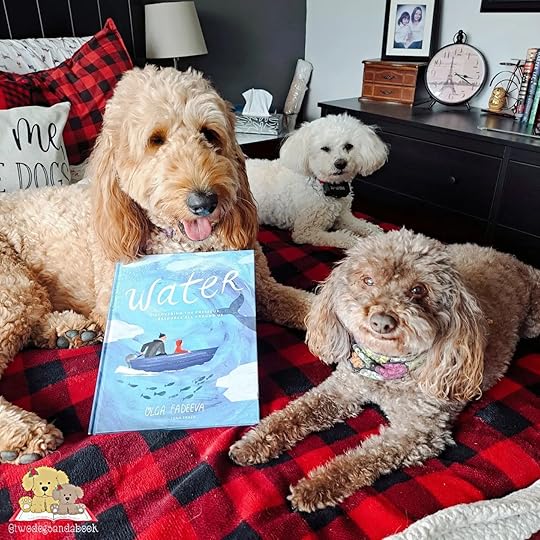
A curiosity-sparking book about water in rainstorms, the Great Lakes, the drip from our taps, and other places in our world. Water is everywhere, and we rely on it every single day. But do you ever wonder about water? How much water is on our planet? What happens when there is too much water or too little water? Why does it rain? What are lakes, rivers, seas, and oceans? Why are the seas and oceans blue and salty? What lives underwater? What about water in human history—how did people get water in ancient times? How do we get water today? What do humans build to travel on the water, and how have we harnessed waterpower? How do we protect this amazing resource for the future? Gorgeous and informative, Water invites children to tour through science and history with two characters they may recognize from Discovering Air in Motion . Colorful acrylic art and energetic text help readers learn about the natural resource we have depended on since the beginning of life itself.
Olga Fadeeva (Ольга Фадеева) is the author and illustrator of Water: Discovering the Precious Resource All Around Us, Wind: Discovering Air in Motion (Eerdmans), and many other books for children. Wind earned a starred review from Kirkus and was named a USSBY Outstanding International Book, and Water earned starred reviews from Booklist and School Library Journal. Olga’s art has been honored in Italy, China, and her home country of Russia.
Water: Discovering the Precious Resource All Around Us is a surprisingly thorough and interesting picture book.
Targeted for older picture book readers (or for an engaging classroom read), there's a lot of text per page and about double the page count of a standard picture book. Fadeeva uses this space well, offering up a large variety of facts in this quick book for children. She covers the science behind the water cycle, rain, clouds, rainbows, groundwater, oceans, lakes, rivers, seas, and more. She touches on how much water there is and how much salt the world's water has, as well as what wildlife is like in places that have extremely little water. She also covers a surprising amount of history, including prehistoric water sources, ancient (and modern) methods of getting water to people, historic (and modern) human relationships to water and exploration of it. She also touches on climate change and protecting water systems from harm. Every page has a mixture of paragraphs about that page's topic, as well as related fun facts across the page (which also feature on the inside of the cover at each end of the book).
The illustrations are really lovely. They're done primarily in water colour (there's a note about how much water she used to create the art for the book!), and there's newsprint collage and experimentation with salt in the paint as well (which she notes as one of the facts in the story, demonstrating what that looks like). The character art, while limited, is very cute. The animal and water art is all gorgeous. Her use of shape and colour really draws the eye, and combined with the layout of fun facts, it's really nice to look at and easy to follow along.
The translation appears to be really smooth and accessible. The writing is engaging and accurate without being bogged down by that dry textbooky feeling.
Overall, this is a really informative and fun read that's worth the read for children and adults alike. There are tons of fun facts that are great for trivia-oriented kids, and the science and history are all straight forward and engaging for kids who are enjoy learning about nature and science.
Çocuklara suyu ve suyun önemini anlatmanın yanı sıra, yağmurun, denizin, bulutların kısacası tğm su ile alakalı şeylerin bilimsel olarak açıklanması çok güzel.
“No living being—whether plant or animal—can survive without water. What is water, then, if not the most precious resource on our planet?”
There is a lot more to know about water than you may think. There are different forms in which we see water—such as rain, rivers, lakes, and oceans—and every single one of them has its own story. There are animals in the water, there are places that rely on very little water, and there are cities that are planted on shores just to be closer to the water. Olga Fadeeva’s Water goes over all of these things and more in an awe-inspiring picture book full of blue hues and lovely landscapes, including a gorgeous one resembling Pine Reads’s hometown of Tucson, Arizona.
When I heard the title of this book, I thought I knew how this review was going to go. I was going to tell you it was a book about water, so, obviously, it would have to be boring. Instead, I found that water and its forms can be surprisingly interesting, and this is coming from someone who did not enjoy science as a kid. A big reason for my disinterest in science was that I never felt like I was getting the full story of how things work and why, but Fadeeva presents what feels like the full story in a very clear manner. I will admit, it felt like an awful lot of words for a children’s book. The bigger words can serve as an introduction to a more scientific vocabulary, though younger children may prefer just to look at the stunning artwork. The artwork is reminiscent of Bengt Elde, a Swedish artist who often painted people against watery backdrops. I challenge readers to take away at least one fun fact every time you read it—because believe me, at the very least, you’ll open it up again just for the pictures. I know I will.
Pine Reads Review would like to thank Eerdmans Books for Young Readers for sending us an ARC in exchange for an honest review. Any quotes are taken from an advanced copy and may be subject to change before final publication.
Follow us on Instagram, Twitter, TikTok, and Facebook @pinereadsreview, and check out our website at www.pinereadsreview.com for reviews, author interviews, blogs, podcast episodes, and more!
Water. It’s the stuff of life. Following their previous book, Wind, Russian author and illustrator Olga Fadeeva takes young readers into an informative and engaging conversation about the liquid of life.
Each two-page panel in the book asks and answers a question:
Does water make you wonder? (An introduction) How much water is there on earth? Why does it rain? Is there water underground? How do rivers form? How are rainbows and water related? What are lakes? How is a sea different from an ocean? How is an ocean different from a sea? Why are the seas and the oceans salty? Why are the seas and the oceans blue? Who are the involuntary travelers in our oceans? (Icebergs!)
And that’s only about half of them. Fadeeva’s answers are well-researched and beautifully illustrated. The language isn’t quite technical, but doesn’t shy away from using more complex terms, making this best for upper elementary students. The formatting and structure are engaging and the content is relevant. Having read a lot of educational books like this with my kid, most of them just aren’t that well-written. Water offers an array of interesting and engaging facts and knows how to balance being thorough against just info-dumping. All of this is made more impressive by the fact that Water was originally published in Russian. Lena Traer gives readers a translation that feels natural and retains accuracy.
Fadeeva’s illustrations absolutely shine. With an array of blues and swirling paint strokes, she invites readers to dive into learning, offering eye-catching views that perfectly complement the text. It’s especially fitting that Fadeeva utilizes watercolors for the illustrations—in fact, a postscript to the book says that about 10 liters of later were used in the making of the art for the book.
Water is a must-have for elementary school libraries. I can’t wait to see what element Fadeeva introduces readers to next!
Here are some impressive facts about water from the book:
* 71% of the Earth’s surface is covered with water. * 3% of the world water is fresh water. * Only 1% of the world’s fresh water is easily accessible. * Most of the planet’s water is salt water.
Every aspect of water is covered in this book. From rain to clouds to water underground to water above ground. Kids will learn all about rivers, lakes, and the difference between a sea and an ocean even though they are basically in the same area.
Every page spread asks a question about water and then answers the question with various short paragraphs and illustrations to explain the answer. No living thing can survive without water. It is part of our every day from our first drink of water in the morning to our shower and quick brush of our teeth. Water is our most precious resource and we need to be vigilant to protect this resource. Microplastics in our plastic packaging and microbeads in our detergents and cosmetics are affecting marine animals, fish, and our drinking water. The author offers some tips for helping to protect this precious resource including using cloth, glass, or paper instead of single-use plastic and using eco-friendly detergents.
A note at the end of the book shares that the author used about 10 liters of water to create the art for this book by sprinkling and thinning the acrylic paint with water. The illustrations fill the pages and are gorgeous. The inside covers of the book also share extra interesting facts about water.
𝗪𝗔𝗧𝗘𝗥: 𝗗𝗶𝘀𝗰𝗼𝘃𝗲𝗿𝗶𝗻𝗴 𝘁𝗵𝗲 𝗣𝗿𝗲𝗰𝗶𝗼𝘂𝘀 𝗥𝗲𝘀𝗼𝘂𝗿𝗰𝗲 𝗔𝗹𝗹 𝗔𝗿𝗼𝘂𝗻𝗱 𝗨𝘀 𝗯𝘆 𝗢𝗹𝗴𝗮 𝗙𝗮𝗱𝗲𝗲𝘃𝗮 is an exceptional book that dives deep into the world of water. Although it's too advanced for my 11-month-old grandson now, I can't wait to share it with him as he grows. This book brilliantly combines colorful acrylic art with engaging text, making the science and history of water accessible and fascinating. Following the journey of a girl and her grandfather, it explores everything from why it rains to the history of water use. The detailed answers to many common questions about water make it an informative read. Perfect for school or public libraries, it is loaded with nonfiction text features that are instrumental in learning. The stunning illustrations enhance the rich content, making this book a must-have for sparking curiosity about our most precious resource.
I wouldn't want you to think that I'm impulsive, but I ordered a copy to be sent to my Ohio 12 year old even before I finished reading my temporary EARC! This is a fantastic study, reference, and absolutely impressively illustrated study of the characteristics, need for, and locations of all the impressive sources of water here on earth. I have run out of words to tell how much I love this beautiful and instructive book! Many thanks to Lena Traer for translating the words from Russian to English and to Olga Fadeeva for her talents as writer/illustrator. Not sure if this is suited to ESL, and the reading level, while listed as 8-14 goes successfully to 108. However, I feel that it is great for gifting to everyone, but especially to a school, hospital, or your local public library! I requested and received a free temporary e-book on Adobe Digital Editions from Wm. B. Eerdmans Publishing Company via NetGalley. Thank you!
Brief summary: This book about water is both interesting and informative. It features a girl and her grandfather who explore everything there is to know about water. The book covers various topics, such as the history of water, its importance to humans and nature, and how it is used. It provides detailed answers to many of the questions about water.
Comments: This book is an absolute must-have for all school or public libraries. The questions are thought-provoking. The book is loaded with nonfiction text features that are instrumental in learning and presenting facts. Furthermore, the pastedown endpapers of the book reveal fascinating water facts. The acrylic paint and water illustrations are simply stunning and magnify the text.
Rating: 5/5 📗📗📗📗📗 *I received a complimentary copy for an honest review.
It did a good job of painting the bigger picture. A few new things clicked for me because it's very simplified and easy to connect the dots versus a more academic book.
my favorite section was the one on rivers. the art was gorgeous and was the perfect companion to explaining a watershed. the only thing that was missing was the use of the word: watershed. this section was in stark contrast to the salty oceans section. as soon as I turned the page, there were lots of bubbles with walls of text. yikes.
I don't know if this is a good book for young readers. although, it's well written and all jargon is explained, I can see some high schoolers struggling with this. my best guess is reading grade level is 9 which is kind of unavoidable with science books.
This book is stunning! The gorgeous illustrations and beautiful text take you on an extraordinary learning journey. You'll discover so many interesting facts about water and why it's such a precious resource. This book is best for an older audience as it has quite a bit of text (grades 4 and above). Great for use in science classrooms to introduce this concept.
A question and answer fact book about water. This book contains a ton of facts, and a lot of text, about water. It would be useful for a unit about water, and it could be read in chunks. I wish it had a table of contents.
This book has an ocean of information! It can be read to kids or used as a college reference since it has so much knowledge. I never knew there were 5 oceans...
Si tratta di un albo illustrato che esplora l’importanza dell’acqua, non solo dal punto di vista ambientale ma anche emotivo, attraverso immagini che parlano tanto quanto le parole. Il libro si distingue per un equilibrio ben riuscito tra la narrazione informativa e la rappresentazione visiva, creando un'esperienza di lettura immersiva e poetica. Le illustrazioni sono senza dubbio uno dei punti di forza principali dell’albo. L'uso del colore è straordinario: le diverse tonalità di blu dominano le pagine, riflettendo le molteplici forme e stati dell'acqua, dai toni freddi e cristallini dei ghiacciai ai blu più profondi degli oceani e ai toni più caldi delle acque tropicali. I dettagli visivi sono ricchi e vari, ma mai sovraccarichi. L’artista riesce a catturare sia la vastità di un mare sconfinato sia l’intimità di una goccia d’acqua che scivola su una foglia.
Le texture sono usate in modo intelligente per suggerire la fluidità dell’acqua: pennellate morbide e sfumate ricreano la sensazione di movimento continuo, rendendo le immagini dinamiche. La cura nel raffigurare l’acqua in tutti i suoi stati, solido, liquido e gassoso, rende il libro visivamente stimolante. Inoltre, l’uso del bianco e degli spazi vuoti è altrettanto efficace: crea un senso di leggerezza e purezza, quasi come se l'acqua si muovesse senza peso attraverso le pagine. L’albo riesce a trasmettere un profondo senso di meraviglia e rispetto per l’acqua come risorsa vitale. Le immagini non sono solo didattiche, ma evocative: c’è una bellezza intrinseca nel modo in cui l’acqua viene rappresentata, che può toccare corde sensibili anche nei lettori più giovani. Le illustrazioni evocano la tranquillità di una pioggia leggera, la potenza di una cascata e la fragilità dei ghiacciai in scioglimento, invitando chi legge a riflettere sul ruolo che l’acqua gioca nella vita quotidiana e nel mondo naturale.