What do you think?
Rate this book


333 pages, Kindle Edition
First published November 1, 2011


"For after the rain, when with never a stain
The pavilion of Heaven is bare,
And the winds and sunbeams, with their convex gleams,
Build up the blue dome of Air
I silently laugh at my own cenotaph
And out of the caverns of rain,
Like a child from the womb, like a ghost from the tomb,
I arise, and unbuild it again." - P.B. Shelley
"Are all of us the same, I wonder, navigating our lives by interpreting the silences between words spoken, analysing the returning echoes of our memory in order to chart the terrain, in order to make sense of the world around us?"
Are all of us the same, I wonder, navigating our lives by interpreting the silences between words spoken, analyzing the returning echoes of our memory in order to chart the terrain, in order to make sense of the world around us?"...the heart of a contemplative state", in Tan's words, would have worked as a subsidiary title. Forbearing all contemptuous accusations of New Age influence, of course, for everyone knows that acceptable enlightenment may only be found in the dry and musty cacophonies of the classics, Europe as the official and Asia as the guilty pleasure. Certainly not in the pages of Malaysia breeding brought only to light within the last five years, growing to life a branch of World War Two and indeed a span of the globe entire rarely touched upon in modern literature with such respect, such dignity, a measured tread of facts and culture with a strength and a beauty to it that is so often shoddily spat out with glib pathos and cloying sentiment. But not here.
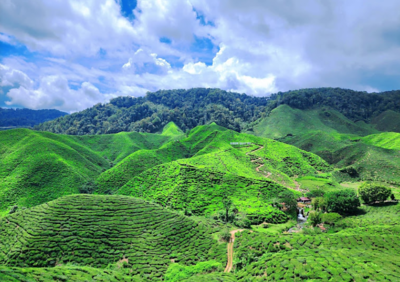
Through the windows I watch the mists thicken, wiping away the mountains borrowed by the garden. Are the mists, too, an element of shakkei incorporated by Aritomo? I wonder. To use not only the mountains, but the wind, the clouds, the ever-changing light? Did he borrow from heaven itself?
"On a mountain above the clouds once lived a man who had been the gardener of the Emperor of Japan. Not many people would have known of him before the war, but I did......
....He did not apologise for what his countrymen had done to my sister and me. Not on that rain-scratched morning when we first met, nor at any other time. What words could have healed my pain, returned my sister to me? None.
And he understood that. Not many people did."
The pavilion’s roof was taking shape. Mahmood, the carpenter, and his son Rizal were unrolling their rugs on the grass next to a stack of planks.Regarding Arimoto, the very first sentence of this book is On a mountain above the clouds once lived a man who was the gardener of the Emperor of Japan. This sounds like the setup for some sort of Zen odyssey, but that is not the story Tan is interested in telling. The woman narrating the passage above is Yun Hong’s sister, and despite the phrase in the poem Yung Hong has indeed died and the narrator misses her so very, very much. This is not a book where people go around quoting poetry at one another, so when it happens, I pay attention, and when I pay attention, I realize that this book is operating on about a dozen different levels at once. 'The pavilion of heaven' turns out to have a very different meaning than I thought it would; the zen guy is dismissive of the name, at first; a Malay Chinese woman is quoting Shelley; everything in this novel strikes at an oblique angle.
Arimoto glanced at me. “Think of a name for it – the pavilion.”
Taken by surprise, nothing came to me. I stared at the half-finished structure, thinking furiously. “The Pavilion of Heaven,” I said finally.
Arimoto grimaced, as if I had waved a putrifying object beneath his nose. “That is the sort of phrase ignorant Europeans come up with when they think of…the East."
“Actually, it’s from one of Shelley’s poems. ‘The Cloud.’”
“Really? I have not heard of it.”
“It was one of Yun Hong’s favorite poems.” I closed my eyes and opened them again a moment later. ”I am the daughter of the Earth and Water / And the nursling of the Sky / I pass through the pores of the ocean and the shores / I change, but I cannot die.”
Remembering how Yun Hong had so often spoken these lines, I stopped; I felt I was stealing something from her, something that she had treasured.
“I have heard nothing about the pavilion,” Arimoto said.
”For after the rain, when with never a stain / The pavilion of Heaven is bare, / And the winds and sunbeams with their convex gleams / Build up the blue dome of air, / I silently laugh at my own cenotaph, / And out of the caverns of rain, / Like a child from the womb, like a ghost from the tomb, / I arise, and unbuild it again.”