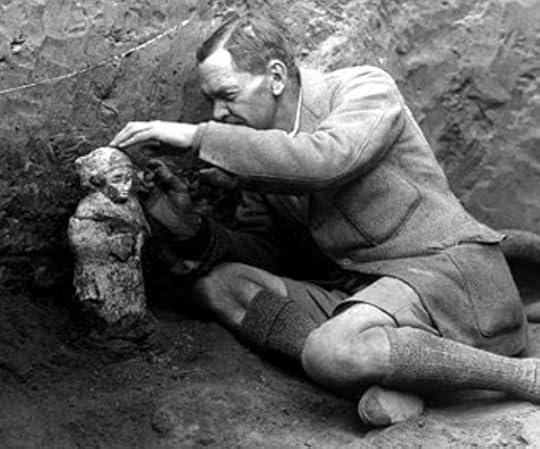
Sir Charles Leonard Woolley was a British archaeologist best known for his excavations at Ur in Mesopotamia. He is considered to have been one of the first "modern" archaeologists, and was knighted in 1935 for his contributions to the discipline of archaeology.
He was married to Katharine Woolley who worked as the illustrator for his excavations.
This was the wrong book to read. Not that it was wrong for me to read this book but that I was supposed to read another one of Leonard Woolley’s books. In a couple other reviews, I have mentioned the Seminar via Zoom I am taking – we look at the various memories written by the early generations of Archaeologists. The one that was discussed in the Seminar was the earlier Dead Towns and Living Men, and which I have not read yet, published in 1920, his first book. The one I am review dates from ten years later, which means that he had already began excavating at Ur, endeavour which made his name in the field. It originates in a series of talks he gave for the BBC.
This is a good introduction to the field of archaeology, as it was practiced during the time of major discoveries, practices that have changed considerably – both from a scientific point of view, and in the legal framework that sponsors and allows them.
Several points drew my attention:
The detached manner in which Woolley differentiates between Treasure hunting and scientific archaeology. The latter is more abstract since it seeks the objects for their associations which will be revealed through “observation, recording and interpretation.”
The deliberation on the interrelationship between objects and written records. I was astonished by his assertion that there are no written records of Britain prior to 55 BC. Knowing how many books we have now on ancient, and not even ancient, but just plain older times, it had not dawned how much of what these secondary texts contain now are based on the studies of archaeologists who had only the objects and the remains to conjecture a narrative history out of them. Similarly astounding was his comment that we know more of how everyday life in Egypt was during the 14thcentury BC than in England in the 14thcentury AD. And we have to admire the picture that Arthur Evans managed to draw of the Minoan civilization with no texts whatsoever to draw upon.
Also curious was Woolley’s assertion that once an object has been excavated and interpreted, the object per se loses its value. Its scientific and historical evidence has already been delivered. We can then consider all those objects in glass cases in museums as dead things, their souls are in libraries.
He also emphasizes the importance of comparative archaeology. A sample of this is the finding of cylinder seals in both Egypt and in Mesopotamia. To the question of whether this technology originated in both places independently, the realization that in Egypt they are found in only one stratum, that is, one period, while in Mesopotamia they are present at different levels, indicates that the latter were the inventors and that the trade and political relations between the two powers brought the fashion to Egypt where it was no more than a fashion. In Egypt they preferred papyrus to bases of clay.
His explanation of how it happens that long drawn periods in history become materialized in rubble and the various ways in which this rubble accumulates becoming their own records is the clearest I have read or heard so far. It is in this light, that the consolidating title of these talks, digging up the past, takes on its full meaning.
This is a fascinating and gorgeously-written book, written as a popular history of archaeology's methods and aims as a field. Woolley himself was a prominent figure in interwar archaeology (present at the dig of Ur!) and speaks with an unmistakable and endearing enthusiasm for his subject. He waxes positively lyrical on more than one occasion. The book is also a fascinating and disquieting look at the social dynamics of archaeological digs. "The archaeologist," Woolley's default practitioner, is clearly an Englishman. But in asides and between the lines of Woolley's text, it appears that the practitioners were much more diverse than one might infer from this. Woolley covers "not a few ladies who do excellent work" in a couple of sentences, leaving me eager to know more. "The Arab foreman," observes Woolley, "is invaluable"; this figure appears as not only a subject expert and administrator, but a multilingual diplomat. Woolley observes that he's seen the practice of rewarding workmen for digging up valuable finds work equally well with "Arabs, Italians, Poles, and Englishmen." It's both unsettling and interesting to have such an example of how the agency of all those around the default, university-educated Englishman could be obscured and neglected by the latter's perspective.
I picked up this rather random book at a book market in Deventer. And I am so glad I did. "Digging Up the Past" by C. Leonard Woolley is an exciting look at archaeology. He shares his experiences digging at Ur, bringing ancient history to life in a way that is enjoyable for someone who has never even bothered to learn anything about archeology in the past.
A random read, but one that flowed like poetry:
"It is the field archeologist who, directly or indirectly, has opened up for the reader new chapters in the history of civilised man; and by recovering from earth such documented relics of the past as strike the imagination through the eye, he makes real and modern what otherwise might seem a far-off tale".
Dated but well written and fascinating look into how excavation was undertaken before modern commercial archaeology and survey techniques. I loved learning about how the archaeologists had to pay attention to the land and it's contours to identify graves and feature, which is knowledge still used today with the addition of geophysical survey.
However, the funniest claim in hindsight has to Woolley's statement at there is no absolute chronology in archaeology. Typology and seriation are methods that Woolley explains about when he discusses relative dating and dating methods like radiocarbon dating or luminescence were not available to archaeologists in the 1930s to 1960 when this book was last published. It's amazing to see how far archaeological science has come, even with the new challenges that they present. Similarly, Woolley praises Sir Arthur Evans ingenuity of reconstructing Knossos and yet those reconstructions often cause problems for modern archaeologists attempting to separate archaeological evidence and Evans' and and his artists' interpretations of the site.
All in all, a wonderful overview of excavation in the early and mid 20th century and an invaluable piece of archaeological method history
This entire review has been hidden because of spoilers.
مدخل إلى علم الآثار / ليونارد وولي / ترجمة د . حسن الباشا / 1956 . يتألف الكتاب من 130 صفحة بالإضافة إلى 31 لوحة .
يظن الكثيرون أن التنقيب عن الآثار هو مجرد الحفر المضني في سبيل الحصول على آثار ثمينة أو تحف جميلة تدر على مكتشفيها صيتاً وغنى . الحق إن الحفائر الآثارية كانت قبل نحو 150 سنة تهدف إلى البحث عن الكنوز ، غير أن علم الآثار بمدلوله الحديث يختلف عن ذلك اختلافاً كبيراً ، فهو يتلخص في أمرين يرتبط كل منهما بالآخر ، أولهما أعمال الحفر والتنقيب واستخلاص الآثار وتسجيل أوصافها وأوضاعها بالنسبة لغيرها والمحافظة عليها وترميمها . وثانيهما استخدام هذه الآثار المكتشفة في إلقاء أضواء جديدة على الحضارة الإنسانية الماضية وتطورها واستنباط التاريخ منها ، حيث ان هدف العالم المنقب عن الآثار هو أن يكشف مجرى التاريخ البشري ويوضحه .
At the time of publication, in 1961, Archaeology was still generally seen as the preserve of wealthy scholars who did not need to work for a living. In the sixty years which have passed since then Archaeology has boomed as a university subject and has become ever more popular through various television presentations. Wooley's book may seem rather simple to the modern reader, but it was a milestone in the growing popularity of the subject. A milestone on the way.
A readable introduction to the methodology of archaeological digs. Granted it's quite old now but, as Woolley comments, the principles are the same and those principles are largely what he's trying to get across.
The book is written for the layperson - of which I am one. There are lots of examples given, hardly any jargon, and the text is simple and clear. I found particularly interesting Woolley's comments on the logistics of managing an archaeological dig. I imagine things have changed in that regard in the intervening decades but it gives the feeling of what archaeology was like in Woolley's day - the book was first published in 1930 (although updated some decades later) so one has to sift out the lasting observations from those that are a product of the time.