Романы «Лисица на чердаке» и «Деревянная пастушка» английского писателя Ричарда Хьюза (1900—1976) объединены общими героями и охватывают период с 1923 по 1934 год. Действие переносится из Англии в Германию, Америку, Морокко. Размышляющий над кардинальными проблемами современности художник создает широкое социальное полотно. Его романы — это история мрачного, не подлежащего забвению времени, когда в реваншистской Германии зрел фашизм, история десятилетнего пути Гитлера к власти, начало которого, мюнхенский путч, изображено в «Лисице на чердаке», а завершение, «ночь длинных ножей»,— в «Деревянной пастушке».
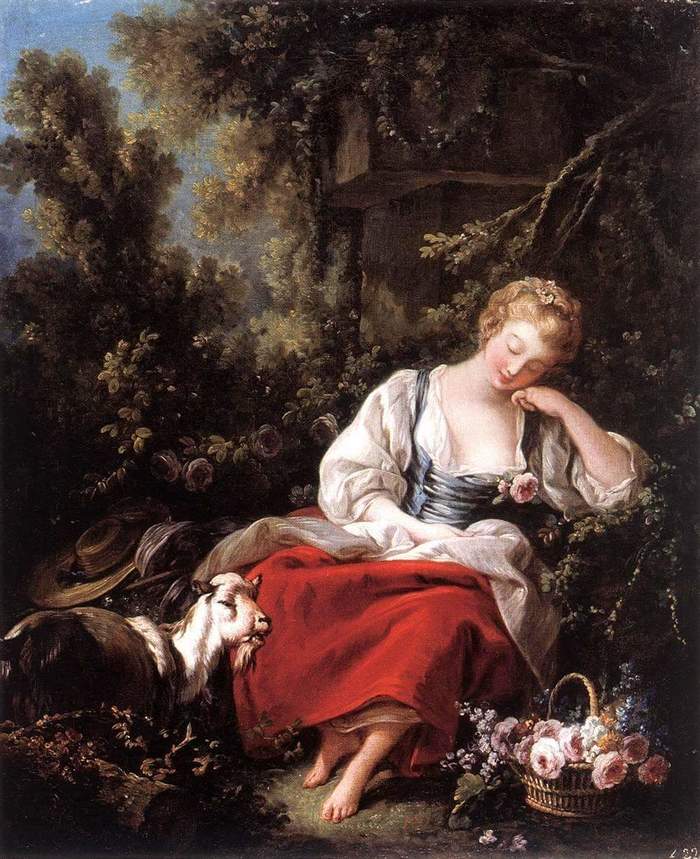
Dreaming Shepherdess, 1763 François Boucher Residenzgalerie Salzburg
Tynnwyd o stoc. Llyfrgell Coleg Normal, Bangor
Description from the inside flap: This new volume widens a huge canvas even further: with Augustine a fugitive from the law in Prohibition America among a Bacchanalian troop of American youngsters, the grandparent's of today's rebel generation 'already doing their own thing' in the Connecticut woods; with Mitzi in her Carmelite cell, Hitler in prison - and the night Our Norah fell through the floor...
Opening: ABOVE, in the dried aromatic scrub, an early cicada churred.
This is the second, and sadly final, instalment in Hughes's 'The Human Predicament' trilogy.
This novel is a continuation of Hughes' 'Human Predicament' trilogy of which only two books were completed. It picks up with most of the main characters a year after the events of 'the Fox in the Attic'. The central character again is Augustine. The story begins with him hiding out in Prohibition-era Connecticut, believing himself to be a fugitive from the law. The real story in the novel is that of Hitler. Once again, Hughes' draws on historical fact and anecdote to paint a compelling portrait of the Nazi dictator. What he examines here is the psychology of the German people in the 1920s and 1930s. He shows how they were ripe for someone like Hitler to step in and give them guidance. He also shows how the young, even in Britain, were captured by Hitler's magnetism. Augustine travels through the US, tarries a bit at the family estate Mellton then sets off for Morocco before finally returning to Germany at the close of the novel. Other characters revisited include Augustine's sister Mary and her husband Gilbert, Mitzi and the rest of the von Essens and, of course, Adolf Hitler. Whereas the predominate philosophy in 'the Fox in the Attic' was the delineation between 'we' and 'they', the philosophy in 'the Wooden Shepherdess' deals with the subsuming of the 'I' in something greater than one's self. For the Germans this something is Hitler, for Mitzi it is God. Augustine alone remains naively convinced of his own importance and consequently drifts from one experience to the next gaining little knowledge. His 'epiphany' comes in Morocco when, at last, he feels his life at risk... a sense of urgency that his generation is lacking, having missed out on the First World War for which they had been preparing.
It has taken me some time to get to The Wooden Shepherdess after I read and enjoyed The Fox in the Attic - the first instalment in what Hughes hoped would be a trilogy.
It is hard to fully judge this second book as his death meant Hughes did not complete the third volume. Judging by the 12 chapters that we do get of the final novel in this edition, the second part was laying down markers for the concluding book.
On its own merits though, I found The Wooden Shepherdess both less satisfying and focused than The Fox in the Attic.
What made the first volume memorable was the focus on the insidious rise of the Nazis as seen through the largely oblivious gaze of central character Augustine and the German family he stays with.
The shadow of events in Germany continues to creep across The Wooden Shepherdess but only intermittently, and Hughes struggles to find ways of putting his characters at the heart of the action.
Instead of returning to Germany, we follow Augustine on adventures in the US, Canada, and Morocco. All have their merits - and I particularly enjoyed the opening sections in Prohibition-era America - but they don't really add up to more than the sum of their parts.
There are also what seem unnecessary sections focusing on a working class family in Coventry. They are tangentially connected to the main characters, but as Hughes has not made any effort to build our connection with them I felt little investment in those chapters. It's clear from the surviving section of the third volume that they were going to be important in the narrative to come, but their introduction in The Wooden Shepherdess feels inelegant.
Instead we want to get back to the characters we are already invested in, but some are almost forgotten. There is one compelling interlude in Germany involving Mitzi and the family Augustine was involved with in The Fox in the Attic, but then we barely meet them again.
Hughes finally returns to the Third Reich towards the end as he relays the events of The Night of the Long Knives. This is well-described, but although Hughes does manage to place a couple of his characters into the action, they are ones who have barely been seen during the rest of the book, and they are passive, giving no point of view. The events would have had more power had we seen them through the eyes of characters we had invested in. Augustine in particular disappears from the final sections of the novel - a real narrative misstep.
Hughes is certainly striving towards epic historic literature, but for me he spends too much time on the history and not enough on the literary side. What makes this frustrating is that Hughes is a talented writer, and he has some compelling elements, but they don't quite gel.
It is possible that the third volume would have added to the power of The Wooden Shepherdess and produced a more coherent work. Unfortunately we will never know. The Fox in the Attic remains a powerful and compelling testament to Hughes' skills. Many of those strengths are on show again in The Wooden Shepherdess, but, for me, there are also too many narrative flaws.
It took Richard Hughes over forty years to write four novels. Sadly, each one is weaker than the one before: if, like me, you read them in chronological order, there is a sense of anti-climax, the initial promise fizzling away. The Wooden Shepherdess is his last completed novel, the second part in his ambitious The Human Predicament trilogy – the final volume was never completed. The narrative carries on straight after The Fox in the Attic – apparently Hughes thought of the trilogy as one novel. The Wooden Shepherdess has the same ambitions as The Fox in the Attic, to offer a panoramic view of the 1920s and 1930s when Europe moved from one war to the next. The central challenge of The Fox in the Attic was following its characters while relating them to the broader political situations. There was a character involved in the crisis in the British Liberal Party, in Germany we follow a landowning elite steeped in nationalism while the vulgar oikes of the Nazi Party begin to flex their muscles. This continues in The Wooden Shepherdess, although the crisis in the Liberal Party fades into the background and the Nazis take over the book by the end, taking power and then Hitler eliminating his rivals. The book also includes the United States, the central character, Augustine, ending up there with a plot manoeuvre worthy of a Victorian melodrama. But if The Human Predicament is trying to sum up its times, the American episode doesn’t quite work, unless its series of young Americans are supposed to illustrate the American future. It is all quite readable, but the characters don’t really manage the symbolic force that I presume they are supposed to have, while not being that interesting in themselves. And they just seem a little lost in the broad historical-political narrative. Large chunks of the last section read a little like a popular history of 1930s Germany, the characters almost dropping out of the work. When I first read High Wind in Jamaica some 30 years ago, I thought I had found an unrecognised major British writer – sadly, Richard Hughes' career seemed to have fizzled away.
Really more like five stars for effort, three for execution, but he never got to write the last volume to the trilogy. The end of The Fox in the Attic and the first couple hundred pages of this one are very, very disjointed. His minor characters, whether historical or fictional, are fascinating, but for some reason his major characters look more like plot devices (Augustine gives him an excuse to write about Germany, America, Morocco, the upper classes of England, Wales...) or ciphers (er, Hitler, who I guess kind of was a cipher). At points everything pulls together, particularly when he deals with financial turmoil and how it moves from location to location for a variety of reasons. It's tough to make enthralling fiction out of finance, but he manages to do it in only a few pages. But even with all that, and the beautiful writing, which hovers somewhere between fairy tale and Jane Austen level irony in style, the lack of conclusion really hurts the Human Predicament as a whole. This one also has more tedious passages than Fox, so unless you really like that and are fascinated by the project, you might want to give this a miss, sad to say. If you do take it on, there are plenty of mind catching scenes (Ree's attempted seduction) and details (wax dropping on a christmas decoration) and characters (Mitzi! Mitzi rules) to make it well worthwhile.
Hughes set out to create a kind of War and Peace of the 20th century's and in this, his ambitious effort reminds me of Vasili Grossman's similar goal for Russian history. Grossman succeeded to a far greater extent, drawing on his own experiences as a war correspondent at Stalingrad and Treblinka, but was blocked from publication by the Soviet state. Hughes' failure in his great project was due to a basically disjointed overall plan. His protagonist Augustine, a wealthy and unambitious young Englishman, goes from 1923 Britain to Germany at the time of Hitler's beer hall putsch in the first volume of the series ("The Fox in the Attic") and falls in love with a blind cousin who vanishes into a nunnery. And then in the second volume, the young Brit ends up in Prohibition era Connecticut. The scenes in which he is "adopted" by a lively crowd of American adolescents are quite convincing, but then the scene switches to Morocco where the protagonist does some sightseeing for many chapters. The final section describing Hitler's massacre of his own storm troopers in 1934 is really the best part of the volume but has nothing to do with Augustine. All in all, Hughes creates some great stand-alone pieces in the two volumes he completed but they should have been published as separate novellas.
This the second and last complete part of Hughes' planned trilogy, spanning the early 1920s into WWII (the posthumous 50 pages that would have started the third volume are appended). It seems fairly necessary to have read its predecessor (not always so with such extended works) and there are quite a few plot lines that feel a bit dangling - presumably they would eventually have been resolved. I'd have preferred more on the fictional English family and their German cousins who are at the center of the story, but the historical fictionalizing of the Nazis and their rise to power gets a lot of pages. The welter of names and incidents goes by quite quickly, perhaps presuming the reader knows more than I do about the actual history. As a novelist, Hughes favors the more dramatic historiographies of the era - homosexual orgies among the high command that are more rumored than proven, details from the Night of the Long Knives that probably can't be known so clearly, but no matter - the book is engaging and well-written.
pp. 205-208: “For the Count brushed Hitler aside as a featherweight, lacking the stuff of a leader: 'A febrile weathercock, useful perhaps down South; but the soldier Protestant North distrusts his sort. If the Nazis want to cut any ice up here they had better forget about Hitler and hitch their wagon to Strasser.' 'I beg to differ,' said Reinhold. 'I happened to run into Captain Röhm just before he sailed, and he made my hair stand on end with his tales of what Hitler is like to work with. Poor old Röhm, he got so excited his scars lit up like the comb of a cock! Each twopenny problem has to be solved by Hitler himself—though half the time it has only become one because of his own vacillation. Again: if you offer advice he throws it back in your face, then three days later announces that very decision as if it was his idea from the first. Indeed Röhm doubts if Hitler has ever produced one single idea of his own: he filches the lot, he's a peacock naked apart from borrowed plumes—an ideological scarecrow.' 'With great respect,' said Reinhold mildly, 'isn't that always the stuff that leaders are made of? Of course I mean the Caesars who get to the very top, not the high-minded Strassers who merely win our esteem.' The aged and deeply furrowed face of the Count took on an ironical look, with cool gray eyes more ready to be amused than convinced: 'Then what becomes of the typical charismatic leader's obsessional Grand Idea that he's ready to die for? His superhuman will, which forces unwilling disciples to follow his Great Ideal like sheep?' 'Thus Spake Zarathustra—not the revered [Count] Lepowski, who knows no leader has ever forced men to do things against their will. We only imagine he has.' 'Proceed,' said the Count, no longer smiling. 'The world-shaking “Leader” is just what Röhm described: a tabula rasa without any will or ideas of his own at all, but a superhumanly sensitive nose for what potential followers think and want. He must find that out before the bulk of them know it themselves, then announce it as his unchangeable will—when of course they will follow his lead like sheep, because that's the way they're already unconsciously wanting to go.' 'So that's your idea of the famous “Führerprinzip”?' mused the Count: 'No need for Democracy's ballot-boxes because the Leader himself is a walking box, with sensitive ears where everyone posts his vote? But come! That's merely a human weathercock, not what we mean by a “Leader.”' 'Aren't you forgetting your Leader's implacable will?' 'But you've just denied him a will of his own at all!' cried the Count, amazed. 'I only denied him the choice of his will's direction: I never denied him its strength. It's the strength of will they so signally lack themselves which makes the herd so dependent on him. Themselves they pursue their ends so feebly; but he lets no obstacle stand in the way of their faintest unspoken and even unrealized wishes....' … 'These Nazis—a so-called “national” party almost unknown in the North,with only a few thousand members and those at each other's throats....If you ask me, it is Strasser who ought to ditch the Nazis and join some party which counts. They can only thrive on despair, and will disappear altogether now our Seven Lean Years seem over.' 'Yes, I agree that by all the rules they should now fade away—and doubtless they would, if it wasn't for Hitler.' The old man made an impatient gesture: “Your Hitler, Hitler--I'm sick to death of the name!' 'Very likely—but don't think you've heard the last of it!' Reinhold's Cassandra-like tones confronted the frank disbelief in Lepowski's face. 'He is powerless now; but can't I get you to see he's the very archetype of a Leader—the pure Platonic Idea of “Leader” with everything normally human left out?' Lepowski tried to break in, but Reinhold was not to be stopped: 'Consider how far he has come already, though starting from nothing—an ignorant workhouse tramp. And remember I've watched the diabolical skill of his every move: his technique leaves Machiavelli's Prince at the post, for he sees at least five moves ahead of everyone else. But the nub of the matter is this: he is bound in the long run to come to the top because—in the long run—no one will try to stop this uncanny clairvoyant who knows what Germany wants. That's more than she knows herself—but all the same it's what she is doomed to receive at his hands some day, however little she likes what she gets when she gets it.' 'If what you mean is the German rabble....' But Reinhold brushed this aside. 'The rabble's a bogy we make too much of: they only want bread. But think of Germany's middle classes, the class from which Hitler himself once sank to the gutter—and therefore knows what it's like, that fate which all of them fear like hell. Imagine the secret desires and hates of our solid Bürgerlich little shopmen and civil servants, our teachers and Lutheran pastors, our skilled artisans and our farmers—imagine that Freudian nightmare released into waking life! Imagine the coming to power of everyone terrified out of his Spiessbürger wits by inflation, and everything else which has hit him these Seven Lean Years: who longs for a chance to hit back at something or someone, he doesn't care who or what!' The Count curled his lip in derision: 'So that's what you think your Hitler can bring to fruition! But how on earth, with so tiny a following?' 'Listen: you've got to look on Hitler's “tiny following” more like the first few cases of plague than as any normal minority.'
My lament is even more plaintive than after having finished The Fox in the Attic: The Human Predicament Trilogy is incomplete, alas. While I did get a 12-chapter taste of what would have been the last volume in the trilogy, it only makes sadder the absence of a full treatment. In short, The Wooden Shepherdess is a worthy successor to Fox in the Attic, and it even better incorporates the movements of Hitler as he navigates the German political terrain from 1924 – 1934, at which point he has executed his Night of the Long Knives and made himself, Goebbels, and Goring the principal leaders of the Nazi party.
Fox in the Attic only covered a single year, 1923, but this second volume covers a full decade in the same narrative space. In Hughes’ treatment of various interbellum national temperaments, he has his protagonist, the young gentleman Augustine Penry-Herbert holed up in Connecticut for nearly a year. At the conclusion of Fox in the Attic, when he recoils from news that his blind beloved (to whom he’s never spoken a word of his feelings) has elected to enter a convent, he flees his German cousins and is on his way back to England, via France. On the quays of St. Malo, he is mugged and dropped into the hold of a ship, and he’s not discovered till the crew is at sea and looking for its pet cat. For several months, Augustine, without money or passport, works on the English rum-running ship, galvanized by the unwonted physical demands of a rope-climbing, deck-hauling mate. When the ship’s Long Island landing party is ambushed by gun-toting mobsters, he flees into the hinterlands of New England.
Hughes has a keen, ironic perspective on America’s bewildering affair with Prohibition, intimating America is ill-prepared to take on world affairs, hence its isolationist stance (pace Wilson’s work to form the League of Nations). Augustine’s peter-pannish adventures in America eventually force him to flee further north, to Canada, at last realizing he can summon means to get back to England without political or criminal difficulties. Meanwhile, his sister Mary and back-bencher Gilbert Wadamy are delivered of a second child. And, meanwhile, Hitler is sitting in jail, writing his opus Mein Kampf, then released after the December elections, considered no more than a harmless small fry. There are also quick peeks into the activities of Mitzi in the convent, and of Nellie and her child Syl in Coventry; and Hughes introduces a new female character, Norah, whose activities bring her into the Wadamy household at the novel’s end).
Hughes’s writing is sharp, precise, even jaunty, and he keeps all these small and large stories moving at a good clip. At the microscopic level, there are small humane ironies and the frequent pleasing turn of phrase; at the large-scale level, Hughes is not averse to several times offering up witty surveys of politics in England and Germany. The German cousins appear in this second novel, but their presence is slight, and it is only in the novel’s final pages—when Hitler has had his purge—that we are again in the full midst of the family. However, it is solely Mitzi in the convent to whom Hughes adverts when recounting the sordid death of her uncle Colonel Otto.
As the 30s commence, it is only Jeremy Dibden (Augustine’s school chum and now a White Hall civil servant) who suspects that there is more going on in Germany than is apparent. While Augustine does not go, Jeremy brings along three of their mutual friends with him for an automobile tour of Germany. When Jeremy later tries to rouse full-Minister Gilbert to the sights he’d seen in Germany (and how there were clear violations of the Versailles agreement), Gilbert is too quick to dismiss his brother-in-law’s friend. Hughes very ably brings us through the German, English, and American depressions to this point in history, 1934, when there are looming international worries and the smaller, human concerns of his characters. What’s particularly good in Hughes’ treatment of the large and small is that he’s not forcing the pieces to fit together but allows the reader to work out how the stories intersect and reinforce one another.
The first twelve chapters of volume three bring on a new love interest for Augustine (he’d dithered with Joan in The Wooden Mistress, and she married his racist, isolationist American friend, Anthony Fairfax), and new concerns for Mary, who for nearly a decade has been paralyzed from a broken neck, with only her arms, hands, and head mobile. The two novels are worth a read, just for Hughes’s brisk, buoyant writing, if not for a glimpse onto a panoramic vista that fades to black all too quickly. Ah, the human predicament!
I decided not to go beyond page 214. Some of the characters were interesting. He jumps around too abruptly between characters and it is hard to see the thematic connection. I liked the previous book in the projected trilogy. That was The Fox in the Attic. Hughes set a very high standard for himself. He wanted to write a 20th century War and Peace. Napoleon and General Kutusov are brilliant characters, but it is difficult to make a convincing character out of Hitler because of the nature of his catastrophic effect on 20th century history. The previous reviews on Goodreads give a good picture of the novel. I would only add that the prose is very finally crafted and often has the rhythmic flow of poetry.
Really would have been nice to see how all of this came together in the final form once all the books were done. There are teases of threads picked up from the first book and set up for the third and that just didn't come off. It makes for an unsatisfying experience and this one felt, a bit rushed and less polished than his 3 previous novels. Ah well.
Dang. When I first added this to my wishlist, I thought it was one of his children's books. I mean, he wrote A High Wind in Jamaica which was good, though for readers wiser than tots, and I learned about him in the first place from Alison Lurie's wonderful The Oxford Book of Modern Fairy Tales. To finally get a copy of this, then find out it's almost 400 dense pp, then to find out what it *really* is... - ! I mean, gosh, look at the title: does that not say 'children's book' to you? Maybe something like The Velveteen Rabbit or The Magic Fishbone? Well, no, not interested in this middle entry of an incomplete trilogy of historical fiction. Blech.
I've been reading this guy for a couple months now... The Fox in the Attic was awesome, but the sequel tries to do too many things at once. At this point he's following about seven characters, including Hitler and a British statesman, and there are endless historical background passages about Hitler's rise to power, and the quibbling of British politicians. Which would be cool if I was interested in that sort of thing at the moment, but as it is, every time I come to one of those sections I drop it on the floor and go to bed. The characters are pretty wonderful, though, so I've stuck with it. He writes children well, which is no small accomplishment; he's focused on four children under 14 so far (in addition to all the adult characters and made them all individuals.
i gave up a couple of times . i found the story uninteresting at best and the only thing that saved it for me was the second part. in it the tales is combined with the accurate events of the raise of hitler.