YES & NO :
Yes : "Young Lions" is one of the major American novels dealing with World War II. And Yes! I am glad I have read it - it was epic, rich in detail and in human interest stories, professionally written and often emotionally moving. The fact that Irwin Shaw talks from direct experience is clear and confers an almost documentary quality to the material.
& NO : It didn't have quite the same impact on me as the other majors I've read, "The Naked and the Dead" and "From Here to Eternity." My complaints are not easuly articulated, but there is a certain awkwardness in a lot of the set pieces: they feel staged, theatrical, unnecessarily melodramatic, especially when one of the characters starts on a long rant or an internal monologue. The pacing is also off for most of the first half of the novel during the long civilian life scenes before boot camp, only picking up after the Normandy landing. The best scenes are the ones where the author lets the facts speak for themselves and refrains from editorial comments. I could also mention that I appreciate the inclusion of both the acts of heroism and the discrimination and atrocities perpetrated by both sides in the conflict, but when it comes to the German side of the equation, the balance is clearly tilted towards reinforcing the monstrous propaganda image.
>><<>><<>><<>><<>><<
The scope of the novel is big, but luckily for me, most of the readers are probably already familiar with the subject and with the sequence of events, World War II being still one of the most written about and filmed subjects. No need for me to write a lengthy reresume. Irwin cuts a world war down into a manageable size by focusing on the parts that he witnessed himself (American boot camp, North Africa, England, Italy, France) and telling the story through the eyes of only three major characters - the three young lions of the title.
Christian Diestl was a tall, slender young man, with a solemn, abstracted face and close-cut hair, his skin burned dark by the sun, his eyes light and almost golden with the yellow flecks you find in an animal's eyes.
Diestl is the closest of the three to resemble a lion : a predator, athletic, ruthless, courageous. He is also the first to see actual combat, as we follow him through the blitz advance to Paris, then, after a quiet interlude on garrison duty and a short steamy leave in Berlin, fighting in North Africa, both on the offensive and during a disastrous retreat. Later on, after wounds and betrayals and witnessing the collapse of the Nazi Reich from Italy to the coast of Normandy all the way back to the Fatherland, Diestl loses what is left of his humanity and becomes in truth a wild beast.
---
He got a glimpse of himself in a dimly lit shop window. He looked shadowy and unreal in the reflection, but, as usual, he was annoyed with what he saw. Self-consciously, he straightened his shoulders. I must remember not to slouch, he thought, and I must lose fifteen pounds. I look like a fat grocer.
Michael Whitacre is a young man on top of the world before the war starts : a successful Broadway producers with access to the highest echelons of high society, a beautiful wife in Hollywood and numerous liaisons on both coasts. Yet Michael is slowly killing himself with alcohol, debauchery and sterile political discussions. He joins the army both because he is drafted and because he hopes to finnally discover some sort of direction in his life.
This tent, this blanket, these snoring men have been waiting for me for thirty-three years, and now they have caught up with me and I have caught up with them. The expiration has begun. I have begun to pay up. Pay for my opinions, pay for my easy life, for the good meals and the soft beds, pay for the easy girls and all the easy money. Pay for the thirty-three year holiday that ended this morning when the sergeant said, "You. Pick up that butt."
Michael is probably the closest Irwin comes to including autobiographical elements in the novel, although it is probably incorrect to try to draw to many parallels between the author and his creation. Michael Whitacre joins as an ordinary private in the infantry, but he discovers he is not exactly fit for the role, and later drifts into a non-combatant role with a propaganda / human relations outfit. His two highest achievements during the campaign are a visit to the 'liberated' city of Caen, witnessing the high const paid by civilians caught in the middle between two iron juggernauts, the Germans and the Allies, and the liberation of the concentration camp at Buchenwald, the only scene where the three POV finally meet.
- - - -
The Army. They sure love to make speeches in the army.
Arguably, the one true hero of the story is private Noah Ackerman, a second generation immigrant Jew who feels duty bound to defend his adopted country, despite being rejected repeatedly by the draft board for weak lungs. Once accepted in the army, the troubles of private Ackerman are only beginning, as in boot camp he is the target of vicious bullying for his ethnicity. No matter how hard he tries and how brave he is, the Jew Ackerman will not be considered as part of the team. Noah's troubled relationship with his father, his tentative friendships with a couple of regular WASP Americans and his moving romance with a young woman from Bronx are adding depth and texture to an introverted personality that sees his early patriotic impulses and dreams of brotherhood shattered on the battlefields of France. In the end, Noah dreams only of survival and of coming back to his wife and newborn son.
>><<>><<>><<>><<
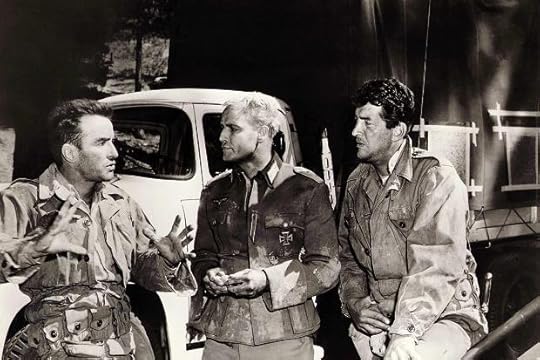
I remember, many years ago, I saw the movie version and I believe the casting was spot on with Marlon Brando as Christian, Dean Martin as Michael and Montgomery Clift as Noah. I am tempted to see it again, but in the meantime I have one more BIG American war novel to read to make my set complete : "The Caine Mutiny"