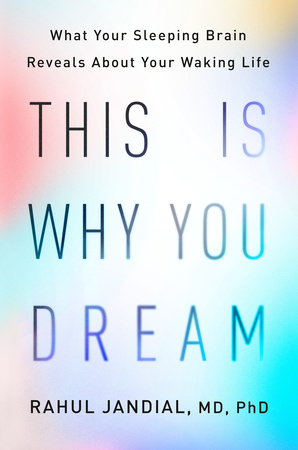
This Is Why You Dream opens the door to one of our oldest and most vital functions, and unlocks its potential to impact and radically improve our lives.
Dreaming is one of the most misunderstood functions of the human brain. Yet recent science reveals that our survival as a species has depended on it. This Is Why You Dream explores the landscape of our subconscious, showing why humans have retained the ability to dream and how we can now harness its powers in both our sleeping and waking lives.
Dreaming fortifies our ability to regulate emotions. It processes and stores memories, amplifies creativity, and promotes learning. Dreams can even forecast future mental and physical ailments.
Dreams can also be put to use. Tracing recent cutting-edge dream research and brain science, dual-trained neuroscientist and neurosurgeon Dr. Rahul Jandial shows how to use lucid dreaming to practice real-life skills, how to rewrite nightmares, what our dreams reveal about our deepest desires, and how to monitor dreams for signs of Parkinson's and Alzheimer's.
This Is Why You Dream ponders some open-ended questions on why we dream and what they mean. I found the parts about lucid dreaming and nightmares the most interesting - however, if (like me) you are already interested in dream science, or you perhaps also keep a dream journal, none of this will really feel like brand-new information to you.
Unleash the creative power of dreaming and make your dreams work to your advantage. Dare to discover their nature and purpose to turn your sleep into a fascinating adventure.
Read on the Headway app, which condenses non-fiction books by their key-points to maximise quicker and more helpful learning. ✨🧠🖤
Confession: I’ve been obsessed with dream science for a decade. In fact, I started keeping a detailed dream journal seven years ago and have since logged several thousand sequences. “This is Why You Dream” is among the half-dozen books I’ve read on the subject. It's among the most enlightening.
Jandial, a neuroscientist and brain surgeon, aptly writes the following: “You may have thought that someone who has spent a career immersed in the brain would reject dream interpretation as nothing more than pop psychology.” He goes on to explain why he has made such effort to explore the notion that our dreaming and waking selves are not separate. He maintains that dreams provide a unique portal to self-reflection and understanding.
True, Jandial does tend to go on tangents in some sections. Nevertheless, these tangents were so intriguing that I didn't mind meandering down those divergent paths. What’s more, given the healthy dose of neuroscience in this book, it’s a remarkably “accessible” book to non-experts.
Some criticism focuses on the fact that the book doesn’t always provide concrete, black-and-white answers or conclusions. To me, that’s what makes dream science so fascinating. Even the most renowned researchers are still in the exploration stages of truly understanding the science and psychology.
Consider this the end of my review. I now include about a dozen thought-provoking nuggets from the book for those readers who are true dream science diehards:
— The link between the dreaming mind and our physical health is far more intertwined then we could have imagined. The author cites evidence that dreams can predict the pending decay of the brain and nerves years before any diagnostic tests. Example, aggressive dream enactment/combative dreamers are common threads that run through people who are later diagnosed with Parkinson’s (Apparently, no one knows exactly why there seems to be this connection between our dreaming mind and health.) — There has been a remarkable consistency of dream topics across cultures and centuries. — “Dreams are a different way of thinking. It is their very wildness that gives them the potential to be transformative.” The creative process is much like the dreaming process in that we explore new ideas and look at things from different perspectives. — “Out of the box" creative thinking is facilitated in dreams because the brain biologically adjusts adrenaline and other physiological factors to allow us to think more creatively and less reactively than we would in a real-life pressure cooker setting. Creativity dreaming allows us to take actions we might not otherwise take. Experts call it divergent thinking. Dreaming can free us from a preconceived idea. We can harness our nocturnal narratives for positive creative purposes. Who knew that dreams were the inspiration for two of Stephen King’s most famous novels: “Misery” and “The Shining”? — We actually learn to dream. Research indicates that very young children under five don’t dream or have very primitive dreams that are more like still photos. By seven or eight, children become more active participants in their dreams. — Some believe that dreams serve a real purpose of being a “threat rehearsal' that allows us to practice responses to real life challenges — almost like a virtual simulation. One example: students who were on the verge of taking entrance exams were asked about dreams. Of those who recalled dreams, many recalled nightmares where they missed the test, failed it or had their eyeglasses broken just as they were about to take it. Interestingly, students who dreamed about the test did 20% better than those who could not recollect dreaming about the test. The hypothesis is that those dreams gave students a “cognitive benefit.” — Dreams assist with emotional regulation that benefit us in our waking lives. — Other theories are the dreams serve as a “nocturnal therapist," example: people going through divorces would dream negative thoughts about their spouse, and this would help to diffuse the situation in the coming days. — “Overfitted brain hypothesis:” Dreams exist to help generalize what we have learned in our waking lives. – Some experts believe we have a separate memory system for dreams. Even when we cannot recall them, they live somewhere else in our brain. — Changes in the patterns of our nightmares should raise an alert that something deeper might be wrong involving our mental health. — The book ends by raising a chilling question: Will scientific and technological advances make it possible to accurately determine what people are dreaming and perhaps even make a detailed video of these dreams? Now for many folks, this prospect would be a true nightmare.
Fascinating, informative book about dreams, written by a neurosurgeon and neuroscientist.
A few things I’ve learned from the book:
1. During dreaming, the Default Network of the brain is active while the seat of your executive functions is dormant. However, frequent lucid dreaming is associated with increased (compared to non-lucid dreaming) functional connectivity between frontopolar cortex and temporoparietal association areas. The term Imagination Network is better than the Default Network. 2. Dreams are visual, often emotional. 3. Dream engineering is real. You could engineer your dreams to some degree. One way is to trigger certain dreams using smells. 4. Cutting edge dream research could give corporations tools to invade our dreams. For example, if you dream about a certain product, you are more likely to buy it when awake. 4. Nightmares in children are normal, not necessarily associated with bad parenting. Nightmares in PTSD patients are different from those in a normal person. Certain types of nightmares suddenly appearing in adults without recent trauma could be an early sign of dementia. 5. Dream interpretation is real, but not in the way Sigmund Freud described or those horoscopes-like interpretations in popular culture. Pay attention to emotions in your dreams.
Quote: Death itself may be one final dream that we do not go quietly into the night.
Джандиал пише още в началото: „Мога да кажа със сигурност, че сънищата възникват от нашия мозък и по-точно от електрическата активност на мозъка ни“, и допълва: „сънуващият мозък е също толкова активен, колкото и будният“. Интересно е твърдението му, че „много от разпространените днес сънища не са по-различни от сънуваните в Египет по времето на фараоните или в Рим по времето на Цезар“, като и другаде съм срещал интересния факт, че крайно рядко до никога сънуваме модерни джаджи като телефоните си например, нищо че прекарваме прилична част от будното си време вторачени в тях. Друго важно е кога точно в детството се появяват сънищата и как се развиват, както и какви са еволюционните ползи от тях.
The book initially captivated with its insightful exploration of evolution, nightmares, and the erotic dimensions of sleep science. These sections were intellectually stimulating, offering somewhat profound insights into their respective domains. However, the book's trajectory faltered as it progressed beyond these thematic explorations. The author's focus wavered, veering into tangential musings on various sleep theories. While occasionally entertaining, these diversions often felt like aimless meandering, detracting from the book's initial promise and coherence.
This was quite fascinating and truly informative. I was a bit wary about getting this, but I love learning new things. Since it's written by a brain surgeon, I was like "okay I'm curious." It did not disappoint! I'm truly astonished, totally worth the new information and tid bits. It's truly astonishing!
I enjoyed my time with this which is always a plus, it's written in an easy to comprehend style with clearly laid out explanations. I thoroughly enjoyed the physiology part because that's the thing that drew me in in the first place. In the end I am underwhelmed because the question at the heart of this, also the title of the book, was not answered to my satisfaction. In the beginning strides were made to try and answer it but we sadly veered off the path. I found the chapter on nightmares to be the most intriguing and would recommend anyone who comes across this book to peruse it. A pro for it is that it gave me somethings to look into further and research on my own time. To that point I am looking for books that cover this topic further and would appreciate recommendations.
An interesting examination of the sleeping brain and the power of dreams on our waking lives. Rahul Jandial uses his extensive experience as a brain surgeon and neuroscientist to delve into a relatively unexplored part of all our lives. Dreams have long been interpreted and there are many theories as to why we dream, Jandial explores some of these theories, referencing the research which has been carried out in this field. This is grounded in science but written in a clear and accessible way. The referencing is thorough throughout and useful for further reading. The chapters exploring lucid dreaming were especially interesting, something which has been recorded historically and practised, but only fairly recently explored by cognitive scientists. This is not a sleep dictionary which will interpret your dreams, but a far more insightful study into why we dream and what we can learn from our sleeping brain.
Thank you to NetGalley and Random House UK, Cornerstone publishers for an advanced readers copy of this book.
Alleen de titel al maakt me super nieuwsgierig naar de inhoud van het boek. Ik ben altijd gefascineerd door neurowetenschappelijke verhalen die van invloed zijn op onze ontwikkeling en gezondheid. Persoonlijk weet ik weinig over dromen, dus ik hoop met dit boek veel kennis en nieuwe inzichten op te doen.
Dr. Rahul Jandial legt je in dit boek alles uit hoe en waarom je droomt. We zijn al eeuwen gefascineerd door onze dromen. Ze zijn realistisch, maar ook vaak niet te verklaren. Als je je dromen kan analyseren, kan je misschien wel ontdekken wat je onderbewustzijn je wilt vertellen. Aan de hand van verschillende wetenschappelijke onderzoeken en ervaringen uit de praktijk onthult dr. Rahul Jandial, alle geheimen over dromen. Wat betekenen ze? Wat zeggen ze over je gezondheid? Kan je je dromen beïnvloeden? Leg je verlangens bloot en leer jezelf nieuwe vaardigheden aan tijdens een lucide droom. Wist je dat je je dromen vroegtijdige symptomen van ziektes als parkinson of alzheimer kan ontdekken?
Wat een super leerzaam, inspirerend en goed boek. Dr. Rahul Jandial heeft een vlotte, heldere en toegankelijke schrijfstijl. Hij weet de ingewikkelde materie over de werking van de hersenen, het aansturen van bepaalde hersengebieden en stadiums van slaap zo te beschrijven dat het voor iedereen te volgen is.
Daarbij kent het verhaal een heldere en goede opbouw, waarmee dr. Rahul Jandial begint met de dromen die een rol spelen in onze evolutie. Wist je bijvoorbeeld dat kinderen op een andere wijze dingen dromen en over andere onderwerpen dromen dan volwassenen? Dit heeft alles te maken met de ontwikkeling van de hersenen en dit heeft belangrijke functies.
Vervolgens speelt dr. Rahul Jandial in op verschillende dingen die we dromen, zoals dat nachtmerries een belangrijke functie hebben op ons leven en onze gezondheid, maar hij weet ook interessante dingen te vertellen rondom erotische dromen en dromen en onze creativiteit.
Daarna volgt voor mij persoonlijk het meest interessante deel van het boek. Dromen en onze gezondheid. Want wist je door onze slaapcyclus te analyseren en onze dromen te analyseren dat ziekten vroegtijdig kunnen worden opgespoord? Dit is enorm fascinerend. Dr. Rahul Jandial weet dit boeiend en erg goed te vertellen. Ook leert hij je alles over lucide dromen, dat zijn dromen die je zelf kan opwekken en beïnvloeden.
Waarom je droomt is een mega interessant, leerzaam en boeiend verhaal van dr. Rahul Jandial over de werking van onze hersenen tijdens onze slaap. Hij vertelt je alles over het hoe en waarom van onze dromen, dit alles op heel heldere en toegankelijke wijze. Ik heb met dit boek erg veel kennis en inzichten opgedaan en het heeft me zonder twijfel anders laten kijken naar dromen.
I picked this book because I have an undergraduate background in neuroscience and a fascination with all things neuro so I thought it'd be interesting. It's well referenced and engaging. I particularly liked reading about the consistency of dream themes across different human cultures. Some of the interpretations don't quite work for me, seeming a little convoluted. But overall it is a good book for providing a scientific basis for why we dream. I expect I will return again to reread some of the chapters again.
I received a copy of this book via NetGalley. All opinions in this review are my own alone.
- The mind consists of a Executive Network (logic) and an Imagination Network (creativity) - dreaming acts as a "nocturnal therapist", as the brain deals with issues thought about during waking hours - even nightmares can help to heal from traumatic events (heal PTSD) - but only if accompanied with processing what is happening in the brain, e. g. in therapy - cheating during erotic dreams is merely acting out all possibilities and doesn't induce a tendency to cheat in the waking life - CREATIVITY: think about an issue before going to bed (or before taking a nap) --> Imagination Network will pick up this thought and can find extraordinary solutions --> write down the dream and put the solutions into practice in the waking life - taking a nap will increase creativity and consolidate learned material - certain dream patterns can predict future illnesses (e. g. sudden appearance of nightmares can lead to Parkinson's ~10 years afterwards) (e. g. dreaming of speaking animals is connected with multiple identity disorder) - while dreaming, all muscles are in paralysis, but the eyes and the lungs can be moved (REM and breathing) - LUCID DREAMS: in some studies, a communication between researchers (waking world) and lucid dreamers (dreaming world) could be achieved, i. e. asking math questions and responding by a number of L-R-L-R eye movements according to the right answer. This just happened during the past years and the future research offers a lot of possibilities, what can be accomplished with lucid dreams - there are a lot of techniques to induce lucid dreams, while a combination of all leads to highest success rates - right now, researchers achieved measuring what people were seeing in movies, reading in books or hearing from audio. Algorithms can determine, whether the mind processes a car, a tree, or a person. - FUTURE: it might be possible to build a video of one's dream in real time with said algorithms - another possibility is to reverse engineer this principle, leading to the possibility to select the dream you have tonight like in a Netflix library - learning can be increased by smelling the same scents while asleep as you smelled during learning that day - the manipulation of dreams through senses like smelling can also be used negatively: to burn a product into our subconscious, which is already done by some companies and will be exploited more in the future - some, maybe all, people dream one last time while dying.
This entire review has been hidden because of spoilers.
Na dit boek kijk je nooit meer hetzelfde naar je dromen.
Dr Rahul is een neurowetenschapper en verteld in het boek over zijn kijk op dromen, soms zijn het slechts hypothesen, andere keren is het wetenschappelijk onderbouwd. Een pluspunt is dan ook dat achterin het boek alle voetnoten en verwijzingen naar de desbetreffende onderzoeken zijn opgenomen.
Het boek behandeld verschillende aspecten van het dromen. Je leert over het nut van nachtmerries. Hoe je stappen kan zetten naar lucide dromen (bewust dromen). Hoe dromen een signaal kunnen zijn dat je ziek bent of gaat worden en nog veel meer.
Ik heb dit boek heel bewust willen lezen, iets wat voor mij op het moment met mijn long covid en concentratieproblemen niet heel makkelijk was. Maar het is gelukt!
En wat een ontzettend goed geschreven en interessant boek. Er worden wel regelmatig onderwerpen die al besproken zijn even opnieuw aangehaald, wat voor mij nu prettig was om even mijn geheugen op te frissen.
Rahul heeft het boek zo geschreven dat het goed weg leest en niet droog is. Hij zorgt ervoor dat vaktermen goed uitgelegd worden. En heeft een hele interessante kijk en hypothesen over onze dromen.
Wie had verwacht dat dromen ons juist zo erg helpen in de normale wereld? Dat het sociale experimenten zijn die we 's nachts uitvoeren, zodat we ze niet in de echte wereld hoeven te testen? Dat nachtmerries kinderen helpen uit te zoeken wie ze zijn? Dat veranderingen in dromen een signaal voor ziekte kan zijn?
Dit boek is ontzettend interessant als je een kijkje in je hersenen wilt krijgen, meer wilt leren over onze droomwereld, meer wilt weten over wat dromen voor effect op je kunnen hebben of hoe om te gaan met terugkerende nachtmerries en meer. Een dikke tip van mij!
Bedankt @lsuitgeverij voor dit recensie exemplaar.
This is a fabulous book, written by a neurosurgeon yet holistically approaching dreams and what we do and do not know about them. I listened to this book and loved the authors voice, I could listen to this book over and over! My take home message for myself was to no longer be afraid of dreams or all the lucid dreams that I have, and to maybe even start to try and remember them and write them down. I would definitely like to find time to start analysing my own dreams (as he said, we are the ones who know best what a dream may or may not mean to us). Talking about dreams with my husband (as he recommends) would be a great thing to look forward to. Highly recommended book.
This was very interesting. I must admit, I already knew a lot of things but I can't fault the author for that and some chapters were really insightful. I especially liked the ones on nightmares and lucid dreaming. The ones on creative dreaming and erotic dreams were incredibly repetitive and boring though. Overall I would recommend it, if you like non-fiction. I might be a little biased with my preference for fantasy books haha
Nothing wrong with the book, I think it’s written well and has some interesting parts, on the whole I didn’t find that there was a lot to take away from it and didn’t find it particularly insightful
In "This Is Why You Dream: What Your Sleeping Brain Reveals About Your Waking Life", neuroscientist Rahul Jandial delves into the fascinating world of dreams, offering a comprehensive exploration of how these nocturnal experiences shape our emotions, creativity, and cognitive functions. Throughout history, dreams have been interpreted in myriad ways, from divine messages to creative inspirations. However, Jandial moves beyond traditional interpretations, grounding his analysis in modern neuroscience to reveal the profound impact dreams have on our waking lives. By unraveling the mysteries of the dreaming brain, he provides valuable insights into why we dream and how these nightly narratives can influence everything from our emotional well-being to our creative potential.
Dreams have long been a source of fascination and wonder, captivating the imagination of people across cultures and epochs. Throughout history, they have been interpreted as divine messages, omens of the future, and even creative inspirations. In ancient civilizations like Egypt, dreams were seen as communications from the gods, with interpreters playing crucial roles in deciphering their meanings. The Greeks and Romans similarly viewed dreams as prophetic, and Native American traditions considered them as soul journeys that offered guidance and healing. Even in the realm of science, dreams have been credited with inspiring significant discoveries, such as the structure of the periodic table, which Dmitri Mendeleev reportedly visualized in a dream.
While dreams have historically been shrouded in mysticism, modern neuroscience is beginning to uncover the scientific underpinnings of these nocturnal experiences. Recent research suggests that dreams are not merely random occurrences but play essential roles in memory consolidation, emotional regulation, and problem-solving. They might even act as a form of therapy, helping us process and integrate the myriad experiences of our waking lives.
At the heart of our dreams lies the brain's electrical activity, which, during sleep, is distributed differently across various regions, leading to unique experiences. A significant discovery in the neuroscience of dreaming is the heightened activity in the limbic system during dreams. The limbic system, responsible for emotions, behavior, and long-term memory, becomes notably more active while we dream, which explains why our dreams are often charged with intense emotions. Contrary to earlier beliefs that dreaming occurs only during REM (Rapid Eye Movement) sleep, it is now understood that dreams can happen in any stage of sleep. This revelation has profound implications, suggesting that we spend a considerable portion of our lives dreaming, not just sleeping.
Dreams are a form of cognition independent of external stimuli. Unlike waking consciousness, where our thoughts are influenced by our surroundings, dreams are entirely self-generated by the brain. This showcases the incredible power of our imagination, as our brains create entire worlds and narratives without any input from the external environment. The brain's central executive network, which governs goal-directed behavior and cognitive control, needs to disengage for dreaming to occur. In its place, the default mode network (DMN) takes over. This network, which might be better described as the "imagination network," becomes active when we are not focused on the external world. It seeks out loose associations, makes random connections, and weaves narratives out of seemingly unrelated elements, creating the rich and often surreal landscapes of our dreams.
Interestingly, despite the boundless possibilities of our imagination, dreams often follow recognizable patterns across different cultures. Common themes such as falling, being chased, or facing social anxieties are prevalent in dreams worldwide. These patterns suggest that dreams may serve as social experiments, powered by the medial prefrontal cortex (mPFC), a brain region crucial for social cognition, self-reflection, and decision-making in social contexts. Various theories have been proposed to explain why we dream. Some suggest that dreams evolved as a form of "threat rehearsal," allowing us to practice responding to potential dangers. Others propose that dreams serve a therapeutic function, helping us process and metabolize the emotions of our daily lives. The overfitted brain hypothesis, introduced by neuroscientist Erik Hoel, posits that dreams introduce noise into our cognitive systems, preventing our brains from becoming too specialized or "overfitted" to our daily experiences. This noise helps maintain our ability to generalize and adapt to new situations.
Nightmares, those vivid and terrifying dreams that often jolt us awake, are a universal human experience. While they are generally seen as unwelcome intrusions into our sleep, nightmares may serve important cognitive and emotional functions. It is essential to distinguish between nightmares and bad dreams. While bad dreams may evoke unpleasant emotions or depict negative scenarios, nightmares are characterized by their intensity and their ability to wake the dreamer. Nightmares often follow common patterns, such as experiences of failure, helplessness, or imminent danger. These recurring themes suggest that nightmares may have played a role in our evolutionary history, helping to prepare us for potential threats.
Interestingly, children are significantly more likely than adults to experience nightmares, which aligns with their rapid cognitive development. Some researchers hypothesize that nightmares help children learn to distinguish between waking and dreaming states, contributing to the formation of their sense of self. The lasting impact of nightmares on the brain was vividly demonstrated in the 1950s by neurobiologist Wilder Penfield, whose experiments revealed that nightmares leave a lasting imprint on our brains. While the exact purpose of nightmares remains unclear, the brain's significant energy expenditure during these intense dreams suggests they serve an essential function.
The connection between creativity and dreaming has intrigued both scientists and artists for centuries. Dreams provide a unique window into the mind's creative potential, offering a space for free, associative thinking that fuels creativity. Our brains operate in two primary modes: the executive network, which keeps us focused on tasks, and the imaginative network, which takes over when our minds are allowed to wander. This mind-wandering state is conducive to eureka moments, where unexpected connections lead to novel ideas. Research has shown that dreams can be a powerful source of creative inspiration. For instance, a study conducted by sleep researcher William Dement demonstrated that students who went to sleep with unsolved brainteasers in mind sometimes found solutions in their dreams.
One of the most famous examples of dream-inspired creativity is the discovery of benzene's structure by chemist August Kekulé, who envisioned a snake made of atoms biting its own tail in a dream. This insight led him to realize that benzene's structure was a closed ring. This example highlights how dreams can lead to problem-solving by bypassing the logical constraints of waking thought and allowing for more imaginative solutions.
For those looking to harness the creative potential of their dreams, the sleep onset phase—the transition between wakefulness and sleep—offers fertile ground for creativity. Studies have shown that during this phase, the brain makes more wide-ranging connections between disparate concepts, leading to increased creativity upon waking. This opens exciting possibilities for using dreams intentionally to enhance creativity in our waking lives.
Lucid dreaming, the experience of being aware that one is dreaming, offers a unique opportunity to consciously explore and harness the power of dreams. Lucid dreaming has been used in therapeutic contexts to alleviate recurrent nightmares and symptoms of PTSD, among other conditions. Techniques for inducing lucid dreams include wake-initiated lucid dreaming (WILD), mnemonic induction of lucid dreams (MILD), and keeping a dream journal. With practice, individuals can learn to recognize when they are dreaming and take control of their dream experiences.
In conclusion, "This Is Why You Dream: What Your Sleeping Brain Reveals About Your Waking Life" by Rahul Jandial offers a compelling journey into the science of dreams, shedding light on their complex neurological origins and their profound impact on our lives. From the therapeutic potential of lucid dreaming to the evolutionary significance of nightmares, Jandial provides a nuanced understanding of how dreams contribute to our emotional processing, creativity, and problem-solving abilities. As our knowledge of the dreaming brain continues to expand, this book serves as a valuable guide, helping readers appreciate the transformative power of dreams and their essential role in our cognitive and emotional lives.
Prw deset godina govorila sam svojim studentima da će nas čipovati i da će nam za odredjeni iznos novca biti omogućeno znanje bez muke da učimo. Mislili su da nisam pri zdravom razumu... Sada se ide ka tome da nam utiču i na snove, a autor se s pravom da se pita da li ćemo plaćati da i u snu ne slušamo reklame. Iako se puno ne pominju konkretni uredjaji sva je prilika da ćemo taj film gledati vrlo brzo i da ćemo tražiti prostore bez gedžeta, wi-fi i drugih signala. Kada još malo razmislite eto futurističkih soba sa Faradejevim kavezom oko njih, plaćaćemo za mir koji smo imali pre mnogo decenija.
Interesting book. I have recurring nightmares and disturbing dreams and have had them in varying degrees of frequency most of my life. I learned in one day how to redirect the Course of a disturbing dream. It worked. For this alone, I recommend this book.
I've just finished this very good book. I was very interested in it because after a dreadful accident 5 years ago, I now have the very best dreams and the best thing is that I always remember what I was dreaming about. This book doesn't really talk much about people not being able to remember what they were dreaming about. What I didn't like about this book is that I had to use my Kindle dictionary ALL the time, usually (but not always) medical terms/words. like "electrooculogram" "opalescent" "limbic" "occipital" "salience" and very difficult words like "longitudinal" "confluence" "chimera" "contextualizing" I could only give this book 3 stars because some of this book was too confusing.
I enjoyed learning about the difference between dreamscapes and lucid dreaming.
Very interesting that people sometimes have nightmares all their lives, some only as kids, some a bit of both.
I'd recommend this book if you have any interest in dreams/dreaming
This was extremely interesting, but I feel like I need to reread it to really absorb some of this information. I’ve always been super interested in Dreams so this just scratched an itch for me, but I was hoping for a little more out of it. This was another book that got returned before I was done and I had to wait until it came back to me.
Super informative and interesting, I've always had an interest in dreams so it was an immediate purchase. Fairly heavy with a lot of technical language so not easily accessible.
(Note: I received an advanced reader copy of this book courtesy of NetGalley)
Why we dream has always been a topic that has interested me and I have occasionally read books about it. This book covers a lot of ground. A lot of it is culled from other research and there doesn't seem to be a huge amount that the author has seen himself during his career (unsurprisingly as nearly everyone works in very narrow areas).
The author emphasises the role of the Executive Network and the Imagination Network in our dreams. He believes our dreams partly train us for the future by rehearsing scenarios and that we can learn about ourselves by studying our dreams. I'd always thought dreams were more for information processing and organising our memories, which was my recollection from other books. So it was good to read this side of the debate on why we dream (so much is still unknown).
The book looks at nightmares but the most interesting areas are lucid dreams and the hints of what might be possible in the future such as better dream interpretation and even dream engineering.
I would have liked a few more interesting case studies. It was quite a short book and covers a lot of ground skimming over related research and dipping into history (e.g. Graham Greene) for examples.
This book offers some advice on how to lucid dream, recording your dreams, and what you can learn from your dreams. I think I would have preferred a more practical step-by-step book just about lucid dreaming or dream interpretation. This is a very broad overview of the whole area of our dreams with snippets of advice here and there.
There is a huge bibliography but it's not divided into chapters or subject areas so it's hard to know where to go for more information about the bits I was interested in.
C'était sincèrement hyper intéressant ! J'ai un peu un besoin en ce moment de comprendre les rêves et surtout les cauchemars, et c'était vraiment pertinent de lire un livre à ce propos qui se base surtout sur les neurosciences et les dernières recherches, les analyses poussées ne sortent pas de nulle part et ont été étudiées, donc forcément ça donne une dimension beaucoup plus pausible à ce qui est expliqué.
J'ai beaucoup aimé les chapitres sur les liens entre rêves et créativité, sur les cauchemars, et sur l'étude des rêves pour expliquer sa santé. Mais j'avoue certains autres passages ont été un peu trop longs. J'ai notamment eu envie de ff lors de la lecture sur la partie sur les rêves lucides, l'auteur y accorde beaucoup d'importance alors qu'une partie infime de la population en fait régulièrement. Donc je trouve dommage d'y avoir consacré autant de temps.
Aussi, malgré un effort immense de vulgarisation, on se perd parfois dans les explications scientifiques, mais ça reste assez accessible malgré tout.
I first learned about this book from a Youtube interview with the author. He impressed me as someone who had a very healthy, scientific, and open-minded theory of why we dream. I wanted to know more, so I got his book through our library.
The book is easy to read but goes into depth about the author's theories. He readily admits that there is so much we do not know about how and why we dream. Yet there have been multitudes of studies that have given enough data that at least some things can be understood about this amazing thing that everyone experiences.
I dream every night and I always remember at least some of my dreams. I found that this book gave me insights into my own personal dream life that I had never considered before. It's a fascinating subject and this book treats it as such.
I love reading about sleep and dreaming so was excited about this book, but very early on it stated that children below a certain age don't and can't dream, which my own experience refutes - I remember some early dreams of mine that I can only have had before the threshold stated as the beginning of the ability to dream because of where I lived at the time. I was also disappointed to find uncritical reference to impaired Theory of Mind in autistic people; I am autistic and I would not consider myself impaired in ToM, and know many others who would say the same. From a personal standpoint I just feel distrustful now of whatever else the author has to say. I don't want to give just one star though as that seems harsh lol
I loved this book and it was the perfect read right before bed. I learnt so much about the brain and also myself individually as a dreamer. Some things mentioned as rare were my regular experience which was interesting to know. I liked the structure of the book, how each chapter delved into a different aspect of dreaming. I loved the tales of experiments and trials. The only reason it didn’t quite warrant 5 stars was because sometimes it went a bit too far into scientific explanation and I got a bit lost. But otherwise I think he is a very knowledgable brain surgeon who managed to mix the science with the psychological mystery of the dream world.