«Le donne mi hanno ordito una congiura e, riunite nel tempio delle dee, decideranno per la mia rovina.» Nella Festa delle donne, ambientata ad Atene nel V secolo a.C., le eroine di Aristofane fanno sentire la propria voce riunendosi in assemblea e osando istruire un processo contro un uomo, e non un uomo qualsiasi: Euripide, il più grande poeta del tempo, colpevole di averle “umiliate e offese” nelle sue tragedie. In un susseguirsi di travestimenti, parodie, caricature e altre geniali trovate, questa brillantissima commedia deve però soprattutto alla personalità delle sue protagoniste l’originalità e la forza che ne hanno fatto un classico senza tempo.
Aristophanes (Greek: Αριστοφάνης; c. 446 – c. 386 BC) was an Ancient Greek comic playwright from Athens and a poet of Old Attic Comedy. He wrote in total forty plays, of which eleven survive virtually complete today. These provide the most valuable examples of a genre of comic drama known as Old Comedy and are used to define it, along with fragments from dozens of lost plays by Aristophanes and his contemporaries. Also known as "The Father of Comedy" and "the Prince of Ancient Comedy", Aristophanes has been said to recreate the life of ancient Athens more convincingly than any other author. His powers of ridicule were feared and acknowledged by influential contemporaries; Plato singled out Aristophanes' play The Clouds as slander that contributed to the trial and subsequent condemning to death of Socrates, although other satirical playwrights had also caricatured the philosopher. Aristophanes' second play, The Babylonians (now lost), was denounced by Cleon as a slander against the Athenian polis. It is possible that the case was argued in court, but details of the trial are not recorded and Aristophanes caricatured Cleon mercilessly in his subsequent plays, especially The Knights, the first of many plays that he directed himself. "In my opinion," he says through that play's Chorus, "the author-director of comedies has the hardest job of all."
Thesmophoriazusae is a comedy that satirizes Athenian society, gender roles, and the works of the tragedian Euripides. During the Thesmophoria festival, the women of Athens plot revenge against Euripides, angered by his unflattering portrayals of them in his tragedies. Euripides' relative, Mnesilochus, attempts to spy on the women in disguise. When his cover is revealed, events spiral into comical chaos. Ultimately, the play is very funny, and I thoroughly enjoyed reading it. I can only imagine seeing it performed live in Aristophanes' time.
The play is very vulgar and filled with earthy humor. It was intended for a wider audience, so I wonder when we have become prudish as a society. Aristophanes ridicules everything from gender dynamics to homosexuality, and he feels like a true curmudgeon.
On a side note, the play casually mentions the Diolkos, an ancient paved trackway near Corinth. The Diolkos spanned approximately 6 to 8.5 kilometers across a narrow strip of land--the Isthmus of Corinth, connecting the Gulf of Corinth to the Saronic Gulf. This allowed boats to avoid the long and dangerous circumnavigation of the Peloponnese peninsula by transporting them overland. It's a fascinating historical detail I discovered within the play.
Perante a ameaça de vingança por parte das Tesmoforiantes, que crêem a mulher como representada na obra de Eurípides uma ofensa, o tragediógrafo em questão procura levar alguém a defender a sua causa junto das mulheres. A piada aqui reside em diversos graus de interpretação: histórico, textual e crítico. A saber, primeiro: as Tesmofórias (que Eurípides planeia invadir) são as festas ou o festival das sementeiras — dedicado a Ceres — e reservado exclusivamente às mulheres; segundo: os colaboradores de Eurípides são personagens sui generis e obscenas, dotadas de um calão baixíssimo cuja missão é a de interferir num ritual feminino sagrado; acresce a isto que o texto está pejado de referências euripidianas a todo o tempo deturpadas pela fala destas personagens; terceiro: Eurípides é tido como um dos expoentes da tragédia grega e da representação das aspirações e motivações femininas, o que eleva esta crítica (dado o muito pouco conhecimento que temos do que a rodeia) a um nível difícil de apreciar.
Já eu não sou particularmente versada na obra de Eurípides para ler este texto ao nível de pormenor que exige. Mas, tal como em Ésquilo (que aprecio e sempre consegui estudar em maior profundidade), reconheço neste último uma vertente muito atraente (embora não fosse e não seja por muitos assim encarada), que serve de base ao texto das Tesmofórias, e que lhe permitia elaborar obras com recurso a personagens femininas que quebram estereótipos — mulheres que infringem regras e contestam o poder masculino como Medeia, Efigénia ou Helena. Pois, Aristófanes pega precisamente nesta faceta de Eurípedes para explorar os arquétipos antigos e censurar a imagem feminina quasi emancipada que o autor advoga (não o faria conscientemente já que nunca esperaria, por um lado, que as mulheres alguma vez o lessem, e por outro, que jamais tivessem liberdade para o criticar*), e isso não me pode agradar muito:
(...)hoje em dia, Penélope não se pode apontar uma única entre as mulheres, mas Fedras são todas elas sem excepção.**
Daqui resulta uma sátira de mau gosto (acho que sátira falogocentrista seria o termo) — mesmo tendo em conta que é composta por e para homens, e interpretada exclusivamente por eles. Mas esta composição não é única no seu género, nem tão pouco a única a que deitei mãos, e, como tal, isso não é motivo suficiente para despachar esta obra. É, aliás, típico de Aristófanes, e da comédia grega, recorrer à troça (ou ironia, se preferirem) sobre as mulheres, mas normalmente o empreendimento sai mais eficaz — sim, também eu tenho cá a minha capacidade de encaixe. Lisístrata, talvez porque se compõe de uma vertente política mais evidente na qual o autor era exímio, é um bom exemplo disso mesmo. Mas em As mulheres que celebram as Tesmofórias falta algum espírito chistoso que se substitui pelo humor másculo/machista que retrata as mulheres (sejam elas figuras femininas ou efeminadas) como megeras bêbedas, debochadas e, a todos os níveis, absolutamente incapazes de governo. Pessoalmente, a todos estes séculos de distância, isto não me chega.
No que concerne a literatura clássica não sofro de grandes pruridos (nem seria correto tê-los quando a maioria das obras clássicas se presta a várias leituras), mas, neste caso, à parte a materialidade do texto — que certamente permitia uma dose de humor físico —, os mecanismos cénicos que o acompanham e o testemunho de rituais e simbolismos associados às mulheres na época de criação e encenação desta peça (muitas vezes é esta a única forma de recuperar este tipo de evidências), não lhe encontro mais pontos positivos.
Ora bem: se somos uma peste, porque é que vocês se casam connosco, se de facto somos mesmo uma peste? Porque é que nos proíbem de sair, de pôr o nariz de fora e em vez disso se empenham em guardar a peste com tanto cuidado? Mal a pobre mulher sai, e vocês descobrem que ela está fora de portas, ficam completamente doidos; quando deviam mas era dar graças e esfregar as mãos de contentes por saberem que realmente a peste se tinha ido embora e já não a encontrarem lá dentro. Se passamos a noite em casa de alguém, cansadas de uma festa, não há quem não venha rondar os leitos, à procura dessa peste. Se nos debruçamos à janela, lá andam vocês a tentar ver a peste; e se, por vergonha, nos metemos para dentro, ainda mais desejosos ficam todos de verem a peste debruçar-se outra vez. Em resumo: é evidente que nós somos muito melhores do que vocês.
*Da mesma forma, tantos outros dramaturgos pela história fora criaram grandes heroínas que defenderam aguerridamente sem acreditar alguma vez que uma mulher de carne e osso se lhes comprasse, sem jamais interceder pelas mulheres como o fizeram pelas figuras míticas que criavam. **Por oposição à dedicação e dignidade de Penélope, Fedra (enquanto mulher adúltera e transgressora do código social) é tida como protótipo de mulher debochada e sem lei.
Eurípides tem conhecimento que durante uma celebração em honra das Deusas Tesmóforias (Deméter e Perséfone) irá haver uma conspiração das mulheres contra ele — porque nas suas tragédias diz mal delas. Como esse festival é interdito a homens, convence um parente a disfarçar-se de mulher para dar uma palavra a seu favor. O Parente aceita e inicia-se a paródia...
Uma peça que se lê bem e diverte. O mesmo não digo da Introdução.
I actually quite like Aristophanes, not because he is a brilliant playwright, though since eleven of his works have survived 2500 years I really do not think that I am in a position to comment on his ability. Obviously there is a reason, and probably a good reason, not only why his plays have managed to survive, but that his plays managed to survive a somewhat puritan Dark Ages where pretty much anything that wasn't Christian was discarded. Okay, that is probably a bit too general since the Catholic Church didn't really begin banning books until after the Catholic Reformation (and despite my respect for my former Church History Lecturer, I still somewhat disagree with his assessment of the Catholic Reformation).
Aristophanes' comedies stand out in two ways: first of all they give as an insight into the common people of Athens of the 4th century, and also gives us an understanding, and some very good examples, of the vernacular language. It is the difference between reading a book written in proper English and a book that relies heavily upon a region's slang (such as Australia: for instance, the word sook and prima-donna mean the same thing, but in Australia we use the former, where as the latter is probably a more polite and correct usage). The second thing about Aristophanes' plays is that they are incredibly imaginative, and in some cases quite fantastic. Moreso, the plays are actually pretty funny and remains so despite the 2500 year gap and the language complications. Okay, a lot of the humour (such as the puns) are lost, however the Barrett translation of his works is still very good (and he even manages to use a rhyme scheme in places, noting that English is probably the only language, at least what I know of, that uses rhyme as a poetical form).
The Thesmophoriazusae is one of those interesting, and imaginative, plays that also gives us a bit of an insight into Classical Athens. Remember that the tragedies are written in a stylised language, and people do not, and have not, transacted like that. People in Elizabethan England did not talk to each other using blank verse and Shakespearian language. While the vernacular was no doubt a lot different to what it is now, they still used it. The only time such high form language would have been used would have been in diplomacy, and even then I can't imagine Queen Elizabeth and the King of France speaking to each other (or even writing to each other) in blank verse.
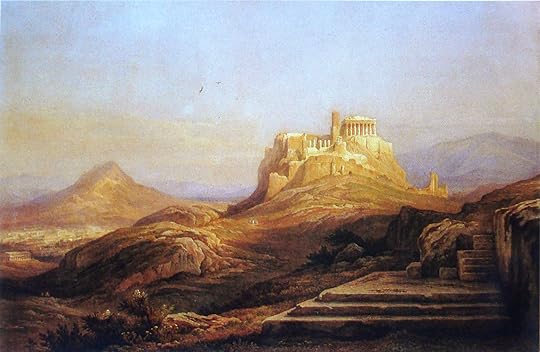
The play is set around a festival known as the Thesmophoria, which was a woman's only festival that lasted three days at a place known as the Pynx. Having read this play I have now learnt that the Pynx was the location of the assembly (I always thought it was the Areopagous, but that was the high court). Type Pynx into Google Images to get an idea of what it looked like, and I have also managed to locate it on the Google Maps image of Athens. It is located to the west of the Acropolis just to the southwest of the intersection of Dimitriou Aiginitou and Apostolou Pavlou. From what I can remember of Athens, there is a promenade that runs along the south side of the Acropolis, and then another path to the west heads uphill, past the Areopogaus, and then curves around to the north of the Acropolis (with a gate that leads to the Agora). Anyway, you do not take that path, but actually continue along the promenade to the west, and it will then curve to the north, but you should be able to find it (and if you don't ask somebody, they do tend to be quite helpful in Greece). Okay, that is enough of me showing off how well I know Athens after spending only a week there, so now onto the play.
The play is about Euripides and how he learns that the women of Athens are upset about his portrayal of them, so he decides to sneak into the Thesmophoria in an attempt to convince the women that he was not all that bad. However, his plan involved a young Athenian who had yet grown a beard (all Athenian men had beards, some quite long at that) to disguise himself as a woman and sneak into the festival. However, this young Athenian didn't want anything to do with it so he gets his brother-in-law, the foul mouthed Mnesilochus, to do it instead. Obviously getting Mnesilochus to act like a woman was never going to work, and sure enough he ends up getting found out and tied to a stake to be executed. However Euripides comes in and convinces them (through a fine sounding argument) to release him.
This play is clearly about women and their role in Athenian society. It is not incredibly deep, but it is clear that the women, despite their lower status in the society, did have some freedom, and also the right to religious celebration (as is clear with the Thesmophoria). These women though are compared to two women from antiquity, namely the model wife that is Penelope, and Euripides' presentation of Helen. Sections of the play actually recite Euripides' Helen, and while I will not go into details of that play here, I will simply mention that the purpose behind Helen was to redeem her in the eyes of the Athenians. Euripides borrowed from a legend that had the Helen of Troy as nothing more than a mischievous phantom, and that the real Helen had been kidnapped by the king of Egypt and that was were she spent the war. In Euripides' mind, Helen was innocent of the charges laid against her.
This is why I find the play rather strange because Euripides is being accused of being anti-women, but it is quite clear from his writings that he is not. Of the plays that I have read, particularly the ones involving women, they are the tragic figures. Consider Medea, Hecabe, Helen, and Iphangenia. They were all innocent of any crimes, yet suffered simply because they were women. In fact, with regards to Medea, it is Jason that is considered to be the antagonist by tossing Medea out of his bed for a younger, more influential, woman.
However, the charges that Euripides (and in a way Aristophanes) is that the women of then modern Athens, were nothing like those women in Euripides' plays. In fact they came nowhere close to them in virtue. Remember, at this time Athens was in the middle of a very long and drawn out war, which means that a lot of the young men were off fighting leaving only the women, the children, and the elderly at home in Athens. It is suggested here, and it is the bait that Euripides uses to free Mnesilochus from the Thesmophoria, namely that while the cat is away then the mice are at play. Of course, you don't want anybody telling the husbands what their women were up to when they returned, and in a way this is a reflection of the Orestia, despite that play being written prior to the Peloponesian War.
Aristophanes uses the plot of this play to make fun of his contemporary playwright, Euripides. The play begins with Euripides afraid for his life. He has received word that the women of Athens plan to have a meeting in order to decide how they can get vengeance for the way the female sex has been portrayed in his plays. They are angry at his plays' portrayal of women as mad, murderous and sexually depraved.
So Euripides arranges to to have a male friend disguised as a woman attend the meeting and offer a defense on his behalf. Subsequently, this disguised friend attends the meeting and speaks out boldly to the gathered women that they are as bad as the plays of Euripides says they are. In other words, Euripides is telling the truth.
Speaking out in this way was an absurdly stupid thing for a man disguised as a woman to do. Even 2400 years ago the women were smart enough to immediately be specious of this woman who is defending the male view of women. Subsequently the women forcibly remove enough clothes from this guy to reveal that he's not a woman. At this point this poor guy is in real trouble.
So Euripides has to go to the meeting and try to protect his spy friend from punishment. He promises the women not to insult them in his future plays. Consequently, after a lot of sexual innuendo and comic drama, Euripides arranges an escape for his friend.
Aristophanes was obviously a quick witted comic. Some of the jokes in the dialog are funny only in the context of Ancient Greece. However, the overall plot and action compares well with today's TV sitcoms.
LAS TESMOFORIANTES o LAS FIESTAS DE CERES Y PROSERPINA de Aristófanes
"MUJER PRIMERA: ¿Qué ultrajes hay que no nos prodigue?... Nos llama adúlteras, desenvueltas, borrachas, traidoras, charlatanas, inútiles para nada de provecho, peste de los hombres; con lo cual cuando nuestros maridos vuelven del teatro nos miran de reojo y registran la casa para ver si hay oculto algún amante."
Esta obra de Aristófanes trata de ridiculizar a Eurípides (uno de mis autores favoritos) pero con una base bien realista, la excesiva culpa o visión negativa que se les da a las "heroínas" en sus obras. Así la obra empieza con Eurípides recurriendo a su suegro Mnesíloco para que lo pueda salvar de las mujeres que reunidas en las fiestas Tesmoforias en honor a Démeter y su hija Perséfone traman hacer pagar a Eurípides muy caro el terrible atropello que se realiza contra las costumbres y el honor de las mujeres en sus obras de teatro. Es ocasión para Aristófanes de burlarse del estilo enrevesado en los parlamentos de las obras de Eurípides (se toman varias frases reales de sus obras), de otros poetas o dramaturgos, como Agatón o Clístenes, a los que se les representa vanidosos o amanerados y desde luego recurrir a obscenidades o temas sexuales para acarrear la risa del público. Y es que para poder estimar la obra en su real contexto es necesario pensar que somos atenienses de la época que muchas de esas costumbres y personajes (generales o políticos) son insultados o denostados. Desde luego también muy interesante es conocer frases u obras de autores perdidos o simplemente de obras perdidas que se mencionan también durante este libro. Esta pieza a mi parecer tiene bastantes partes medio aburridas que no fueron de mi agrado por eso mi puntuación.
Let me not hear it said that one could not laugh at antique pieces! Aristophanes, the father of the Comedy, proves to us that laughter is timeless and that the current generation can be sensitive to it while acquiring a culture of ancient Greece. Defender of the people, politician, he knows how to make fun of the important subjects of his time and make them accessible to all audiences. I had a good time reading Aristophanes' plays, and with a smile, please!
Funny, the argument is quite reminiscent of that scandal in Rome centuries later, when Clodius Pulcher got this mad idea to disguise himself as a woman to intrude into the females-only Bona Dea festival, that got him in hot water and his lover Pompeia Sulla sent back in disgrace and divorced by Caesar. Maybe he was inspired by this play, heh.
Only that whilst the Roman heretic's action had seduction in mind, Aristophanes' comedy has the motive of self-defence. Of sorts. Euripides, the heterodox playwright, is told the news that there's a women's assembly at the goddesses' festival, the Thesmophoria, where they'll discuss what punishment to impose on him for portraying women so badly in his plays, and decides to insert a spy to defend him and sway the women's opinion. But he gets no other candidate for the task than a man, who gets caught and sentenced to death for the blasphemy. The way Euripides schemes to save Mnesilochus is the funniest part together with the latter's "defence" of the tragedian, which does more harm than good in reality. Aristophanes really loves to mock his fellow writers as much as he loves poking fun at the fair sex, because apart from Euripides, he also takes aim at a famed poet of his time and parodies other tragedians's lines and choruses. This is one of his better comedies, in my opinion.
Read this after reading an article in The New York Review of Books which posited that Euripides wrote The Bacchae as a response to this play. The usual sequence is that the comic writer writes his comedy as a satire of an existing tragedy.
After reading this play again, I can definitely see where the author of the article is coming from.
I wish that I could find an edition of Aristophanes that would provide really good notes on what is being parodied and how. Anyone have any recommendations in that regard?
In this play, Aristophanes demonstrates how the very homoerotic society of Athens, Greece managed to tolerate and even encourage fornication between men, yet reviled homosexuality and resented femininity as a concept in both men and women. It’s insane to me that they hated women so much that they became gay.
The Kinsman is very representative of this. His desire for Agathon is described as being very natural because Agathon is feminine, but it is still clear that Agathon is a man. Therefore, the Kinsman resents that he is attracted to this man and berates him for being feminine by calling him slurs and threatening to rape him. This is internalized homophobia at its finest. He mocks Agathon for partaking in sex with men, even as he desires him. It’s incredibly hypocritical. It also shows the heteronormativity that exists even in the homosexual dynamics of Athenian Greece.
As for the gender bending, it is interesting Euripides claims to have once been like Agathon. In order to understand the female mind, he gave himself to the gender and became it. It’s strange that the Kinsman should respect Euripides for doing this while simultaneously hating Agathon for the same thing. Not to mention, the Kinsman actively crossdresses and continues playing the feminine part even when it is no longer necessary and he’s been exposed. Perhaps his hatred of femininity is due to the fact that he believes he doesn’t have the same freedom to explore gender. He hates women for what they inherently have.
All in all, I didn’t really enjoy this play, but it was an interesting commentary on gender and sexuality. I think that Aristophanes’ humor has not passed the test of time, and his opinion that Euripides was a misogynist is not one I agree with. At least Euripides wrote his female characters as people with agency. They might be villainous in many plays, but they are also a product of their environment. If someone has to constantly fight against a society that is systematically structured against their success, of course they are going to be changed. Of course they are going to be angry. The most important thing Euripides did for his female characters was give them power and treat them how he treated men. With Aristophanes, it is clear that he doesn’t like women in the slightest. In this play, they are mute tools at worst (Elaphion) and ineffectual, idiotic villains at best (Mika). Their sole source of joy seems to come from the shaming of the male gender in a way that is certainly not meant to be empowering.
I know this is a heavily satirized comedy, but it seemed to be emphasizing all the wrong points and pardoning misogynistic and homophobic behavior. It was not an enjoyable read.
In ancient Greece, the women have a celebration – Thesmophoria.
And male characters wish to and make the necessary adaptations to attend, with funny results…at times.
I am not taken aback by this play, but I need to write down that I have been trying it.
In fact, before getting on with it this morning I had wondered if it is not included in the category- tried but near miss.
The name sounds familiar and Aristophanes, great author that he is, does not fit my profile of favorite author.
I am not arrogant enough to make a judgment call; he is just not up my alley.
Today the women at the festival
Are going to kill me for insulting them
This is the starting point, from where the need to “infiltrate „the women’s assembly is expressed and then Agathon is asked to attend it.
I found Agathon to be funny…in a way, although it may not be politically correct, for he seems to be somewhat gay.
He dresses in women’s clothes, but on the other hand, in Ancient Greece intimate relationships between men were the norm.
At the women’s assembly, they debate the question of Euripides and how to punish him:
- Euripides has given the wrong advice to men
- We need to “lose „him
- There are plenty of reasons to do that
Then another effeminate known homosexual shows up to reveal that a man is attending the assembly.
However humorous scholars and readers may rightfully find this work, it is not all that amusing to me, but I do not get it and it s my fault.
It must be said that the historical role of Aristophanes is clear and not disputed.
- “Who am I to judge?”
This is just a question of taste, from one point on, since these are not scholarly notes and indeed one is better advised to read reviews by professionals and not amateurs like me.
You may have the time of your life reading Thesmophoriazusae
I still like the tragedians better than Aristophanes, but this is my favorite of the plays I've read by him so far. This was fun in that Euripides features heavily in this play, as he believes a group of women in a mystery cult are plotting to murder him for his bad treatment of women in his plays.
Boy, I'm not sure why Aristophanes satirized Euripides so much, but I can say one thing: it's so funny when he does. In this play (which has a super-complicated, super-long title...), Euripides faces conviction from a group of disgruntled women because they don't like Euripides' protrayal of women in his plays.
Like I may have said before, I feel like I used to see Euripides as a serious figure, but it is hard to have that view anymore because of Aristophanes. Furthermore, I really appreciate having these more vernacular plays from Aristophanes simply because they are much, much more accessible than the more mythical tragedies.
Aristophanes'in cinsiyet kimliklerini ve rollerini eleştirdiği "Thesmophoria Kutlayan Kadınlar" komedyası, her ne kadar çağının ötesinde olsa da pratik olarak çok da mümkün olmayan olay örgüsüyle çok da keyifli bir okuma sunduğu söylenemez. Euripides'in idamını görüşmek için mahkeme kuran kadınların arasına kadın kılığına girerek olayları değiştirmeye çalışan karakteriyle zamanla klasikleşmiş bir komedi türünü edebiyata kazandırması gerçekten önemli. Ama olayların gelişmesi çok da zekice birbirine bağlanmamakla beraber finali de çok çarpıcı değil.
This is easily the most entertaining Aristophanes play that I've read. Consistently funny, and surprisingly more timeless compared to his political works. The basic plot is that Euripides is going to be tried by a group of disgruntled females because they feel he demeans them in his plays. His solution is to send his buddy into their circle dressed up as a woman to defend Euripides's case. If that doesn't interest you at all, you might need to consider the fact that you are humorless.
3/11 - სიგიჟეა არისტოფანე. პროვოკაციული, ყველაფრისგან მოურიდებელი, სწორად მოაზროვნე და თავდაჯერებული ტექსტები აქვს. ოსტატურადაა გადმოტანილი ძველებური მითოსების პაროდიები, უფრო ისაა გასაგიჟებელი თუ რამდენი პატარა, წვრილმანი დეტალი აქვს გათვალისწინებული ევრიპიდეს ტრაგედიებიდან, (მათგან ბევრია რომლებმაც დღემდე ვერ მოაღწია და უკვე ამ ვერ მოღწეულ ნაწარმოებებისგან ცალკე დეპრესია დამემართება მგონი) რათა უფრო მეტად გააშარჟოს თავისი ოპონენტი. თითოეული სიტყვა თუ ხაზი თამაშია, ფრაზათა ორაზროვნება თარგმანშიც კი შენარჩუნებულია და ორიგინალში რა იქნება საერთოდ წარმოუდგენელია, თან ეს იმ დროს, ძვ.წ მე-5 საუკუნეში. მნესილოქეს პერსონაჟი ცალკე თემაა, ერთი შეხედვით მეორეხარისოხვანი გმირის, აგათონის კიდევ ცალკე. უბრალოდ ახლა სასტიკად მინდა ცოტა ხნით მაინც, მეც ვყოფილიყავი ათენში, დავსწრებოდი ლენეებს ან დიდ დიონისიებს სადაც ეს ყველაფერი იდგმებოდა და ოსტატთა ჭიდილის სიმძაფრე სრული სიცხადით შემეგრძნო.. მაგრამ რაც დარჩა ესაა, 25 საუკუნის მანძილზე გაცრეცილი სიტყვები, რომლებსაც ჯერ კიდევ შესწევთ ძალა მათი მკითხველი სრულიად მოაჯადოვონ.
Yine çok eğlenceli bir Aristophanes kitabı. Okuduğum diğer oyunlarıyla aynı seviyede olmasa da benim çok hoşuma gitti. Komedya denilince akla gelen ilk isimlerden ve gerçekten oyun yazarlığında çok yetenekli olması bile insanı kitaplarını okumaya itmeli. Yazardan diğer yorumlarda bahsetmiştim zaten kitabın Giriş kısmında da bolca bilgi var (kesinlikle okuyun bu kısmı). Kitap Euripides'i ana karakter olarak almış. Euripides kadınlar tarafından yargılanacak ve bundan bir çıkış yolu arıyor. Tabi ki işler karışıp duruyor bu sırada. Aristophanes bu olayı anlatırken Euripides'in tragedyalarına da bol bol gönderim yapıyor. Kadın karakterlerin işlenmesi, kıvrak dili ve ilginç konusu derken çok hoş bir oyun olmuş. Aristophanes bence kesinlikle daha çok değeri bilinmesi gereken yazarlardan.
“AGATÓN. Pero si uno escribe piezas de tema masculino, ya tiene esto en su persona. En cambio, lo que no poseemos, la imitación nos ayuda a conseguirlo. PARIENTE. Entonces cuando escribas una pieza de sátiros, llámame para ayudarte por detrás, llevándola bien tiesa. AGATÓN. De otra parte, no es propio de las Musas ver a un poeta rústico y peludo. Fíjate en el famoso Íbico y en Anacreonte de Teos y en Alceo, los que cocinaron la harmonía: llevaban diadema y vivían con relajo, a la manera de los jónicos. Y Frínico —a éste le has oído tú— era hermoso y hermosamente se vestía: pues por esto eran hermosas sus tragedias. Es fuerza que uno escriba de acuerdo con su naturaleza.”
Me gusta mucho que en mi clase de género dramatico estemos leyendo comedias, es que es lo primero del genero que leo y vaya cosa. Este griego la tenia clara, sabia a quien trabajar y como hacerlo. Utiliza un lenguaje fresco, que para nada parece escrito hace milenios. Me reí en mas de una ocasión y eso es dificil de lograr. En conclusión, quiero leer más.
i had the time of my life with this actually. read the jeffrey henderson translation, which did not hold back on the obscenity. had a tied up plot for once and i was giggling and gasping the whole way through.
2.5 I like Aristophanes, but this is the comedy I liked the least. I just could not connect, I did not find it funny. It was not bad, but just meh and not for me.