

What do you think?

The Temple Bombing
At 3:37 in the morning of Sunday, October 12, 1958, a bundle of dynamite blew out the side wall of the Temple, Atlanta's oldest and richest synagogue. The devastation to the building was vast-but even greater were the changes those 50 sticks of dynamite made to Atlanta, the South, and ultimately, all of the United States (Detroit Free Press). Finalist for the National Book Award, The Temple Bombing is the brilliant and moving examination of one town that came together in the face of hatred, a book that rescues a slice of the civil rights era whose lessons still resonate nearly fifty years after that fateful fall day.
514 pages, Paperback
First published March 1, 1996
About the author
Melissa Fay Greene
17 books102 followersMelissa Greene has been a contributor to NPR, The New York Times Magazine, The New Yorker, LIFE, Good Housekeeping, Newsweek, The Atlantic, Readers Digest, Ms., The Wilson Quarterly, Redbook, and Salon.com. She lives in Atlanta with her husband, Don Samuel, a criminal defense attorney. They have been married for 28 years and are the parents of nine children: Molly, Seth, Lee, Lily, Jesse (adopted from Bulgaria), Fisseha, Daniel, Yosef, and Helen (adopted from Ethiopia).
Ratings & Reviews
Friends & Following
Create a free account to discover what your friends think of this book!
Community Reviews
Displaying 1 - 30 of 49 reviews

December 13, 2015
This book tells the story of the bombing of The Temple, a Reform synagogue on Peachtree Street in Atlanta, in October, 1958, along with the history and social context of that event. It is a story of the American civil rights movement in the South, and it is the story of Jacob Rothschild, The Temple's rabbi during those years, and his prophetic Judaism (prophetic meaning based on the Prophets, not on telling the future).
It is also in a sense my story, as I was a 13 year old Temple attendee in 1958, but it is hardly based on my experiences. As with so much in my younger days, I have to go back and read or otherwise reclaim many of those experiences; it seems I was just too busy getting along to be very aware of significant events that were happening around me. Fortunately the bombing occurred in the wee hours of the morning when the building was empty. If I and others had been there when it happened, I would have been more greatly impacted and the course of my life changed.
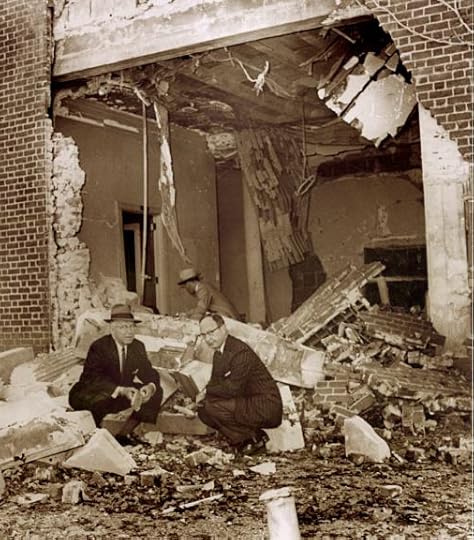
This was the scene on October 12, 1958 (attributed in the book to the Atlanta Journal-Constitution)
The 1950s were part of the Jim Crow era in the American South, meaning that black people attended segregated schools, lived in segregated neighborhoods, and had little access to political power. As for Jews, well, it was after the war. Antisemitism had been associated with Nazis and was no longer openly expressed by genteel people. For them it had gone underground. Public expression of racist and antisemitic views had become the domain of the right-wing fringe. The mainstream taught that such speech wasn't acceptable, but although they may not have uttered it, they weren't likely to counter it, either, at least not outside the family. The way the author sees it, extremist speech and action helped the cause of the existing power structure.
Also, in those days, Jews didn't talk about the Holocaust. Why? I've heard Jews blamed: that they didn't talk about it out of moral weakness or because they knew they were somehow at fault. However, there was no word for genocide in English until the mid-twentieth century, or so I've read. Up until WWI, the world lauded war and victory in a way it's hard to imagine today. Traditionally, losers were killed, deported, or made slaves, or, anyway, became submissive and quiet if they knew what was good for them. If your side or your people lost, that meant the victors--or their gods--were superior, and what happened to you was simply what was expected. It was only later, with changes that were occurring in Western society in general that people began to expect and demand humane treatment. Those changes not having taken place yet, Jews in the South, the well-acclimated natives, anyway, were just trying to fit in. (Newer Jewish immigrants from Eastern Europe were another story.) You could say Atlanta Jews of The Temple were "passing," in a way. They thought keeping their heads down and avoiding conflict and controversy was the best way to preserve their progress in society and avoid antisemitism. I don't believe the author is writing in a spirit of blame; that's the way it has been for most subjugated groups over the centuries (including for women, in my view).
So it spins my head around to hear people say, as some still do, that persecution of Jews is to be expected because, as the accusation goes, they "set themselves apart." In those years, those southern Jews thought fitting in was the way and were trying as hard as they could.
In fact, the congregation hired Rothschild in 1946 just because he had been a naval chaplain, enjoyed sports, and got along in an all-American sort of way. They thought he could further their cause of acceptance by the white Protestant power structure. Little did they know he would hear the call to take up preaching civil rights, a venture precisely suitable for making him--and their synagogue--stick out like a sore thumb, more so in the south than if they'd donned full Orthodox garb, black hat and all. He was blowing their cover, leading them along gradually into acceptance of his role as their own. A couple of his sermons during those early years were "Why Does Being a Jew Make Us Cringe with Fear?" and "How to be Happy though Jewish." Oh, yes: he also was known for his dry humor.
The case of the Scottsboro boys from 1930s Alabama shows something of the climate of the times. Nine black teenagers had been railroaded for raping two white women and all but the youngest, 13 years old, sentenced to death. Worldwide protest and petitions from the likes of Albert Einstein and Thomas Mann resulted in a new trial during which the Communist-supported International Labor Defense paid for one of the top criminal defense lawyers of the day. The attorney, Samuel Leibowitz, had a lot going for him, including the retraction of the rape accusation by one of the women.
"When Morgan County Solicitor Wade Wright began his summation...he gave voice to all the fears and hatreds of the area residents," wrote historian Dan T. Carter in Scottsboro: A Tragedy of the American South. Wright filled his closing remarks with anti-Semitic innuendos and slurs, then pointed a finger at the counsel table where Leibowitz and his Jewish co-council sat: "'Show them,' he paused for effect, 'that Alabama justice cannot be bought and sold with Jew money from New York.'"....
Again there was a verdict of guilty. Until he spoke, most of the newspapermen felt there was an outside chance for a hung jury, but Wright 'registered to perfection the repressed feelings and prejudices of the twelve good men.'"
...None of the Scottsboro boys ever was executed, but the last of them was not freed until 1950. Meanwhile Liebowitz's repeated appearances on their behalf had made an indelible impression. "Obviously," wrote historian Leonard Dinnerstein in Anti-Semitism in America, "Leibowitz's appearance in the Scottsboro case was an example of a northern Jew working to undermine southern values."
"The Negro would behave himself if it wasn't for the Jews,: cried Homer Loomis from a speaker's platform in Atlanta in 1946, arousing his Columbians [white supremacy group associated with The Temple bombing] to dance to an old tune. "It's the Jews' fault that the Negroes are getting out of place." (my parenthetical insertion)
Society was galvanized in 1954 by Brown versus Board of Education ending racial segregation in the schools. This Supreme Court decision was out in front of the rest of society and received no expression of support from the other branches of government. The hate groups accelerated; white southern society kept its silence.
Leaders of the white churches were silent, too. The author quoted statistics that half of the Christian clergy themselves held segregationist views and the other half weren't speaking out. As for southern synagogues, comparatively few in number, about a third of their clergy was preaching civil rights, another third themselves held segregationist view, and a third were silent. Given the climate of hate speech and violence, it was not easy for any of these clergy, with the danger increasing in isolated rural areas. Extremists were bombing black churches and institutions, but ten percent of the targets were synagogues and Jewish community centers. Nor were those targets necessarily correlated with whether or not their clergy had been making waves--unmasking the strategy of keeping a low profile as a fallacy.
After the rioting in Little Rock, Arkansas, in Fall, 1957, eighty ministers in Atlanta released what came to be known as the Minister's Manifesto, supported but not signed by Rabbi Rothschild since it was theologically Christian. That was the first statement of its kind in the south and perhaps the beginning of the end of turning a blind eye.
All of this was part of the context that closely preceded the bombing. Local ministers continued to make use of Rabbi Rothschild in his prophetic role to break civil rights to their own congregations. And the local paper took a decidedly liberal tack in all this. About the award-winning editorial writer Ralph McGill, it was quipped that half of Atlanta couldn't eat breakfast until they'd read his column, and the other half couldn't eat breakfast after they'd read him. Atlanta was a city on the make, billing itself as the city too busy to hate (good for business), and, indeed, gradual changes were occurring. So, when The Temple was bombed--something that could be conceived of elsewhere, perhaps, but not here--instead of further suppressing change or creating helter-skelter, the event brought people together.
How did this bombing bring people together? Did it have to happen that way: that people broke their silence and began to face a dire situation that needed fixing? The author also recounts the Leo Frank lynching in 1915 (the only Jew lynched in the US), part of the history and context that was impacting the members of The Temple's congregation. That occurrence most definitely did not bring people together. The rest of the Atlanta community averted its gaze, and in fact it was a segment of the power structure who lynched him. The author suggests the deciding issue in the present instance was law and order. The Temple bombing violated law and order, and thus the violators had to be stopped. The same rationale was not applied elsewhere across the south to the bombing of black churches, which might lead to consideration of what it means to be a segment of the population that is outside the law and its protection.
Preaching in the overflowing sanctuary on the Sabbath after the bombing, the rabbi joked, "So, this is what it takes to get you to Temple?"
His text was from Isaiah: "And None Shall Make Them Afraid."
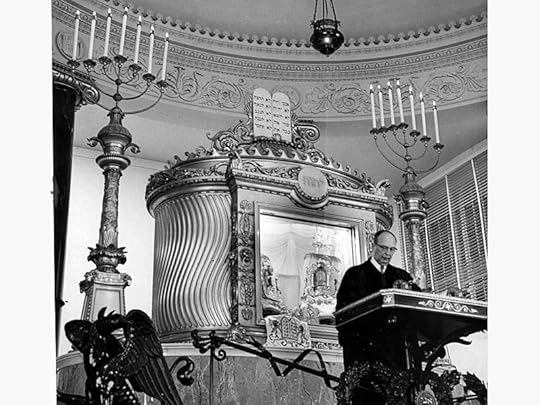
Rabbi Jacob Rothschild pictured reading from the Torah scroll (from georgiaencyclopedia.org)
The story then moves to the trials, unsatisfactory in that only one person was ever tried and that the first result was a hung jury and the second an acquittal. The defense resorted to the same mischief we saw in the Scottsboro boys' trial. For instance, the accusation that "the Jews" did this bombing to themselves--"to bring attention to their cause." Then, when the rabbi's wife, who had taken a threatening call, was on the stand, the defense constantly insinuated extreme wealth by implying her vehicle was a limousine, and he also referred to her husband as "Baron Rothschild" rather than Rabbi Rothschild. He referred to his own "Southland," implying that as a Jew she was a foreigner unable to recognize southern accents. And he badgered her to tears as to what she remembered of the conversation. As it turns out, that voice recognition was the closest thing to hard evidence that the state had. Crime scene investigation was not what it is today.
Subsequently the rabbi preached a sermon entitled "Ordeal by Trial." He strove to convince the congregation this really was a case of insufficient evidence rather than another case of the feared abandonment by white Christian society. Suspects had after all been apprehended and brought to trial.
Part of the argument was that, while many Americans could have latent antisemitism, they don't want to look or sound like these clowns who were brought to trial. With luck and the modicum of hindsight he had even at the time, that analysis at that particular time is probably correct--but certainly that hasn't always been a given. Sometimes enough people do want to sound like that, and enough other people remain silent to tip the balance in the other direction. And his argument continued, claiming we should have more faith in our fellow Americans, for how could they be taken in by all the lies? Yet some populaces have been taken in, or they have sat back and done nothing, tipping the balance. I heard the story recently of how Paul Tillich spoke out of the prophetic mode as the Nazis were rising to power in Germany--and then had to vamoose. So, although we could say Jacob Rothschild to some extent had to "make his own luck," he himself "lucked up" as to his time and place in history.
The story expands to encompass Martin Luther King Jr.'s rise to preeminence. Despite his subsequent near-sainthood status, at the time, his emergence as the leader of his generation was not appreciated by all. When MLK won the Nobel Peace Prize in 1964, there was a joke going around: The good news is an Atlantan won the Nobel Prize. The bad news: It's King. A controversial awards banquet for him was arranged despite the fact that blacks and whites didn't eat together in those days. The author tells how a select few, including Rabbi Rothschild, along with the mayor, the Catholic archbishop, and the former president of Coca-Cola, arduously arranged for the reluctant business community to want to attend it. And then, after all were there, the rabbi praised them for coming and being there together. Again he compared and contrasted them with the rabble outside.
After the rabbi spoke, it was Martin Luther King Jr.'s turn:
If the south failed to move forward, history would record as the greatest tragedy of the era, not the cruelty of the wicked, but the acquiescence of the good.
I found myself wondering under what circumstances the good speak and act and when they don't. What makes speaking possible and, beyond that, what is it about the times in which others can hear what inspired leaders speak? The author is a journalist with a story to tell and sometimes seems to describe a necessity to what happened, but I'm not sure she's very clear on this point. The inspirational leaders are not fated to make themselves heard nor is society destined to be able to hear them.
Today (Monday, December 14, 2015), Donald Trump's ascendancy as a Republican presidential candidate is much in the news. The liberal interpretation is that Trump has ripped away the veil of code words, revealing actual Republican views. The mainstream conservative position is that Trump is a disaster. It is he, they say, who is putting them in a bad light; they are striving mightily to restore their previous position. So I see today's politics as providing something of an analogy: the majority population in the 1950s could no longer get away with tut-tutting extremist views while simultaneously clinging to their segregationist ways. The paradox had been illuminated; it no longer made their underlying attitudes invisible.
With obfuscation, there is silence, except for the voices of extremism. When there is clarity, more people can begin to speak out.
Also, she used much ink to describe the antisemitic meanderings of the white supremacists and others. Why? What's to be learned? Perhaps it's to demonstrate how unattractive those sentiments are as well as those who hold them, but I think she overdid it, perhaps implying an underlying insecurity about her point and introducing a defensive cast. I bogged down in those descriptions the first time I tried to read this book about six or seven years ago, but this time, reading with a group, I persisted. But I haven't included much of what she wrote about the probable perpetrators, as for me they exhibited the banality of evil, which got boring.
The author does seem to see such views as right wing, no matter who holds them. For my tastes she pushes too hard to get those sentiments to line up along one side of the political spectrum. If they can't be erased, at least she can confine them within one deplorable segment of the population: the racists and extreme right wing. That was the convention I grew up with--that these ideologies were the province of the bad guys alone, the ignorant, bigoted, and misguided. But I no longer think it's quite that simple; both our negative and positive tendencies are more evenly distributed than that.
She somehow leaves entangled the concepts of standing up as a Jew and standing up for a particular instance of justice: civil rights. Perhaps it took an outsider to speak out first--a point made in the movie Spotlight. And pursuit of justice is a major part of Judaism. Ultimately, though, Judaism can't be vindicated through taking up someone else' cause. The issue is theology, that is, theological entanglements with Christianity. I've heard it said racism will end before antisemitism does. There are major issues, issues that can seem insoluble. Even to stop denigrating Judaism can be perceived by the fearful as an attempt to convert them! (I am not speaking of Christian fundamentalists here; far from it.) Remember, though, that just the other day, it seems, gay marriage was something that could hardly be spoken of. Who knows what may happen?
There's more to think about. The author is a journalist, not a historian. For her the story is paramount. Does she exploit events and personalities for the sake of her story? That would be ironic, as she has written how keen Rabbi Rothschild was to avoid any semblance of exploiting the bombing--perhaps because he could already hear ringing in his ears how his adversaries would use that. No, this book isn't about exploitation but about telling a little-known story and giving credit where credit is due. Melissa Fay Greene gets the job done and the story told.
Rabbi Rothschild was the only rabbi I knew in my youth. He was a distant figure to me, and then in 1973 he died, young, at only 62. By that time, my youthful involvement at The Temple had ended and I was long gone, part of the youth revolution. This book brought him back, through the author's portrayal, through my memory, such as it is, and through his considerable achievements.

September 29, 2014
I really liked Praying for Sheetrock, so when this book came out, I noted it. I read positive reviews, and put it on my to-read list. When I came across it at the book exhibit at the ASA last month I bought it and started reading. It is a more difficult story than Praying for Sheetrock. The central event is unresolved, in that the bomber is never discovered despite two showy trials (with the star lawyer serving a sentence for contempt of court following the trial). The central character, Rabbi Jacob Rothschild is a brave and admirable leader for civil rights, but he is also distant. Greene's style of journalism is detail oriented, so the book is long. (I cold have done without some of the descriptions of the older Atlantans she is interviewing to get information about the various characters in the book). Still, the story is riveting and important. It is a story about the rise of Atlanta as a commercial hub in the twentieth century, a southern city with an eye for its national image, the place of the Jews, both the upwardly mobile Reform Jews, and the more recent arrivals, the white elites, and the civil rights movement, and the opposition to desegregation-Ku Klux Klan, neo nazis. We go back to the fities--the bombing takes place in 1958-- to see the Black college students in the unique cluster of colleges in Atlanta, and significance of the middle class black community in the segregated city. The book is also good in helping the reader see the conflicts among Jews and what it meant to be "assimilated" at that time. Rabbi Rothschild emerges as a courageous leader in a unique location.

October 29, 2021
Did not finish…. It took me 1 month to read 125 pages and I just can’t go on. I’ve read 2 other of Greene’s books which I loved but not this one. It was written in a “fluffy” manner, had too much information that barely applied to the story at times, and was not chronological.
It’s too bad, because it was an overall interesting topic to read.
It’s too bad, because it was an overall interesting topic to read.

July 4, 2016
The found the book riveting. I connected with the book on many levels. The book’s main character, Rabbi Jacob Rothschild, who served as the Temple’s rabbi during the October 1958 bombing, began his career at Rodef Shalom Congregation in Pittsburgh where he grew up. I belong to Rodef Shalom in Pittsburgh. The book presents a thought-provoking discussion of the cultural chasm between German and Eastern European Jews. The book uncovers tensions within the Jewish community about some Jews’ reluctance to support integration during the post World War II civil rights movement.
Although the book spans 502 pages, the story moves quickly. The account of the bombing and the ensuring investigation and trial reads like a thriller. I was disappointed that the trial failed to reach a conviction, leaving the crime unresolved. It was heartening to read how the bombing evoked sympathy within the community at large.
To my surprise and delight, I learned of a family member, Rebecca Mathis Gershon, who is portrayed in the book. A Temple congregant, she was a civil rights activist and confidant of Rabbi Rothschild. Her branch of the family provided refuge to my father who fled Nazi Germany in 1939.
Author Melissa Fay Greene has enriched tumultuous and vital chapters of our history. I commend her.
Although the book spans 502 pages, the story moves quickly. The account of the bombing and the ensuring investigation and trial reads like a thriller. I was disappointed that the trial failed to reach a conviction, leaving the crime unresolved. It was heartening to read how the bombing evoked sympathy within the community at large.
To my surprise and delight, I learned of a family member, Rebecca Mathis Gershon, who is portrayed in the book. A Temple congregant, she was a civil rights activist and confidant of Rabbi Rothschild. Her branch of the family provided refuge to my father who fled Nazi Germany in 1939.
Author Melissa Fay Greene has enriched tumultuous and vital chapters of our history. I commend her.

December 14, 2015
I wanted to read this book in order to fill a gap in my knowledge of the history of my adopted hometown, where I lived for over 40 years. The events in The Temple Bombing were still relatively recent and raw when I arrived in the Atlanta area to attend college in 1969. In this book, the bombing of the Temple is not only an event to be understood in its historical context, but also a prism through which to fathom the virulence and extent of racism and anti-Semitism in the US, the South, and most particularly in Atlanta. Through extensive interviews, Ms. Greene brings the story to vivid life while managing to maintain sense of time and place, both critical to this understanding. The organization of the book and the quality of Ms. Greene's writing are both such that I was drawn into the story in a profound way, at times feeling the need to set the book aside of a day or two to digest what I had read. Time and again the words I was reading resonated so strongly with current (2016) events that I had to set it aside for a day or two to digest what I had read before moving on. This is a book that connects many dots, in terms of both the historical timeline and laterally across multiple social issues. A must-read -- I cannot recommend it highly enough.

August 26, 2015
The Temple Bombing is a compelling portrait of Rabbi Jacob (Jack) Rothchild and The Temple, the reactionary hardliners who may produce bombs, and the citizens of Atlanta before and during the civil rights movement.
I come to this recent history of my hometown having finally read Carry Me Home about Birmingham and bombs. I can't help but read our history in the light of recent violence including Charleston, SC. This was Atlanta's unsolved bombing case, well portrayed in this great book.
The author interviewed many, many participants in the early 1990s, who have now passed from the scene. There are wonderful quotations from research interviews here. One to note is the just-passed Julian Bond, who always enlightens and usually entertains in his telling of compelling events.
This book is full of those moments of levity in dark times, of all kinds of stories. The rich tapestry of voices and informants included more than I have ever read of aspects of my own home.
Highly recommended.
I come to this recent history of my hometown having finally read Carry Me Home about Birmingham and bombs. I can't help but read our history in the light of recent violence including Charleston, SC. This was Atlanta's unsolved bombing case, well portrayed in this great book.
The author interviewed many, many participants in the early 1990s, who have now passed from the scene. There are wonderful quotations from research interviews here. One to note is the just-passed Julian Bond, who always enlightens and usually entertains in his telling of compelling events.
This book is full of those moments of levity in dark times, of all kinds of stories. The rich tapestry of voices and informants included more than I have ever read of aspects of my own home.
Highly recommended.

June 3, 2020
The Temple Bombing tells the story of the bombing of a Jewish temple in Atlanta in the 1950s. Greene provides context to the bombing by sharing the stories of the key players in the incident. It was interesting to read about ethnic discrimination against Jewish people in the South juxtaposed against racial discrimination of African Americans. It was something I have not read a great deal of in the past. The history of Atlanta and its insistence on being "the city to busy to hate" is detailed in this book.

October 24, 2011
This book is a microscopic exploration of Atlanta in the the sixties. The focus is the temple bombing of the reformed Jewish synagogue in Atlanta and the radiating circles of social complacency and rigidity in the South of that era. The Jewish community members of the Temple (as it was known) mingled nervously with Atlanta's high society and wished to do nothing to rock their favored status. Not rocking the boat meant keeping quiet about racial injustice all around them. The black community existed to them and to their superior WASP neighbors solely as a servant class. Enter Rabbi Rothschild, a young outspoken civil rights activist intent on waking his sleeping congregation. When their Temple is bombed, the horrible underbelly of Atlanta's racist hate groups and the mockery of its law enforcement establishment is shockingly apparent. This book is a riveting slice of historical sleuthing.

October 31, 2015
Absolutely incredible book. One of the best books on the history of Atlanta I have read, and also one of the best books on civil rights and race relations I have ever read. Taking as its starting point the bombing of The Temple in Atlanta in 1958, the story chronicles the civil rights movement from the perspective of Atlanta's Jewish community, neither white nor black but "other" from both worlds, and the rabbi that decided to side with justice. Haunting. Moving. Wonderful.
* - Reserved for nonfiction. Worth a read if you're interested in the subject. Check out from library.
** - Good. May be inconsistent and flawed, but overall worth a read if you're in the mood for that genre. Check out from library.
*** - Very good. Recommended as a book that is either wonderfully written, informative, challenging, beautiful... but not all of the above. Check out from library or buy on Kindle.
**** - Great. Go out and read.
***** - Classic. MUST READ and should be on your bookshelf
* - Reserved for nonfiction. Worth a read if you're interested in the subject. Check out from library.
** - Good. May be inconsistent and flawed, but overall worth a read if you're in the mood for that genre. Check out from library.
*** - Very good. Recommended as a book that is either wonderfully written, informative, challenging, beautiful... but not all of the above. Check out from library or buy on Kindle.
**** - Great. Go out and read.
***** - Classic. MUST READ and should be on your bookshelf

July 27, 2009
WOW!
An amazing book chronicling the civil rights struggle as it developed in the city of Atlanta. The Jewish citizens of Atlanta spearheaded the equality movement for all citizens and as a result became a target of a bomb set off in the temple in 1958. I found this book to be fascinating, but at times struggled to move my way through it. The struggles derived more so from the the writing style than the content of the story.
An excellent read regarding the history of a city in which I was able to live for five years as well as a remarkable story chronicling the continuing struggle for civil rights!
An amazing book chronicling the civil rights struggle as it developed in the city of Atlanta. The Jewish citizens of Atlanta spearheaded the equality movement for all citizens and as a result became a target of a bomb set off in the temple in 1958. I found this book to be fascinating, but at times struggled to move my way through it. The struggles derived more so from the the writing style than the content of the story.
An excellent read regarding the history of a city in which I was able to live for five years as well as a remarkable story chronicling the continuing struggle for civil rights!

July 9, 2009
I read this book because I was so impressed by Praying for Sheetrock. I was not disappointed!
This one puts the Atlanta Temple bombing into the context of race relations in Atlanta and throughout the South, in the '50s and before. The author, who is a journalist, certainly knows how to tell a story. Her writing is straightforward and her descriptions are excellent. A very good read indeed!
This one puts the Atlanta Temple bombing into the context of race relations in Atlanta and throughout the South, in the '50s and before. The author, who is a journalist, certainly knows how to tell a story. Her writing is straightforward and her descriptions are excellent. A very good read indeed!

June 3, 2018
After reading the fantastic history lesson that was Praying For Sheetrock, I expected more greatness from the author in The Temple Bombing. What I got instead was repetitive testimony about life in Atlanta in the first part of the 20th century. I very much enjoy studying the civil rights movement and find it deplorable the way other races have been treated in our nation's past. However, the shared memories of one or two people should suffice when the same thing is being said by all the rest. The title of the book is a misleading as well as it seems little is being shared about the bombing.

October 24, 2013
Well researched is an understatement. I truly wanted to enjoy this book as it is a topic that I was interested in learning more. It is heavy on facts and short on storyline. I struggled to finish and took advice that life is short & stopped just past halfway. It became so boring that you lose sight of the story.

October 9, 2008
It's not that the topic is uninteresting...this book just got kind of boring.
November 13, 2025
The centerpiece of this historical account of one of Atlanta's worst terrorism acts is the titular bombing, book this book is as much a biography of the influential rabbi Jacob Rothschild and a primer on Reform Judaism in the Deep South.
Author Melissa Fay Greene introduces the rabbi as a World War II army veteran who fell into the ministry. She also introduces Old Atlanta's form of Judaism that is all about blending in, not standing out.
In the first half of the twentieth century, Atlanta's Jews worship quietly on Sunday, they ate shrimp and pork and didn't speak Yiddish. When they married other Jews with families from the North, their new in-laws often mistook them for Christians. But they never married non-Jews and did keep the High Holy Days.
Rothschild was determined to change all that. He consulted with local Orthodox rabbis and brought back Jewish traditions of Hebrew blessings, lighted candles and banned pork from Temple events. While these changes were shocking enough to Atlanta's genteel Jews, Rothschild's greatest reforms were still come in his preaching.
Rothschild co-sponsored a protest rally at the state capitol in 1947. This was during a three-man contest for governor when the newly elected but not yet inaugurated Governor Eugene Talmadge died suddenly. Three men, including the lt. governor-elect, Talmadge's son Herman and the man who finished second in voting to Eugene Talmadge, all laid claim and battled each other for the position.
Following the rally, Rothschild began preaching regularly on the issue of civil rights. Congregants became concerned about how the integration-tinged sermons would affect their relationships with the white Christian majority. By the late 1950s, Rothschild was participating in Interfaith Night programs at the First Baptist Church of Atlanta. Inside the church, a lively but respectful discussion took place. But outside the church, there was a one-man protest by George Bright, one of the later accused bombers.
In the early morning hours on October 12, 1958, a bomb exploded in the unoccupied Temple. Police called the rabbi and Mayor William Hartsfield was summoned, too. The mayor spoke to reporters about the shock of the crime and how Atlanta condemned such an act of cowardice.
For Atlanta's Jews, the bombing brought back the horrible memories of the Leo Frank lynching a generation ago, when a Jewish pencil factory foreman was suspected of murdering a little Irish girl who worked in the factory. Suddenly, there was a new gulf between the Temple Jews and their Christian brethren.
But the Christian and business communities rallied around the Temple, offering approximately $30,000 in reward money for information leading to the arrest of the bomber(s). Atlanta Public Schools opened their doors for the Temple use as meeting space. Many devout Christians howled over the atrocity of the destruction of a house of worship. Even the Atlanta Journal-Constitution editor Ralph McGill spoke out on the bombing, leading Janice Rothschild, the rabbi's wife, to quip that it was "the bomb that healed," as many Atlantans came together.
Days later, six men were rounded up the Atlanta Police in connection with the bombing. One was quickly released, but the other five were charged with the crime based on the testimony of the weakest member of the group. The subsequent trial was a circus, led by the flamboyant defense attorney Rueben Garland, father of the current, well-known Atlanta attorney Ed Garland.
Dozens of witnesses were paraded in front of the jury, for both sides, including Janice Rothschild and a young woman who was a date of one of the suspects. Ultimately, no one was found guilty of the bombing.
Less than a decade later, Rabbi Rothschild was again at the certain of Atlanta's healing when he and a group of Black leaders planned and promoted an interracial black-tie dinner to honor Martin Luther King, Jr. for winning the Nobel Peace Prize. Only a few years later, Rothschild stepped in as part of Atlanta's leaders who assisted and consoled Coretta Scott King following King's assassination.
Recommend, especially for Atlanta history buffs and those interested in the history of civil rights.
Author Melissa Fay Greene introduces the rabbi as a World War II army veteran who fell into the ministry. She also introduces Old Atlanta's form of Judaism that is all about blending in, not standing out.
In the first half of the twentieth century, Atlanta's Jews worship quietly on Sunday, they ate shrimp and pork and didn't speak Yiddish. When they married other Jews with families from the North, their new in-laws often mistook them for Christians. But they never married non-Jews and did keep the High Holy Days.
Rothschild was determined to change all that. He consulted with local Orthodox rabbis and brought back Jewish traditions of Hebrew blessings, lighted candles and banned pork from Temple events. While these changes were shocking enough to Atlanta's genteel Jews, Rothschild's greatest reforms were still come in his preaching.
Rothschild co-sponsored a protest rally at the state capitol in 1947. This was during a three-man contest for governor when the newly elected but not yet inaugurated Governor Eugene Talmadge died suddenly. Three men, including the lt. governor-elect, Talmadge's son Herman and the man who finished second in voting to Eugene Talmadge, all laid claim and battled each other for the position.
Following the rally, Rothschild began preaching regularly on the issue of civil rights. Congregants became concerned about how the integration-tinged sermons would affect their relationships with the white Christian majority. By the late 1950s, Rothschild was participating in Interfaith Night programs at the First Baptist Church of Atlanta. Inside the church, a lively but respectful discussion took place. But outside the church, there was a one-man protest by George Bright, one of the later accused bombers.
In the early morning hours on October 12, 1958, a bomb exploded in the unoccupied Temple. Police called the rabbi and Mayor William Hartsfield was summoned, too. The mayor spoke to reporters about the shock of the crime and how Atlanta condemned such an act of cowardice.
For Atlanta's Jews, the bombing brought back the horrible memories of the Leo Frank lynching a generation ago, when a Jewish pencil factory foreman was suspected of murdering a little Irish girl who worked in the factory. Suddenly, there was a new gulf between the Temple Jews and their Christian brethren.
But the Christian and business communities rallied around the Temple, offering approximately $30,000 in reward money for information leading to the arrest of the bomber(s). Atlanta Public Schools opened their doors for the Temple use as meeting space. Many devout Christians howled over the atrocity of the destruction of a house of worship. Even the Atlanta Journal-Constitution editor Ralph McGill spoke out on the bombing, leading Janice Rothschild, the rabbi's wife, to quip that it was "the bomb that healed," as many Atlantans came together.
Days later, six men were rounded up the Atlanta Police in connection with the bombing. One was quickly released, but the other five were charged with the crime based on the testimony of the weakest member of the group. The subsequent trial was a circus, led by the flamboyant defense attorney Rueben Garland, father of the current, well-known Atlanta attorney Ed Garland.
Dozens of witnesses were paraded in front of the jury, for both sides, including Janice Rothschild and a young woman who was a date of one of the suspects. Ultimately, no one was found guilty of the bombing.
Less than a decade later, Rabbi Rothschild was again at the certain of Atlanta's healing when he and a group of Black leaders planned and promoted an interracial black-tie dinner to honor Martin Luther King, Jr. for winning the Nobel Peace Prize. Only a few years later, Rothschild stepped in as part of Atlanta's leaders who assisted and consoled Coretta Scott King following King's assassination.
Recommend, especially for Atlanta history buffs and those interested in the history of civil rights.

January 23, 2018
This book is the history of a single event – the bombing of the Jewish Temple in Atlanta on October 12, 1958. It is a very thorough exploration of the events, attitudes, and people surrounding this event and presents as fair an assessment of all sides as is probably possible for a situation of this type.
It gives a portrait of the southern United States at the time, along with a thorough analysis of Atlanta and how it was different from the rest of the South – and how it was the same. We look at the powerful white elite in Atlanta and how they were trying to minimize unpleasant violence. We look at the lower class people among whom the crime originated and what they were thinking – if anything. We look at the Jews in Atlanta, both the mostly well-to-do Reform Jews, mostly of German origin who attended the Temple, and at the less well-to-do shopkeepers, many of Russian or Eastern European origin who attended the city’s other synagogues. And we look at the Black people in Atlanta, including the educated, well-to-do blacks of the culture of Atlanta’s Black universities and the poor Blacks of Atlanta’s marginal neighborhoods.
We follow, in particular, Rabbi Jacob M. Rothschild, rabbi of the Temple at the time and an outspoken supporter of Black Civil Rights, because that is what he believed God wanted him to do.
We also follow the activities of the United States Rights Party, believed to be in some way responsible for the bombing, although no one was ever convicted in the case.
It gives a portrait of the southern United States at the time, along with a thorough analysis of Atlanta and how it was different from the rest of the South – and how it was the same. We look at the powerful white elite in Atlanta and how they were trying to minimize unpleasant violence. We look at the lower class people among whom the crime originated and what they were thinking – if anything. We look at the Jews in Atlanta, both the mostly well-to-do Reform Jews, mostly of German origin who attended the Temple, and at the less well-to-do shopkeepers, many of Russian or Eastern European origin who attended the city’s other synagogues. And we look at the Black people in Atlanta, including the educated, well-to-do blacks of the culture of Atlanta’s Black universities and the poor Blacks of Atlanta’s marginal neighborhoods.
We follow, in particular, Rabbi Jacob M. Rothschild, rabbi of the Temple at the time and an outspoken supporter of Black Civil Rights, because that is what he believed God wanted him to do.
We also follow the activities of the United States Rights Party, believed to be in some way responsible for the bombing, although no one was ever convicted in the case.

May 20, 2017
"Stories of integrity and courage ought to be rescued, now and then, from the collective historical amnesia." After 6 months of steady reading, I now have a better understanding of the impact one man – Rabbi Jacob Rothschild – had in the history of Atlanta and his faithful demonstration of upholding compassion and conviction. "He required his friends to do as he had done—loosen their grip on the world of the senses, on the material and social southern world—and allow a higher truth to operate. By working for the rights of African Americans, by believing in human rights, his Jews would inferred themselves as well." p.435, The Temple Bombing by Melissa Fay Greene. Thanks to Margo and Jim for the recommendation! @andcampaign

June 3, 2019
What an incredible read. I know the author as a fellow mom, who adopted from Ethiopia. I have a couple other books that I haven't read yet. One is about that experience of adoption.
I picked up the Temple Bombing solely because she wrote it. I didn't realize I was in for such a powerful read. The background is the 50-60's civil rights movement. Rabbi Jacob Rothschild comes in as the senior rabbi of the largest Jewish Temple in Atlanta, Georgia. He speaks truth to his congregation. He speaks integration based on Brown v. the Board of Education.
Brown became law in 1952, before I was born. Yet as a 4th grader in Biloxi, Mississippi, I went to a segregated school. I learned a lot more about why in this book.
Mesmerizing.
I picked up the Temple Bombing solely because she wrote it. I didn't realize I was in for such a powerful read. The background is the 50-60's civil rights movement. Rabbi Jacob Rothschild comes in as the senior rabbi of the largest Jewish Temple in Atlanta, Georgia. He speaks truth to his congregation. He speaks integration based on Brown v. the Board of Education.
Brown became law in 1952, before I was born. Yet as a 4th grader in Biloxi, Mississippi, I went to a segregated school. I learned a lot more about why in this book.
Mesmerizing.

May 21, 2017
In a city too busy to hate, Atlanta managed to have some haters. This true accounting of the people and visions of my city at the time of the bombing is enlightening and disturbing too. Melissa obviously researched her subject thoroughly and tells it without prejudice. I only wish there had been more photos of the time to help tell the story. I like to look into the eyes of the innocent and the guilty and search for further truths.
August 3, 2023
Some chapters I consumed with gusto, others I had to force myself to get through. I felt there were a lot of people highlighted in the book that may have been more familiar to Atlantans 20 or 30 years ago, but whose names are almost forgotten today. So to me, it felt the book assumed some people needed little introduction, when in fact I'd never heard of them.
Overall, would recommend to learn more history of Atlanta and of the civil rights movements.
Overall, would recommend to learn more history of Atlanta and of the civil rights movements.
October 13, 2018
This was a wonderful read. As a native Georgian who grew up in Marietta( a suburb of Atlanta) I was especially interested in this book. It’s well-researched and written. By exploring this catastrophic event from the mid-20th century in the Deep South- this work resonates on cultural, religious and racial levels —and so much more. History does come alive. I’d definitely recommend it.

July 8, 2021
Brilliant, entertaining, informative
July 25, 2024
Greene’s writing is so lyrical and full of imagery that this historical recounting feels like more than simply journalistic or historical writing.

March 23, 2020
Back in graduate school at UGA I was assigned for one of my classes the book "The Temple Bombing" by Melissa Fay Greene, but with all the things I had to read in grad school, I think I only skimmed parts of it. I went back to it recently and finished it tonight. If you claim Atlanta as your city, which I do, this is a powerful read focused on Rabbi Jacob Rothschild, a man who deserves more recognition for his role in our city's civil rights struggle, and the 1958 bombing of the synagogue he led. Greene's work reveals the problems with the old moniker "the city too busy to hate" but also shows how the bombing brought Atlantans closer together against hatred and injustice.

July 9, 2012
Excellent book about a little known incident that took place in Atlanta, Georgia in 1958: the bombing of a Jewish synagogue, where the rabbi had been especially vocal in his support of civil rights for African-Americans.
The book details the history of the rabbi's leadership at the synagogue, Atlanta culture at the time, the trials for those accused of committing the bombing and the aftermath.
The kind of Judaism practiced by southern Jews in the first half of the 20th century would make a contemporary Jew - even Reform Jews - blanch; it is a painfully assimilationist one. But as the writer explains, it was shaped by the hostility around the Jewish community: this was the only kind of Judaism that could safely be practiced.
The book's unvarnished look at how the shifting focus of the civil rights movement impacted Rabbi Rothschild in later years makes for a brief but interesting story as well.
Finally, the writer's acknowledgments at the book's end conclude with a delightful note. She mentions her children and then says to them: "I'm finished. You can use the computer now."
The book details the history of the rabbi's leadership at the synagogue, Atlanta culture at the time, the trials for those accused of committing the bombing and the aftermath.
The kind of Judaism practiced by southern Jews in the first half of the 20th century would make a contemporary Jew - even Reform Jews - blanch; it is a painfully assimilationist one. But as the writer explains, it was shaped by the hostility around the Jewish community: this was the only kind of Judaism that could safely be practiced.
The book's unvarnished look at how the shifting focus of the civil rights movement impacted Rabbi Rothschild in later years makes for a brief but interesting story as well.
Finally, the writer's acknowledgments at the book's end conclude with a delightful note. She mentions her children and then says to them: "I'm finished. You can use the computer now."

July 24, 2009
I thought this was a novel, but it turns out it's a non-fiction story of a Jewish Temple in Atlanta in the 60's. Nonfiction is okay with me, especially when it's historical. The first part of the book didn't have much to do with the bombing itself, but it did a very good job of setting the cultural stage in the South. It was a little slow but still fascinating to read about the way desegregation affected the treatment and status of Jewish people in the South, as well as the way German and Eastern European Jews viewed each other.
However, the second half of the book described the bombing, the story of the bombers, the trial, and everything else you can think of in such minute detail that I was bored to tears. Too bad. I think the book could have been cut in half and been much easier to digest.
However, the second half of the book described the bombing, the story of the bombers, the trial, and everything else you can think of in such minute detail that I was bored to tears. Too bad. I think the book could have been cut in half and been much easier to digest.

January 18, 2014
I found this book unexpectedly gripping. It turned out to be about so much more than just the bombing of Atlanta's well known temple on Peachtree St. I discovered many things I didn't know about how deeply ingrained the race issues were in Atlanta at the time of the bombing, and how brave Rabbi Jacob Rothschild must have been to take the stand he did for social justice. Although this book is especially a must-read for anyone living in the South, I'd recommend it to people living anywhere. The author did a great job of using her storytelling skills to elevate this book from a dry recitation of facts.

November 27, 2014
The Temple Bombing / Melissa Fay Greene. This book is about the modern civil rights movement in Atlanta, Georgia, the Jewish reactions to the movement, and the bombing of the most prominent Reform synagogue in Atlanta. It also directs a lot of attention to the synagogue’s head rabbi, Jacob Rothschild. It was informative, inspiring, and, sometimes, repetitive and verbose, I thought. I like densely detailed books! Written for a popular audience. I enjoyed Greene’s Praying for Sheetrock and I Am Not Me Without You [?] more.

February 1, 2012
Melissa Fay Greene really has a talent for finding, researching and presenting specific stories that serve to illustrate greater portions of history and humanity. From The Temple Bombing I learned a lot about Atlanta during the Civil Rights era that I didn't know before. Wonder if we'll ever know who was responsible for the cowardly crime that became a watershed moment in Atlanta (and thus Georgia) history?

March 28, 2015
A lovingly written and humorous account of Atlanta in the 1950s, when Rabbi Jack Rothschild of the Temple advocated integration and civil rights and saw himself and his temple become a target of "neo-Confederate" white supremacist groups as a result. This book offers insights into the very human motivations behind all of the interconnected communities of that time and afterward. Melissa Fay Greene is a master of interweaving oral history and archival research with her own literary voice.
Displaying 1 - 30 of 49 reviews