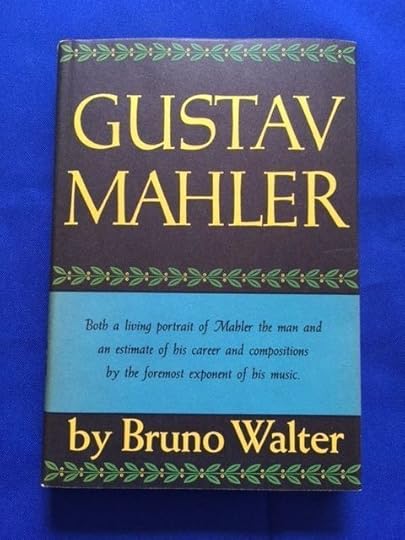
Conductor, composer, and writer Bruno Walter (1876–1962) worked closely with Gustav Mahler as the composer's assistant and protégé. His revealing recollections of Mahler were written in 1936, marking the twenty-fifth anniversary of the composer's death. Walter first encountered Mahler more than 40 years earlier, when he served as the composer's assistant conductor in Hamburg. He worked with Mahler again at the Vienna Opera, and after the composer's death conducted the debut of the Ninth Symphony and Das Lied von der Erde . A staunch supporter of Mahler's genius and defender of his dour personality, Walter cites the pressures faced by a gifted artist striving for perfection. This edition of his tribute to his friend and mentor features supplemental materials that include a biographical sketch of Mahler as man and artist by Ernst Krenek, the composer's son-in-law and musical heir, and a new Introduction by Erik Ryding, author of Bruno A World Elsewhere .
Wonderful personal account from a close friend of Mahler's, and a great musician in his own right. Beautifully written, with marvellous insight into the spirit underlying the music of the great composer. A must read for anyone moved by Mahler's music.
One musical genius, Bruno Walter, guides the reader through the musical life and work of another musical genius, Gustav Mahler. Along the way I gained insights into Mahler's symphonies, which I used to listen to performances from the BBC Proms--very helpful. Walter's writing is formal and somewhat stilted. Mahler's son-in-law, Ernst Krenek, writes more fluidly in the second section about Mahler's career. For classical music lovers, a gem.
If you geek out on Mahler, and you should, this is a good little introduction to the man and his work. It effectively peeled back a few layers as to why his music hits me as it does.
A delightful book! Although hard to read at times because of the German and musical details, I thought the two essays worked well together to give an introduction to Mahler
This book is difficult to review, written by Bruno Walter, a protege, and Czech composer, Ernst Krenek, who had close ties to Mahler. Their observations try to be objective about Mahler and his work, but, they saw him through a magnifying glass. If anything, their subjectivity says more about their observations, limited by close proximity to the composer and his music. Walter’s effusive praise impedes his objectivity, yet he is able to capture Mahler’s personality as opera director and artist - tireless in perfection as opera director/conductor and composing music, longing for answers to his questing existence. He wasn’t novel for novelty’s sake - he had something to say. Krenek has terse observations, no less incisive, about Mahler’s revolutionary music that looks backward as it moves forward. Both agree his time will come. .
Bruno Walter is an excellent conductor (although some of his recordings are so old that they are close to unlistenable in terms of audio quality) and was friends with many of the major figures of his day, including Thomas Mann and Albert Einstein, his neighbors in California after expatriation (their neighborhood burned down in the LA fires last year, tragically). This book is basically a memoir about his friendship with Mahler, whom Walter knew so well that it almost doubles as a biography of the composer. There are plenty of interesting details, such as about Mahler translating the lyrics to vocal music so as to be native to whatever country he was performing in (something unthinkable then as today) and praise of his smooth, articulate conducting style. There's no profoundly revelatory material here, and both the portrait of Mahler as a sensitive but wide-ranging intellectual & gentleman, and the brief discussion of his works, are roughly what you'd expect from such a work. Nevertheless as a short testimony by an highly respectable first-hand witness, I find this an excellent overview of Mahler's life and would make for a great introduction to anyone interested in learning about him. I also find the tale about Mahler first conducting Resurrection quite entrancing; Mahler had suffered the worst migraine of his life shortly beforehand and nearly needed to cancel the performance, but miraculously recovered just in time & then slowly won over a skeptical audience over the course of the intense symphony to riotous applause, a tale which Walter tells wonderfully in his elegant, intelligent style.
A funny bit of intended irony can be seen in a two-part documentary series called The Art of Conducting in which Bruno Walter can be witnessed in an old film interview claiming something to the effect of, "A man who does not appreciate the babbling brook and birdsong," or some such, cannot be a real musical artist. That is followed by a clip of an old video interview of the fearsome conductor contemporary of Walter, Otto Klemperer, more or less saying that he, Klemperer, was a hedonist and misanthrope who hates humanity and pretty much everything else.
It's a marvelous refutation of Walter, since most critics would agree that Klemperer was every bit as accomplished a conductor and interpreter of the classical repertoire. Sinners and saints are equal at the podium.
It is in the same somewhat limiting spirit that Walter interprets the life and work of his mentor, the titanic composer/conductor, Gustav Mahler. While bordering on hagiography, Walter doesn't completely ignore Mahler's faults and shortcomings, but neither does he dwell on them. At the end of the day, all is forgiven because of Mahler's artistic genius.
This book was written near the end of Walter's life, in the late 1950s, and reflects mainly on the time at the outset of his career when he was a rising young conductor in Europe in the late 1800s and early 20th century, near the end of Mahler's life and career, when the latter became a great mentor and friend. As one reviewer on Amazon has succinctly and accurately said of this book, it is: "Indispensable, in its minor way."
So while we are privileged to have a firsthand account by a man who had intimate access to a very private major genius of music, we also find ourselves craving for more details oftentimes. Walter is very articulate and poetic in his upper middlebrow European way, but he is also repetitive, seemingly finding different metaphorical ways to say the same things, particularly when commenting on Mahler's symphonic and vocal music.
Walter, of course, became the first significant conducting champion of Mahler's work, making the first recordings of many of his symphonies, and to ignore his take on the creator of them would be remiss. And I did gain some insights into Mahler and his world, particularly some of the peculiarities of musical Vienna in its heyday, and found the book very much worthwhile for anyone interested in classical music, European history, Mahler or Walter.
The book is a decent attempt at analysis without psychoanalysis, but something with the latter approach would probably give a more rounded view.
I'm glad to have found a mint condition 1957 first American edition hardcover with a like-new dust jacket protection in mylar at Half Price Books for the price of $5, and will probably go ahead and sell this off now for a tidy profit.
KR@KY 2017-----
This looks just like the near-mint, first-edition 1957 hardcover copy I just bought at Half Price Books for $5 minus discount. It's pretty rare. I'm reading it and will sell it when done.