From a wealth of vivid autobiographical writings, Emmanuel Le Roy Ladurie reconstructs the extraordinary life of Thomas Platter and the lives of his sons. With masterful erudition, Le Roy Ladurie deepens and expands the historical contexts of these accounts and, in the process, brings to life the customs, perceptions, and character of an age poised at the threshold of modernity.
"Le Roy Ladurie paints a remarkably contemporary picture of life in the sixteenth century. . . . It's a good story, told with a deft narrative touch."—Michael S. Kimmel, The Nation
"Le Roy Ladurie is a master of the representative detail and uses the Platters' lives as a means to see a whole century 'through a glass, darkly'."— The Independent
"Le Roy Ladurie has not only thoroughly sketched out the Platters' particular brand of gusto, he has also made it seem a defining characteristic of the sixteenth century."— The New Republic
"All [of] the drama and pathos of a Disney film."—Emily Eakin, Lingua Franca
Emmanuel Le Roy Ladurie was a French historian whose work is mainly focused upon Languedoc in the ancient regime, particularly the history of the peasantry.
Emmanuel Ladurie was professor at the Collège de France and, since 1973, chair, department of history of modern civilization. He has had a distinguished career, serving as Administrateur Général of the Bibliothèque Nationale de France (1987-94); member of the Institute (Academy of Moral and Political Sciences); Agrégé of the University, Doctor of Letters; Commander of the Legion of Honor (1996); and has taught at the universities of Montpellier, the Sorbonne, and Paris VII. Dr. Ladurie is the author of many historical works, including Les Paysans de Languedoc (1966), Histoire du Climat depuis l'An Mil (second ed., 1983), Montaillou, village occitan (1975), Le Territoire, de l'Historien (2 vols., 1973, 1978), Le Carnaval de Romans, 1579-1580 (1980), L'Etat royal (1987), L'Ancien Regime (1991), Le Siècle de Platter (1995), and Saint-Simon, le systeme de la Cour (1997).
A rare find thanks to Thomas and Felix Platter's obsessive journaling in 1500s-1600s. Ladurie essentially frames this family biography as a rags to riches story though it's more like rags to riches to rags to riches with lots of debt involved. Thomas Platter is a Swiss patriarch with extreme hiking skills (walked from one end of Switzerland to the other numerous time, across the Alps etc.) who was born in pastoral village and became a political and economic player. The story features his brilliant but neurotic surgeon son, Felix whose quirky personality and frequent dust-ups with other kids give texture to the memoir. Who knew 16th century Swiss society was so class-mobile; with Calvin on the scene and many changes underway the opportunities were open. A thoroughly modern tale except for the plague and all the mules.
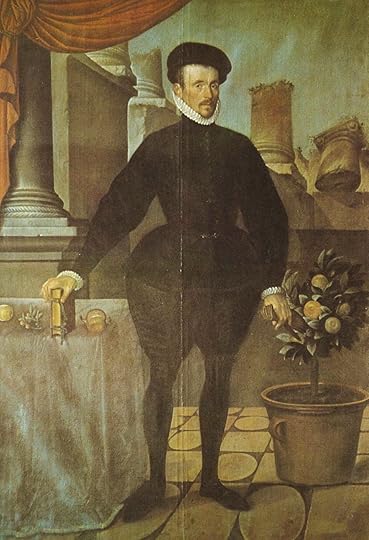
(Thomas Platter, son, ...who "spent approximately a month in England in the autumn of 1599.")
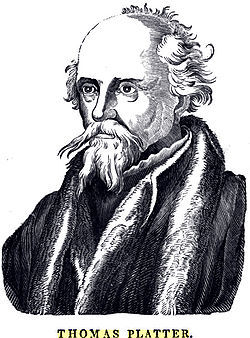
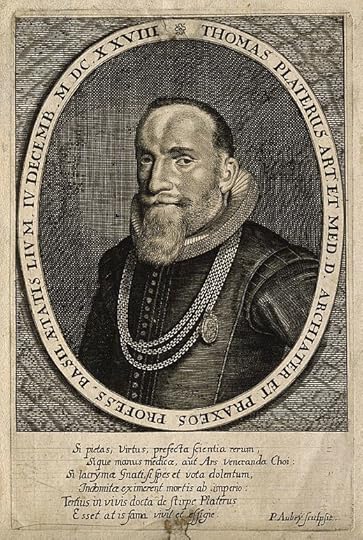
"Félix et Thomas Platter, nés à Bàle tous les deux, étaient frères. Mais il y avait entre l'ainé et le plus jeune une différence d'âge qui, même chez les familles nombreuses, n'est point fréquente ; Thomas était venu au monde trente-huit ans après Félix. Leur père, qui portait également le prénom de Thomas, était de condition infime. Il avait d'abord gardé les chèvres. A dix ans, il abandonna le Valais, son pays natal, ...A la sollicitation de son fils aîné, Thomas Platter le père écrivit lui-même le récit de sa vie."
"Le 27 février, nous vîmes un mariage à l'église de la Magdeleine : c'étaient des gens du peuple. On leur tint un long voile blanc sur la tète, pendant qu'on leur lut quelque chose en latin."
"Les Juifs sont très assidus à fréquenter leur temple ; ils prient avec ferveur, mais sans intelligence. ...Les Juifs croient posséder quatre dons que les autres peuples n'ont pas, ce sont : le pays de Chanaan, la loi, les prophéties et la résurrection. La science des rabbins a enfermé toute la loi de Moïse en 13 articles, divisés en prescriptions et en interdictions. "
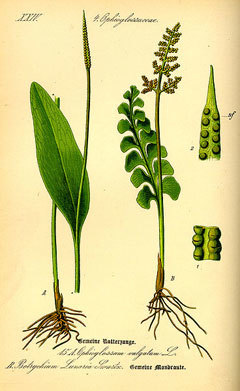
in: La botanique en Provence au XVIe siècle: Félix et Thomas Platter, avec extraits relatifs à la Provence des mémoires de Félix et de Thomas Platter, By Ludovic Legré
(Botrychium lunaria, Thomas "discovered",...so he says in his diaries)
hoe een familie zich tijdens de zestiende eeuw in twee generaties ontwikkelde van schaapherders tot leraren en medici. Fascinerende en toch historisch exacte reconstructie van het dagelijks leven van de lage en middenklasse in Europa uit dagboeken. Nooit geweten dat we over het hele tijdvak van middeleeuwen tot en met renaissance maar van vier! kinderen dagboeken hebben...
Ben blij dat ik deze klassieker uit de Annales school eindelijk uit heb (na een mislukte poging meer dan 10 jaar geleden)! Het concept van dit verhaal is erg simpel: Le Roy Ladurie neemt de memoires en geschriften van Thomas en Felix Platter, vader en zoon die in het Zwitserland van de zestiende eeuw leefden, en gebruikt deze om een intieme inzicht in het leven van die tijd te schetsen. Hij doet dat door te springen tussen de dagelijkse ervaringen van de Platters en de sociale, politieke, religieuze, academische, of economische ontwikkelingen die destijds uitspeelden. Zo kom je bij voorbeeld door de ogen van Felix Platter, die zes jaar in Frankrijk doorbrengt om medicijnen te studeren, te weten over drinkculturen onder de Duitse en de Franse “naties” (studentengroepen) aan de universiteit van Montpellier, maar ook hoe het leven in Franse steden en op het platteland verschilt, en hoe de verhoudingen tussen Frankrijk en Zwitserland in het algemeen toen waren (zijn ervaring in het halen van een doctoraat was vooral fascinerend voor mij). Zo vlecht Le Roy Ladurie het micro-perspectief van de individuen en het macro-perspectief van de historicus aan elkaar.
Een goed voorbeeld van deze manier van vlechten komt voor aan het begin van hoofdstuk 7. Terwijl Felix Platter met een meisje in Béziers (buiten Montpellier) spreekt breekt een stukje van zijn kies af. Hij schrikt hier hevig van – komt het door zijn “overmatig gebruik” van suiker? Le Roy Ladurie gebruikt hier de mogelijkheid om over de suiker handel te spreken: waar komt het suiker in Frankrijk rond die tijd vandaan? Suiker maakt namelijk 2% uit van de totale Franse import. Het komt vooral uit Spanje, Portugal, en Afrikaanse eilanden. Maar het suiker dat Felix eet kwam waarschijnlijk nog niet uit Brazilië: dat werd pas later geïmporteerd (275-6). In één alinea leren wij dus dat Felix zijn kies brak kort nadat hij Montpellier verliet, dat het voorval blijkbaar belangrijk genoeg was om op te schrijven, dat het waarschijnlijk kwam door het hoge suikergehalte van zijn dieet, en dat het suiker in Frankrijk in die tijd vooral uit Iberië en Afrika kwam en een redelijk groot onderdeel van de import uitmaakte. Zo zijn er tal van andere kleine inzichten in het bredere West-Europese leven, verteld door middel van ogenschijnlijk banale details uit het leven van de Platters.
Het boek leest erg makkelijk, en dat terwijl het ook prop vol zit met details en weetjes; zie bijvoorbeeld het middag- en avondmenu van Felix Platters bruiloft, in vergelijking met de voorschriften van de stad Bazel uit 1628 voor bruiloften (391)! De informatie die de lezer krijgt is soms wat overbodig, maar Le Roy Ladurie heeft enorm respect voor alle personages die voorkomen in het verhaal: bijna iedereen krijgt een “backstory”, van adellijke figuren tot bediendes. Secondaire literatuur subtiel wordt ingebracht – het is bepaald geen academisch boek, al getuigen alle kleine details van een brede kennis. De moeilijkste passages om te lezen waren diegene waar de chronologie soms voor- of achteruit sprong. Vooral de stukjes over Thomas Platter Jr waren wat verwarrend, omdat hij vaak voorkomt in het verhaal van Felix maar zijn verhaal speelt bijna een halve eeuw later uit. Maar over het algemeen is het een plezierige leeservaring!
An extensive reworking and synthesis of the writings from Thomas Platter, the Swiss humanist scholar and writer, and the first in a trilogy. It paints a rare contemporary picture of the life and times of ordinary people as they lived in Switzerland and southern Germany (Baden-Wurttemberg). Maps of his and his sons travels are included in the back, as well as extensive footnotes and references. Prose is somewhat lacking in flamboyance, largely because little of interest happens, and even a multi-generational event such as pestilence is mentioned in a matter-of-factly way.
Fascinating account, based on various autobiographical narratives, of an upwardly mobile swiss family in the 16th Century. Lots of really cool details of their everyday life,and a real sense of the thickness of connections within a community in the midst of an intellectual ferment. Only gets three stars because the book is a really lopsided narrative, with far too much time devoted to recounting details of the various towns one of the family members visits during a tour of France, and a hasty conclusion that I assume is an abridged version of the other two (untranslated) volumes of the saga. Still really worth reading, at times I really felt like I was really experiencing the richness of life in another century.
Ein typisches Werk der "Annales"-Schule. Detailreiche, von einem biographischen Ansaz ausgehende Studie, die viel Überraschendes zur sozialen Mobilität in der Hochrenaissance zu sagen hat und deren Ereignisse obendrein hauptsächlich im Südwesten unterwegs sind, zwischen Frankfurt, Heidelberg, Straßburg und Basel.
I've been a bit lax in noting the books I've read for my thesis (on account of the thesis itself, which needs to be completed in the next few weeks!) but wanted to mention this highlight. Absolutely fascinating account of sixteenth-century life based on the autobiographical writings of self-made man Thomas Platter and his son Felix, who became a doctor. (Even though people with deformities and broken bones grossed him out. Also, he was terrified of rings. You have to read to find out why!) The writing is patchy but wholly entertaining. Unsure whether the persistent thread of bizarre informality is the work of the author or his translator, but I'm into it.
I read this to enlarge my understanding of life in the sixteenth century, beyond the 'sexed up' accounts of history penned by historians inorder to sell books more than inform. I was not disappointed.
But the work was a hard read, and one for those seriously interested in the era. Life was a little unextrodinary I think for most, and this work confirms it as such. This a serious book, but at times I was confused regarding whose thoughts were being presented.
Am I better informed... well not so much. Will I be reading it again... no.