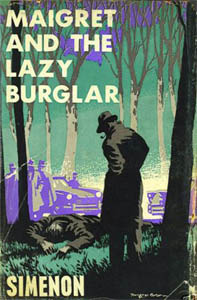
Because genre fiction typically pays little attention to prose style and subordinates character to plot, I lost interest in it decades ago. Georges Simenon, a Belgian novelist who, between 1930 and 1980, produced an eye-popping two hundred novels, avoids both these failings, a fact the more remarkable since he often cranked out 60 to 80 pages a day.
The Lazy Burglar of the title is Honore Cuendet who, as the novel opens, has had his face bashed in, his body dumped in the street. Police Inspector Maigret has a history with Cuendet, having nabbed him for various jobs in the past. But with the passing of time, Cuendet has become more refined, both in his methods as a burglar and in his awareness of his rights under the penal code (he keeps a well-thumbed copy in his room), so Maigret's pursuit of him becomes progressively fruitless. And now the man is dead.
I'll leave the details of the story there, unspoiled, and turn to the novel's merits. They are all on display in the work's first two chapters, twenty pages or so that showcase most of the reasons I'm addicted to an artist of whom I'd never heard six months ago.
Georges Simenon knows how to set a scene. When, in the novel's opening pages, Maigret is roused from his bed on a wintry Paris morning, you can see the solitary circles of white light cast by the street lamps, and you can feel both the frost in the air and the unwelcoming cold leather of the taxicab seat.
The first character you meet -- besides the corpse -- is Fumel, an odd and amusing character who demonstrates Simenon's ability to succinctly build character on a foundation of delightful idiosyncrasy and personal history.
Fumel was already ugly then, and people already felt sorry for him, while at the same time making fun of him, firstly because his parents had taken it onto their heads to name him Aristide, and secondly because, in spite of his appearance, he was always getting into amorous tangles.
He had got married, and after a year his wife had left him without leaving a forwarding address. He had moved heaven and earth to trace her. For years, a description of her had been in the pocket of every policeman and gendarme in France, and Fumel would rush to the morgue every time a female corpse was fished out of the Seine.
It had become legendary.
"I can't get it out of my head that something terrible happened to her and it was all my fault."
He had a wall-eye. It was brighter than the other, almost transparent, which made his gaze unsettling.
"I'll always lover her. And I know I'll find her again one day."
Did he still hope that, at the age of fifty one? Not that it prevented him from falling in love periodically. Fate continued to be unkind to him, because all his affairs were incredibly complicated and ended badly.
Lending an often moving human interest to all this writerly finesse is the author's persistent emphasis on the humanity even of the criminals that Maigret must doggedly pursue and bring to bar. We are never allowed to forget that everyone has a story. Having pursued Cuendet for two decades, Maigret takes it on himself to inform the burglar's mother Justine of his death. At the end of a scene that would have been very touching in any event, Maigret retrieves his hat and pauses at the door and turns to tell Justine: "I held your son in high regard." And he means it, and you know he does, and you sense you would have also.
For all the delight they afford, Simenon's Maigret novels are also very minor investments of time. They run, on average, to a little over a hundred pages. Which means that, at his most frantically productive, Simenon may have cranked this one out in a couple of days.