Influenced by his contemporaries Michelangelo and Leonardo, Raphael Santi (1483-1520) became, in his own right, one of the most important artists of the High Renaissance. Though Raphael painted many important works in his Florence period, including his famous Madonnas, it was his mature work in Rome that cemented his place in history, most notably the Stanza della Segnatura in the Vatican featuring his School of Athens and Triumph of Religion murals. This overview traces the life's work of this Renaissance master who achieved the height of greatness in only two decades of creation and whose influential work paved the way for the Mannerist and Baroque movements.
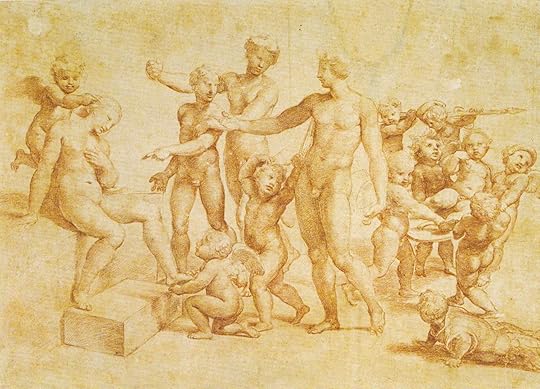
Decent overview of the Renaissance palette-botherer, splitting his short life into clear sections with the focus more on biography than on art criticism. Some attention is paid to the context of 15th-16th century Italy, but in general it's a book about staring at the art. As you'd expect from Taschen, the pictures are big and full-colour and excellently reproduced. The inclusion of some of his chalk sketches is welcome, and really shows what an unbelievable draughtsman he was. The influences section unaccountably fails to mention the red-bandanaed ninja turtle. Otherwise, good.
A 96-page read on one of the most prominent Renaissance painters, Raffaelo Santi/Raphael. As someone who has travelled to Italy from Rome to Florence, I recognize many of the paintings and locations where his work is exhibited, such as the Galleria de Uffizi and Sistine Chapel. He lived for 30+ years and was a master at 17 years old. His passion and ambition to recreate biblical and political history is what made him not just a solid painter, but I would say an exceptional concept artist. It states in the book that he revolutionized the genre of historical painting.
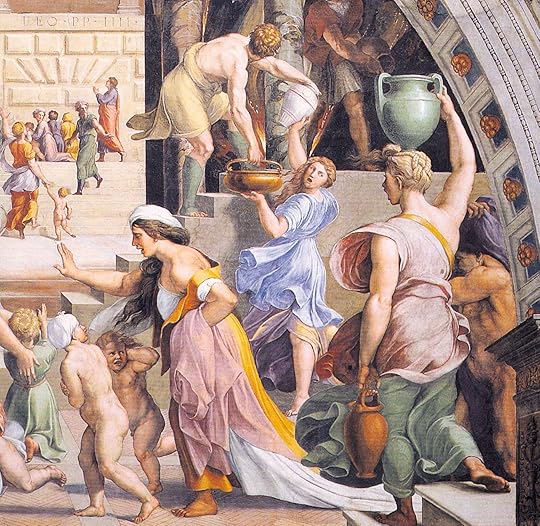
My favorite painting is Galatea (loved the concept behind it, of the giant ogre trying to woo her as in a battle against cupids). The “Expulsion of Heliodorus” and “The Fire in the Borgo” are equivalent to stage-plays. There is a wide-range of action and expression. I appreciate the underdrawings which are much more simple. I also appreciate how Thoenes describes the potential story behind the painting based on the commissioners and Raphael’s personal life.
Che idea aveva l'artista del proprio ruolo? Cosa si proponeva? Per quanto sappiamo, Raffaello non ha mai parlato della sua arte o comunque non ha lasciato testimonianze scritte del suo pensiero. Magari lo avrebbe fatto se fosse vissuto più a lungo [...] Di conseguenza, il cammino verso la comprensione dell'artista passa unicamente per la traccia grafica e pittorica lasciata dalla sua mano, insomma, attraverso i suoi dipinti.
When that cunt Kanye West claimed to be God’s greatest artist of all time, I instantly thought of Michelangelo. This isn’t Michelangelo. It’s another ninja turtle. I’m cautious of how Raphael depicts middle-eastern figures with such white and pale faces but this is still great art.
The writing was reasonable but the images of the artworks were stunning - I was amazed how many pieces the artist managed to complete in his short life.