

What do you think?
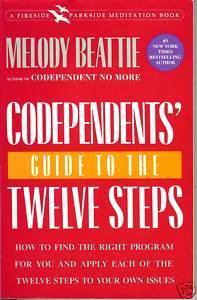
Codependents' Guide to the 12 Steps
The author offers a directory of Twelve-Step groups and teaches codependents how the Twelve-Step principles can help them take their vital first steps toward recovery.
273 pages, Paperback
First published January 1, 1990
Ratings & Reviews
Friends & Following
Create a free account to discover what your friends think of this book!
Community Reviews
Displaying 1 - 24 of 24 reviews

July 24, 2008
OK, you can read all my caveats about 12 Step lit on my reviews of the Big Book and the 12 & 12, but if I was gonna HAVE to do the 12 Steps, I would do them from this book b/c she makes a point of saying that it doesn't have to done exactly as AA Nazis tell you it does, and you can even not have a diety, especially not a male one, as a Higher Power! :)
January 30, 2008
Very good for people working a 12 step program
May 11, 2026
A wealth of comfort and information.
I highlighted the heck out of it!
A keeper, something to go back to.
Highly recommended for people pleasers like me.
I highlighted the heck out of it!
A keeper, something to go back to.
Highly recommended for people pleasers like me.

September 21, 2013
'how recovery programs work. finding the rt one for you. interpreting 12 steps specifically for codependent issues. explains @ step & how to apply to your issues. individual & group exercises & activities.'
everything Melody Beattie does is worth reading. she is for the soul what Stormie Omartian is for the spirit!
everything Melody Beattie does is worth reading. she is for the soul what Stormie Omartian is for the spirit!
October 13, 2008
Easy to read, the author isn't up on a holier-than-thou pedestal, she makes no assumptions about your concept of a higher power. Great program tool for all friends of Lois and Bill. The questions at the end of each chapter are wonderful tools for working the step. Thank you to the author.

August 30, 2007
Very insightful, good guidance.

October 31, 2009
This is my other bible must read.,

January 14, 2011
This is a fabulous journey for anyone who is sick and tired of being sick and tired! Melody is a fabulous story teller, writer and guide through the steps to transformation.

November 24, 2011
the best 12 step literature I've read. written to a wide audience and how to apply the 12 steps to different symptoms while showing the 'causes and conditions' of our soul sicknesses

April 30, 2012
Wonderfully written and a definitive must have for people in recovery.
January 22, 2026
Great book! Favorites:
I needed to become aware of how much pain I was in. I needed to take care of myself. 7
I was trapped, locked into the victim role. People didn't just do things. They did things to me. No matter what happened, each event felt like a pointed attempt to do me in.
My ability to separate myself from others to separate my issues, my business, my affairs, and my responsibilities from the issues, business, affairs, and responsibilities of others-was nonexistent. I blended into the rest of the world like an amoeba.
If someone needed something, I considered that need my personal and private responsibility, even if I was just guessing about what he or she needed. If someone had a feeling, it was my responsibility to work through it for him or her. If someone had a problem, it was mine to solve.
I didn't know how to say no. I didn't have a life of my own. I had a backlog of feelings from childhood, and chances were great that whatever I was reacting to today was probably a patterned reaction from childhood. Two weeks after I got married, I raced home from work, flung open the closet doors, and checked to see if my husband's clothes were still in the closet. I was certain I was going to be abandoned, left. I felt totally unlovable. And I didn't have the foggiest idea what it meant to own my power.
The base I operated from was fear, coupled with low self-esteem. I spent most of my time reacting to other people, trying to control them, allowing them to control me, and feeling confused by it all.
I thought I was doing everything right. Aren't people supposed to be perfect? Aren't people supposed to be stoic? Shouldn't we keep pushing forward, no matter how much it hurts? Isn't it good to give until it hurts, then keep giving until we're doubled over in pain? And how can we allow others to go about their life course? Isn't it our job to stop them, set them straight? Isn't that the right way, the good way, the Christian way?
The codependent way.
As many others have said about themselves, I wasn't me. I was whoever people wanted me to be. And I felt quite victimized and used up by it all. Pg.8
Using our recovery programs to identify, accept, and heal from abuse is no small part of our recovery process. Some recovering people believe this is a core part of the process.
Understand, we do not do this to blame parents or any other persons. We do it to stop denying and begin healing from its impact. Many of us have lived with abuse for so long that we do not even identify abuse as such. We call it normal and make excuses for the perpetrator. Some of us were severely abused and may have complete memory blockage of the abuse.
That doesn't mean the abuse went away. It will haunt us until we are ready to deal with it. This type of work, this deep work, must be approached with caution. It is not to be handled casually or haphazardly. Seek professional help, if necessary. Use judgment and discernment in exploring this area. If this issue applies to you, it will surface in its time -when you are ready and when the time is right to face it.
As Louie Anderson, the comedian, has said, it's not about blame. Often, our parents were more abused than we were. But abused people abuse people. And they hurt themselves. We all need to begin identifying this problem and start healing from it, so it can stop.
Growing up in an addicted family is abusive, not normal. It doesn't produce health, self-esteem, and well-being among its members. Usually, it produces codependency. This condition we call codependency is not new. Addicted families are not new. Recovery is what's new.
We can finally do something to stop the family tradition of codependency, shame, and low self-esteem from being handed down generation to generation. We can begin our own healing Process Pg.74
People who love themselves don't stop growing and chang-ing. People who love and accept themselves are the people who become enabled to change. That is what this Step is about-continuing the process of self-love and acceptance we began in Step One.
People who love themselves do not become self-centered.
They become people able to love others because they love and accept themselves. If anyone told you it was bad or wrong to love yourself, don't believe them. It is the best, healthiest, and most loving thing you can do for yourself and all the people in your life. Pg.76
We also need to make certain that the person with whom we share our deepest secrets will hold our confessions in confidence.
Most agree that it is better not to do a formal Fifth Step with a neighbor, friend, spouse, or other family member: It may backfire and hurt us. We're learning to be vulnerable and honest, but part of taking care of ourselves means we choose carefully who we do that with, so that our information can't be turned on us and used to hurt us.
It's also helpful to find someone who can see the good and the worthwhile in us, especially if we're not yet able to do that ourselves. Pg.90
Sometimes we find that the most troublesome things for many of us, don't seem so bad once we get them into the light. We learn that nobody is perfect and nobody needs to be. But when something bothers us, we need to get it out into the light to be healed from it. If it's bothering us, we need to talk about it. And the more it bothers us, the more shame and self-hatred it causes, the more it controls us and our lives, the more important it is to bring it out. Pg.90
"I always learn the hard way. But come to think of it, so do most people. Rarely have I heard a person say, 'I learn the easy way.' "
Gary E. Pg.100
I don't believe that we act out because we're defective or bad. I believe we act codependently because we're wounded.
And telling someone who's wounded that she is defective or has sinned or falls short of the mark is abusive. Now this philosophy doesn't give anyone permission to continue to harm themselves or another person, but it seems more compassionate.
Whether we call them defects of character or our protective devices Pg. 101
Lessons don't go away. They keep repeating themselves until we learn. In fact, when it's time to change, it becomes harder to stay the same than it does to change. Pg.109
Some relationships have come into my life to make me strong, teach me how to own my power, and show me how to set boundaries. Some have come into my life to bring healing. Some have come in to bring and inspire gifts of creativity, spontaneity, nurturing, femininity, and support, or to help me believe I deserve the best that life and love have to offer. Some have come to show me what I don't want. Some are here to show me what I do want.
Our relationships, many say, are a mirror of our issues and our goals, a reflection of us. Each has a gift. Letting go of resentment and bitterness is the key to unlocking that gift. We can say thank you for each gift. There is a place in our hearts that will put us on the right course with people and ourselves. That place is l willingness to make amends, willingness to achieve healing in our relationships with people, and willingness to find the gift. When we achieve that place, when the idea of willingness begins to enter our minds, even before it has worked its way down into our hearts, it's already beginning to happen. We are beginning to open ourselves to the reparation, healing, and love available to us in our relationships. We are ready to begin to love ourselves, and others, unconditionally. This attitude doesn't mean we stay in relationships that have reached their time to end. It doesn't mean we have to go back to relationships that aren't good for us. It doesn't mean we surrender to any treatment from any person who isn't good for us. If someone treated us badly, our lesson from that relationship was learning to own our power and find our own liberation. What we do in recovery is what one woman, Beth, calls "realigning myself with my relationships.” But to begin that realignment, to find that place of peace with self and others, we need to be willing. Becoming willing does not mean we deny what is or has happened. It does not mean we forfeit ourselves or give away our power with people. It means we become ready to open our hearts to people, despite what has happened. Pg.128
Healing begins within us. It begins with a thought, a vision, a feeling of willingness. A great chain of healing and love begins when we make the decision to take care of ourselves with people and to come to a place of peace about our relationships.
We take ourselves out from under the control and influence of others and their addictions; we align ourselves with recovery, ourselves, and our Higher Power. We are beginning to own our power in new ways, ways that we have not known before. We are taking ourselves out of anxiety, shame, and guilt, and stepping into peace. We have stopped fussing over others. We have taken the risk to look within. Now, we are asked to take an even greater risk- that of quietly, but clearly, accepting responsibility for ourselves and our behaviors. This Step, and the next, heals our relationships with ourselves and others. We are on our way to learning to own our power in any circumstance and in any situation. We are learning how to stop allowing others to victimize us and to stop victimizing ourselves. We are giving up our victim role. We are part of a new consciousness. It is this recovery work that each of us is doing that will stop the chain of victimization and abuse-not just in our lives, but in those around us. Pg.129
Many of us have wanted to change the world. Well, we are simply and quietly, by doing our own work and our own healing. Pg.130
The purpose of amends is not to change others or expect anything different from them. The purpose of amends is to take responsibility for our own behavior, clean up any messes we've made, and feel good about our conduct in relationships. Pg.142
there are times when bringing up what we have done and then apologizing for it would make matters worse. If we have allowed ourselves to become hooked into a particular person, allowed them to control us, or if we have been rescuing them, then feeling victimized by it, we may make the relationship worse by mentioning this. "Hey! I've been letting you control me. I've been rescuing you because I really didn't believe you could take care of yourself. Now I'm going to stop!" That may make things worse because it sounds more like a confrontation than an amend. Understand that it is sometimes important to state these kinds of intentions. Sometimes the best possible course we can take is to seek the path of our own self-care quietly. Pg. 145
We don't have to apologize for our anger--only the inap. propriate behaviors surrounding our anger. We don't have to apologize for taking care of ourselves, dealing with feelings, setting boundaries, having fun, feeling good, or becoming healthy We don't have to apologize because people are trying to control us and induce guilt in us. We don't have to apologize for being, for being here, and for being who we are. We don't have to apologize for not wanting to be abused or mistreated. If we're doing all the apologizing for other people's behavior, it doesn't leave room for the people who truly need to apologize to do that. Pg.148
The most powerful form of helping others comes from helping ourselves. When we do our own work, feel our own feelings, change our own beliefs, and take care of our selves, when we are honest and open about who we are and what we are working on, we affect others more than by our best-intentioned helping gestures. We cannot change others, but when we change ourselves, we may end up changing the world.
Each time we do our own work or a piece of it, each time we take a step forward, we pull the collective consciousness of the recovery movement forward. Pg.190
I needed to become aware of how much pain I was in. I needed to take care of myself. 7
I was trapped, locked into the victim role. People didn't just do things. They did things to me. No matter what happened, each event felt like a pointed attempt to do me in.
My ability to separate myself from others to separate my issues, my business, my affairs, and my responsibilities from the issues, business, affairs, and responsibilities of others-was nonexistent. I blended into the rest of the world like an amoeba.
If someone needed something, I considered that need my personal and private responsibility, even if I was just guessing about what he or she needed. If someone had a feeling, it was my responsibility to work through it for him or her. If someone had a problem, it was mine to solve.
I didn't know how to say no. I didn't have a life of my own. I had a backlog of feelings from childhood, and chances were great that whatever I was reacting to today was probably a patterned reaction from childhood. Two weeks after I got married, I raced home from work, flung open the closet doors, and checked to see if my husband's clothes were still in the closet. I was certain I was going to be abandoned, left. I felt totally unlovable. And I didn't have the foggiest idea what it meant to own my power.
The base I operated from was fear, coupled with low self-esteem. I spent most of my time reacting to other people, trying to control them, allowing them to control me, and feeling confused by it all.
I thought I was doing everything right. Aren't people supposed to be perfect? Aren't people supposed to be stoic? Shouldn't we keep pushing forward, no matter how much it hurts? Isn't it good to give until it hurts, then keep giving until we're doubled over in pain? And how can we allow others to go about their life course? Isn't it our job to stop them, set them straight? Isn't that the right way, the good way, the Christian way?
The codependent way.
As many others have said about themselves, I wasn't me. I was whoever people wanted me to be. And I felt quite victimized and used up by it all. Pg.8
Using our recovery programs to identify, accept, and heal from abuse is no small part of our recovery process. Some recovering people believe this is a core part of the process.
Understand, we do not do this to blame parents or any other persons. We do it to stop denying and begin healing from its impact. Many of us have lived with abuse for so long that we do not even identify abuse as such. We call it normal and make excuses for the perpetrator. Some of us were severely abused and may have complete memory blockage of the abuse.
That doesn't mean the abuse went away. It will haunt us until we are ready to deal with it. This type of work, this deep work, must be approached with caution. It is not to be handled casually or haphazardly. Seek professional help, if necessary. Use judgment and discernment in exploring this area. If this issue applies to you, it will surface in its time -when you are ready and when the time is right to face it.
As Louie Anderson, the comedian, has said, it's not about blame. Often, our parents were more abused than we were. But abused people abuse people. And they hurt themselves. We all need to begin identifying this problem and start healing from it, so it can stop.
Growing up in an addicted family is abusive, not normal. It doesn't produce health, self-esteem, and well-being among its members. Usually, it produces codependency. This condition we call codependency is not new. Addicted families are not new. Recovery is what's new.
We can finally do something to stop the family tradition of codependency, shame, and low self-esteem from being handed down generation to generation. We can begin our own healing Process Pg.74
People who love themselves don't stop growing and chang-ing. People who love and accept themselves are the people who become enabled to change. That is what this Step is about-continuing the process of self-love and acceptance we began in Step One.
People who love themselves do not become self-centered.
They become people able to love others because they love and accept themselves. If anyone told you it was bad or wrong to love yourself, don't believe them. It is the best, healthiest, and most loving thing you can do for yourself and all the people in your life. Pg.76
We also need to make certain that the person with whom we share our deepest secrets will hold our confessions in confidence.
Most agree that it is better not to do a formal Fifth Step with a neighbor, friend, spouse, or other family member: It may backfire and hurt us. We're learning to be vulnerable and honest, but part of taking care of ourselves means we choose carefully who we do that with, so that our information can't be turned on us and used to hurt us.
It's also helpful to find someone who can see the good and the worthwhile in us, especially if we're not yet able to do that ourselves. Pg.90
Sometimes we find that the most troublesome things for many of us, don't seem so bad once we get them into the light. We learn that nobody is perfect and nobody needs to be. But when something bothers us, we need to get it out into the light to be healed from it. If it's bothering us, we need to talk about it. And the more it bothers us, the more shame and self-hatred it causes, the more it controls us and our lives, the more important it is to bring it out. Pg.90
"I always learn the hard way. But come to think of it, so do most people. Rarely have I heard a person say, 'I learn the easy way.' "
Gary E. Pg.100
I don't believe that we act out because we're defective or bad. I believe we act codependently because we're wounded.
And telling someone who's wounded that she is defective or has sinned or falls short of the mark is abusive. Now this philosophy doesn't give anyone permission to continue to harm themselves or another person, but it seems more compassionate.
Whether we call them defects of character or our protective devices Pg. 101
Lessons don't go away. They keep repeating themselves until we learn. In fact, when it's time to change, it becomes harder to stay the same than it does to change. Pg.109
Some relationships have come into my life to make me strong, teach me how to own my power, and show me how to set boundaries. Some have come into my life to bring healing. Some have come in to bring and inspire gifts of creativity, spontaneity, nurturing, femininity, and support, or to help me believe I deserve the best that life and love have to offer. Some have come to show me what I don't want. Some are here to show me what I do want.
Our relationships, many say, are a mirror of our issues and our goals, a reflection of us. Each has a gift. Letting go of resentment and bitterness is the key to unlocking that gift. We can say thank you for each gift. There is a place in our hearts that will put us on the right course with people and ourselves. That place is l willingness to make amends, willingness to achieve healing in our relationships with people, and willingness to find the gift. When we achieve that place, when the idea of willingness begins to enter our minds, even before it has worked its way down into our hearts, it's already beginning to happen. We are beginning to open ourselves to the reparation, healing, and love available to us in our relationships. We are ready to begin to love ourselves, and others, unconditionally. This attitude doesn't mean we stay in relationships that have reached their time to end. It doesn't mean we have to go back to relationships that aren't good for us. It doesn't mean we surrender to any treatment from any person who isn't good for us. If someone treated us badly, our lesson from that relationship was learning to own our power and find our own liberation. What we do in recovery is what one woman, Beth, calls "realigning myself with my relationships.” But to begin that realignment, to find that place of peace with self and others, we need to be willing. Becoming willing does not mean we deny what is or has happened. It does not mean we forfeit ourselves or give away our power with people. It means we become ready to open our hearts to people, despite what has happened. Pg.128
Healing begins within us. It begins with a thought, a vision, a feeling of willingness. A great chain of healing and love begins when we make the decision to take care of ourselves with people and to come to a place of peace about our relationships.
We take ourselves out from under the control and influence of others and their addictions; we align ourselves with recovery, ourselves, and our Higher Power. We are beginning to own our power in new ways, ways that we have not known before. We are taking ourselves out of anxiety, shame, and guilt, and stepping into peace. We have stopped fussing over others. We have taken the risk to look within. Now, we are asked to take an even greater risk- that of quietly, but clearly, accepting responsibility for ourselves and our behaviors. This Step, and the next, heals our relationships with ourselves and others. We are on our way to learning to own our power in any circumstance and in any situation. We are learning how to stop allowing others to victimize us and to stop victimizing ourselves. We are giving up our victim role. We are part of a new consciousness. It is this recovery work that each of us is doing that will stop the chain of victimization and abuse-not just in our lives, but in those around us. Pg.129
Many of us have wanted to change the world. Well, we are simply and quietly, by doing our own work and our own healing. Pg.130
The purpose of amends is not to change others or expect anything different from them. The purpose of amends is to take responsibility for our own behavior, clean up any messes we've made, and feel good about our conduct in relationships. Pg.142
there are times when bringing up what we have done and then apologizing for it would make matters worse. If we have allowed ourselves to become hooked into a particular person, allowed them to control us, or if we have been rescuing them, then feeling victimized by it, we may make the relationship worse by mentioning this. "Hey! I've been letting you control me. I've been rescuing you because I really didn't believe you could take care of yourself. Now I'm going to stop!" That may make things worse because it sounds more like a confrontation than an amend. Understand that it is sometimes important to state these kinds of intentions. Sometimes the best possible course we can take is to seek the path of our own self-care quietly. Pg. 145
We don't have to apologize for our anger--only the inap. propriate behaviors surrounding our anger. We don't have to apologize for taking care of ourselves, dealing with feelings, setting boundaries, having fun, feeling good, or becoming healthy We don't have to apologize because people are trying to control us and induce guilt in us. We don't have to apologize for being, for being here, and for being who we are. We don't have to apologize for not wanting to be abused or mistreated. If we're doing all the apologizing for other people's behavior, it doesn't leave room for the people who truly need to apologize to do that. Pg.148
The most powerful form of helping others comes from helping ourselves. When we do our own work, feel our own feelings, change our own beliefs, and take care of our selves, when we are honest and open about who we are and what we are working on, we affect others more than by our best-intentioned helping gestures. We cannot change others, but when we change ourselves, we may end up changing the world.
Each time we do our own work or a piece of it, each time we take a step forward, we pull the collective consciousness of the recovery movement forward. Pg.190

January 17, 2017
Yet another Melody Beattie book. Luckily this one was far superior to Stop Being Mean to Yourself and more along the level of helpfulness that books like Codependent No More occupy. Or perhaps a nice mixture between that and Choices. It's a good workbook, with an ample bibliography at the end to help anyone delve deeper into whatever area of focus they feel would be most helpful for themselves.
The Twelve Steps are commonly viewed as ways to break addictions such as Alcoholism or Narcotics abuse. The Twelve Steps related in this book are a way to reframe your world so that you can learn to live with, and correct, Codependent Behavior. Each chapter details a Step and how to Work it effectively and incorporate it into your own life. Each chapter ends with Activities. This is a complete workbook, an even includes glossaries, groups, books, and other helpful resources at the end.
I would be hardpressed to criticize this book at all. I believe that it is a valuable resource and that most people would be able to benefit from the advice therein. Even if you do not suffer from codependent behaviors, reading this book could help you understand better the people in your life who do and how to relate with them more effectively.
The Twelve Steps are commonly viewed as ways to break addictions such as Alcoholism or Narcotics abuse. The Twelve Steps related in this book are a way to reframe your world so that you can learn to live with, and correct, Codependent Behavior. Each chapter details a Step and how to Work it effectively and incorporate it into your own life. Each chapter ends with Activities. This is a complete workbook, an even includes glossaries, groups, books, and other helpful resources at the end.
I would be hardpressed to criticize this book at all. I believe that it is a valuable resource and that most people would be able to benefit from the advice therein. Even if you do not suffer from codependent behaviors, reading this book could help you understand better the people in your life who do and how to relate with them more effectively.

December 4, 2021
"The journey has not been easy. It has been good, but sometimes difficult. Sometimes I believe the good parts have been harder than the pain. Despite my success, things still don't always work out the way I want. But they happen as they are meant to happen. And I am still in awe of what happens when I let go. And comfort is always available. I am trusting that God will keep directing me in this journey."

July 28, 2008
Awesome.

July 1, 2009
I've read this through a number of times in group settings. Each time, I still get a lot of ideas on how to improve my relationships with others and how I treat myself.
September 9, 2011
It is a good book and worth reading, but not my favorite of Melody's books so far.
January 10, 2019
Melody Beattie never disappoints. A friend recommended this to me and I enjoyed it. It made some points as it relates to the 12 Steps and how they apply to codependent recovery vs. addictions and it was very informative; Step 4 and Step 12 were particularly enlightening. All good interesting stuff. If you haven't read this one, are familiar with 12 steps program, and think you might be codependent, reading this is a must.
September 4, 2018
It was brilliant when first read but time has made it less so
October 6, 2019
I can't wait to read it

July 2, 2023
Anything Melody Beattie is 5 stars.

March 21, 2024
Transformative.
July 15, 2024
Needed this read right now for sure -
March 18, 2025
Life-changing book for me. Highly recommend to anyone struggling with codependency.

November 5, 2013
Read this book a long time ago and I remember that I didn't like it. Looks like I didn't really finish it.
Displaying 1 - 24 of 24 reviews