The Dark Knight continues his crusade as defender of Gotham City, taking on his greatest foes during a breakout at Arkham Asylum. But when his enemies gain powers and abilities far beyond their normal capacities, the Caped Crusader's crusade may finally be at an end!
Artist discovered by Topcow comics. Worked on various comics including Cyberforce, Witchblade, Tales of the Witchblade, Darkness and his creator own title Ascension. He also co-created Aphrodite 9. The artist then moved on to working for Marvel comics including the titles New Avengers, Ultimate X-men, Wolverine covers, and various others.
Librarian note: There is more than one author in the GoodReads database with this name
(B) 74% | More than Satisfactory Notes: A brag-book artistic showcase, it’s formulaic eye-candy, portioning by plot a daisy-chain of cheesecake and fisticuffs.
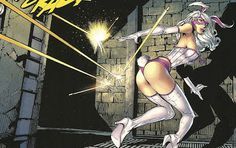
It's not good, it's not bad. It's stuck somewhere it the realm of utterly forgettable. Something, something, bad guys on super-venom. One thing this one does give you is a window into Batman's inner thoughts. Unfortunately, his inner thoughts aren't all that interesting. For some reason he's also (sort of) dating yet another bad girl. Maybe. And you wanna know what? I'm going to tell you anyway. Normally, I don't get all femi-nazi over the way comics portray women, but something about that White Rabbit chick just rubbed me the wrong way. Nothing about the way she was dressed could be in any way defended. Hello? She doesn't look like Alice's White Rabbit at all. She looked like a straight-up Playboy Bunny.
I mean, if she was going for a 'rabbit' look, she would have been wearing an Easter Bunny costume. And as far as I could tell, the costume had no useful function to it...unless the goal was to get her pursuers to trip over their erections. Ok. End of the rant.
If you're out of stuff to read, this this is would be an ok book. But don't be in a big hurry to get your mitts on Knight Terrors.
The most original plot device opens this Batman book: the inmates all escape from Arkham Asylum! Oh wait, that's not original, that's basically every other month. Newly freed, the inmates begin wreaking havoc on Gotham (so many windows smashed!) except some of them as displaying inordinate muscle mass and strength - almost like they're on venom... This new toxin has the added bonus of removing fear from the user so they are no longer afraid of the Dark Knight or any of Gotham's other masked vigilantes. But who's behind this new toxin? And a new character pops up, a skimpily dressed woman in bunny ears and tail - time for Batman to follow the White Rabbit; he doesn't want to be late...
The plotting of the book isn't bad, even though there are way too many characters crowding the pages. There are so many cameos from a whole range of the DCU, you'll feel swamped. But the story is fairly interesting and keeps you turning the pages, if only to find out who this White Rabbit character is. Her appearance though is fairly contrived - she is dressed as a lingerie model throughout. There is so much gratuitous T&A in this book purely for the boys to gawp at.
There's a lot of Lewis Carroll/Alice in Wonderland references in Batman generally isn't there? Besides the White Rabbit, writer Joe Harris (who?) pens a one-shot featuring Jervis Tetch aka Mad Hatter and Tweedle Dee and Tweedle Dum as if to hammer home the Wonderland references - to no real effect, other than making the reader wonder why that children's book has such an impact in Batman's world.
Writer Paul Jenkins has real trouble with dialogue and I found his characterisations wildly off. The book starts awkwardly with Bruce Wayne mangling a metaphor of fear and cannibalism that doesn't quite make sense, and from then on I never felt Jenkins had a strong hold on the characters to make them feel like they were who they are. Jim Gordon is good example - he spends most of the book leaving weepy voice messages on Bruce Wayne's mobile, wondering where his pal Batman is. This isn't Gordon's character!
The book rounds out with a one-shot written by Judd Winick. "I Can No Longer Be Broken" is about the Talon from Scott Snyder's "Court of Owls" storyline, giving him a backstory and reminding the reader they'd rather be reading that story arc than this rather lacklustre one about Batman chasing a new strain of venom.
"Knight Terrors" is an entertaining enough story but could've been great with a more competent writer on board (where's Paul Dini in this reboot?) and a weak final act lets the book down. David Finch's art is fantastic as always and for fans of the "Court of Owls" storyline, the book is worth a look for the "Talon" issue, but overall this is an underwhelming start to the new "Dark Knight" series though out of the 3 Batman lines started in the "New 52" it is slightly better than the god-awful "Detective Comics" but nowhere near as good as Snyder/Capullo's "Batman" run.
For some reason this Batman story felt kind of “old school”, but in a good way. Knight Terrors runs a whole gamut of classic Bat villains, but something sinister is afoot: they’re all seriously powerful and amped up on some drug (sound familiar?). Yep, it’s like that –the 80s all over again. This series isn’t a reboot; it refers to events in the previous DC continuity.
Knight Terrors is pretty violent and bloody; this isn’t a comic you’ll want lying around for the kids to read. I’ve heard the same thing regarding the New 52 Detective Comics series but I haven’t read that yet. Something amusing: Batman gets heavily beaten up at one point… so you’d think that Bruce Wayne would at least sport a few bruises or a black eye the next day. But you’d be wrong. This is either a very good ad for make-up or an inconsistency by the creative team – take your pick. It didn’t put me off the story though. I rather liked Knight Terrors. I can see how some people won’t, to be fair… it’s rather action oriented and not as sophisticated (or cinematic) a story as the City of Owls arc being explored in the other New 52 Batman series. Speaking of which, there is a crossover in the last issue collected here, featuring one of the Talons of the Court of Owls. Also: The Flash and Superman both make appearances in Knight Terrors.
I am, of course, of the opinion that there are way, way too many Bat-related titles out there at the moment (anything from Batman incorporated through Batgirl, Batwoman and Batwing – what’s next? BatLantern? Oh wait, they did that already) so it’s debatable whether there really needs to be a Dark Knight series in addition to Batman, Detective Comics and Batman & Robin. However, I’ll continue reading the series. Even if it is just for the art (which is great, by the way)… and the mayhem… and the female villain that looks like a Playboy Bunny!
Reading all New 52 Bat-titles this year is self-obligatory which was why I knew that I was going to pick this up--granted, later rather than sooner because I was quite aware of the lukewarm response a lot of fans and critics share when it came to Paul Jenkins and David Finch's first nine issues collected in this particular volume misleadingly entitled Knight Terrors.
It took me only two nights to finish this entire thing and even while I was midway through, I was already patting myself in the back for making a wise decision to simply review it later as a volume as oppose to the usual per-single issue quota that I've been doing since April. And I'll tell you why:
Knowing that the quality of writing for this one was subpar due to my research on other comic book websites, I decided that The Dark Knight might be best reviewed as a collected work for the most understandable reason ever: I DO NOT WANT TO REPEAT THE SAME INCIDENT WITH TONY DANIEL'S DETECTIVE COMICS which, if you've read my reviews for each of his issues in that title before, WAS LIKE WILLINGLY STEPPING INTO A CIRCLE OF HELL TO GET NEEDLESSLY TORTURED FOR A SIN I HAVE COMMITTED IN ANOTHER LIFE. It had been such a depressing week for me since I read Daniel's run last month, and I vowed from then on (after deciding to read and review his second volume as a collected work though it was already too late by then; the damage has been done) that I will NEVER READ AND REVIEW whatever heavily criticized Bat-title INDIVIDUALLY again.
Hence why I am only posting this review for the first volume and for the second one before the year ends. And boy, I can't tell you how relieved I am right now while calmly typing this review.
Just like with Daniel, the quality of artwork for this title was the only best thing it had to offer consistently. Jenkins and Finch's nine issues were beautifully drawn with luscious illustrations colored splendidly. I loved Finch's depictions of Batman in a lot of panels and there are strong visual choices that really made me pause reading (which is probably not that difficult to do, mind you) just so I can stare at a particular landscape or an entire page filled with the most minuscule yet interesting background details. There is a great energy and motion in Finch's art that I admired all the while the writing end of the spectrum made me laugh so hard aloud once or five times while reading.
And this is actually a good thing for me. The writing wasn't shitty enough if I compare it to Daniel's which HAD NEVER MADE ME CRACK A SMILE. Jenkin's writing at least made me throw my head back and laugh. And that's because the first five issues of this volume are "RIDONCULOUS" which is an adjective I hope to never use again and yet it seemed to be the best one to describe what I just read in their scope, dialogue and plot. I even screencapped some panels and posted them on my Goodreads notes because I felt the need to share to the rest of the cyberspace the absurd bullshit fun I was reading.
My favorite moments include that roided-up Clayface-as-Joker hugging Batman ("Come on, hugs!" he says which made me almost spit out the coke I was snorting drinking); and that random shot of Batman HOLDING A FUCKING ICE CREAM CONE which Alfred had given him one night while they were talking about the mission at hand. I will forever wonder what happened to that ice cream cone. It was never shown again in the next panels. Did Batman just finish it in one gulp and not get a brain freeze, like the badass he is? Or did he spend some time licking the damn thing off-screen while he as inside the Batmobile? These are just the many questions I never thought I will ask and then get frustrated when they were never answered.
Who am I to rob you of these pristine beauties? It would be an injustice so, here, allow me to bequeath you with said panels:
A notable thing that I want to bring up for this volume is the fact that it made use of the Alice in Wonderland allegory which I was actually fine with. I'm an avid Lewis Carroll fan, especially his Alice character, and the fact that we have Mad Hatter as part of the rogues gallery here in Batman is a treat for me. However, I don't think Jenkins did a good job applying this allegory on his stories for this volume, especially his incorporation of the White Rabbit lady whom I loathed because she was so uncomfortably blatant in the pages. She's basically a sexy girl in a white lingerie and bunny ears, like some Playboy knock-off prancing around coquettishly, making suggestive remarks to Batman about how far down the rabbit-hole goes. Her insertion in the issues was confusing and forced, and did not help me appreciate what I was reading, truth be told.
By the sixth to seventh issues where Bane was the focus, I was shockingly happy about it because I retain that those issues have to be the most enjoyable ones I have read for the volume--and judging from my previous review of the Knightfall Omnibus volume one last July, y'all should know that I am not the biggest fan of the venom-totting guy. That said, I loved Bane and Batman's confrontational fight scenes, and the tonality of the dialogue sounded better too whereas in the previous five issues they were often out-of-character (most particularly Gordon's. He's a bit weepy and clingy with Batsy, by the way. I don't understand why he's acting like some scorned ex-girlfriend or something). The eighth issue was plenty of exciting read too with a few moments to criticize in between. Again, we get another Alice allegory but it was pretty acceptable with the plot.
Finally, we have the Night of the Owls tie-in for issue #9 which I remember reading way back so I didn't bother reading it again because I also recall it was one of the weakest of the tie-in bunch too. So that's Knight Terrors, ladies and gents.
With a fabulous artwork by David Finch, the volume was a visual achievement but the writing by Paul Jenkins and Finch themselves lacked any kind of memorable moments except those that were utterly ridiculous and out-of-character. Still, there is some potential here and pieces of the plot that can be salvaged and improved upon.
Since I didn't have to individually examine each issue, it helped me enjoy even the most irritating bullshit this volume offered, hence why I can give it a generous rating below and just happily walk away so I can start reading Grant Morrison's New 52 line-up for Batman Incorporated by next week.
I must admit: I'm a Bat-whore. The Batman franchise is one of those few franchises I have loved since childhood (Star Trek being the other), when my mother and I would watch reruns of the old Adam West series on Nick At Nite. I've been with Batman through the Tim Burton films (which blew away all memory of Adam West's rendition of the character), through Paul Dini's masterful animated incarnation, beyond the horror of the Joel Schumacher ruinations (though I have to admit: "Batman Forever" is a guilty pleasure, and as bad as it was, "Batman & Robin" is good for a campy laugh now and then), all the way through Christopher Nolan's masterpiece distillations of the character. While I greatly appreciate the early work done by Bob Kane and Bill Finger and I can... TOLERATE the campier version of the character popularized during the 1960s and 1970s, I grew up reading the Post-Crisis On Infinite Earths version of Batman (greatly inspired by Frank Miller's seminal classic "The Dark Knight Returns" and kicked off by Miller's much-acclaimed "Year One"), so this is the Batman I am accustomed to: the paranoid, obsessively master-of-all-trades super-powerless bad-ass masquerading as yet another WASPy half-wit member of the drunken elite "trust fund babies", a clueless male Paris Hilton by day, brilliant-but-brooding nigh-Olympiad techie detective/crime scene investigator/one-man intelligence service mourning the loss of his beloved parents via hunting down criminal scum by night.
When DC announced it's "The New 52" reboot but reported that Batman's chronology would remain largely the same (which it hasn't, but that's a bitchfest for another time), I was greatly pleased. When they announced what books would be released first and who the creative teams behind the books would be, I was ecstatic (especially seeing preview pics of Greg Capullo's stunning work on "The Court of the Owls"). However, there was ONE Bat-book that didn't impress me at all for some reason. It wasn't that I didn't look forward to the book; it just didn't grab me the same way that the stories and creative teams from "Batman", "Detective Comics", "Batman & Robin", "Batgirl" and "Nightwing" would.
As you've no doubt guessed, this - "Batman: The Dark Knight" - was the book in question. I should've gone with that initial gut instinct... Batman would've.
My first impressions of the premiere issue were lackluster, to say the least. When a new Batman book debuts, the book will invariably bring to mind an earlier version of the character in the Batman fan's memory. If your Batman comic makes me think of the following, then you've done well: * Tim Burton's "Batman" and "Batman Returns"; * "Batman: The Animated Series"; * "Batman: Arkham Asylum" (characters, not necessarily plotwise); * Christopher Nolan's Batman trilogy; * Frank Miller's "The Dark Knight Returns" and "Batman: Year One" (but NOT "The Dark Knight Strikes Again" or anything following that); * Any Batman book with the name "Jeph Loeb" on the cover.
If your Batman book makes me think of Joel Schumacher, you have passed beyond the boundaries of mere failure and have plunged headlong into the miasma of franchise destruction. This is the point when longtime fans begin asking themselves: "Is the writer's plotting and dialogue so terrible on accident, or is he purposely trying to destroy the character?" This isn't necessarily a bad thing, mind you. Garth Ennis despises the concept of super-heroes, yet he has penned some fantastic super-epics. When someone reviewing your work uses descriptive phrases like "Prequel Era George Lucas" to describe your writing (and you'd better believe I WILL be in this review), you suck worse than a supermassive black hole at the center of the galaxy and need to seriously reconsider writing comic books as a viable career option.
Let's take a closer look at this disaster...
--- SPOILERS! SPOILERS! ---
Sam Quixote already mentioned the cliche manner this story begins. Beginning a story with an inmate escape at Arkham Asylum has been done to death so many times even Nightwing has made a running joke about Arkham's "revolving door" policy. Bars in real life have "Ladies' Night"; bars in downtown Gotham have "Arkham Night": no cover charge for any patron still wearing their straight-jacket.
Oh, but this time the Batman villains are displaying powers and abilities beyond the norm (what's "norm" for them, anyway) and are acting without the typical fear they possess for Batman. While a novel concept at first, the idea quickly grows tiresome.
The most effective uses of the "inmates escaping Arkham" concept I've seen were in the "Knightfall" saga (essentially, Bane was Batman's version of Doomsday) and in the epic "No Man's Land" tale. In "Knightfall", Batman had already been running in high stress mode for some time and his health was slowly deteriorating with every villain he fought. Seeking to conquer Gotham's Dark Knight and claim the city as his own, Bane released numerous inmates from Arkham in order to weaken Batman further until Wayne was ready to drop from sheer mental and physical exhaustion before Bane finally confronted him at Wayne Manner (as Bane had somehow already deduced Batman's secret identity). Several issues focused on Batman trying to round up all the Arkham escapees while being stalked by the muscle-bound madman in a luchador mask. In "No Man's Land", a massive earthquake hits Gotham (which had already been hit pretty hard by a highly infectious pathogen designed by Ra's al Ghul). Arkham Asylum was relatively untouched, its recently-upgraded security measures keeping its inmates confined to the Asylum complex. However, as Gotham City proper deteriorated and city services (water, electricity, emergency medical services, et all) shut down in the wake of the disaster, the inmates at Arkham faced starvation. Rather than think of the safety of Gothamites first, bleeding heart senior psychiatrist Dr. Jeremiah Arkham released the inmates to allow them the chance to survive in the ruins of Gotham rather than starve inside the asylum. Naturally, the inmates flooded Gotham's streets, and the worst of the inmates carved large swaths of the city apart in brutal gang wars. Since Gotham's police were busy trying to maintain some shred of order & rescue victims of the 'quake and Bruce Wayne was in Washington, D.C. petitioning for Federal aid for Gotham, no one was able to prevent Batman's rogues gallery from eventually transforming a post-earthquake Gotham City into an active warzone with Batman's regular villains as feudal lords.
Sadly, this story has none of the brutal, well-plotted panache of "Knightfall" or "No Man's Land", and the inmate escape - even with the inmates acting like muscle-pumped jocks on a 'roid rage - rarely seems like more than a minor inconvenience to Batman. "Ho hum, they escaped again. Bring out the Bat-tasers. Beatings for everyone!"
Probably the worst part of this segment of the story is the reveal of the drug-addled Harvey "Two-Face" Dent, now calling himself "One-Face" as the drug has apparently reconciled both his Two-Face and Harvey personas into one monstrous, fearless mess. Merely reading the name "ONE-FACE" was cringe-inducing enough, but the dialogue was an absolute mess that gave me really, really bad "Batman & Robin" flashbacks. Reading this comic was less a literary experience and more like a really bad drug trip, minus the fun of actually being on drugs.
As Quixote mentioned in his review, "Alice & Wonderland" references abound in this story, from appearances from the Mad Hatter, Tweeldedee and Tweedledum to the new villainess of the story, a rabbit-eared, white lingerie-clad reject from the Playboy Mansion calling herself the "White Rabbit". (God, now I'm having flashbacks to "The Matrix Reloaded". Quit making me think of bad movies, comic book!)
Now, I'm a happily heterosexual male and I enjoy depictions of the female form as much as the next heterosexual male, but DC Comics villainesses in the Batman family seem to be wearing less and less clothing lately. Less clothing does NOT make a villainess sexy; their attitude, the way they are written, makes them sexy. The artwork either enhances or detracts from that.
Moreover, Batman villainesses have displayed various types of "sexy" over the years, from the bizarre (Poison Ivy has made many a male want to go vegan) to the fetishistic (Catwoman was a dominatrix in Frank Miller's "Year One", hence her characteristic cat-o-nine-tails whip) and the downright frightening (Harley Quinn - sweet, girly, cutesy, demure Harley - is totally devoted to a sadistic, psychopathic killer clown who carves smiles into his victim's corpses, poisons people with lethal overdoses of laughing gas, and once beat a teenage boy - Robin #2, Jason Todd - nearly to death with a crowbar before leaving him in a warehouse with a timebomb). Nevertheless, the Batman villainesses have managed to be sexy without having to resort to wearing naught but lingerie. (Poison Ivy: essentially a one-piece bathing suit with a plant pattern; Catwoman: skintight full-body leather bodysuit, technically a form of very-light leather armor; Harley Quinn: full-body Spandex jester's costume, in keeping with her clownish character; Talia al Ghul: anything from a stylish, conservative business suit as CEO of LexCorps to skintight, full-body black leather tactical gear as head of the League of Assassins. All the skintight clothing makes sense in a combat situation: less loose cloth means less for the enemy combatant to grab and use as leverage to throw you across the room.)
That seems to have changed with "The New 52". While Power Girl has gone refreshingly conservative with her wardrobe and closed the silly cleavage hole her past costumes have possessed, the Batman villainesses are tarting it up, wearing less and less. In the new Suicide Squad, Harley Quinn 2.0 wears a corset and bathing suit bottoms, sports a short shock of black-and-red dyed hair and looks less like the cheerful Harlequin and more like a generic punk rocker. Her personality is totally gone, replaced by a generic "bad girl" 'tude and the sort of clothing one might find in a fetish shop.
This new villainess is no exception. What's her costume? White lingerie. Bunny ears. An eye-covering mask. A rabbit tail. That's it. She's a Playboy bunny who fled from Hefner's palatial manse (probably next door to Bruce's; where do you think Wayne finds all his dates?) to start a life of crime in Gotham City. No real personality to speak of outside of Alice & Wonderland quotes, which we already got from the Mad Hatter (who had more style). No real air of menace. A little bit of "Who IS she?" mystery, but that's all. A dab of mystery and gratuitous T&A does NOT a character make.
If all I wanted from a female comics character was lots of cheesecake, I'd watch porn instead. Give me characters with real personality or stop writing!
Granted, the "Who Done It?" mystery at the heart of the story is intriguing enough to keep someone reading, but - again, as Quixote noted in his review - the dialogue and characterization is a train-wreck. At one point, Batman asks Alfred to scour the Internet for information on the White Rabbit and gives Alfred her description: rabbit ears, lingerie. Alfred actually makes a joke about surfing the 'Net for porn out of this, and Bruce *smiles*.
BATMAN DOES NOT SMILE.
Unless he's about to beat someone senseless for not telling him where the Joker is before he can prevent a bomb from filling City Hall with laughing gas, that is. But that's it! Batman doesn't smile!
And since when did genteel, kindly Alfred make jokes about looking at photos of scantily-clad ladies on the Internet? Granted, Alfred has always had a biting sense of sarcasm, but he's always been a classy, highly professional British butler. This joke seems out of character even for Michael Cane's rough-and-tumble version of Alfred.
Sam Quixote noted Commissioner Gordon's very out-of-character phone calls to Bruce pleading for Batman to come out and play. As he noted, British comic writer Paul Jenkins is to blame. Jenkins worked primarily for Marvel, where he drew critical acclaim for his work on Peter Parker: Spider-Man and Spectacular Spider-Man. That's his main problem: he's still thinking in a Marvel mindset. The characterizations and dialogue in this book would work well in one of the Spider-Man books; in a Batman series it all feels very off kilter.
Remember how flat and dull the characters in the Star Wars prequels were compared to how vibrant and lively the characters in the original Star Wars trilogy were? That's the difference. In Snyder's and Capullo's seminal Batman series, the characters feel like the Batman, Alfred, Nightwing, et all that we all know and love. In this series, it feels like we're reading some strange alternate universe Batman. The difference is as glaring as the difference between George Lucas' early work with the original Star Wars trilogy and his later work with the prequels, and when it comes to dialogue "Batman: The Dark Knight" is just as bad as the prequels were.
Ultimately, the story revolves around a novel concept: "What if the Scarecrow made a different version of his fear toxin that took away your fears rather than inducing terminal panic attacks?" Interesting idea, barely adequate execution. As former Marvel editor-in-chief Tom DeFalco once said, "A good idea does not a story make," and that adage rings true here. The concept is solid, but it needed much more coaxing to make it work, much less cliche, and the writers needed to familiarize themselves with the characters more in order to make their dialogue and actions more believable.
--- END SPOILERS -- END SPOILERS ---
Out of the three primary Bat-books available monthly from DC - Batman, Detective Comics and this book, Batman: The Dark Knight - this book is definitely the weakest link. If you can only afford one Batman comic per month, skip this one and read Snyder's and Capullo's subtitle-less "Batman" monthly series instead.
I noticed on the back cover of this volume, many of the raves pointed out the quality of the art. I can see why. The artwork is quite well done and David Finch deserves some credit for his talent. His writing ability? Not as good. This simplistic story, by itself, would have merited a 2 star, but the art carries the story.
There has been a breakout at Arkham. A new drug called "Fury" (it's basically Bane's venom) is causing inmates to act differently since they are roided up. This then leads to Batman chasing down a variety of roided-up inmates from ScareCrow to Clayface. It's the usual deal, except they are on Fury. There is also a mysterious Playboy Bunny called the "White Rabbit" that he chases around. She has something to do with the mystery.
That's the volume's story. Doesn't sound too deep, eh? It's not. It merely tells a story, that isn't terrible, which highlights Finch's considerable artistic skills. So expect nothing deep. But it is a fun little jaunt, some good fights and great art.
Not a fan. The book opens with Batman doing an extended internal monologue about the nature of fear that is really poorly written. In fact, most of the dialog and internal monologue is bad. The overarching storyline (Rogues escaping Arkham! Modified fear toxin! Bane trying to kill Batman for no real reason!) is so overdone that I'm just bored by it. And then there's the new White Rabbit character, who exists only for stupidly gratuitous fanservice. The art is a nightmare of 90s vein-and-bulding-muscle artwork that I despised back then. The only true bright spot is Alfred, who spends his every scene being awesome.
Look, I admit it. I'm 45 and still love reading comics and graphic novels. These days it seems like the majority of the world has some kind of interest in superheroes and why not? It's fun.
Batman has always been up there as one of my all time favorite superheroes. And if you're looking for a collection of Batman comics that pretty much captures what classic Batman storytelling is all about then you need to read this. I absolutely loved it. This collection is based off of a Batman series that for some reason only lasted 29 issues. Maybe there were too many other Batman titles at the time but I'm surprised this didn't survive the whole New 52 thing. Anyways, this book has it all. Of course it starts with a whole bunch of baddies escaping Arkham and yeah if you're a Batman fan you've seen that happen in the comics at least a hundred times but who cares...I loved it. Scarecrow, Bane, Poison Ivy, Mad Hatter, Two Face, Clayface and more...all make appearances here. The art is fantastic with many full page spreads. There's some drama with commissioner Gordon, there's a mysterious female love interest for Bruce....again...we've seen it all before but sometimes it's good to go with the formula that's carried a character for as long as Batman has been around. Highly recommended!
I seem to be reading a good number of comics lately that are just ok. Add another one to the list.
Beyond asking wtf is going on with White Rabbit's lack of a costume, I'll just point you over to Anne and Sam's reviews. They gave it the same 'meh' 3 stars that I did, but they actually felt up to typing out why.
After the terrible mess that was Golden Dawn this one's better. Which still doesn't make it so good.
Hulked out inmates escape from Arkham, under the influence of a toxin that make them know no fear. This part is rather quickly done with, the point being to find the creator of the toxin.
The plot isn't too subtle and drags on a bit too long, one false lead after another until the revelation of the culprit.
This time Finch didn't disperse himself with too many subplots- good idea- but still goes heavy in portraying Forbes as a first class mofo-not so good. I don't see why he's on to Gordon so much. Did he rape his dog or something? There seems to be something at play here but either it spreads in other bat-titles or it's simply awkward. Gordon also seems a bit too much weepy to be true.
There's a Playboy Bunny running around and for the love of me I can't find any reason to her presence but to show some ass. I'm past fantasizing over comic book character so it actually bored me more than anything else. Her link to someone else is pretty obvious and shows once again a lack of subtlety.
Artwise it's some good Finch- the Arkham inmates are really creepy and the babes gorgeous- with a touch of fumbles. Some compositions are as awkward as some proportions but it can easily be overcome. One was notably ridiculous though: there's a scene where the Playboy Bunny teases Batman before running away. Anyone running so leaned forward would just simply fall flat on the ground. It's called the law of gravity.
and the crowd goes mild. looney gang breaks outta arkham and they’re doing drugs, bats has to stop them before they turn gotham into a crackhouse.
but tell me why the thing between commissioner gordon and forbes + alfred and his ice cream peace offering was way more appealing to me. like therapy? ice cream? fuck yeah
speedrun: playboy looking ahh bunny girl 🙅♂️ feigning for 1 main villain instead of throwing hands w a couple that unless ur a diehard batwhore u wouldn’t even care ab them 🙅♂️ the word fear ctrl c + ctrl v 🙅♂️
The good is that at least Batman was punching people in this one. There was a good amount of action, which some of the other new Batman titles are lacking sorely.
The bad is that the overall story was pretty, well, business as usual. Bane tried to kill Batman. Someone made a weird Scarecrow formula.
The best parts in this book were the Alfred bits. I'm serious. There were a couple sections where Alfred was actually funny instead of acting like Batman's mom and suggesting he stop fighting crime for the upteenth time. There's even a part where Alfred hands Batman an ice cream cone. I'm not sure why exactly, but regardless, seeing Batman hold an ice cream cone is one of the bigger thrills of my recent life.
I DO feel obligated to inform you at this point that my life is an endless labyrinth of darkness and shame from which there will be no escaping.
I very much enjoyed 'The Dark Knight' series as it was launched as part of the 52 initiative. This Batman is drawn very well, a ripped, ass-kicker, who's still quite the detective, but just manages to seem a wee bit more intimidating. Story lines have him crossing paths with Two-Face, Scarecrow, Mad Hatter, Clayface, Ivy, Flash, Wonder Woman, and Superman. Not too shabby at all, and I really enjoy his interactions with Flash and Superman especially. In this volume, Alfred has a bit more sense of humour than in other versions, which is a nice change of pace. I look forward to following this even more, as I still don't think there's a thing as too many Batman titles.
Well this is a big sloppy pile of nonsense. I find it pretty hard to believe Paul Jenkins did all of the writing on this terribly-plotted straight-line of fight scenes and deux ex machinae. This 100% feels like the writing of an artist like David Finch who's basically just trying to move things along so he can draw a cool new bad guy.
And hey, he does that well. His designs for juiced-up, freaked-out versions of pretty much every villain Batman has ever fought are the exact right amount of disturbing, and the detail he adds to scenes is just a couple levels down from Michael Turner (which is high praise). But that can't save this story from feeling like a boring parade of villains, none of which have any real goals or stakes attached.
There's nothing in here that feels like a twist or a revelation. Things just kind of progress, with new villains suddenly showing up out of absolutely nowhere. They will literally just jump into a fight from off screen. Same goes for heroes like The Flash and Superman, who make appearances here that do nothing to service the plot. They're seemingly just around so Finch can draw them. In fact, we don't even see any real consequences for anything that happens in this book. It's just a bunch of fighting and yelling.
Oh, and we can't forget Bodacious Babes. There are two women in this book, both of which were fabricated for this story, and they're both drawn from the Maliest Male perspective this side of a 1980s Playboy. One of them, a woman who is legit dressed like a sexy bunny, is in full-on lingerie everywhere she goes. Just, out and about, scheming up schemes in her corset and nothing else. I thought for sure we'd moved past this kind of junk by now, but I guess not.
In any case, I'm glad to see Gregg Hurwitz takes over with the next volume. Hopefully a new, seasoned writer taking over will mean stronger stories to go with the great art. I'll give it a shot for that reason, but if it's anything like this, I'm not excited.
I'm a really big Batman fan. Batman Beyond was what got me into DC comics as a young teenager and ever since I've grown with DC, Flash and Green Lantern became my favourites, but Batman will always have a special place in my heart. This obviously makes me a fan of pretty much EVERY Batman book.
Having said this, this series SUCKS. I have never read such a dreadful Batman series. The only good thing about this was a cheeky Alfred, who isn't the sober character he usually plays. It's a mix of gratuitous boobage and bum and overly ripped characters that made me embarrassed to read it in public. Seriously, I got some major looks from the old lady sitting next to me in the train.
If you're a horny teenage boy, looking for a brainless story, full of boobies and gory punches...THIS IS THE BOOK FOR YOU!
If on the contrary you were expecting this to be an entertaining action full interesting Batman story, don't bother. Read Scott Snyder's run. Or some of the good oldies.
This seriously makes me think that sometimes people on the comic book industry just don't want women to read comics. Or grown ups to read up, for that matter.
Focusing on the more macabre elements in the life of Gotham's guardian, the Dark Knight is a bloody journey through themes of fear, pain, and control. It's also filled with dozens of Bat-villains, with appearances from Joker, Two-Face, Poison Ivy, (and a whole host of others), ranging to some lesser known crims like Tweedledee and Tweedledum and the Ventriloquist (who are ridiculous, but unsettling).
Overall it's well weighted and beautifully drawn, with negative points only being awarded to the porn-bait character of the White Rabbit, who is basically a morally-ambiguous Playboy bunny (in full bunny regalia, including panties so small and revealing that it's a wonder why she bothered wearing them at all). But that horny-old-man impulse to include porno characters aside, this really is a fun, dark journey into the depths of Batman's world.
Parents, don't get it for you kids unless they're 14 and over.
One of the most popular superheroes of all time, Batman has stood out as the most gritty and serious do-gooder in DC's roster. Even the Warner Bros. television cartoons can be rather dark at times.
However, this volume is more "PG-13" than "TV-Y7-FV". Though the artwork was fabulous and the story left me hungry for the next volume, a smattering of profanities and an excess of blood, along with some rather scary villains and some scantily clad female characters, made this a shock to my Disney Channel sensibilities.
If you don't mind such content, you may enjoy this better than I did; it was still fun for what it was, though.
It's fine the story is pretty simple and not really much to rant and rave about but it's serviceable enough. Very pretty looking though the art is great though that playboy bunny running around is kind of ridiculous like maybe don't make the fan service so obvious is all i'm saying
The Dark Knight is one of four (count ‘em) Batman series that were released as part of DC’s New 52 reboot in 2011. Knight Terrors is probably my second favorite of the four debut volumes (i.e., the first story arc in each of the four series), a bit better than Batman and Robin and Detective Comics, but far behind the outstanding Batman.
The gist of the plot is that, believe it or not, the top-notch security at Arkham Asylum has been breached once again and a breakout has occurred. This latest prison break involves some strange drugs and a mysterious, scantily clad woman. There’s also a sideplot about the the Gotham P.D. getting a little too suspicious of Bruce Wayne’s and Batman’s relationship for the Dark Knight’s comfort, but that’s not really here nor there. There are some twists and turns which I will not spoil because I am a gentleman. But overall this felt fairly generic plot-wise: I was entertained, but I did not find the story to be particularly gripping or memorable.
With four bat-titles clogging the New 52 release calendar, I was curious to see how this series would set itself apart from the others. At least in the early going, the answer seems to be with a lot of cameos from the wider DC universe. In this book alone, the following heroes appear on the scene: . I suspect that how you feel about this aspect of the series will go a long way towards determining how much you like the book as a whole, as the story & art are both solid but unspectacular. A pleasant read, but just OK. 3 stars.
I really enjoyed this one. It is a typical Batman comic, it has some nice artwork, it lightly waxes philosophic on some dark themes, there's lots of action. I loved the cameos from certain Justice League members and bat-family members. Plus, there is a panoply of my favourite villains in this volume... it even introduces a new villain (though I did't really like her). However, Alfred is really well written in this story, and he steals the spotlight, for me.
I guess my major complaint about this volume is the fact that it is a new series title for the Batman brand, and there is really no point of departure for it. Nothing that makes it unique from anything that came before it. I had hoped that, with the reboot and with the opportunity of a new series, the writers would have peel back a new layer of the Batman mythos; but, unfortunately, it is really just the same-old-same-old.
The last issue in this collected edition is a one-off for Talon, which ties into the "Court of Owls" storyline. I found it a little unnecessary, especially since it will likely be reprinted elsewhere.
That Bats sure does keep busy: this volume manages to showcase some very familiar faces (Poison Ivy, Jim Gordon, Two-Face, and a bakers dozen of other villains, among others) as well as introduce some interesting new ones (the shapely Bruce Wayne lurve interest Jaina Hudson and the ludicrously antagonistic internal affairs cop Forbes most notably).
And, while I enjoyed the story and the extremely on-point art I was held back a bit by wondering just where in the overarching bat-continuity this storyline falls- before, during, or after the events of Court of Owls, etc.? Just how long have Bruce and Comm. Gordon known each other? And how do the Justice Leaguers fit into all this? Things ultimately beyond the individual title author's control, I know, so no points docked, but definitely something the DC Overlords should address sooner or later if they are going to be running 3 or 4 different Batman titles concurrently!
Lastly, a recent conversation led me to realize that this title should be kept out of the clutches of 13-year old boys, unless you fancy an acute Kleenex shortage at your home.
Jeez, is it the '90s again already?! This smacked of that decade's desperate attempts to be "totally extreme": What's more extreme than Venom? CARNAGE! What's more extreme than Carnage? An invasion of an army of symbiotes! Seriously, the villains all jacked up on (extreme) venom were absolutely ludicrous. The portrayal of female/s was insulting, like, right-off-a-porn-DVD-sleeve, insulting. The "flirty" back and forth between Bruce and Jaina Hudson is as subtle and delicately rendered as a Penthouse Forum letter...seriously, you'll cringe, giggle, or do some awkward blend of the two. Jenkins' writing bugged me on all fronts. The Dark Knight's internal monologue was so completely banal and tired that you could paste up random passages in any Batman story. Also, was he paid by the amount of times he used the word "fear" in his script? Good lord. Overall, it felt like a game of Exquisite Corpse played with a Batman script: disjointed and unappealing. Snyder & Capullo have raised the bar so high, the rest of the Batverse folks are coming off like slobs.
This was one of the better of the New 52 Batman titles. I always liked Dave Finch's art, and you can see his love of the Batman character here. There's also some really sexy art as well (White Rabbit, Rawr. Nice costume there.) The storyline is also pretty cool as several heroes and villains put in appearances. You have Superman, The Flash, Wonder Woman, Poison Ivy, Bane, Two Face, Scarecrow, Clay Face, Deathstroke and others at least putting in a cameo. Some people may think the story was a little overdone and more sizzle than steak, but overall I found it entertaining. It also has a darker tone then the other Batman books, probably due to Finch'a art more than anything else. Paul Jenkins is also an important collaborator, as the writing did seem a notch higher than Finch writing on his own.
Overall if you're a Batman fan I'd recommend this one.
I've been reading comics for 40 years and I've never understood the attraction to either Batman or Superman.
(my opinion) Batman is just really not that interesting of a character - kind of a one trick pony.
But I try every 5 years or so to read something in the hopes that I will discover what I've been missing (everyone else seems to love him) and this just didn't do it for me. Oddly the story I was most looking forward to was when Judd Winick was the writer and that was also the low point of the book.
Pretty interesting - lots of classic Batman villains in this, which I appreciated. But I think my favorite part was the snippet at the end - about the Owls. Not entirely sure what was going on there, but I found it to be quite awesome.








![Profile Image for Amanda [Novel Addiction].](/_next/image?url=https%3A%2F%2Fi.gr-assets.com%2Fimages%2FS%2Fcompressed.photo.goodreads.com%2Fusers%2F1415744673i%2F4886503._UX200_CR0%2C36%2C200%2C200_.jpg&w=128&q=75)