A captivating tale spanning 5,000 years of the oceans' history, The Conquest of the Ocean tells the stories of the remarkable individuals who sailed seas, for trade, to conquer new lands, to explore the unknown.
From the early Polynesians to the first circumnavigations by the Portuguese and the British, these are awe-inspiring tales of epic sea voyages involving great feats of seamanship, navigation, endurance, and ingenuity. Explore the lives and maritime adventures, many with first-person narratives of land seekers and globe charters such as Christopher Columbus, Captain James Cook, and Vitus Bering.
From the Polynesian navigators to modern day pirates Brian Lavery's "Conquest of the Ocean" covers virtually every activity humanity has carried out on and under the seas. Lavery tells the tale of human ingenuity and bravery, technical success and human failing. From transportation to economics to engineering, every aspect of human beings on the sea is covered. Even the history of the America's Cup.
Warfare too, is a part of this history. From war canoes to aircraft carriers Lavery traces the engineering and economics that have lead to conflicts. Mahan said whoever controlled the seas, controlled the world and that remains true today. Sea power protecting economic interests are a cornerstone of the modern world, as it has been since we've taken to the sea to trade.
At the same time "Conquest" never bogs down in any one aspect of this fascinating and ongoing tale. Modern shipping faces the same problems it has all along. Only how humans deal with that set of issues changes and Lavery covers them all.
An excellent read for anyone interested in the evolution of the modern world and how we got here of of naval history in general.
"I must go down to the sea again, to the lonely sea and sky." John Masefield's poem, "Sea Fever", is one of innumerable literary examples of the fascination the sea has exerted over the ages. In his new book, "The Conquest of the Ocean: an Illustrated History of Seafaring" (2013), Brian Lavery offers an accessible history of the relationship between human beings and the ocean. Lavery, Curator Emeritus at the National Maritime Museum, Greenwich, London, has written more than 30 books about seafaring. He also served as a consultant on, among other things, the filming of Patrick O'Brian's novel, "Master and Commander".
"The Conquest of the Ocean" is a glossy book of about 400 pages consisting of Lavery's text together with many illustrations of ships and sea scenes, seafarers, maps, maritime equipment, and more. The illustrations are in color and well reproduced. Lavery's text is clear and accessible to lay readers with maritime terms explained when they are used. Lavery writes with a lifelong enthusiasm for his subject, the most important factor in a historical overview of this type. The book consists of passages of history and of explanations of the oceans and of the technology of understanding the sea together with extended passages of storytelling.For example, Lavery tells the story of Matthew Maury, the first Superintendent of the Depot of Charts and Instruments in Washington, D.C. As a young naval officer riding a stagecoach late at night, Maury offered his seat to a lady and went to the top of the coach. When the coach overturned, Maury broke his leg, ending his naval seagoing career at once. Confined to a desk, Maury began the detailed scientific studies that soon brought him recognition as the founder of the science of oceanography.
The book offers an overview of sea fever beginning with prehistoric times and continuing to the present day. The many subjects covered include the exploration of the sea by different peoples, mapmaking, shipbuilding over the centuries, including sail, steam, submarines, and nuclear power, seafaring and commerce, the era of the slave ship, famous sea battles, sea disasters, the development of the science of oceanography, piracy, luxury ships, yachting, cruising, and more.
The book is arranged in six large chronological followed by a glossary and a brief bibliography. The photos, art, and diagrams are well-integrated with the text. The book includes material that many readers will find familiar in addition to material that will likely be known primarily to students of the sea. There are good discussions of, for example, the Vikings, Christopher Columbus, the Battle of Trafalgar, and the D-Day landings. The final section on "The Global Ocean" includes a treatment of the Cuban Missile Crisis and the Falklands War, among other things. Lavery treats the exploits of John Paul Jones and of the Confederate ship the Alabama during the Civil War. Among other disasters, the book considers extensively the wreck of the Royal Charter off the coast of Wales in 1852.
With the range of coverage, it is unsurprising that some things are left out. England's 1588 defeat of the Spanish Armada is covered in a short paragraph. Other lesser-known aspects of the Spanish-English conflict receive fuller treatment. Lavery includes a two-page painting of the sinking of the Titanic but virtually no textual explanation. The book includes a good treatment of commercial whaling but no treatment of Melville or of "Moby-Dick". The book on the whole is devoid of literary references.
The book is written for an informed lay audience more than for readers with a thorough knowledge of the sea and of seafaring. It manages to be informative, absorbing, and highly entertaining. This book will please readers with sea fever -- any kind of yearning for or interest in the sea.
I don't read a lot of non-fiction but, when I do, I tend to look for books which will capture my attention in a variety of ways. This isn't to say that I've had much interest in seafaring previously – sure, I've heard of the Titanic, and have wondered about explorers such as Christopher Columbus and Captain James Cook, but I've never sought out further information. However, that changed with The Conquest of the Ocean.
This is undoubtedly one of the most beautiful books on my shelf. It's presented in standard hardback size, so nothing too bulky, and is wrapped in a striking dust jacket. Honestly, this dust jacket is attractive all on its own, with raised lettering and a combination of glossy and matte textures.
Inside, you'll find ivory coloured pages and a plethora of full-colour illustrations. These illustrations work to support the written content, which covers a vast amount of maritime history (5,000 years in under 400 pages!). Indeed, there's a lot of information in The Conquest of the Ocean and that makes the book perhaps most suited for those who, like me, don't know much about seafaring and want to learn more.
The way the book is organised also gives readers the option to choose how they'd prefer to use it. For example, you can read it cover-to-cover such as I did, or you can go straight to something specific. This is all made possible by a detailed contents page and index. There's also a glossary which explains some of the more technical terms used in the book.
Overall, The Conquest of the Ocean is a wonderfully presented, well-written, and easy-to-follow work of non-fiction. If you're interested in learning more about the history of seafaring and love aesthetically pleasing books, I would definitely recommend this.
This is the kind of book that's going to go places and look life in the face. Well thought-out, firmly bound, classily illustrated with a theme and purpose, this publication takes no prisoners. Sir Francis Drake would have been proud.
The captured Spanish ship was nicknamed the Cacafuego, or "Shitfire". Every seaman and ship's boy, if he survived the voyage, would be comfortable for the rest of his life, and Drake could set himself up as a country gentleman.
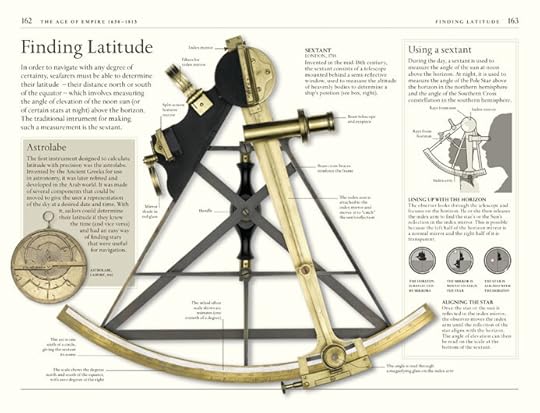
Logical layout always captivates me, particularly when the linearity brings a sphere of comfort to the reader. By that I mean that this book is broken up into chronological chapters, going from the very beginning of mankind's first voyages through to the present. Within each chapter, there are also maps which make sense. As one who always was confused about which wind blew which way, this made me very happy. Within each section there are also "spotlights" showing particular ships using detailed craft models or visual explanations of nautical concepts, such as latitude.
Loved this book. Brian Lavery is the Curator Emeritus at the National Maritime Museum at Greenwich, a place I always say I will get to and never have. That will now change, as I can't wait to see the place and learn even more about the oceans and the people who have conquered them.
Sometimes nonfiction can be dry and a bit on the drawn out side, but that wasn't the case here. I thought for sure a 400 page tome on the history of ocean seafaring would bore even me at times, and I have a history degree and love this stuff, but it didn't. There are a couple of big reasons for the ease of reading this. First, its chronological, starting with the earliest seafarers like the pacific islanders and working through history up to the 1970s and 80s with the America's cup sail boat race and the Exxon Valdez oil spill. Second, the fairly short, subject specific chapters made it simple to pick up and read just a handful of pages at a time, without feeling lost. Lastly, the illustrations were well done and helpful in aiding the understanding of much of the subject matter. As someone with only a cursory knowledge of ships, submarines, and navigational instruments, among other things, it was extremely helpful to see detailed pictures to match the descriptions that I was reading. To see the evolution of sailing vessels, for example, made a number of the points the author was setting out easier to follow and understand. While this book isn't for everyone and is more a glance at a vast number of historical events than in-depth academic research, its a great overview. This is the kid of book you read and then seek out other books more specific to the items that you found most fascinating. I truly enjoyed this far more than I expected and have made a note to seek out other books written by the author. 5/5
I know absolutely nothing about ships or sailing, and this book was entertaining, informative, well illustrated and nice to hold. Lavery works chronologically through the history of sailing from the premodern times right up to the present day.
The book is divided into 5 sections: The First Ocean Sailors to 1850 (Arabs, Vikings, Polynesians, Chinese, Pilgrims, Greeks and Romans); The Age of Exploration 1450-1600 (European journeys to the Americas, first cirumnavigation of the Earth, Drake, Columbus, Amerigo and medieval ships); The Age of Empire 1600-1815 (Colonialism, piracy, the slave trade, Cook, Trafalgar and whaling); Steam and Emigration 1815-1915 (early steamships, American emigration, Chinese and Japanese trade, Clipper ships, submarines, liners and battleships); The Wars on the Oceans 1914-1945 (World War I and World War II, Jutland, Midway, Atlantic, D-Day, U-boats) The Global Ocean 1945-present (containers, Cuban Missile crisis, birth of oceanography, Falklands, ocean racing, oil spills, modern piracy)
Each section is illustrated with excellent maps showing the information such as main trade routes, winds, currents, shipwrecks, iceberg zones and battles although sometimes the colours are a hard to distinguish. There are drawings of the ships spoken about in the text, and usefully page numbers given for cross references. The maps are mostly accurate, although according to the Battle of the Atlantic one The Hood was sunk nearer Greenland than Scapa Flow! However, in general the book is generously illustrated, ephermera, paintings, photographs, quotations and facts on almost every page that bring the subject alive.
Lavery paints a colorful montage of great episodes in ocean history, such as China's sea expeditions of the 1400s, the battle of Jutland, or the rise of luxury liners. At first I thought it was a glossy picture book of facts, but the stories were lively and generally narrated from the personal perspective of a real witness. There are military, scientific, economic, or social triumphs and tragedies. But perhaps most of the conquests are military, and these include some conquests far from the sea, such as the Spanish conquest of Mexico. All told, I'd say the book is a bit more about conquest in general that it is about the ocean or its native creatures.
Wine tasting. That is the perfect metaphor for this book. It's like a wonderfully elegant wine tasting. In that Lavery covers so much history in a short 400 pages that all you really get is a taste from each era. If you want more, buy the bottle.
And to keep on this track: if you're at a wine tasting, and you have the option of trying a famous red or a lesser known red, well, Lavery selected the lesser known red. His short vignettes that highlight the different eras of seafaring are, to me, the lesser known of the associated events. For example, when he gets to the Golden Age of Piracy, you don't learn more about famous pirates like Blackbeard. Rather, Lavery highlights Raveneau de Lussan, a French pirate operating across Panama in the late 1600s. Same with the American Revolution. After a quick mention of the Boston Tea Party, Lavery moves onto the adventures of John Paul Jones and his ocean battles against the British in the latter's home waters. Admittedly, I haven't taken a US history class for ... well, that is irrelevant, but let me say that I do not recall learning anything about American Revolution battles occurring overseas. I remember Washington crossing the Delaware and the Battle of Lexington and all that. But if I learned about John Paul Jones in History class, I have relegated that knowledge to the part of my brain that doesn't work.
All that said, I relished being introduced to these new characters and these new historic moments. A segment I enjoyed more than I thought I would was Lavery's vignette on modern piracy. I watched Captain Phillips and loved it (and by the way, Academy, how could you NOT nominate Tom Hanks for the Best Actor Oscar for that film???). And now that I have read about the 2010 Marida Marguerite incident, I feel a new interest brewing here. Don't be surprised if a book on modern piracy shows up on my "currently reading" shelf soon.
I'll wrap it up now with a few final thoughts on this great work: I devoured the illustrations, so a big shout out to Lavery for including those because my poor "visual" brain has struggled to imagine some of these different kinds of ships based on textual descriptions for years. I caught the half a dozen or so typos in the text, so I agree with other comments I saw that whoever proofed this book needs a refresher course. And thank you for a nice readable writing style. It's great to see that some authors can take very technical subjects and make them an enjoying read.
i received an ARC compliments of DK through the Goodreads First Reads program.
Subtitled 'An Illustrated History of Seafaring', the book examines both the forces driving innovation in seafaring and the consequences to history of seaborn exploration, trade and warfare. As a historical survey the book covers a vast amount time and territory. Laverly uses detail to bring meaning to his chosen subjects, especially first person accounts. The chapter 'Going to America' concentrates on one voyage of one ship of immigrants in the 19th century. This definitely supplements one's understanding of the broader topic. The illustrations are also very informative with maps, ship types, explanations of instruments. And there are statistics sprinkled throughout, some of the "I had no idea" variety. There is a glossary (where I learned the difference between a stevedore and a longshoreman), and a bibliography that contains some good leads for further reading.
With it's brief chapters, many topics and illustrations this would be a good book for students who have an interest in history and/or boats and ships. It's a good read for adults of the same bent. And the overall production makes it a keeper.
I finally finished this book over the course of nearly two years. It was perfect to read a short chapter here and a short chapter there on occasion, and to absorb the marvelous illustrations which are the hallmark of any DK publication. Some chapters are certainly more interesting than others, but on the whole this was a great overview of the history of seafaring. I was much more interested in the stories of technological advances, and the adventure stories much more than I was in the war stories. The WWII chapters were the weakest part of the book, because they consisted of three successive chapters, none of which were really done justice in their bite-size formats. The need to squeeze in so much information left the events feeling clinically detached from the large scale horror of all of it. In the end, I appreciated the glossary, and the book has introduced me to a lot of topics that I plan on reading more about. Overall, a good book.
This is a great captivating book for all those who love history, maritime life, adventure, exploring, and inventions. In very interesting but short chapters we get a full account of how the oceans were conquered through the centuries. Discover how the trading companies pushed the boundaries of exploring Read how the daring and skills of seamen shaped our history. And realize where there are people, there might be war ... even on the wide open oceans. Easy read, but nonetheless this is a very interesting book.
I put this on my list years ago and I don't know what prompted me to do so. I don't know what I thought it was about but it ended up being something I wasn't expecting. Instead of an overall narrative, it was mostly little vignettes about sailing/exploring/conquering/piracy/war. I ended up liking it. The 2.5 comes from the fact that several times the stories spent more time on land than they did in the water, and the last section wasn't quite as interesting. But it was great for maps and illustrations.
This chronological history is divided into six periods, with each section comprised of chapters of around 4-6 pages, each of which focuses on a particular important event. This approach makes the content easily digestible, and Lavery is an excellent writer who, wisely, always remembers to include the human element and brings these events vividly to life in a detailed yet concise manner. I found the book fascinating from beginning to end and learned a great deal in the process. The lavish illustrations are great too.
Nonfiction can be dry, but these short chapters do this book well! I enjoyed the history, the adventure and tales of travels and exploration on the seas. The maps and illustrations were especially helpful. I live by the ocean so I will leave this book in one of my guest bedrooms to be perused by visitors.
This wasn't an amazing read by any means, but it was interesting and broken up into managable bite-sized chapters. Not a lot of depth, but a really good surface read on various aspects of the history of mankind and the ocean.
History of man’s relations with the oceans from the ancient Phoenicians to modern times. Almost a textbook, but written in short segments about specific stories. Too broad a topic to go very deep into any one, but full of interesting stories.
Highly systematic view of the history of humankind's voyages on the high seas, complete with maps and photographs. One of the best non-fictions out there.
Today's nonfiction post is on The Conquest of the Ocean: An Illustrated History of Seafaring by Brian Lavery. It is 400 pages long including a bibliography, index, and acknowledgments. It is published by DK. The cover is white with a golden sextant on it. The intended reader is someone who wants to know more about seafaring and the ocean. There is no sex, no language, and some descriptions of violence on this book. The story is told from third person with dairies, letters, and other first person narratives added in. There Be Spoilers Ahead.
From the dust jacket- For many years, the oceans that cover most of our planet were considered unimportant- even as late as the 19th century the naturalist Charles Darwin dismissed them as 'a tedious waste, a desert of water.' Yet the oceans have had a huge influence on our history, whether offering the possibility of migration or exploration, providing a livelihood and sustenance, enabling trade and transportation, hosting some of the most strategically important battles ever fought, or sparking a new generation of science and technology. The Conquest of the Ocean explores the agonies, achievements, and adventures of sailors and their ships. What impact did the invention of the sea clock have on the life of a sailor? How did a man breaking his leg in Ohio lead to the birth of oceanography? Which naval leader dismissed the idea of a submarine as foolish? Drawing on his expertise as one of the world's leading naval historians, Brain Lavery weaves together eyewitness accounts and illustrations to bring these stories of the sea vividly to life. Using paintings, photographs, maps, and objects alongside anecdotes and firsthand reports, he picks out key episodes in the history of seafaring and celebrates the experiences that have defined how our relationship with the sea has evolved.
Review- As someone who loves the ocean and was raised by a marine biologist, the history of the sea is interesting to me. Lavery does a good job with this broad topic. He takes the reader from the beginnings of seafaring all the way to present day. With the full maps, pictures, and art the images just become more defined. Using his sources wisely, Lavery helps the reader understand how important the ocean has been and will continue to be to humanity. Watching the evolution of sailing was interesting too. To go from ships that could only partly sail and partly be rowed to most advanced yachts of today over the course of the book. This book could have been overwhelming in its information, going from the beginnings of seafaring all the way to modern day, but Lavery keeps that under control. He gives the reader an overview of the topic but not every little detail. Still at times the chapters were very long with lots of names, places, and dates. Very interesting and good read.
I give this book a Five out of Five stars. I get nothing for my review and I borrowed this book from my local library.
Note to start: I won this through First Reads. Thanks DK. On with the review.
The Conquest of the Ocean by Brian Lavery is a great book if one is interested in the history of, well, human conquest of the ocean. Lavery includes a number of historical accounts related to topics such as the Vikings, slave ships, sailing on ocean liners, and the impact of major oil spills such as the Exxon Valdez. There is a vast array of topics covered from the beginnings of seafaring to the very present. Not comprehensive exactly, but certainly broad and focuses on specific moments in history including some which I never knew about or bothered to really be interested in previously. Enlightening if not always compelling, but well thought out with a number of useful illustrations. This is certainly in keeping with my overall positive viewpoint of all things DK.
A somewhat interesting, if disjointed, collection of short (roughly 6 - 18 pages) topics all related one way or another to seafaring. But the topics jumped around, everything from Jacques-Yves Cousteau, to the career of the Confederate raider Alabama, the 1983 America's Cup race, to the Battle of Midway, the Exxon Valdez disaster, and to voyages of exploration. There didn't seem to be any continuous thread linking them all together, so the transition from one topic to the next was usually extremely abrupt; more like moving to the next entry in an encyclopedia than a history.
Some of the topics were new and interesting to me, but many seemed just superficial overviews (and how could it be otherwise given their length) of more complex or interesting topics.
I received this book free in a first reads giveaway for my honest review. The first thing I noticed is that this is a beautiful book. It is handsomely illustrated and just thumbing through the book, the illustrations make an impact. It is also an interesting study of ships and how they are used from man's first voyages on the seas. It does a great job of explaining how they were used and why they evolved. I would recommend this book to anyone that loves history or the seas.
Quite a good account of the history of humanities' interaction with the ocean. More attention should have been paid to other cultures India, China and the Arabs.