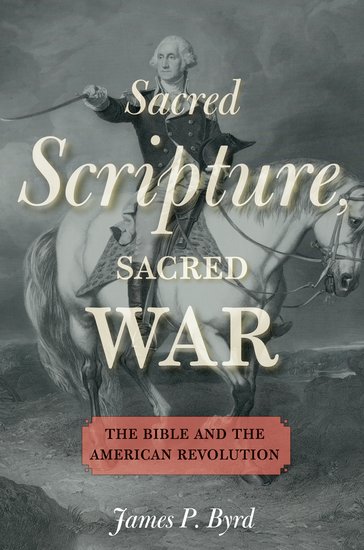
On January 17, 1776, one week after Thomas Paine published his incendiary pamphlet Common Sense, Connecticut minister Samuel Sherwood preached an equally patriotic sermon. "God Almighty, with all the powers of heaven, are on our side," Sherwood said, voicing a sacred justification for war that Americans would invoke repeatedly throughout the struggle for independence.
In Sacred Scripture, Sacred War, James Byrd offers the first comprehensive analysis of how American revolutionaries defended their patriotic convictions through scripture. Byrd shows that the Bible was a key text of the American Revolution. Indeed, many colonists saw the Bible as primarily a book about war. They viewed God as not merely sanctioning violence but actively participating in combat, playing a decisive role on the battlefield. When war came, preachers and patriots alike turned to scripture not only for solace but for exhortations to fight. Such scripture helped amateur soldiers overcome their natural aversion to killing, conferred on those who died for the Revolution the halo of martyrdom, and gave Americans a sense of the divine providence of their cause. Many histories of the Revolution have noted the connection between religion and war, but Sacred Scripture, Sacred War is the first to provide a detailed analysis of specific biblical texts and how they were used, especially in making the patriotic case for war. Combing through more than 500 wartime sources, which include more than 17,000 biblical citations, Byrd shows precisely how the Bible shaped American war, and how war in turn shaped Americans' view of the Bible.
Brilliantly researched and cogently argued, Sacred Scripture, Sacred War sheds new light on the American Revolution.
James P. Byrd is Chair of the Graduate Department Religion and Associate Professor of American Religious History at Vanderbilt University Divinity School. He earned his master's degree at Duke University and his Ph.D. at Vanderbilt University. He is the author of Sacred Scripture, Sacred War: The Bible and the American Revolution (OUP, 2013).
I don't think I've read many books that I've found more problematic than this slim volume. My reasons for finding it so troublesome are threefold: historicity, execution and biblical authenticity.
To examine the first, Mr. Byrd seems to be arguing for American exceptionalism in terms of faith and biblical usage during the American revolution. "Historians have neglected the symbiotic relationship between religion and American war and have not appreciated how much America's "sacred wars" depended on the sacred violence in scripture" he tells us. This negates the fact that governments of that era and those before it had long utilized religion as a tool to inspire their people to battle. An excellent example of this is the Crusades, framed carefully as a freeing of the holy city from the infidel to encourage men to die for control of the lucrative trade routes held by those same infidels. However, two books - Encyclopedia of Wars Charles Phillips and Alan Axelrod and also Myth of Religious Violence William Cavanaugh - show how common it was for those who had the most to gain to cloak their greed beneath a mantle of religious fervor. America was not unique in calling on God or the bible to explain their violence.
Another issue combines historicity and execution: Mr. Byrd utilizes the term "Christian" to refer to everyone. In an era when people often attended church for social and economic reasons, it is almost impossible to divide out those who were actually Christians, attending services for faith purposes and those who attended for show. The author himself admits that "Several of the founders, for instance, doubted the historical validity of much of scripture, including its stories of miracles. Even so biblical skepticism did not interfere with biblical patriotism." This would seem to validate that biblical patriotism has nothing to do with belief in the bible itself but instead is founded on biblical usefulness. Certainly, this was true of Thomas Paine who could quote the bible in his pre-war/war time pamphlets and then cheerfully refute Christianity during peace.
Mr. Byrd would have you believe Americans were scripturally literate, an amazing feat when one considers the first English language bible wasn't printed in the States until 1782. While bibles were imported from England or Holland prior to that, bible shortages during the war would indicate that bibles were not widely owned prior to the war. This was most likely due to cost. Even of those printed in the states, they did not sell wildly. Most purchasers would make smaller purchases, such as pamphlets. People did own Psalters (book of Psalms) and some owned Testaments (often just the gospels), full access to full bibles was restricted to only a portion of the colonists. This means that most knew the stories of David or Moses but would most likely not have been able to read their stories for themselves.
This heads us to point number three – biblical authenticity. This is important because of the difference between what the colonial sermons said of David and what the bible said of him.
1. His being a warrior was not a glorious act before God. 1 Chronicles 22:8 When David wants to build a house for the Lord he receives this response: But the word of the Lord came to me, saying, ‘You have shed much blood and have waged great wars; you shall not build a house to my name, because you have shed so much blood before me upon the earth”. Clearly, God held against David the blood he shed in war and did not want it associated with his house.
2.The author tells us that sermons proclaimed that it was David’s military prowess, his courageous service in both military and spiritual conflict, that earned him the epithet “man after God’s own heart.” In fact 1 Samuel 13 tells a different story. After Saul offered his unlawful offering, this is what Samuel said: 13 And Samuel said to Saul, “You have done foolishly. You have not kept the commandment of the Lord your God, which He commanded you. For now, the Lord would have established your kingdom over Israel forever. 14 But now your kingdom shall not continue. The Lord has sought for Himself a man after His own heart, and the Lord has commanded him to be commander over His people, because you have not kept what the Lord commanded you.” That one act and no other cost Samuel his forever kingdom. The irony is that Saul was asking God’s blessing on a battle – clearly, he did not fear to go to war! 3. Moreover, the idea of a republican David(p. 110) was sheer lunacy: God said to him (thru Nathan) in 2 Samuel 7:16 Your throne shall be established forever. That was why it was so important for Jesus to have lineage from the house of David: to be Israel's king forever He must have that blood.
These are three mistakes, all with just David. I am not going to go in to the sheer wrongness of the New Testament passages except for this: Peter makes it clear that if you are beaten for spreading the gospel (doing good) this is fine, but not for civil disobedience. (1 Peter 2) Every time the apostles were pulled before the authorities it was for disrupting the peace not for their rights but for the sake of the gospel. I will not say we can never assert ourselves for any other cause, but we should be careful how we apply scripture to that. Lower taxes is not that cause! (Matthew 22:21)
No cause can call itself Christian and so thoroughly ignore Jesus Christ. It was deeply disappointing to read such a text under the guise of Christianity when it promotes a religiosity which does not center in the teachings of the Messiah.
Much more terrifying now than when Byrd wrote it over 10 years ago. Necessary reading not only on the religious "thinking" that backstopped the unnecessary tragedy of the American Revolution, but on the crazies behind the current madness of "Christian nationalism," who use the same, mostly Old Testament, verses in support of their radical nonsense.
In his book "Sacred Scripture, Sacred War: The Bible and the American Revolution," James P. Byrd examines the influence of the Bible on the worldview of the American patriots during the American Revolution. Many patriots looked to the Bible for direction and inspiration in their fight against Great Britain. Byrd argues that they were especially influenced by three important convictions: “political liberty was a divine cause against tyrannical evil, sacrifice and martyrdom for God’s chosen nation were virtues, and there was an intimate relationship between spiritual and military warfare.” (Byrd 2013, 13). He argues that American Christians, especially patriot clergy, saw the Bible as a militant book and believed that the Revolution was consistent with the biblical worldview. This provided American patriots with the motivation to sacrifice for the cause of Christian liberty and pursue excellence in spiritual and military warfare.
Byrd explains the importance of the Bible to the colonial American culture and how it influenced patriots’ perception of the importance of liberty. Byrd shows that American colonists, patriots and loyalists, took the Bible seriously. Most American Christians believed that the Bible was historically accurate and relevant to their lives. Pastors were some of the most influential men in the colonies. Christian patriots believed the Bible supported their desire for liberty. The story of the Exodus was particularly important to them. They saw parallels between their struggle for independence from King George’s Britain and Israel’s flight from slavery in Pharaoh’s Egypt. Byrd includes examples, including correspondence between John and Abigail Adams, that illustrate the prevalence of this parallel in American thought (Byrd 2013, 46). In response to loyalists using New Testament writings of Peter and Paul to argue for submission to British authority, patriots pointed to Paul’s statements on Christian liberty in Galatians (Byrd 2013, 116-117). Byrd argues that these and other examples show the connection in the patriotic mind between Christianity and the political liberty they fought for.
Byrd also argues that the “sacred violence” (Byrd 2013, 168) in the Bible was used to justify, motivate, and inspire militancy in support of the American cause. Byrd focuses on biblical characters that were used as examples of biblical violence. Moses, Deborah, Jael, David, and many Old Testament prophets are biblical characters who preached and/or practiced violence in faithfulness to God. Sermons referenced the portrayal of Jesus as a fierce warrior in Revelation (Byrd 2013, 157). Byrd provides examples of sermons and writings that encouraged soldiers to follow the examples of these biblical heroes by courageously fighting for the American cause. Many Christian patriots also connected spiritual and military warfare. Many believed that a good Christian would be a good soldier. Thus, the “connection between military sacrifice and authentic faith” was important to patriot pastors and soldiers (Byrd 2013, 15). The majority of Byrd’s arguments eventually come back to the idea of violence in the Scriptures being used by patriots to inspire militancy in favor of the American cause.
Byrd makes a convincing and well-supported case in his book. Perhaps his greatest strength is his frequent and skillful use of primary sources to back up his arguments. His arguments rely on analysis of over 17,000 biblical citations in more than 500 sermons, letters, and other sources from the revolutionary period (Byrd 2013, 3). He uses these sources to determine which biblical passages and ideas were cited the most by people of the founding generation. In this way, he prioritizes their ideas and concerns over his own. Each chapter of the book references primary sources from a variety of perspectives in the founding era. Byrd also demonstrates a high level of biblical literacy. Although his main focus is on the ideas of the founding generation, Byrd’s own knowledge of biblical literature, both Old and New Testament, is evident in his analysis. This is important because, as he explains, the Bible was an essential part of colonial America, and it is impossible to really understand colonial culture without familiarity with its most influential book. However, Byrd does not approach his subject from an obviously pro-Christian perspective. Byrd mainly sticks to analyzing the ideas of the founding generation without inserting his own commentary. He refrains from picking sides of any particular debate, and reports his facts as objectively as possible.
If the book has a weakness, it would be Byrd’s assumption that patriotic ideas shaped Americans’ interpretation of the scripture instead of vice versa. Throughout the book, Byrd assumes that the American patriots had pre-conceived ideas about their fight for liberty and that those ideas determined how they viewed the Bible. For example, Byrd often asserts that patriots used, or sometimes even twisted, the Bible to justify their ideas. However, given Byrd’s own evidence, it seems that the founders believed the Bible, and biblical principles shaped their ideas about liberty and the justice of their cause. Thus, it seems that Byrd sometimes has the wrong idea about which ideas were of primary importance to the founders.
"Sacred Scripture, Sacred War" is an important addition to the study of the worldview of America’s founding generation. Byrd’s use of primary sources and scriptural analysis help him effectively demonstrate the Bible’s influence on American ideas about military action in defense of liberty. By any standard, the Bible was important to the American patriots, and, according to Byrd, was the most influential book of the period. Thus, understanding how American patriots viewed the Bible is essential to any study of the American Revolution and the motivations and ideas that shaped it.
There should be little doubt that this book is a significant piece of historical scholarship. James Byrd takes us into the minds of American colonial, pre-revolution, and revolution preachers as they appealed to scripture to warrant patriotic fervor and stimulate courage among the colonial combatants in the struggle against English imperial tyranny. The motherlode for Byrd's excavation is the extensive collection of preserved sermons of colonial preachers, a treasure of source material for anyone who inquires into the mindset of religionists who confronted a series of oppressive English monarchies.
With a widely-read Bible and the choice of biblical figures, narratives, and axioms drawn from the moral teaching of both testaments, preachers opened a path for the colonialists to justify their taking up arms and committing themselves to fight--kill and die--for their biblically-sanctioned liberty. As Bryd states in his epilogue, "Patriotic ministers shaped a martial view of Christianity that inspired wartime zeal. in the process, the Revolution, which patriots defended as a just way, also became a sacred war, endowed by God and defended by Scripture.... [W]hen battle lines are drawn through the lines of scripture, the war takes on religious significance."
As most participants in the debate know, there are multiple perspectives on the question of whether and to what extent this nation was founded as a "Christian nation." To this debate, Byrd's scholarship is a valued contribution. In the final analysis, what he argues is that, for the most part, the majority of preachers in colonial and revolutionary America drew upon scripture to argue for and support the colonial/revolutionary resistance to Great Britain. In itself, this historical inquiry and its conclusions do not unequivocally demonstrate that the United States was founded as a Christian nation, nor that the founding leaders were reading the same Bible and drawing the same conclusions regarding the will of God or divine providence. What it does demonstrate is that the Bible played a most extraordinary role in interpreting the colonial and revolutionary context and justifying the course of militant actions that ultimately lead to American independence. Byrd's contribution to historical scholarship into the origins of the independence project in colonial-revolutionary America is to be commended.
(NOTE: I'm stingy with stars. For me 2 stars means a good book or a B. 3 stars means a very good book or a B+. 4 stars means an outstanding book or an A {only about 5% of the books I read merit 4 stars}. 5 stars means an all time favorite or an A+ {Only one of 400 or 500 books rates this!).
This was a very interesting book. The author has done his homework. I found his findings not surprising but still disappointing. My frustration is with how often the Bible was wrongly interpreted to justify the American Revolution. But Byrd is to be lauded for his methodology: “Despite the variety of studies on religion in the Revolution, however, we have no comprehensive analysis of how revolutionary Americans defended their patriotic convictions through scripture, which texts they cited and how they used them. As a result, any conclusions historians have drawn about the Bible in Revolutionary America have been necessarily tentative. In this book, I draw on an analysis of over 17,000 biblical citations in over 500 sources from New England, England, the middle colonies, and the South (see appendix). Through a reading of the sources and an analysis of their biblical citations, I have identified the biblical texts that colonists cited most often to inspire troops to fight for God and country. Although historians have known for years that the Bible was present in the American Revolution, this book reveals how it was present, specifically how it was used to make the patriotic case for war. It, for the first time, provides an analysis of the biblical texts and themes that rose to the forefront as American patriots rose to the task of challenging the British Empire. This book is not only about the Bible and the American Revolution; it is also a book about the patriotic Bible of the American Revolution. (3)
What role, then, did the Bible play in the Revolution? Its primary purpose was to forge militant patriotism. We can see this, in several ways, from the most-cited scriptures during the Revolution. First, the Revolutionary American Bible prioritized present needs over future aspirations. (164)
Second, the Revolutionary American Bible drew from a diverse range of texts from across the scriptures. (165)
Third, in the Revolutionary American Bible, character mattered. Both republican and Christian traditions esteemed virtue above all. It makes sense, therefore, that patriots scoured the scriptures, looking for virtuous heroes. (165)
To be sure, most revolutionaries claimed to be fighting a just war, and not an outright holy war. But how successful were they in staying true to that rationale? Too often, as historian George Marsden has observed, the problem with just war theory is with the theory—“it is too theoretical” in that “it does not take into account how people actually behave.” Because patriots believed that their cause of liberty had divine support, they fought a war that blended political and religious motivations rather seamlessly. They saw the conflict as a just war, fully defensible on those grounds, but they fought it with religious resolve, fully believing that God endorsed the cause and actually helped to fight the war. (166-167)
Preachers did not blatantly assert that Americans would go to hell if they did not go to war—but they sometimes came close. (167)
Today, some Americans believe that scripture inspired the Revolution and profoundly shaped American patriotism. In 2009, the publication of The American Patriot’s Bible, an edition of the Bible framed within a patriotic narrative of American history, garnered national media attention. (168)
The American Patriot’s Bible is part of a long tradition of works Americans often reach for in wartime. During the Civil War, for example, several books appeared that glorified the image of the patriotic minister in the American Revolution, especially those who left the pulpit for the battlefield.: (168)
This book has examined the beginnings of that long-standing relationship between patriotism and scripture, an alliance forged in wartime and refined by preachers and even presidents. Historians have neglected the symbiotic relationship between religion and American war, and have not appreciated how much America’s “sacred wars” depended on the sacred violence in the Bible. This book has ventured into that biblical terrain, focusing on some of the scriptures that patriots found to be most persuasive in supporting the Revolutionary cause. In the American Revolution, when it came to making the case for war and ushering citizens to the battlefield, the Bible was a persuasive ally. The ramifications of this relationship would cascade throughout American history as the United States came to define itself and its destiny largely though the justice and sacredness of its wars. (168)
Interestingly James Byrd found 8 passages that were cited more than 50 times in the sermons etc. that he read: Romans 13; Exodus 14-15; Galatians 5; Judges 4-5; 1 Peter 2; 1 Kings 12; Psalm 124; Matthew 5; From my point of view they more often used these passages to fit their agendas than took them at face value.
This past Fourth of July, the Freedom from Religion Foundation took out a full-page ad in a number of newspapers, the banner of which proclaimed, “Celebrate Our Godless Constitution.” According to FFRF’s description of it, the ad quoted “U.S. Founders and Framers on their strong views against religion in government, and often critical views on religion in general.” Its purpose was to counter Hobby Lobby’s annual July 4th ad, which “shamelessly promote[s] the myth that the United States was founded on God and Christianity.”
The ad is strange for several reasons. For one thing, the Fourth of July celebrates the decidedly non-godless Declaration of Independence, not the supposedly godless Constitution. For another, three of the six Founders quoted—Thomas Paine, John Adams, and Thomas Jefferson—were not part of the convention that drafted the Constitution. And finally, the ad selectively quotes the Founders, overlooking the more benign view of religion found in other statements by them. (For a balanced overview of the role of religion in the Founding, see the Library of Congress’s exhibit, “Religion and the Founding of the American Republic.”)
I mention this ad not so much to refute it as to provide context for my review of James P. Byrd’s excellent new book, Sacred Scripture, Sacred War: The Bible and the American Revolution. Before we enlist history on one side or another of a contemporary political cause—whether on behalf of FFRF’s secularism or Hobby Lobby’s Christian nationalism—we must understand it on its own terms. Failing to do so results in anachronistic, selective readings of history that misinform—sometimes, intentionally disinform—rather than inform the readers.
The focus of Sacred Scripture, Sacred War is “how the Bible inspired patriotism in Revolutionary America” (p. 2). Byrd approvingly quotes Gordon S. Wood on this topic: “it was the clergy who made the Revolution meaningful for most common people” because “for every gentleman who read a scholarly pamphlet and delved into Whig and ancient history for an explanation of events, there were dozens of ordinary people who read the Bible and looked to their ministers for an interpretation of what the Revolution meant” (ibid).
To see how the Bible inspired patriotism, Byrd compiled what he describes as “the most comprehensive database on the Bible in colonial America, including 17,148 biblical citations from 543 sources over more than a century (1674–1800)” (p. 169). Based on this database, he identified the eight “most cited biblical chapters (50 or more citations) in the Revolutionary Era (1763–1800)”: Romans 13, Exodus 14–15, Galatians 5, Judges 4–5, 1 Peter 2, 1 Kings 12, Psalm 124, and Matthew 5 (p. 170). Successive chapters in Sacred Scripture, Sacred War describe how Patriots used these passages to buttress their revolutionary resolve, often in the teeth of Loyalist criticism.
Not surprisingly, patriotic clergy often turned to martial passages in the Old Testament to exhort their parishioners both to die and to kill for the revolutionary cause. God’s deliverance of Israel from slavery in Egypt, accomplished by divine war against Pharaoh and his army, was an obvious choice for revolutionary preachers. So was the boldness of Deborah and Jael against Sisera the Canaanite general Sisera. Then, of course, there was David, who combined both martial prowess with spiritual depth, serving as a model for Patriot soldiers. (The fact that David was a king required some finessing on the part of preachers.)
More controversially, patriotic clergy rooted support for the Revolution in New Testament texts. “Stand fast therefore in the liberty wherewith Christ hath made us free” (Galatians 5) was a biblical motto for the Revolution. Other New Testament passages required significant re-interpretation. Should Patriots submit to the king as Paul and Peter commanded (Romans 13, 1 Peter 2)? John Wesley certainly thought so, but patriotic clergy argued that obedience was owed only to just kings. Didn’t Jesus command his followers to turn the other cheek and love their enemies (Matthew 5)? Yes, but Revelation also portrayed Jesus—like God in the Old Testament—as a man of war.
Having surveyed the use of select biblical passages by Patriots, Byrd identifies three roles the Bible played in the Revolution (pp. 164–166): “Its primary purpose was to forge militant patriotism.” Second, it underwrote republicanism. Byrd quotes Rev. John Mellen, whose view was common among Patriots: “liberty is the spirit and genius, not only of the gospel, but of the whole of that revelation, we have, first and last, received from God.” Third, it provided “virtuous heroes” for Patriots to emulate.
One need not agree with Patriot exegesis of Scripture in order to appreciate the role it played in their revolutionary cause. Byrd’s task in Sacred Scripture, Sacred War is descriptive, not normative. That is, he describes how Patriots used the Bible; he doesn’t judge their use of it. That is the task of Christian theologians, not historians. For my part—American patriot that I am—I nonetheless unsettled by how my colleagues in the 18th-century clergy used the Bible in the cause of war. (Of course, on the other side, Loyalist uses of Scripture generated their own set of exegetical problems.)
Regardless of my reservations about Patriot exegesis, I am unreservedly appreciative of James P. Byrd’s analysis of it, and heartily recommend it to readers interested the role religion played in the American Founding. Perhaps some open-minded person at the Freedom from Religion Foundation will read it too and come to realize that both the godly and the godless felt they had a stake in the Revolution.
P.S. If you’re interested in reading some of those patriotic sermons, check out
Insightful product of diligent research showing the involvement of church ministers in the development and maintenance of an attitude toward the Revolutionary War that contributed much to the success of the revolution. I was surprised by the author's breadth of understanding of the issues involved and his objectivity in dealing with the issues. This is a worthwhile read for preachers wrestling with the role they consider playing in the political climate of their nation.
Fascinating analysis of how the Bible was used to support the American Revolution. I’d mark it as a must read for politically or historically minded Christians.
Byrd tries to broaden and deepen the scholarly work on clergy in support of the American Revolution. He looks at the major Biblical passages that informed their sermons relating to the war, and argues that "civil millennialism" (the belief in the close relationship between the patriots' cause and the millennial reign of Christ) has been given undue attention by previous historians. Byrd argues that sermons were more often intended to inspire men to fight with courage and without shame. His concluding sentences are provocative: "In the American Revolution, when it came to making the case for war and ushering citizens to the battlefield, the Bible was a persuasive ally. The ramifications of this relationship would cascade throughout American history as the United States came to define itself and its destiny largely through the justice and sacredness of its wars" (168).
Byrd offers a lot of insight into revolutionary preaching, but it seemed to me that he understated the continuity of Revolution-era sermons with colonial-era sermons. He offers many examples of pre-Revolutionary sermons that strike the same themes, though of course they supported fighting for Britain. It seems to me that the sermons studied show that the patriotic preachers used an inherited approach that assumed a close relationship between church, society, and the subject/citizen that all ought to be committed to righteousness and unalterably opposed to the forces of Antichrist (the Roman Catholic Church, in their view). They applied this inherited approach to the American Revolution, with Britain sometimes portrayed as being aligned with Antichrist. If you've read the book and I am missing something here, please set me straight!
As this book's title states, "Sacred Scripture, Sacred War" shows the relationship the Bible had to the American Revolution. The basis of this book is the author's careful examination of primary source material (mainly sermons, but also pamphlets, etc.) that cited passages from the Bible to support patriotic fervor. Byrd tabulated the scripture texts that were the most often used and then explained the common interpretations given within their historical context. In the appendix, he gives a table showing the most cited passages. I was surprised to learn that at the top was Romans 13. Loyalist interpretations are obvious, and the approach many of the patriotic pastors took was very interesting. The role of Moses, David and his kingdom were surprising features as well.
Byrd's book is important not only for historians, but for pastors and Bible teachers as well. It is important for early American historians because the author examines a source for much of what encouraged common, ordinary, colonists to take up the sword against their king. One is able to understand a little better the psyche of the 18th century patriot. This book is important for pastors and Christians who will learn how politics and culture effect interpretation, often verses being exploited for political gain. Some of the "patriotic" exegesis would sound very odd to Biblical scholars today.
It gets 4 stars just for how unique it is. Extremely helpful for understanding the religious background and motivation for the Revolution. Doesn't make blanket statements of approval or disapproval. Simply reports (quite successfully) how leaders, especially ministers, turned to the Bible for guidance in a decisive moment of American history.
Kind of a long read but interesting. With this being an election year and all of the culture wars we are experiencing now it really puts things into a bit of perspective. I question whether or not our government would even allow this type of comingling of religion and government today. Although perhaps it is true that there are no atheists in fox holes.
Couldn't get through this book and finally threw in the towel. It was really interesting but half way through it seemed to become repetitive and start running together.