“An undercover has to tell you if he’s a cop. Otherwise it’s entrapment, right?”
Wrong. That’s just one of many popular myths about criminal law that get repeated on street corners, in locker rooms, and on websites every day—all of them wrong.
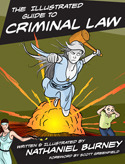
Based on his popular Illustrated Guide to Criminal Law webcomic series, Nathaniel Burney debunks all of those myths and teaches everything you never learned about the law. Not just what the law is, but why it’s like that and how it works.
Collected here in the first printed volume, The Illustrated Guide to Criminal Law is a complete law school course that keeps the “laughter” in “manslaughter.” As you read, you start from the absolute basics (“What is crime?”) and are soon deep in complex concepts like conspiracy, self-defense and, yes, entrapment—all explained with humor, wit, and passion.
After reading this I must admit - ignorance of the law is no excuse anymore (or at least for Americans). :) It's really all about criminal law in States, but the basic is same. So it really won't hurt to read to get a clue why court makes decisions as it does.
It doesn't matter if you're a law student, lawyer or nonlawyer. You get the understanding what and why criminal law is, what is punishment, actus rea or why is mens rea very important. And while you go through those witty dialogues and explanations you might even have a lot of fun. :)
Author also explains many popular myths and why those myths don't apply really. For example: 1. An undercover has to tell you if he's a cop or not. 2. The police cannot ask you to commit a crime. 3. The police can't break the law themselves. 4. The police can't help you break the law.
And all this is not entrapment! It's just a tool to get to you, criminals!! :)
This is a great primer for young and old alike introducing the complexities and intricacies of criminal law. It's presented in a clear and engaging way and covers a lot of hopefully never useful material (unless you're studying to be a lawyer, where I imagine it would be quite a useful study aid). I enjoyed the illustration, though was once or twice distracted by scantily clothed characters. Recommended (for the legal introductions)!
I hope I don't have to use the knowledge gained from this scroll of wisdom, ever. Nonetheless, this is just the right amount of insight into the (criminal) law for the common person. A great comicbook intro for the generalists. And why not a quick and easy first step for the specialists before digging deep into the dry details.
I enjoyed the illustrative side and the ease it explained the basic logic of law. How it should help the civilized society to fundamentally work and help by granting the monopoly on violence to the state. And the logic of a conviction. But also talking about overcriminalization and the multitude of "precedural" laws. The specialists of jurisprudence should keep in mind the first law of IT: KISS - keep it simple, stupid. Actually everyone would be happier to remember that fundamental maxim.
Furthermore, I will probably appreciate researching the "Code of Laws" in various Civilization games much more from this day forward.
This book is intended to be something like a civics class: basic introduction to legal concepts for non-lawyers. It goes through some common misconceptions: what is entrapment, what is self-defense, etc. There's some fascinating editorializing from Burney about overcriminalization, the Just World phenomenon, and the purpose of imprisonment (he makes an interesting claim that the justice system's basic purpose is actually retribution or retaliation, not rehabilitiation or deterrence). The presentation of the book is very well done: I had trouble putting it down, and it never gets slow or too confusing. There's one point where I thought a hypothetical crime should have been murder 2 instead of manslaughter but other than that everything is quite clear, considering how complicated the subject matter can be.
I picked this book up on a whim, and was pleasantly surprised. The content is definitely distilled to a point that a layman (like me) can understand, but more importantly the 'why' of criminal law is defined. Why do we have criminal law? Why are there so many laws? Why is an act of terrorism that accidentally kills one person punished harsher than a car accident that kills four people?
When I was a child, whenever a character in a movie or tv show would go underwater (for whatever reason), I would hold my breath to see if I could make it as long as the character. When I watch a law drama where a character decides to represent themselves, I like to imagine if I could defend myself in the same circumstance. This book has made it clear to me that I definitely could not have. (However, now that I've read this book... )
Very Impressive! A cool way of taking what might otherwise be an impenetrable subject (criminal law) and making it easy to grasp and entertaining to boot! What a great piece of reference material to have on the shelf for the crime novelists. Of course it's not a law book, we'll leave those tomes to the libraries of the folks who interpret what society needs, but what a great overview of different legal scenarios. Debunks myths that we all carry around about the long arm of the law while also addressing the idea of ineffectual laws that can be made by those totally unaware of who the law is supposed to serve. Whew! Heady stuff for a graphic work. Comic? No I think not, Mr. Burney is to be congratulated for pulling back the curtains on a subject we normally try to ignore unless it affects us personally.
I highly recommend this book. There is no way I'd be able to slog through a text about criminal law, but I was able to finish this book in a day. And I enjoyed it. No citing cases, no pedantic explanations, just pithy descriptions and apt illustrations. I broke out into a smile because I was charmed by something in the text or illustrations at least once per chapter. I will definitely get all the sequels.
I read this in about a day and a half because it was so good. A little text-heavy at times but overall some great explanations of basic criminal law as illustrated through various scenarios. The storyline alone is much more compelling than trying to learn the same information reading a few online articles though Burney's art adds to the pleasure too.
Surprisingly introductory book given many of the topics I've frequently seen Nathaniel's law comics blog discuss. On top of that, the commentary on the US's legal and judicial systems shows high faith in the systems themselves---hard to swallow after any amount of Gramsci, Foucault, or Michelle Alexander.
Whether you're interested in criminal law, or you're just a fan of crime dramas, Nathaniel Burney can help you understand the different criminal charges, defenses, and the determination of guilt while making you laugh.
I enjoyed this law lesson. Reminds me of Donald Palmer's Does the Center Hold? Clear, concise and quite entertaining, if a little morbid at times (but how are you going to talk about murder without talking about murder?).
A great read. Fun & quick. Non-lawyer speaking here, but it's all neat information. My only complaint might be that it's not a huge 'value' for your money in terms of hours vs. cost, but whatever, it's good.
An engaging guide, which not only explains legal elements, but offers discussion of current issues like overcriminalization. With this book, ignorance of the law is no longer an excuse