Aye, aye, Seaguy! Straight from the brow of one of comics' most remarkable creators, Grant Morrison, comes Seaguy, a hero without purpose in a World, Without Evil! Seaguy follows the strange adventure of would-be hero Seaguy and his faithful companion Chubby Da Choona as they try to decipher the mystery of Xoo, a ubiquitous new food that seems to have evolved into a brand-new conscious life form! Quirky and heart-wrenching at the same time, Seaguy is something utterly and completely new.
Grant Morrison has been working with DC Comics for twenty five years, after beginning their American comics career with acclaimed runs on ANIMAL MAN and DOOM PATROL. Since then they have written such best-selling series as JLA, BATMAN and New X-Men, as well as such creator-owned works as THE INVISIBLES, SEAGUY, THE FILTH, WE3 and JOE THE BARBARIAN. In addition to expanding the DC Universe through titles ranging from the Eisner Award-winning SEVEN SOLDIERS and ALL-STAR SUPERMAN to the reality-shattering epic of FINAL CRISIS, they have also reinvented the worlds of the Dark Knight Detective in BATMAN AND ROBIN and BATMAN, INCORPORATED and the Man of Steel in The New 52 ACTION COMICS.
In their secret identity, Morrison is a "counterculture" spokesperson, a musician, an award-winning playwright and a chaos magician. They are also the author of the New York Times bestseller Supergods, a groundbreaking psycho-historic mapping of the superhero as a cultural organism. They divide their time between their homes in Los Angeles and Scotland.
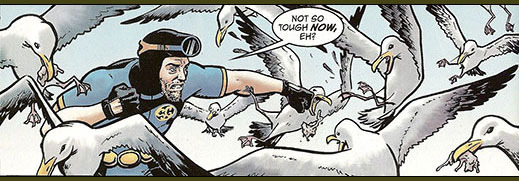
Seaguy, an ordinary bloke in diving gear, lives in a world which used to have superheroes but doesn’t need them anymore – they simply go to the amusement park and ride the rides forever (literally!). Meanwhile, Seaguy himself is dissatisfied with his own life and wants some adventure. He can’t stand watching TV shows every night, eating processed dinner meals every evening, living a homogenised, safe life without trouble – he wants to be a hero and do heroic things! And then a bizarre new food called XOO comes to life and bricks with hieroglyphs begin raining down on Seaguy’s idyllic seaside town. Is this Seaguy’s chance to save the world?
Seaguy is Grant Morrison’s tribute to the classic 60s TV show, The Prisoner. If you’ve never seen the show, it’s a trippy, paranoid series about a man who is abducted and wakes up on a strange island, unable to leave. Seaguy is similar in that he’s living in a brainwashed, tightly controlled environment that’s designed to divert rather than force anyone to think for themselves – just consume, consume, consume! And when Seaguy tries to leave in his boat, he encounters the dark chocolate sea, stopping him from going any further.
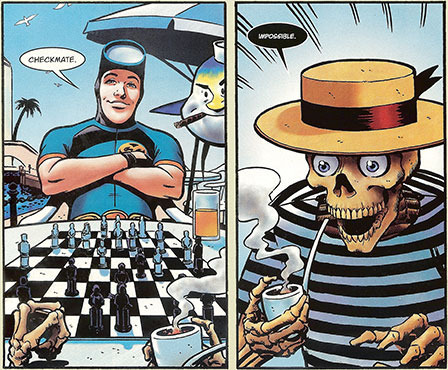
The surreal and absurdist tone to the story means Morrison can do the kind of zany, imaginative things critics of the writer don’t like – things like going to the moon in a basket and playing chess with a gondolier skeleton and too many more to list, all in the space of three issues. The superheroes he creates for this book are also similarly brilliant inventions - Seaguy is just a dude in a wetsuit and it's amazing! - and Seaguy’s sidekick, Chubby da Choona, who's a giant floating, talking tuna fish with a face is awesome!
The whacky flavour of the story also gives artist Cameron Stewart the chance to draw some of the weirdest scenes I’ve ever seen him draw, and some of the coolest character designs ever, with the colours in the book accentuating the feeling of a manufactured world by being overly bright and too intensely cartoonish to be real. And yet despite the colourful, imaginative landscape, there is a feeling that the world Seaguy lives in is far more dangerous than he knows – even the ending has an Orwellian tone to it.
While I think that more than anything Seaguy is definitely Morrison’s version of The Prisoner, you could argue that it’s subtext includes a critique on 21st century consumer culture and Western governments’ increasingly militaristic approach to its own citizens. It could also be enjoyed as a celebration of Golden/Silver Age superheroes where creators were allowed to make any kind of crazy superhero and give them their own (often short lived - like Seaguy!) series. It’s definitely not his best comic or the most engaging book but it’s enjoyable enough and shows once again that more than anything Grant Morrison is a true original comics visionary.
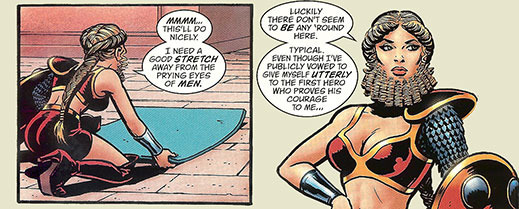
It would be easy to dismiss Seaguy as a regular Grant Morrison madhouse, and many of their critics would do just that. But I was actually pleasantly surprised by how straightforward it is after you get past the wackiness of the setting and the characters. Sure, it is a comic about a guy dressed in scuba gear, his best friend is a floating tuna fish called Chubby da Choona who hates water, and the warrior lady he fancies has a magnificent beard. Sure, Seaguy drives a car-boat called Bumble B and gets stuck in the chocolate sea, he goes to the Moon in a basket and finds out it is populated by the ancient magical Egyptians, and the new food called XOO turns out to be a sentient being. It all somehow makes sense in the context of this tiny three-issue comic — a twisted, bizarre kind of sense, but still. And beneath all that lies a very simple story of a hero out of work looking for adventure, a story of friendship, loss, and — this is a Morrison book after all — subversion of reality and mind control. Seaguy is not going to win over any haters, but for Morrison fans who can take their kind of crazy this obscure mini-series will be a treat.
What's that? You'd like to read a story about a guy in a scuba suit who longs for a woman named She-Beard, who plays chess with Death who's garbed as a Venetian gondolier, who has a friend who's a floating shark that speaks like an extra in a Scorsese movie and who's afraid of water, who befriends a sentient glob of edible paste named Xoo, who discovers the lost continent of Atlantis before being kidnapped by the Egyptian dog people who live on the moon, who eventually winds up captured and brainwashed and sent back to the very start making the reader wonder what actually happened?
You're not? Then what the hell are you doing here? This is Grant Morrison, get ready for weird and fantastic and wonderful or go back to reading technical manuals for communist toasters.
I think this story is probably the most successful example of 'random' or 'disconnected' humor amongst the numerous (mostly terrible) attempts I have come across.
The real problem with such a construction is that it denies a basis, as Morrison himself denies the influence of metaphor or allegory. I cannot stand the oversimplifications of didactism or allegory in writing, and prefer the presentation of a case by showing many views and ideas, and leaving the conclusion to the reader.
However, when a writer denies such effects and tries to write outside of them, he runs into another flaw: that his imagination and writing abilities are based in reality and specifically in the literary world with which he is familiar. Any piece of writing, be it fiction, poetry, or whatever, is a critique of other works that have influenced the author.
Even in the cases of the pulps, critics who later took those authors seriously were able to find symbolic meanings, especially in early sci fi. What Morrison does here works very much like those pulps, in that it embraces what is 'fun' and interesting and not what is socially and politically popular.
The author must also be careful not to replace those cultural messages with their own identity. This is a problem both of established but untrained authors and of authors trying to escape their own patterns. Morrison falls to this bleed-through of personality and opinions in some of his other works, but the apolitical nature of this one mostly spares him his usual fault.
While this is a quick, enjoyable read, I just didn't find it to have much in the way of a payoff. There's a ton of big, interesting ideas dumped into this book into a big idea soup, and unfortunately it feels like it's got just a few too many ingredients. I love Grant Morrison, but this one's a little all over the place.
I enjoyed the surreal, expansive world Morrison crafts here, with its satirical commentaries on the entertainment industry, Big Oil, consumerism, corporate culture, and many more, but like, pick a lane? This book is so short, we only get about 6 pages with each idea, and each one of them could easily sustain an entire issue. I know Morrison wants this to be a 3-volume series (the 2nd volume was never collected in a trade paperback and the 3rd is in limbo), but I wish he had a few more issues to flesh this weirdo world out a little more. Right now it all feels rushed and forced through.
If the final volume, Seaguy Eternal, ever comes out, I'll probably read it. I'd like to be proven wrong about this world, and I'd hope Morrison would use the opportunity to flesh things out a little more evenly. But as it stands, it reads more like a very enjoyable pitch for a series, rather than an actual series.
Thanks to all regular readers who come here in search of slightly more traditional essays on the "classics," however defined, for holding on tight through my now year-long re-reading of comic-book writer Grant Morrison.
My own perhaps too hasty disparagement of Morrison in my review of Greg Carpenter's The British Invasion was my initial impulse to revisit his work, and I have had another powerful stimulant in the Morrison discussions going on at Dave Fiore and Elise Moore's excellent podcast. Dave and I were discussing Morrison back on the comics blogs in 2003 ("bliss it was in that dawn" etc.), and I've enjoyed hearing his and Elise's considered responses to Animal Man, Doom Patrol, The Filth, and now Seaguy. It makes my own re-reading feel like what our friends on BookTube call a readalong, and it has helped to change my perspective on the writer, or changed it back to what it was when I was younger.
As I wrote earlier this summer on Tumblr: in the middle of the 20th century George Steiner tried to explain modernity and modern literature by asking, Tolstoy or Dostoevsky? I wonder if by the middle of the 21st century some critic will try to produce a book-length investigation of postmodernity by positing a similarly rival pair of powerful imaginations: Alan Moore or Grant Morrison? While my heart will probably always rest in the end with Moore, I have had periods of my life where I was more interested in, or persuaded by, the worldview of Morrison, and this is one of them. Something in his wilder style, his refusal of neat artistic formalism or political formulae, his odd mixture of aggressive experimentalism and grotesquery with no less flagrant sentimentalism, speaks to me now.
Even so, I was hesitant to revisit Seaguy, a projected trilogy of three-part miniseries, two of which have so far been published by DC/Vertigo, the first in 2004 and the second in 2009. Not only didn't I grasp Seaguy at all the first time around, I was not alone; it sold poorly and was received mostly with bafflement. I seem to recall Morrison in interviews around 2004 berating the bewildered audience for not understanding it because they had not read Chrétien de Troyes or someone like that—this from an author who these days likes to tell interviewers he doesn't read anything and is only influenced by TV!
Seaguy is set in the (imaginary) city of New Venice in a dystopian—or, more accurately, falsely utopian—future. The eponymous hero, along with his comic sidekick Chubby Da Choona (a floating cartoon tuna fish who talks like a character in a gangster movie), is one of the few remaining superheroes after the cataclysmic defeat of Anti-Dad, a cosmic villain whom the world's superheroes took down in an apparently pyrrhic victory. This apocalyptic liberation parodies DC/Marvel's habit of using regular crossover catastrophes (or crises) to reboot their continuity as well as (note Dave and Elise) the geopolitical projection of the post-Cold-War "end of history."
In the wake of Anti-Dad's defeat, the pacified world is now a consumerist pseudo-paradise under the corporate control of Mickey Eye, a cross between Disney and Big Brother. Artist Cameron Stewart's superb art evokes the disquiet of this seeming utopia, the uncanny unease of a bad normality, most unforgettably through his scary-funny illustrations of anxious adults and traumatized children shuffling through an amusement park.
After this set-up, Seaguy becomes an essentially unsummarizable sequence of bizarre adventures, involving sentient food-stuffs, a mummy on the moon, and a first shot at liberating the Mickey-addled world.
In keeping with Morrison's ingenious crossing of two very different genres, the medieval romance and the modernist dysoptia, the themes that emerge from Seaguy's sojourns are twofold and at odds: first, Morrison demonstrates through his naive and brave hero a constant need for heroism, a refusal of the merely given, even when the given entertains or pacifies, just as the romance hero is urged ever onward toward the transcendence embodied by the Grail; on the other hand, every exercise of heroism in Seaguy's world seems to generate in its turn new forms of authority and control, from the mummy's tale of his own overweening performance as Pharaoh to the new normal brought about at the conclusion of the second miniseries, where the restored superheroes who have defeated Mickey Eye speak of protecting the status quo.
As a political polemic, Seaguy might be considered an attack on corporate monopoly and its mask of benevolence. The mask has been growing ever more benevolent since Seaguy's first publication—Benetton was once more of an outlier, but all the tech monopolists now parade as "woke," whatever their actual labor practices, environmental impact, or stultification of culture—so Morrison can be credited with prescience.
The narrative is probably better read biographically, though, than as some kind of political statement. It was Morrison who was counseling his audience in the early 2000s to accept the fact of corporate dominance and to use it to disseminate counterculture aesthetics and ideals; by the middle of the decade he was one of DC Comics's chief writers, a development that would have been unimaginable in the '80s or early '90s.
Seaguy, also published by DC though a creator-owned property, reads to me like an expression of bad conscience in the midst of this success: it suggests that, despite Morrison's hopeful rhetoric to the contrary, heroism in collaboration with the powers than be will always find itself compromised, will always function as a ruse of control. Reverting to my allusion above to the Morrison vs. Moore feud, this Pynchonian paranoia powered by wistful '60s anarchism is a characteristically Moore-like point, not one we associate with Morrison, whose insistence on interpersonal love generally overpowers the political as such to provide an image of redemption in his work.[1]
Seaguy gives us two moving relationships in this vein—that between Seaguy and his animal sidekick Chubby and that between Seaguy and his love interest She-Beard—but the tone of the book remains, from first to last, alienating and ungraspable. Maybe this is itself the point. Morrison is a writer often accused of perpetrating "weirdness for weirdness's sake"—but what is the sake (that is, purpose) of weirdness?[2] I suggest the surplus of the inexplicable and incomprehensible in Seaguy, its extraordinary weirdness that so put off the initial audience, is a desperate and wishful demonstration that even in corporate comics sheer unbridled imagination can do its best and its worst.
____________________________________
[1] One more Moore/Morrison observation: Moore has resentfully and accusatorially noted points of convergence in the two writers' careers, which he interprets as vindictive imitation. Seaguy, then, may be read as a response to The League of Extraordinary Gentlemen. If that series came out of Moore's desire to trace the superhero archetype back to its roots in 19th-century popular fiction, Morrison in Seaguy goes Moore one better by finding the roots of superheroes in 12th-century Arthurian romance.
[2] There is also the dispiriting possibility that the weirdness in Seaguy has precise meaning available only to occultists. Early and late in his career, from Arkham Asylum to Nameless, Morrison has used various magical systems to structure the meaning of his stories, which he has then elaborately explained in afterwords, interviews, or published scripts, like Eliot annotating his own Waste Land. I dislike this artistic practice; as Coleridge explained 100 years before Eliot and 200 years before Morrison, the symbol is preferable to the allegory because both more grounded and more open-ended. A story you have to read a grimoire before you can understand is not a very good story; Eliot, anyway, was in his rather dryly macabre fashion being ironic, which many subsequent writers failed to understand.
Grant Morrison, as I’ve said elsewhere (and as is pretty obvious just from sampling any cross-section of his oeuvre), is a big idea guy. I love this about him. Unfortunately, I often don’t find his dialogue or storytelling to be all that compelling. In some ways, that makes Seaguy the perfect niche for him. The book doesn’t need great storytelling or plausible dialogue. It’s a comedy—and in many ways an absurdist comedy.
It’s like a not-quite-as-awesome version of Mignola’s The Amazing Screw-On Head, where the important thing is that it brings the funny.
And Morrison does. Even in the midst of propelling his once-and-would-be hero through adventures that unsubtly mask any number of socio-political lessons, Seaguy bristles with a humourous sense that easily overwhelms any of the deficiencies in the story or dialogue. Or didacticism. Seaguy‘s sense of humour isn’t going to be for everyone just like Monty Python‘s isn’t. Which isn’t to say that Sea guy resembles Python in any way. More just to say that Morrison’s book will find a particular receptive audience.
I was going to say what Seaguy is about, but I’m not sure it really matters. There’s some stuff about heroes. There’s some stuff about consumerism. There’s some stuff about corpocracy. There’s some stuff about dreams vs. comfort. But really, none of that matters. It’s all rather facile and works better as fodder for amusement than it does as grist for thought.
I’m looking forward to reading the next two volumes of Seaguy. I’m not exactly racing to pick up the second volume, but it’s on my radar and I’m sure it will be an enjoyable diversion. Because sometimes comics are meant to be enjoyed more than they are meant to be considered.
Pareciera que todo lo que ocurre en Seaguy son sólo un montón de cosas que pasan, sin mucho sentido no conexión entre sí, y probablemente así sea. Es probable que Grant Morrison haya pensado este volumen con esa intención, de que el lector sienta que algo falta y se quede con ganas de una segunda parte, pues es hasta el final de este volumen que vemos que existe algo que le da coherencia a las aventuras de Seaguy, pero no sabemos más de ello sino después, en el segundo volumen que continúa a este.
Por sí mismo, este volumen se siente incompleto, la sensación de que forma parte de una historia es palpable entre más te acercas al final de esta aventura. Sin duda debió ser desesperante para quienes gustaron de este cómic cuando se publicó y se enteraron que había grandes posibilidades de que nunca apareciera su continuación.
Seaguy está repleto de personajes, lugares y situaciones descabelladas, además de las esperadas referencias de Morrison al mundo del cómic y a mitos de todas partes del mundo; así que hay algo de encanto en tratar de identificar todas las referencias presentes en Seaguy.
Por otra parte, el arte de Cameron Stewart es estupendo. Hace ver fácil dibujar las cosas más absurdas y que estas tengan consistencia entre paneles y páginas. Este es probablemente el aspecto más fuerte de este volumen de Seaguy.
Damn that was fun! Really cool, less of a political tract and more of vibes on various themes. This was put on my radar by the meme page the supercontext (all morrisonheads need to like it post haste) posting a screencap from the mickey eye opening theme song, which I googled the lyrics to which brought me to a thread on it from defunct gamer site rpgsite's forum and a bunch of gamers tripping over their dicks to pontificate how incomprehensible this was to each other, thread closed after 2 pages of agreement. Weird. It's pretty straight forward honestly, its a post-modern take on heroes in an age without a need for them. The parallels between that and the Bush/Blair era in Grant's two homes are pretty easy to draw.
It's easy enough to dismiss this as a relic of the tail-end of Vertigo's reign as one of the great comic imprints. But Seaguy is truly a gem in the crown of Morrison's more eclectic output of comics. It features Seaguy, a regular dude who walks around in diving gear seeking adventure in a world where adventure as a concept seems to have been extinguished. He's joined by a giant floating, talking tuna fish called Chubby da Choona as they languish their inability to do anything outside of watching TV and failing to get into meaningful romantic relationships. The listless nature of their existence pushes Seaguy and Chubby into a mission to elucidate the nature behind a mysterious new food called XOO that seems to be having a detrimental impact on their little beach town.
Morrison employs a highly zany, absurdist tone to tell the story of Seaguy's adventures, and it works remarkably well. Hidden beneath the cartoonish nature of the story is a more deep rooted sense of existentialism and surrealism that is really impressively weaved in. This probably stands up well alongside Morrison's "Coyote Gospel" story from their fantastic Animal Man run. The insanity that is Seaguy also lets Cameron Stewart just do whatever he wants on art duties, and it works impeccably well. Just like Richard Case on Doom Patrol or Chas Truog on Animal Man, Morrison finds yet another artist who can capably act as a conduit towards delivering the sheer insanity going on in their mind to the page.
Oddly, I don't remember hearing about this book at all when it came out, but Grant Morrison is usually worth reading, even when he's at his most incomprehensible. Sadly, this one skirted that border a bit to closely for my tastes, so I couldn't give it more than three stars. I mean, the story involves everything from a pastiche of a scene from The Seventh Seal to a weird parody of Red Sonja. Egypt wasn't what we think, and neither is the Moon. Seaguy is a mildly aquatic superhero with a sidekick who seems to be a large flying fish who smokes cigars. Why he and the other heroes all retired is only partly explained, but that's to be expected, because in a Morrison story, very little ever really is. If you like other Morrison comics work and missed this one, it's worth reading. If you've never read any of his comics, I wouldn't recommend this as an introduction to his work. It's sort of intermediate Morrison...too weird as a starting point, but too short to really get you involved in his work.
mi è piaciuto MOLTO più del previsto, l'ho comprato pensando "dai, sarà qualcosa di silly, mi faccio una risata" e infatti per buona metà ho continuato a pensarlo ma, devo ammettere che mi ha preso molto; la trama ha iniziato a interessarmi, i personaggi mi sono piaciuti e in generale le tavole sono molto belle. "l'Occhio" viene un po' messo da parte dopo l'unica scena in cui parla con Lupo di mare e non si capisce effettivamente cosa sia (ma potrebbe essere una mia mancanza). Chubby è il mio personaggio preferito :3
This entire review has been hidden because of spoilers.
This is the sort of imaginative zaniness that seems more interested in being pleased with its own random novelty than trying to tell any sort of coherent or satisfying story. The plot feels like listening to a kid describe a chaotic dream they had after watching too many Saturday morning cartoons; there’s not any sort of internal logic or narrative through line, it’s just a series of unrelated kooky things that happen and then it ends.
Oh wow, this was so much fun! Surreal and confident and constantly one-upping itself, this is the saddest I've felt about a cartoon fish in a while. Preposterous silliness with a lurking awful darkness underneath, in true Morrison style. The artwork is clean and bright and helps sell the oddness, and there are so many ideas packed in here that I wanted more. Luckily there's a sequel, so.
Despite on the surface seeming like utter nonsense, this limited series from Grant Morrison strikes a perfect balance between pulp sci-fi and surreal comedy, wrapped up in a story with a strong anti-capitalist message.
Highly imaginative, with some of the nicest art you'll see in the medium.
I've tried to like Grant Morrison, but cleverness by abstraction doesn't work for me. I want his stories to work on a real level and a metaphorical one. They never work on a real level for me.
Decades removed from the age of supernatural conflict, Seaguy and his floating flounder companion Chubby are enjoying a lackadaisical evening on the boardwalk with all the other retired ex-superheroes. Wistfully hoping for one more heroic adventure, the pair serendipitously get their wish and mysterious moon rocks begin falling to the earth in addition to a strange alien creature emerging from a popular new snack.
A superhero schlock parody that follows absurd characters navigating a continuously escalating series of farcical scenarios and uncovering an elaborate web of conspiracies that lead nowhere. I love how purposefully stupid and ill conceived the plot and characters are in this, both as satire of the "big dumb event energy" in cape comics but also just as an outlet for Morrison's big idea storytelling style to run wild with. While this absurdity leads to numerous cheeky gags and some wonderfully hammy lines, sadly the humor never got much more than a smirk from me (even if that smirk was pretty much ever-present while reading). I also feel like there was a missed opportunity for more overt self parody as Morrison's love for over-engineered, labyrinthian superhero plots and "grand theory" narratives feel apt for ribbing here yet this storytelling style only takes a glancing blow at best. The miniseries is cheeky fun regardless but I was left a bit wanting; either for laugh out loud humor, more biting genre commentary, or a compelling narrative separate from its genre symbolism / abstraction.
Stewart's art is similarly serviceable, making proper use of the wacky character designs and silly set pieces, but is stylistically pretty blasé. The uninspired aesthetic feels somewhat fitting as a component of the genre parody but if that was the intention Stewart could have squeezed much more juice from that lemon.
Okay, first things first, I didn't love this story. Liked it, but not enough to give it more than 3 stars for good execution.
It helps to know that I have a small bone to pick with Grant Morrison. He writes truly fantastic, very Manic Boy-friendly stuff, but--and this goes for the stuff I love as well as the stuff I don't--he has a tendency of writing his characters as ciphers for his strange ideas. They don't discover so much as belatedly remember and recite the secrets of their universe, which are quite often no more illuminating than if he had written them in the nonsense vernacular of Little Nemo, I don't think.
I don't quite mean to say that Grant Morrison's work is impenetrable; he has many very intelligent fans who understand him just fine, as the historic Barbelith forums would seem to indicate. However, his knack for rendering the arcane and the mundane alike as Zen koans (with the f-word added for effect) tends to rob his smartest works of some of their enjoyment factor.
Not all of his work is blatantly high-brow, although most of it has the background hum and grind of some serious clockworks a-spinning. Some of his work is done for chuckles, such as Seaguy here. However, as with most things Morrison writes, even his comedy is delivered on the end of a pike.
This review doesn't say much about the book itself, for which I apologize, but that's essentially because I can't think of how to explain it. I'd have to reread it to explain the plot to you, and I honestly don't remember enjoying it enough for a reread. I will say it's not a boring read. It's quite cute and amusing in places. I'm just not sure it serves any real purpose, other than to put a smiley face on an otherwise very Morrisonesque piece of work. It's neither as advanced as The Filth, nor as safe and by-the-numbers as his current run on Action Comics is looking so far. It might seem unfair to call it such, but I'm labeling this one Morrison-Lite.
My advice: give it a try, but don't expect The Invisibles or Arkham Asylum. Still, chances are, you'll probably enjoy it more than I did.