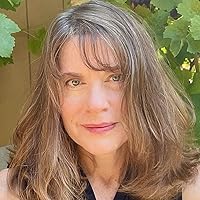
Anne Michaels (born 15 April 1958) is a Canadian poet and novelist whose work has been translated and published in over 45 countries. Her books have garnered dozens of international awards including the Orange Prize, the Guardian Fiction Prize, the Lannan Award for Fiction and the Commonwealth Poetry Prize for the Americas. She is the recipient of honorary degrees, the Guggenheim Fellowship and many other honours. She has been shortlisted for the Governor General's Award, the Griffin Poetry Prize, twice shortlisted for the Giller Prize and twice long-listed for the International Dublin Literary Award. Michaels won a 2019 Vine Award for Infinite Gradation, her first volume of non-fiction. Michaels was the poet laureate of Toronto, Ontario, Canada from 2016 to 2019, and she is perhaps best known for her novel Fugitive Pieces, which was adapted for the screen in 2007.
it seems to be something of a goodreads sin to give this book any fewer than four stars. and were i rating it solely on the beauty of its language, it would be an easy five-star book. but as a novel, it missed the mark for me somewhat, so it is really just a high-three for me.
i know - blasphemer!
the poetry-as-novel thing can be a truly wonderful beast, or it can leave the reader wanting more - more story, more impact, more cohesion. reading this book made me long to re-read Justine, which is an example of this style done perfectly. durrell's enviable mastery of language turns alexandria into a paradisiacal blend of the natural, the erotic,and the cerebral, but he never sacrifices story despite his emphasis on lyrical language.
fugitive pieces, while it all but accidentally tells a story, remains that - pieces; offhand musings that sparkle beautifully but fail to make connections that would bind this into a solid and emphatic novel.
the strongest parts of this book, to me, are when she is describing the women in the two narrator's lives: each has two life-altering lovers; one failed, and one lasting, and the four of them are prismatic in their allure and their vivid realization on the page. they remind me of the women in jonathan carroll, or leonard cohen: perfectly self-sustaining and generous, selfish and regretful.
but another, and bigger, problem is that at one point in the book, there is a shift in narrators, and yet the voice is exactly the same as what has come before; the same fragmented, desperately lovely poetic musings, doling out the story in brief paragraphs. it is frustrating that there is no change in tone with the change in character. it is all well and good to have a personal style, and it is difficult to cut portions that are pleasing to you-as-writer, but sometimes you have to sacrifice beauty for craft.
having gotten all the negative out of the way, i did enjoy reading this book. there are shockingly gorgeous passages, many of which are recounting the horrors of the holocaust, and so are even more potently beautiful for the darkness that undercuts the words. it's a lot of this:
-Nothing is sudden. Not an explosion - planned, timed, wired carefully - not the burst door. Just as the earth invisibly prepares its cataclysms, so history is the gradual instant.
-Gradually Athos and I learned each other's languages. A little of my Yiddish, with smatterings of mutual Polish. His Greek and English. We took new words into our mouths like foreign foods; suspicious, acquired tastes. Athos didn't want me to forget. He made me review my Hebrew alphabet. He said the same thing every day: "It is your future you are remembering." He taught me the ornate Greek script, like the twisting twin of Hebrew. Both Hebrew and Greek, Athos liked to say, contain the ancient loneliness of ruins, "like a flute heard distantly down a hillside of olives, or a voice calling to a boat from shore."
-How many centuries before the spirit forgets the body? How long will we feel our phantom skin buckling over rockface, our pulse in magnetic lines of force? How many years pass before the difference between murder and death erodes? Grief requires time. If a chip of stone radiates its self, its breath, so long, how stubborn might be the soul. If sound waves carry on to infinity, where are their screams now? I imagine them somewhere in the galaxy, moving forever towards the psalms.
so. lovely passages of filler-bits that please the mind and the ear, but they just lack that driving force that is supposed to sustain a narrative. and while there are echoes and pockets of repetition throughout, there is never a sense of solidifying these observations into a unifying statement. it is mysticism without religion.
and i am probably being overly-critical here, because i did enjoy it, and it does tell a story, despite my grumblings, i just think that it had more potential than it ultimately delivered, and it sacrificed substance for style.
Click here to watch a video review of this book on my channel, From Beginning to Bookend.
A haunting elegy. Michaels pairs the story of an orphaned Jewish boy who clings to memories of the family he lost during a Nazi raid in 1940 with the narrative of a man whose parents survived the concentration camps but whose scars from the experience have a disastrous effect on the child they conceived after the war had ended. Crafted with luminous, poetic prose, this laudable addition to the pantheon of World War II literature is a masterfully written meditation on grief, loss, family legacy, history, and memory.
"To survive was to escape fate. But if you escape your fate, whose life do you then step into?"
Jakob Beer is a Holocaust survivor. At the age of seven, he is rescued while on the run – a fugitive of sorts – from the death grip of the Nazis. His mother, father and beloved sister Bella are not so fortunate. Jakob will spend a lifetime trying to piece together the memories of his past and those he loved. The writing is simply astonishing. The prose often reads like poetry and the effect is quite powerful. I actually hesitated about writing this review and have delayed putting my mind to the task – it's very difficult for me to express my thoughts on this book. I feel inclined to state that you just need to read this and absorb the words on your own. However, I will attempt to cobble together something of a review here!
Hidden in the mud of an archeological dig site, Jakob is rescued by a Greek geologist named Athos and is spirited away to the Greek island of Zakynthos where he will remain hidden for the duration of the war. Here Jakob will learn about those things that Athos is most passionate about – geology, geography, languages and poetry. An everlasting bond of love is formed between this pair, yet the memories of Jakob's family continually haunt him. "Any given moment – no matter how casual, how ordinary – is poised, full of gaping life. I can no longer remember their faces, but I imagine expressions trying to use up a lifetime of love in the last second. No matter the age of the face, at the moment of death a lifetime of emotion still unused turns a face young again." He has the sensation that his sister Bella visits him and calls to him from beyond the grave. Not understanding the meaning of this, he feels she is beckoning him to join her. "Awake at night, I'd hear her breathing or singing next to me in the dark, half comforted, half terrified that my ear was pressed against the thin wall between the living and the dead…" After the war, Athos and Jakob emigrate from Greece to Toronto, Canada where Jakob will continue to be nurtured by the love and teachings of Athos. Jakob translates works, he develops his artistry as a poet and further learns the power of the written word and the meaning hidden in those words not spoken. The key to understanding what Bella has always hoped and wished for him finally becomes evident as he eventually discovers true love. "To remain with the dead is to abandon them. All the years I felt Bella entreating me, filled with her loneliness, I was mistaken. I have misunderstood her signals. Like other ghosts, she whispers; not for me to join her, but so that, when I'm close enough, she can push me back into the world." If you read this book, no doubt you will adore Athos and love him as Jakob did, you will cry for Jakob and want to comfort him when he wakes from another nightmare, and you will ache for Jakob as he attempts to put the pieces of his life together in his search for self.
Now, I would have been quite pleased if this novel had ended here with Jakob's story. However, I began a new section of the book and was admittedly a bit confused to realize that a new character is introduced at this late point. Ben's story is his own, with only a small tie to Jakob's story in that Ben once heard Jakob reading his own poetry. Ben is the son of Holocaust survivors. He also has his own struggles to overcome. It took some time, but I eventually realized that Ben's salvation hinged on his discovery of Jakob's story. Here the reader will again be able to piece together another portion of Jakob's life; a hole in the earlier story will be filled in for us.
I highly recommend this book if you admire exquisite poetic language and are not opposed to a non-linear story. Bits of Jakob's memory of his life before the Nazi invasion are intertwined with his current life under the care of Athos. The beauty of Zakynthos and Greece are wonderfully conveyed through Anne Michaels' writing. If you are perhaps thinking that you have had your fill of Holocaust books, please reconsider and read this one. This is a story of loss, memories of those lost, love in its many forms, the power of words, and the grace of salvation. I have given this book 4 stars only because of the slightly disjointed feeling I had with the change in narrator in the last third of the book. However, things did eventually tie together in a sense so this is just a minor quibble. I definitely think that I could take away even more from this book on a re-read and that ultimately this would be a 5 star book on my shelf.
"The English language was food. I shoved it into my mouth, hungry for it. A gush of warmth spread through my body, but also panic, for with each mouthful the past was further silenced."
“There’s a moment when love makes us believe in death for the first time.”
I read and noted the presumed truth of that line: the fear of losing those we love. Now I feel and live it. When a friend recently consoled me with the idea that grief is love with nowhere to go, I knew exactly what she meant.
This is a beautiful and profound novel that I ended up finishing at a painfully and unexpectedly (in)appropriate time.
It’s about making a life after sudden death (“no one is born just once”), nurturing memories, and living with ghosts (not literally). It’s about the importance of stories: of piecing them together from fragments, whether the sort of snippets refugees abandon or treasure, or natural artefacts that the brave, wise, big-hearted geologist, Athos, studies.
The first 200 exquisite pages are fictional poet Jakob Beer’s unfinished memoirs, “a biography of longing”. All his writings were, in some sense, ghost stories, or about hiding. But this charts his being the sole survivor of a Nazi raid on his home, aged seven, then to Zakynthos, Toronto, and back to Zakynthos. It’s profound, painful, poetic, and hopeful. It drips with symbolism and recurring tropes. It was 5* at least.
Then, for the final 100 pages, it suddenly switches to Ben, the son of refugees, who “was born into absence… A hiding place, rotted out by grief” to a father “who erased himself as much as possible within the legal bounds of citizenship”. Ben was a student admirer of Jakob, who meets elderly Jakob once, at a party. When Jakob dies, Ben tries to assemble the pieces of his life story, travelling to Jakob's home on Zakynthos, living some parallels of his Jakob's life. The trouble is, Ben’s voice is barely distinguishable from Jakob’s (even the chapter titles are taken from those in the main part). The only difference is that there are hardly any of the poetic aphorisms that make most of the book sublime. A hugely disappointing way to finish.
Living after Loss
“There is no absence if there remains even the memory of absence.”
Jakob lost his parents and older sister in terrifying circumstances. Piano-playing Bella is the strongest memory and hence greatest loss throughout his life.
"She whispers; not for me to join her, but so that, when I'm close enough, she can push me back into the world.”
He nurtures and cherishes his memories, the times he almost glimpses her, but gradually he learns the best remembrance is to embrace the life he’s privileged to have. Not to forget, but to focus more on the future than the past.
“To remain with the dead is to abandon them."
Quotes about Loss
• “To survive was to escape fate. But if you escape your fate, whose life do you then step into?”
• “The intimacy that death forces on us.” Going through letters and possessions.
• “A house, more than a diary, is the intimate glimpse. A house is a life interrupted.”
• “Murder steals from a man his future. It steals from his own death. But it must not steal from him his life.”
• “I tried to embroider darkness… Black on black, until the only way to see the texture would be to move the whole cloth under the light.”
Other Quotes
• “Limestone - that crushed reef of memory” and cave formations “spasms in time”.
• “Find a way to make beauty necessary; find a way to make necessity beautiful.”
• “Starlight [is] only the white breath of an old cry. Sending their white messages millions of years, only to be crumpled up by the waves.”
• “I long to steal your memories... to syphon off your dreams [nightmares].”
• Writing about childhood memories “in a language foreign to their happening… English could protect me; an alphabet without memory.” Translation as a form of transubstantiation.
• “The best teacher lodges an interest not in the mind, but in the heart.”
• “One could look deeply for meaning or one can invent it.”
• “History is amoral: events occurred. But memory is moral; what we consciously remember is what our conscience remembers… History and memory share events; that is, they share time and space. Every moment is two moments.”
• “The leaves whisper under the street lamps… Flowers dripping from window boxes.”
• “The visitation of moonlight. It occupies the darkness, erasing everything it touches.”
• “The ship’s flag grabs at twilight. Heat washes away under the rushing fountain of stars.”
“Write to save yourself… and someday you’ll write because you’ve been saved.” Hence this review. I hope. I do. And this book is part of that process.
5 stars !...One of the wisest and most beautiful books I have ever read.....A book about longing, loss, grief, beauty and love....I would reread whole chapters, sentences and phrases and then actually either ache with wistfulness or weep with bittersweet joy. I felt myself transforming as I read this for the better and I think it will continue to have effects on me for many months and years ahead. A rare jewel that I will take out from time to time from its box and put it against the night sky and watch it sparkle....Thank you Ms. Anne Michaels for this work of art.
The story itself is straight forward and easy to follow....( not 'all' characters are developed fully), but the overall plot - and the depth of the plot is clear....beautiful in its ways....and powerful. The lyrical crafting is luminous.,
Jakob Beer's parents and sister, Bella, were killed in his home --victims of the Nazi reign in Europe. Jakob is now an orphan....at age 7. He flees into the marshes and forests in Poland and meets a Greek Geologist, Athos Roussos who takes pity on him -and smuggles Jakob to the Greek island of Zakynthos. Later they go to Toronto where Jakob develops his language ...become a poet, and comes to some inner peace over the loss of his older- beautiful sister, Bella.
Athos, is a Holocaust survivor himself....a widower. Both Athos and Jakob have experience loss -- grief -- sorrow--all the pain that this horrific war has done to people. These two characters - pretty much - save each other. Over time ...Athos encourages Jakob to learn the Hebrew letters and language. Athos teaches Jakob courage....the value of remembering - and having a future. Athos teaches Jakob to love from his heart...and not to let anger and fear dominate his life.
When Jakob's narrative ends, Ben takes over. I had already heard many opinions about the introduction of Ben - positives and negatives....( a few from locals - a couple from Goodreads friends). I didn't have a problem with this change..because I never think the Holocaust is about one person.. Somehow, Ben reminds us... that we've all been touched by the memories of death.
What makes this Holocaust story different than others is the poetic descriptions. The imagery was lovely.....literature and art dancing side by side!
Jakob Beer understands love. He also understands loss. He understands love as only a man who has lost and found it once again can. He finds it in the faces of those who come after the tragedy and in the memories of those who have never come out of it. We all have our way to communicate with those long gone. Only, while we change, they stay the same. We wish to keep those memories alive for as long as we can. But time is merciless. When we have lost someone we truly love, we cannot escape from the memories of them. Jakob cannot escape from the image of his mother, his father, and mostly of his sister Bella. She goes on living in his mind, breaking his heart over and over again and uplifting it with the same power. She lives. Bella lives. And while Jakob grows up, gets older, falls in love, falls out of love, falls in love again, learns, experiences, hurts and rejoices, Bella stays the same, forever imprisoned in the depths of his tortured consciousness. She is the child that never grows, never falls in love, never gets old, never dies. She is an eternal presence by his side. And as he grows and changes, but she never does, he gets to feel her loss, and his own loneliness, ever more keenly. We change, but the ghosts in our minds stay the same. They always take a piece of us with them, a part of us that, like them, stays frozen in time. Do our ghosts protect us or condemn us? Who are we after the loss? Do we remember to be solaced or to be hurt? Sometimes I think that memory is like a garden. We crush the grass under our feet, but new one will always grow. We pluck a flower, but the seed stays in the ground. We cut off a tree, but its roots go on living. We can give up on memories, but they never give up on us. Even when the mind forgets, the soul remembers. Subconsciousness, like time, is inexorable. Jakob remembers with both his mind and his heart, which ultimately saves him. We all think of the dead, but how much do we think of the parts of ourselves that die with them? I shall quote my friend Jeffrey who told me that when someone dies, we grieve not only for the person who died but also for the person we were while they lived. I wonder, whether as we change, we also change a little bit the reality of who these people were in order to fit them better with our new selves. As Jakob falls in love, he thinks of his sister, he imagines that despite her not living to adulthood, there was a part of her that felt and knew what it is to be an adult, to be loved, to be held by a man’s arms. And in the end he thinks of her as one not calling him to herself, to the other side, but trying to keep him alive, telling him to go on living in the real world. She is his saviour. She saves him as a boy. And she sustains him as an adult. As he changes, she stays the same, but at the same time changes with him. He sees her as a child, as a grown woman in love, as a wise mature woman. He reaches out to her in time of sorrow, in time of joy, in time of doubt. She haunts him, she saves him. She is his nightmare, his beacon, his darkness, his light. His past, present, and future. The child that never grows, possessed by the wisdom of decades. Who are we after the loss? When a loved one dies or leaves us, a piece of us leaves with them, when a violence is committed against us, a piece of us leaves, when we commit a crime a piece of us dies. When we forgive, we give a piece of us to the forgiven. When we love, we give another to our loved one. When a dream dies, when a sorrow dies, a piece of us is gone. We consist of fragments, fugitive pieces, ever changing selves. We change and our memories change. Sometimes it seems like the only constant thing in the universe is change itself. Change cannot be stopped, cannot be escaped, our pain, our happiness take so many different forms. As long as we live and breathe, we change and the world changes. Time, like a restless fugitive, never slows down its course. It seems like the past is the only thing constant and we hold on to it, to the memories as a way of having a single speck of stability into our tumultuous lives. It is our sustenance in our eternal, merciless race with time. But the past too changes. Events past don’t change, but our view of them changes and so the past is changed. Sometimes for the better, sometimes for the worse. Bella dies in 1940, when Jakob is only seven. But he carries within himself the essence of who she was for the rest of his life. In the end he finds the happiness he has been longing for for so long. And Bella is no more a corpse, a victim, a ghost. She is his strength, his inspiration. His release.
I’m afraid that this review does not do the book justice. It is so much more than what I’m making it look like. It is hard for me to convey what this book is about. The writing is like nothing I have ever seen. And I shall carry the wisdom it offers with me like a ghost and find in it the strength and release I need so much. It is an outstanding piece of literature. It is both lyrically and philosophically very strong. It covers so much more than what can be grasped by my review. I wanted to include quotes, passages of it, but I found myself confused. Somehow I couldn’t decide where to place what. Just read it and you’ll see what I’m talking about.
This novel often reminded me of what a brilliant accomplishment Virginia Woolf’s The Waves is. There are parallels. The piecing together of shards, of fugitive pieces, the deployment of one narrative to unravel another, in an attempt to complete biography. It’s not, of course, as good as The Waves – few novels are!
The first part of the novel is narrated by Jakob Beer. He is seven when his parents are murdered by Nazi soldiers. His beloved sister, Bella is abducted and will become the ghost that haunts him his entire life. He is saved while hiding in a forest, sheathed in mud like a golem, by a Greek geologist, Athos Roussos, who takes the boy back to his home on the Greek island of Zakynthos. Athos is the stuff of fairytales – wise, kind, generous, resourceful, deeply knowledgeable about a wide range of subjects, especially the natural world: in short, an ideal mentor whose vast and detailed imagination gives Jakob another world to live in. Jakob will eventually become a poet.
The second part of the novel is narrated by Ben, who met Jakob once and is deeply influenced by Jakob's poetry and goes to the Greek island in an attempt to find the writer's notebooks after his death. Ben is the son of Holocaust survivors.
The writing is often stunning. There are so many beautiful and deeply profound passages of prose in this novel. But there isn’t always the feeling that this beautiful writing is fused into the narrative. Sometimes these passages appear like isolated magical islands, somehow adrift from the any recognisable world. This novel is very self-consciously poetic. As if Michaels is more concerned with proving to us how beautifully she can write sentences than any of the more rudimentary disciplines of the novelist. By contrast I was reminded of how brilliantly Ondaatje’s poetic passages flow organically into his narratives without bending them out of shape. There’s no ugliness in this novel, nothing of the commonplace. Everything is poeticised. But it poeticises what is already poetic rather than poeticising the ordinary, a more difficult and rewarding feat. Also the sensibility of Ben becomes almost indistinguishable from the sensibility of Jakob. Again reminding me of how much more successful Woolf was in creating a single biography out of truly disparate and distinctive voices.
I’m really surprised this has been made into a film and am very curious now to see it because it never quite worked for me as narrative. That said, it’s well worth reading for the beauty of the prose. No surprise Anne Michaels is a poet. I’d argue though that she’s a better poet than she is a novelist.
Fugitive Pieces is a tour de force that must be consumed slowly and savored, like a good wine or a piece of New York cheesecake. It is the story of Jakob Beer, a Jewish child saved from the holocaust by a Greek stranger. In a style that is beautiful and stark at the same moment, Michaels ferrys us through Jakob’s life as he deals with his loss and its impact on his future.
When Jakob’s story is complete, and you feel the book has reached its logical end, Michaels pulls a rabbit out of the hat and introduces some new magic in the guise of Ben, the child of holocaust survivors who is touched in a profound way by Jakob. Ben is proof that the influence of an individual can outlast his life, that a life can mean more than we know, that our own grief can assuage someone else’s.
The night you and I met, Jakob, I heard you tell my wife that there's a moment when love makes us believe in death for the first time. You recognize the one whose loss, even contemplated, you'll carry forever, like a sleeping child. All grief, anyone's grief, you said, is the weight of a sleeping child.
For grief is so often memory, and memory is what extends us beyond the limits of our corporeal bodies. No one would protest the burden of carrying a sleeping child.
I marked numerous passages in my reading. I stopped and reread paragraphs because the beauty they expressed was too profound to be satisfied by only a single reading.
As for your brother's unhappiness, I'm naive enough to think that love is always good, no matter how long ago, no matter the circumstances. I'm not old enough yet to imagine the instances where this isn't true and where regret outweighs everything.
and
She knows as well as I that history only goes into remission, while it continues to grow in you until you're silted up and can't move. And you disappear into a piece of music, a chest of drawers, perhaps a hospital record or two, and you slip away, forsaken even by those who claimed to love you the most.
There are myriad holocaust stories, but the best are the ones that remind us of our humanity, what we share, and that, as Donne told us, “any man's death diminishes me, because I am involved in mankind, and therefore never send to know for whom the bells tolls; it tolls for thee."
A novel that wants to convince us academics can be deeply feeling, sensitive to personal life and even sexy!
A seven year old Jacob Beer is hiding behind a wall when his parents and sister are taken away by the Nazis. He is eventually rescued by a Greek archaeologist and smuggled to Greece where he still has to do a lot of hiding. His saviour is a wise elderly Greek geologist with whom he forms a magical bond. After the war they emigrate to Canada together. Jacob becomes a poet. This is often not so much a novel as a meditation on loss and restoration. It becomes a little confusing in the second half when a new narrator enters the scene, another man who survived the Holocaust and who admires Jacob's poetry. Confusing because he too narrates in the first person in the same voice as Jacob and his relationship with women seemed to mirror exactly Jacob's. it's a novel that eschews dramatic tension in favour of hindsight wisdom but is very beautifully written.
Finally, I have finished this one. I loved the cover and a quick flick through excited me because the writing was poetic and lyrical and the prologue about lost manuscripts from people who wrote about the holocaust was tantalising. The story is about a young Jewish boy, Jacob Beer who, while hiding, witnesses the slaughter of his parents and the abduction of his sister, presumably for the death camps, by the Nazi police in Poland. He survives living in the marshland outside the town until he is rescued by Athos, a Greek naturalist/geologist/scientist who smuggles the 7 year old to his home on Zakynthos where he stays hidden until the end of the war. They move then to Toronto where, many years later Athos dies and Jacob becomes an academic and later a writer, but is tortured by his war experiences and survivors guilt. His marriage fails and he eventually finds some solace with Michaela. The last part of the novel follows Ben, a man brought up in Toronto but whose parents were holocaust survivors. He meets Jacob at a party and finds some of his own peace in Jacob's writing. Some of this novel is beautifully descriptive, moving and inventive. Every now and then I would read a sentence that blew me away... "I learned the power we give to stones to hold human time." speaking of temples and Cairns. There were also some shocking descriptions of cruelties that came without warning to draw you back to the relevance of the times... "Jews were filling the corners and cracks of Europe, every available space. They buried themselves in strange graves, any space that would fit their bodies, absorbing more room than was alloted them in the world." After enjoying the first chapter I believed that I was in for a real treat of a book and I was very enthusiastic about it. However I wasn't far into it before I realised it wasn't holding my interest consistently. It was clear that meticulous research had taken place prior to writing the book, but its knowledgeable sections about geology, philosophy or other academia, while impressive, were quite a slog and my interest began to wane. There were whole sections of the book where my attention wandered and I was not bothered to recount the lines to re enlighten myself. I felt that these sections compromised any plot or character development so that I did not care much about them. I was feeling very little at all. There is no doubt that Anne Michaels is a talented writer but it almost seemed that she flexed her literary muscles too much at times so that this seemed to be more of a poem than a novel. I also had a problem when the narrative voice took Ben's persona in the last section, mainly because there is no warning of this and the voice still sounds exactly like Jacob. I was quite a way through before I realised we were now witnessing someone elses story. Quite a lot of the last section is also quite hard to decipher, and I found some of the plot lines are confusing and almost deliberately contradictory or vague and unexplained. At this point though I just wanted to get it finished and was beyond trying to clear up any anomolies. Its a shame because I really wanted to enjoy it and when its words lit up, I felt inspired by it. But I don't think these interludes were enough for me. There are sections of this book that I don't even remember reading and that is not good for me. I realise that there are millions who count this book among there favourites, if not the best book ever. It has also won quite a few awards. But there are also others who feel like me, and blogger/writer Elizabeth Baines has eloquantly described some of the problems that I have tried to write about here. There is a lot for discussion in this book, both subject matter and style.Some moments of magic but also disappointing so mixed feelings with this one.
Sometimes (not always) it helps to persevere. Around page 150 I tended to close this book. Okay, the language was imaginative and poetic, but what was the story really about? And then it suddenly started to speak and gradually I realised what Michaels probably wanted to offer: pieces of our own past, for which we are on the run, or which themselves flee from us and with which we want or need to come to terms with.
In this case it revolves largely (two-thirds of the book) around the story of Jakob Beer, a 7 year old Jewish boy in the Second World War in Poland, that was saved from the holocaust by the Greek geologist-archaeologist Athos and eventually ended up in Canada. He is obsessed by the memory of his sister Bella who was deported and exterminated together with their parents. Jakob only finds inner peace far beyond his 50th birthday, with his 2nd wife, but - alas - also not for long. The thing Jakob stood for, gets an echo in the last third of the book, in the long monologue of Ben, also a son of holocaust-parents (who survived and were deeply tormented by the trauma), and he also finds the foundation of his life after some wanderings and through a woman.
I know, it all sounds fairly trivial, as if Michaels has made a calculated mix of clichés, kitsch and things that appeal to the average reader. But still this is an unruly book that evokes a lot of resistance. Especially the wrought, poetic language of Jakob and his impressionist stance, ensure that the reading initially is a very difficult experience. The storyline is sometimes very hard to detect, and also at the end you have the impression that the author was not really presenting a valid, complete story, but rather wanted to uncover a number of basic intuitions about life, in which the poetic language represents an additional enriching layer. I'm certainly going to reread this book and taste it again! (rating 3.5 stars)
This is a novel I will never forget with a title, which is more, that I've always remembered. Anne Michaels chose it well. Fugitive Pieces references a poem by Lord Byron. Some of it could have come straight from the novel.
Though a tear dims his eye at this sad separation, 'Tis nature, not fear, which commands his regret; Far distant he goes with the same emulation, In the grave, he alone can his fathers forget.
Those lines, for me, sum up what this novel is about. Tears, sadness, separation, nature, fear, a grave and forgetting. And it is beautifully written. Also one of the best portraits of a Greek that I know besides Zorba. My own "sad separation" was finishing it.
Together, my 75-y/o mother and her 82-y/o sister, spent a whole month (last month) vacation here in the Philippines mostly in my house. For few days, they went to our province, the town they were born. When they came back, my mother showed me a bunch of old photographs. Included in those were the pictures of her parents. My grandparents.
It was amazing how they could still tell the stories behind each of the photograph as if they were only taken a few years ago. When we came to those of her own parents she told, or retold, me stories about them. I heard some of them before but hearing them again coming from the mouth of my old mother and using my now becoming old ears, was different. Our own feeling of mortality, death lurking at us, made those memories, especially their last few years on earth, more spirited or true to life. With me now in my middle age and she, in her twilight years, looking back to the lives of her parents made us reflect more on what would be ours when we finally come to our last years, or months or days on earth.
There was one photograph with both of their father and mother in it. Of my grandmother's last days before she died. My mother and aunt took turns in describing how they took care of her. I could sense the pain of loss especially when they said that she died so young because she had to give birth to 15 infants (only 5 or 4 survived to adulthood) not because there was no money for caesarian operation but because there was no hospital then. Our hometown is in a small island in the Pacific and this was in the 20's and 30's. How they also lost their father whose eyes were ravaged by diabetes. Their stories are too vivid that you could feel their pain. The pain of losing one's parents is, I think, a pain that will never go away.
Anne Michaels, the author of Fugitive Pieces is a poet. Thus, this book is peppered with phrases that are poetic, rythmic and layered with metaphors. It is a bit difficult to read, especially in the first 50 or so pages, as I am used to straight narrative prose but when you finally adjusted to her style, you can't put the book down. It is like reading a fragmented prose in different multiple layers and at least two voices, that of Jacob in the first part and of Ben in the later part. Jacob is a 7-y/o Jewish boy when he hides by digging himself in the forest mud to escape the Nazis in Poland. I was struck by his idea of making a hole so deep that he could escape in the other side of the world. This came into my mind too when I was at that age and playing inside our backyard in our island hometown. I will not tell you about the "hole" and why the idea came into my mind.
Jacob has a sibling, Bella who plays the piano. The memory of Bella and her parents stays with Jacob all his life even if Athos, his rescuer, brings him to Greece and later to Canada to live and forget his past. It affects his married life until the end of his life. In the second half of the book, with Ben as the narrator, the same theme permeates his recollections of his parents who he lost in WWII. Ben is an admirer of Jacob's poems and the way the latter has handled his life as a survivor.
This memory of losing their loved ones, with pain expressed in exquisite lyrical prose, makes this book a very memorable read. The pain of loss that will never go away. The beauty of prose that will always be remembered.
It’s not easy to sustain a poetic voice for almost three hundred pages though Virginia Woolf managed it brilliantly for two hundred in The Waves. And as a result of this difficulty this wasn’t always compelling. At times the writing is stunning and it’s brilliant how much poetry and pathos she manages to extract from everyday detail. At other times the unrelenting insistency on poetry felt a bit strained as if there was too much idealising going on. It’s a novel that investigates separation and the mind’s struggles to create a continuity of wellbeing. Jakob manages to escape when his parents and sister are arrested by the Nazis. After months of hiding, often digging himself into holes in the landscape, he is rescued by a Greek archaeologist called Athos. Later it falls on an admirer of Jakob who becomes a poet to keep his and Athos’ memory alive. The book is narrated in the form of two journals and is a kind of archaeology of memory. There are probably two hundred brilliant pages and another hundred of unnecessary upholstery. I couldn’t help feeling this would have been a masterpiece if those other pages had been edited out.
Literary ambrosia. This gets at least six stars from me.
I stubbornly avoided this book for a long time because the promotional blurb just didn't make it sound appealing to me. I finally gave it a try so I could stop wondering why it won half a dozen awards and shows up on "must read" lists everywhere I look. I'm so glad I did! The blurb doesn't even begin to tell you about the book as you'll experience it while reading.
If you're the left-brain dominant sort who needs everything spelled out in flat little rows and columns, you may not appreciate this one. However, if you enjoy encountering profound little pockets of prose to be read slowly and savored and then re-read, you'll love this book the way I do. The author is a poet, and it shows here in her first novel. Many of the best passages were sort of like a combination of Lawrence Thornton and Per Petterson, beautifully descriptive and ethereal. And yet Anne Michaels has her own distinctive style, which I don't mean to diminish by comparing her with others.
For the first 200 pages, the narrator is Jakob Beer. He tells the story of his life, being rescued in Poland by a geologist named Athos and secretly taken to Greece, then emigrating with Athos to Canada after the war. This is interspersed with his contemplations on life, loss, beauty, love, hatred, forgiveness, and remembrance.
The final 100 pages are narrated by Ben, a young man who briefly met Jakob Beer before his death, and now tells his own story as if he were speaking to Jakob. I found it quite jarring to have a sudden change of narrator without being told anything about Ben, so if you're reading this review, I'm saving you from that disorientation.
Although not as compelling as the first 2/3 of the book, I did appreciate Ben's story from the perspective of someone who grew up as the child of Holocaust survivors. He absorbed their fears and their silences and their losses without ever being made to understand that he was not inadequate as their child. It was their history, too painful for them to share with him, that shaped his life.
I strongly suggest that everyone at least give this a try. The first few pages are somewhat fragmented and hard to follow, but it smooths out and finds its footing by about page 20 or so.
Oh my goodness, this book. What a book. Densely poetic, stuffed with ideas and knowledge, rather experimental in structure, enigmatic with much of the story. And heart-breaking. I listened to it (read in a beautiful slow Canadian drawl by the author) and now I am going to go and buy a physical copy so that I can go back and reread sections. Book 1 is Jakob Beer's memoir, not finished because he dies in a car crash (easy to miss this and get confused). He describes in snippets of circular memories how when he was seven he was rescued by Athos after his parents are killed by the Nazis and his sister taken. Athos takes Jakob to Greece and hides him there before the two of them move to Canada. There is lots more, but I don't want to spoil it. Book 2 is narrated by Ben - often writing 'to' Jakob - and details his life as the son of parents who survived the Holocaust. It's about love and memory, fathers and sons, inherited trauma and so much more.
‘Important lessons: look carefully; record what you see. Find a way to make beauty necessary; find a way to make necessity beautiful.’
If you have been to an art exhibition — one of the big marquee ones, a collection of The Greats of something-or-other — you might understand. After queuing good-naturedly for an hour (or more) you are permitted entrance and the first painting… it’s stunning. You gaze at it for a good five minutes, trying to absorb and memorise every detail. Moving on to the next, it’s even better — a masterpiece — so you do the same. At the third you start thinking ‘at this rate we’ll be here all day’ and pick up the pace a bit. Three hours later, your brain is completely saturated, you’re overwhelmed. You’ve already forgotten at least 50% of what you saw, before even leaving the gallery.
Fugitive Pieces is a bit like that. It’s so densely stuffed with both artistry and meaning, it’s impossible to take it all in. Highlighter-worthy passages on almost every page. Layers of profundity that, by the novel’s second half, skim across the edges of my over-saturated brain. Archaeology plays a part in the story, so it’s appropriate that it proceeds like an excavation: slowly, meticulously, never rushing. Wielding its incredibly beautiful prose as a tool, it pores over the details, it circles back, it examines from every angle.
Not everything it unearths is beautiful. In fact much of it is horrific – bearing witness to vivid descriptions of WWII atrocities. But there is heroism, love, and humanity too. It says, of the world: everything is prefigured, nothing is lost, even after events pass out of living memory.
There were times I thought this book was too much, too indulgent, too poetic. At other times I thought that I was not reader enough for this book. I close the last page and have already forgotten half of what I read.
'Fugitive Pieces' is a beautiful elegy in narrative prose. It made me very sad. The book maintains a level of poetic creativity and exquisite writing about Holocaust survivors who are trying to live as normal people do and not to corrosively mourn forever after the devastation of the Holocaust and of surviving it.
Short version: can't be done. But making an effort mitigates the PTSD, even if it doesn't put the pieces all back where they were.
Holocaust survivor and poet Jakob Beer narrates the first two-thirds of the novel, and Ben, a child of Holocaust survivors, narrates the last third. Both are haunted by their dead parents or siblings even though they have learned to pick themselves up and make a life for themselves. Jakob's story is the most harrowing and he speaks graphically of the unspeakable for the first 20 pages; after which he is rescued by an amazingly heroic Greek scholar. It is hard not to cry reading this part of the book. Jakob's life goes on as he grows up in Canada and marries, but he has nightmares all of his life. I am not surprised that as he pursues his education he buries himself in the tangible hard sciences of geology and geography - a type of history literally written in stone. The lessons learned by the death of his parents - indeed, almost his entire small town - and the disappearance of his sister Bella was a searing lesson on the ephemeral nature of flesh.
Ben's story was more problematic for me. He meets Jakob as a student in Professor Beer's class and becomes obsessed with Jakob's life because of his poetry. Ben is raised by Holocaust survivors who are emotionally scarred by their experience, particularly his father. Ben's section is the weaker part of the book, partially because his narration begins without introduction or explanation, partially because there is no change in 'voice'. I was confused by the sudden change of personal history until narrative clues eventually cleared up my confusion.
Innocent and inexperienced persons ignorant of human cruelty and torture and killing are often mystified and stymied by the inner unreachable coldness and withdrawal of damaged people. Spouses and children of survivors are sometimes incredibly hurt that despite their efforts to restore their damaged loved ones' lives they cannot reach in and fix it through love or sympathy.
It is clear having lost everything beloved of one's past so violently while a seven-year-old child, torn away from everything one knows by other human beings who hate beyond rationality, will create adults without a full set of healthy emotions or without a willingness to fully engage with life or trust in the, obviously to them, ephemeral or mercurial anymore. Such survivors learn the lesson soul-deep to not invest much in the courses of human affairs or trust in human 'goodness'. Many live with ongoing deeply rooted fear of caring about anyone ever again.
The language and form of the novel reminded me somewhat of an epic poem; however the writing is clearly a narrative, although a touch fragmented as a diary and written as if a memoir.
Some excerpts:
"Because Athos's love was paleobotany, because his heroes were rock and wood as well as human, I learned not only the history of men but the history of earth. I learned the power we give to stones to hold human time. The stone tablets of the Commandments. Cairns, the ruins of temples. Gravestones, standing stones, the Rosetta, Stonehenge, the Parthenon. (The blocks cut and carried by inmates in the limestone quarries at Golleschau. The tombstones smashed in Hebrew cemeteries and plundered for Polish sidewalks; today bored citizens, staring at their feet while waiting for a bus, can still read the inscriptions.) "
"To survive was to escape fate. But if you escape your fate, whose life do you then step into?"
"Michaela offers her ancestors to me. I'm shocked at my hunger for her memories. Love feeds on the protein of detail, sucks fact to the marrow; just as there's no generality in the body, every particular speaking at once until there's such a crying out...
I am leaning forward on the sofa, she is sitting on the floor, the small table between us. It seems absolution simply to listen to her. But I know that if she touches me my shame will be exposed, she'll see my ugliness, my thinning hair, the teeth that aren't my own. She'll see in my body the terrible things that have marked me."
The narrator has survivor's guilt, as well as the physical issues of having been starved of foods with vitamins such as C as a child, causing bleeding gums and rotted teeth, for example.
"We stopped for lunch...The afternoon heat was thick with burning flesh [a diner's dinner menu being cooked]. I saw the smoke rising in whorls into the dark sky. Ambushed, memory cracking open. The bitter residue flying up into my face like ash."
I know this novel will not suit all, gentle reader. The subject matter alone is a tough read, but there is also the author's purposeful use of literary genre elements, reducing accessibility. However, the beauty of the author's poetic phrases, I think, also causes some cognitive dissonance; at least for me it was a major issue.
“I did not witness the most important events of my life. My deepest story must be told by a blind man, a prisoner of sound. From behind a wall, from underground. From the corner of a small house on a small island that juts like a bone from the skin of sea.”
Early in her brooding, shadowy, aching novel, Anne Michaels sets out the central conflict of her principal character, Jakob Beer. Jakob’s family is slaughtered one winter night in 1940; the seven-year-old boy hides in a hollow in the wall, then escapes into his Polish city, burying himself in the mud of an archeological dig. He is saved by Athos, a Greek geologist, who spirits Jakob away to a remote island in the Greek archipelago. During the years in Greece, when Jakob is forced to hide within his savior’s home, Athos fills the long hours with millennia of history, geology, geography, and literature. Four years later, as the German army flees Greece, Jakob is allowed to emerge from the protection and seclusion of Athos’s home into a world broken by war.
As Jakob rejoins the world and grows into adolescence, the horror of the Holocaust is revealed to him. These are the events which he has survived but to which he did not bear witness. Athos and Jakob immigrate to Toronto, where a geology professorship awaits Athos. Jakob adapts once again, adding English to his linguistic library of Polish, Yiddish, and Greek. He becomes a poet, a husband, but he never settles comfortably into the leafy ravines and changeable climate of his Canadian home. For nearly the whole of his life he is haunted by guilt and crippled by depression.
Yet Jakob is also redeemed by pure, profound love. The bond between Athos and Jakob is beyond father and son, it is deeper than brothers. It is of two souls intertwining in a search for salvation, in a quest for meaning that can be found only by loving another so much that their needs and desires become indistinguishable from your own, that the story of your life would be unimaginable without their own role playing out.
This is a lyrical novel, where tangents on Antarctic exploration and palindromes, explications on the nature of history, irony, language, music, are woven into an atmospheric narrative. I felt dull and morose in the cold, hard cement and steel of Toronto, uplifted when released into the warm, lemon-scented air of Greece. Michaels does not follow a traditional plot structure -- the narrative flow jumps and twists, characters fall in and out, subplots are left on paths unpursued. She is a poet, first and foremost, and surrenders willingly her pen to the force of the story and the power of language.
Michaels adores stringing together sets of words that shimmer with polar magic:
“The winter street is a salt cave. The snow has stopped falling and it’s very cold. The cold is spectacular, penetrating. The street has been silenced, a theatre of whiteness, drifts like frozen waves. Crystals glisten under the streetlights.”
Or autumnal splendor: “It’s a clear October day. The wind scatters bright leaves against the blue opalescence of air.”
But just as you are lulled by the grace of her metaphors and the energy of her phrases, she wrenches your gut with the brutality of fact:
“I think of the Lodz ghetto, where infants were thrown by soldiers from hospital windows to soldiers below, who “caught” them on their bayonets. When the sport became too messy, the soldiers complained loudly, shouting about the blood running down their long sleeves, staining their uniforms, while the Jews on the street screamed in horror, their throats parched with screaming.”
Michaels’s supreme skill is using passionate language to reveal the gross burden borne by survivors of genocide: to relive the nightmare and to retell its details so that the slaughtered will not be forgotten.
Bölük Pörçük Yaşamlar, iki ayrı yaşamı, 2. Dünya Savaşı’nda ailesini kaybedip, Yunan bir arkeolog tarafından evlat edinen ve hayatını Kanada’da geçiren Jakob ile onun yazdıklarını kafaya takmış olan akademisyen Ben’i, birbirine neredeyse görünmez dikişlerle bağlayan, bunu da travma-hafıza üzerinden yapan bir metin. İki ayrı bölümde anlatılan iki karakter birbirlerine “boşluklarla” bağlanıyorlar ki bu da tam romanın isminin hakkını veren bir his yaratıyor. Yaşanan acının nasıl hiçbir zaman kaybolmadığına, hep orada durduğuna; iki karakterin de hayatının ne denli kırık dökük olduğuna okuyucu da ortak ediliyor. Metne dair eleştireceğim tek şey özellikle ilk bölümde kullanılan şiirsel dil oldu. Bazen bu kadar şiirselliğin yabancılaştırıcı bir etkisi de oluyor ama dediğim gibi genele bakınca gayet iyi bir roman.
After watching the film of the same name, I wondered why I had not been similarly moved by the novel. Now I remember why I was underwhelmed the first time. The deeply moving, achingly intense first part of the book is irredeemably overshadowed by the clunky one that follows.
The first part is told by Jakob Beer, 7 years old at the start; he is in hiding when he sees his parents killed by the Nazis and his older sister Bella disappear. After fleeing he is rescued by Athos Roussos an archaeologist, and smuggled out to his home in Greece, where Athos raises the boy as his own son and a deep bond forms between them. We follow their lives in Greece during the war and in Toronto afterwards. Jakob becomes a writer, his life haunted by survivor guilt and the remote possibility of finding Bella again. Long after Athos’s death, Jakob is finally able to come to terms with his past when late in life he falls in love with the much younger Michaela (Michaela/Michaels- what’s with that?). This is a story of heart-rending beauty that rivals any tale of loss I have ever read. Michaels’ ability to depict raw emotion is stunning, stark and spare, and five stars for that.
Then, 2/3 of the way through the book, an abrupt shift to the voice of a younger writer Ben, for whom Jakob is an object of hero worship. Here the novel disintegrates into the overwrought prose of Ben’s homage to the older man, partly because there’s no real connection between them. The homage is in fact tinged with a bit of jealousy as their first meeting was through Ben’s wife Naomi, who happens to get on very well with his parents (also Holocaust survivors, which is the cause of a certain amount of tension between Ben and his father), and thus contributing to some additional tension with Naomi who ... oh god, Anne, make him stop! We. Don’t. Care.
Ben’s life and loves are just narcissistic and inconsequential beside Jakob’s anguish and isolation; in addition, Michaels has made Ben an academic whose specialty is the poetry of weather, which just compounds his absurdity.
It’s as if her explicit purpose was to provide fodder for that dreaded exam question: “Compare and Contrast the two characters in ...”. But reading Ben is to forget Jakob; it’s like getting an ear-worm after a brilliant concert - now you can’t hear Ode to Joy any more.
The film (Michaels wrote the script some 10 years later) was incomparably better because Ben became part of Jakob’s life; he was a young boy when Jakob came to Toronto, they lived in the same apartment building and Jakob formed a close bond with him. And thankfully we didn’t have to listen to Ben’s life through his own voice.
I'm torn with this book. On the one hand the prose is so dense and rich, poetic and downright stunning. On the other hand the story left me a little hollow. Reading this I had the perpetual feeling that I was trying to see through a foggy window, barely seeing. And yet, there was so much feeling.
Characters appear as if in a dream and dissolve away. Frustrating? Yes. But isn't that how life is? People leave. People die. And we feel the loss forever, as the characters in this book do.
I'm not surprised to learn the author is a poet. This book reads like a dream. There was just a little something missing.
There are few words to describe how annoying I found this book. I just don't seem to be either an Orange Prize reader or a good target audience for novels penned by authors who are, as Michaels is described, 'primarily poets.' I love poetry--it was actually my first love, and novels came later. I've also loved quite a few great novels written by first-class poets. However, this isn't a rule of thumb and is actually very often simply an exception. Poetry and narrative writing are just not the same thing and, in cases such as this, it shows. It never ceases to amaze me how easily most people are duped into believing that lyrical, poetic writing automatically translates to 'good' writing, if only because we all still carry in our heads the tedium that if someone is capable of such writing, then they must necessarily have written a really good book.
'Fugitive Pieces' is such a book--my verdict: boring, boring, boring: also annoying. It is the story of a Polish Jew who escapes the Nazis (and simply by virtue of that we're supposed to somehow believe that 'important themes' will follow) and is adopted by a Greek geologist, who takes him to Canada. Unsurprisingly, our protagonist becomes a celebrated poet (ugh, how I hate--with rare exceptions--novels about poets, novelists, playwrights, artists...) and the last part of the book is devoted to another character, admirer of such poetry.
The novel has been promoted as one exploring diverse and thought-provoking themes--grief and loss, for example. Maybe. I'd think it inevitable to brush up against 'grief and loss' if your protagonist has escaped the Holocaust. However, I never discovered or felt particularly touched by any themes whatsoever. The so-called metaphors were so relentless that I was constantly drawn to the fact that the narrative structure was virtually non-existent, to the point where I questioned how much of a novel this book really was and how much, instead, a self-serving personal exploration. In the end, I'd have given it only one star. I didn't because one cannot deny that Michaels has some sort of talent even if, I've little doubt, this novel will barely last another 10 years in anyone's conscience. I guess I reserve my one-stars for truly the very worst offenders.
“The tombstones smashed in Hebrew cemeteries and plundered for Polish sidewalks; today bored citizens staring at their feet while waiting for a bus, can still read the inscriptions.” If only it were simple to find a way to read the words of this book through all these tears. I wiped them away and read on. There is an old Greek saying, light your candle before night overtakes you. I lit mine. A story of the ghosts and spirits still calling to Jakob. He is pulled beyond the rational to those subtle energies of the beyond. As he becomes a man, with the help of Athos, he is reminded of the beauty of life in the present which will inspire him to his end. At long last he understands that when the birds sing their spontaneous joyful songs every morning they are praising the returning sun. The returning and receding of all things is understood. The music that once burned inside his sister as she played her piano didn’t die with her breath’s end anymore than the sun dies come dusk.
Fugitive Pieces tells the story of Jakob, a Polish Jewish child, and Holocaust survivor; Athos, a Greek archeologist; and Ben (the Hebrew for son, not short for Benjamin), a poet and child of Holocaust survivors. It is not a linear telling as it moves from past to present and back throughout. The novels is permeated, saturated with memories, primarily those of Jakob. His escape from the Nazi devastation of his village and massacre of his family, survival in the forest, and escape. He is haunted by his sister, Bella, whose spirit traps him in the past. Athos is an archeologist who spends his life writing a book, and it is a work that takes over his life. After rescuing Jakob, they hide on a Greek island, that despite Nazi surveillance, does not yield the Nazis a single hidden Jew. After the war, Athos and the young Jakob move to Toronto, where Athos gets a faculty position. As an adult, Jakob becomes a translator after mastering Greek and English, and maintaining his childhood languages, Polish and Yiddish.
The lives of the male protagonists in the novel were for me the fugitive pieces of the title. Pieces of their past would appear and disappear throughout. The story is heavy with melancholy and loss. Yet the language is so beautiful, and the telling of it so compelling, it didn’t leave me with a sense of sadness. Instead, I marveled at the survival stories of each of the characters. Ben’s parents were Holocaust survivors who kept some of their secrets their entire lives. Athos’s secrets are buried in notebooks hidden in his house on a Greek island. One can pick any page of this book and find beautiful sentences, impressions and images.
This might be the best Holocaust novel I have read, but fearing I have forgotten the power of others I read longer ago, I will merely say it is definitely in the top 3.
To say that I was underwhelmed by this book would be a fair assessment. I did not connect to anything in this book. The story sounded promising but ultimately fell flat.
The structure seemed similar to a stream of consciousness and it did not work for me. It felt disjointed and confusing. Maybe I'm missing something but I think this style and form detracts from the story. Reading it was exhausting and slightly annoying.
The writing itself isn't great. It's not that the writing is complicated but more so that it's pretentious and repetitive. Sometimes repetition plays an important part but here it doesn't.
Overall I found this book very blah. I think it's okay to skip this one.
“One can look deeply for meaning or one can invent it.”
(3.5) Poland, Greece, Canada; geology, poetry, meteorology. At times it felt like Michaels had picked her settings and topics out of a hat and flung them together. Especially in the early pages, the dreamy prose is so close to poetry that I had trouble figuring out what was actually happening, but gradually I was drawn into the story of Jakob Beer, a Jewish boy rescued like a bog body or golem from the ruins of his Polish village. Raised on a Greek island and in Toronto by his adoptive father, a geologist named Athos who’s determined to combat the Nazi falsifying of archaeological history, Jakob becomes a poet and translator. Though he marries twice, he remains a lonely genius haunted by the loss of his whole family – especially his sister, Bella, who played the piano. Survivor’s guilt never goes away. “To survive was to escape fate. But if you escape your fate, whose life do you then step into?”
The final third of the novel, set after Jakob’s death, shifts into another first-person voice. Ben is a student of literature and meteorological history. His parents are concentration camp survivors, so he relates to the themes of loss and longing in Jakob’s poetry. Taking a break from his troubled marriage, Ben offers to go back to the Greek island where Jakob last lived to retrieve his notebooks – which presumably contain all that’s come before. Ben often addresses Jakob directly in the second person, as if to reassure him that he has been remembered. Ultimately, I wasn’t sure what this section was meant to add, but Ben’s narration is more fluent than Jakob’s, so it was at least pleasant to read.
Although this is undoubtedly overwritten in places, too often resorting to weighty one-liners, I found myself entranced by the stylish writing most of the time. I particularly enjoyed the puns, palindromes and rhyming slang that Jakob shares with Athos while learning English, and with his first wife. If I could change one thing, I would boost the presence of the female characters. I was reminded of other books I’ve read about the interpretation of history and memory, Everything Is Illuminated and Moon Tiger, as well as of other works by Canadian women, A Student of Weather and Fall on Your Knees. This won’t be a book for everyone, but if you’ve enjoyed one or more of my readalikes, you might consider giving it a try.
“History is the poisoned well, seeping into the groundwater. It’s not the unknown past we’re doomed to repeat, but the past we know. Every recorded event is a brick of potential, of precedent, thrown into the future. Eventually the idea will hit someone in the back of the head. This is the duplicity of history: an idea recorded will become an idea resurrected. Out of fertile ground, the compost of history.”
This is a reflection on love and loss in the context of the holocaust and those who survived. Jakob is rescued when seven years old (his family has been arrested by the Nazis)by Athos, a Greek archealogist; who takes him home and brings him up. You are told about Jakob's death at the very beginning of the book, aged 60 with his young wife. The story begins in Poland, then to Greece, Canada and back to Greece where Jakob meets the love of his life. Anne Michaels is a poet and the language and descriptions in the book are beautiful; almost too beautiful, becoming distracting. Jakob is haunted by the loss of his family, especially his sister Bella, throughout his life. His loss, and his coming to terms with life and love and survival are the centre of the book. The last third of the book is told by Ben, a student of Jakob's who follows in his footsteps after Jakob's death and finds his own way back from his own demons. For me, this part of the book is the weakest and felt unnecessary; my own opinion and I'm sure others will disagree. John Berger in his introduction reflects on Adorno's comment (in the 1950s)that "to write poetry after Auschwitz is barbaric" and feels that in this book that comment has become finally untrue. High praise; again not sure I agree, but it is a powerful and moving story and the language is sublime.



 come to my blog!