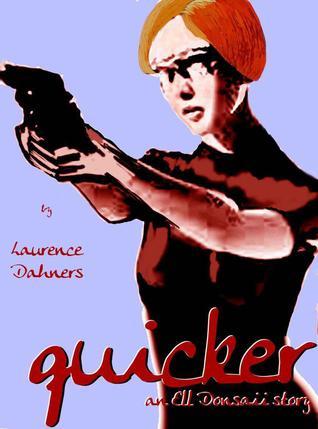
There is such an outrageous amount of flaws contained in Dr. Dahners' Ell Donsaii series that I find it hard to single out specific elements. Here are some of the things I find disappointing:
His heroine Ell Donsaii is set up with a truly staggering amount of potential traumata and restrictions, however, the author fails to truly develop her character defined by her struggles to overcome them. She does not so much meet any potential challenges as leap over them. Donsaii loses her father very early, her mother has problems to keep her small family solvent and then pre-teen Ell witnesses her mother getting attacked by a serial rapist and accidentally maims him. This episode gets mentioned once or twice later in the series, but aside from a greater awareness of her potential to seriously harm other people it does not seem to have an impact on her. Later her mother remarries and Ell's step-father is emotionally and borderline physically abusive, yet teenage Ell, despite her social awkwardness, some issues with her body image and some short-lived periods of frustration and occasional outrage at his behaviour, does not let this impediment have any impact on her life or academic career. In a later novel her mother divorces her step-father and quickly finds a new, better companion, but even this development does not have any real impact on Ell.
Ell grows up poor and several times lacks the money to immediately pursue her preferred course of action, such as attending her choice of college or easily patent her inventions. Again, this never poses an insurmountable obstacle or influences her behaviour unduly. In the end she amasses a staggering amount of wealth, courtesy of her inventions and the company she founds to develop them, but whether poor or the richest woman in the world, her behaviour, her goals and her interests do not change appreciably. Ell Donsaii seems above such concerns, almost untouchable by merely mortal considerations.
One of her more prominent traits, apart from her genius level intellect and aptitude for mathematics, is a set of physical mutations which enhances her nervous system and alters her musculature, granting her almost supernaturally quick reaction speed and sprinting capabilities. More than once she is self-conscious of her physical differences and at first shies away from displaying the full range of her physical abilities, which does not keep her from winning several Olympic gold-medals in gymnastics. In later novels, however, this reticence vanishes without any convincing reason provided by the narrative and Donsaii goes on to prove her superiority by publicly dominating several other athletic disciplines.
The range of emotions the protagonist displays is comparatively narrow and any emotional outbursts are strictly short-term and do not influence her actions. They remain mostly emotional ornamentation rather than a true description of her character. For the most part she seems rather detached and intellectual, despite dating several men and eventually starting her own family. She professes concern for her friends, employees and the human race and is always seen as a wise leader, making the right decisions in the face of opposition by the overly emotional normal human people around her which she either decisively defeats and outsmarts or who become converts to the cult of Ell Donsaii. Consequently, the characters in Laurence Dahner's Ell Donsaii series stay almost uniformly flat.
The same shallowness of response holds true on a wider social level. Donsaii makes several related revolutionary inventions which completely transform almost every segment of everyday life and the economy and apart from an awkwardly narrated impact on the presidential election there are almost no reactions from society as a whole, at least none which relate the complexity and inconsistency of human society which in Dahner's novels remains unconvincingly docile and compliant. Donsaii's conflict with foreign intelligence services, belligerent companies and finally a hostile president's administration remain without deeper impact on either the protagonist or society as a whole, merely temporary inconveniences rather than a true danger. Donsaii always remains the admired heroine, her adversaries fail to accomplish anything and have to accept public censure. Conflict remains a series of singular events with short-term consequences. Even her need to go on the run to keep her dangerous inventions out of the hands of an incompetent administration has been predicted by her and she is able to continue a comparatively tranquil life with her family under an assumed identity and resume her work.
Now, having ranted on Dr. Dahner's literary inadequacies and the social and psychological shallowness of his novels, I will tell you why I continue reading his Ell Donsaii series and why I recommend it as a way to spend some hours of your free time. These novels are what I like to call true science fiction. Dahners comes up with interesting scientific concepts taken from recent research and uses them to envision possible inventions and applications for the near future. On the basis of one perfected mathematical theorem based on a real-life scientific conundrum his protagonist develops solutions to real-life problems such as the shortage of energy and resources if we do not want to render our planet uninhabitable or medical solutions to severed nerve cords and other disabilities and proposes conveniences such as an unlimited bandwidth for a secure and instantaneous global communication network without the need for expensive infrastructure, personal flight capability, clothing with integrated climate control and instantaneous delivery of items bought on the internet. The applications for industry and consumer markets seem limitless and Dahners provides a solid scientific grounding for his speculations such as calculations of the needed energy and amount of carbon dioxide and methane for terraforming Mars, the needed tensile strength to use inflatable bags filled with the necessary amount of water to be an effective radiation shield, quotes from medical journals on the causes for obesity and other fascinating details which fill in the gaps in the reader's understanding of the practical problems science has to overcome to make science fiction become reality. For my part, I remain curious which further ideas Dr. Dahners will pursue in future instalments of his series.