This eerie and visually arresting tale is set in the grotesque city of Uroconium, where Ardwick Crome dreams of a strange ritual from his childhood. The women of his village pursue a "lamb"; to eat a pie made from its head is considered good luck. But in his dream, the living animal itself is offered to Ardwick Crome, and the gift's significance makes it too dangerous to accept...
Michael John Harrison, known for publication purposes primarily as M. John Harrison, is an English author and literary critic. His work includes the Viriconium sequence of novels and short stories, Climbers, and the Kefahuchi Tract trilogy, which consists of Light, Nova Swing and Empty Space.
Unclassifiable. Horror, science fiction, fantasy, magical realism...uniquely M. John Harrison. This is the graphic novel based on the short story, "The Luck in the Head," which can be found in Harrison's collection, Viriconium Nights, as well as his omnibus volume, Viriconium. It is perhaps the best short story I have ever read, or at least my personal favorite.
The story takes place in the city of Uroconium, a coextensive name for Viriconium, where Harrison set much of his early material. This slight alteration is proof that the city is never the same, even though there are some constants, such as the names of streets or districts. On first glance, Uruconium is strange, with fantasy and science fiction overtones, but when you get in deeper it is more contemporary than it appears at first blush. This is the genius of Harrison, who can make the extraordinary ordinary and vice versa.
The story itself is about the dream a young poet, Ardwick Crome, has about a seaside ritual called "The Luck in the Head" and how, through his unwanted obsession with it, falls in with a species of revolutionaries. The prose is dream-like and rich--as only Harrison can master--and Crome's growing dread and the strange familiarity of the city dovetail into an highly unsettling yet thoroughly rewarding denouement.
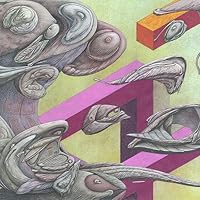
The graphic novel, illustrated by the sensational fantasy illustrator Ian Miller, makes the story doubly disturbing with macabre yet stunning illustrations. If there is one drawback of the graphic novel, it is that it doesn't contain the story's entire text and I would recommend new readers to pick up one of the volumes mentioned above before tackling the graphic novel.
I rate this five stars based upon the full story but must remove a star for the graphic novel because it doesn't contain the entire story text. But it is, nevertheless, stunning.
The Luck In The Head graphic novel is an artefact of tenebrous beauty. Harrison has been keen to point out that the project was a fully fledged collaboration between the him and Miller. I’d love to know the particulars of how they worked together. With those very early ‘90s Victor Gollancz graphic novels, Harrison was ‘label mates’ to the then young bucks of the medium, Alan Moore and Neil Gaiman, both of whom gave their artists tightly controlled scripts. I’m curious about how much of a panel-by-panel breakdown Miller was given. His art, which ranges from highly detailed pen and ink wash, to expressionistic charcoal and paint over collaged elements, is the perfect marriage to the grotesqueries of Viriconium. His interpretation of character and architecture is wildly original, and he envisions elements not delineated in the original text; the religious cult imagery of the queen’s courtiers, attendants – the goon squad that govern the crowds in thrall to the Thatcher-esque Vooley.
When it came to the editing and extraction of plot points required to convert the short story into a graphic novel, Harrison still had time to squeeze in those bizarre incidental details that add so much to the sense of the Weird that Viriconium conjures. (What appears as background detail in the story; a boy in the crowd driving a long thorn into his neck, to be ritualistically nursed by cooing women is given the spotlight of a whole page in the graphic novel. And there’s time for those hermetic, unnerving details that always stood out in the original text: Verdigris breaks from conversation in the Luitpold Cafe to stuff a table cloth into his mouth, only to pull it out again “like a medium puling ectoplasm in Margery Fry Court.”)
It’s interesting that the ending to the graphic novel is more concrete than that of the short story. In the latter, Crome now crippled, his narrative becomes insubstantial, ambiguous, lost to the ‘another night in an indifferent Uriconium’ miasma. Harrison saw this as insufficient or unsatisfactory for the graphic novel, as if some inherent capacity in the visual medium demanded a more qualified ending. The graphic novel concludes by giving the narrative an elegant circular structure, referring back to the text in the first panel on page one, with the image of Crome, although forgiven by Vooley for his treasonous action, being carried off by her goon squad to his death in the arena.
Much of Harrison's beautiful writing has been sacrificed upon the altar of Ian Miller's art. Miller is fantastic (when he spends the time to detail certain pages) but a lot of this book's art seems rushed, for lack of a better word. It's a nice addition to the short story. By itself, I'm not sure the graphic novel would stand up. I guess you'll have to ask someone who hadn't read Harrison's short-story prior to this collaboration :P Either way, I'm pretty sure this is the creepiest graphic novel I've ever read. It's true to the content, in that way, I suppose... The Luck in the Head is a nightmarish tale, and Miller's art matches that theme perfectly. Overall I'm happy to have it on my shelf. As an artist, I think I'll find myself reaching for this as inspiration again and again, but probably only a select few pages. Other than that, I may just bring it out for company, whenever something grotesque or nightmarish comes up, haha.
This story is set in the bizarre city of Uroconium, where the main character dreams of a strange ritual from his childhood. The women of his village pursue a "lamb"; to eat a pie made from its head is considered good luck. This leads him on a surreal odyssey through the city which culminates on an assassination attempt on a religious figure. What sets this book apart is not the story, but the artwork, which is incredible and arresting. Easily some of the best I've seen in this medium
I've never read any Harrison aside from this, and may have encountered artist Ian Miller somewhere before and forgotten him. Luck In The Head has done nothing to make me want to pursue either creator. The book appears to have been written specifically for this adaptation (rather than adapting an existing text), as the words and images work completely together. Even so, this nightmarish dystopic fantasy makes only as much sense as someone else's bad dream is likely to. The art ranges somewhere between Ralph Steadman and Gustave Dore, and is perfectly suited to the imagery necessary to the tale. While slightly incomprehensible in the fine, this is a powerful book if only for the view it gives into what appears to be another person's frightful subconscious terrain.
I love Harrison's work, but I didn't love this graphic adaptation. The purposely inconsistent, nonrepresentational, collage-style artwork definitely suggests the shifting po-mo city that is Viriconium (if you could ever use the word "is" to talk about Viriconium) better than a more traditional comix approach would have.
The problem is that Harrison's Viriconium sequence is so obsessed with the concept of using fantasy as an escape. But I can't imagine wanting to visit Ian Miller's version of this city. I'd rather die!
Just read the short story and picture it for yourself. Isn't that the point?
This is a really interesting unconventional graphic novella, there's weird, nightmarish drawing with lots of collage, obiviously pasted up the old fashioned way. The art starts out strong but deteriorates markedly as it progresses, you get the distinct impression that he was scrambling to get in under the deadline. Worth looking at.
The combination of Harrison's words with Ian Miller's art is nothing short of phenomenal. Fans of either Miller or Harrison will adore this adaptation, and convert readers into fans of whichever genius they were previously unacquainted with. Grotesque, beautiful, funny, and chilling, this nightmarish work is the best graphic novel adaptation of a literary work that I know of.