Jump to ratings and reviews
Rate this book

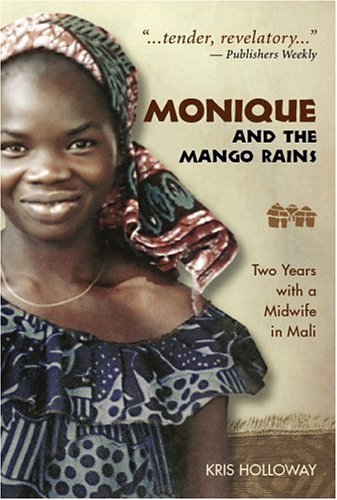
Monique and the Mango Rains: Two Years With a Midwife in Mali

Rate this book
What is it like to live and work in a remote corner of the world and befriend a courageous midwife who breaks traditional roles?

Monique and the Mango Rains: Two Years with a Mali Midwife is the inspiring story of Monique Dembele, an accidental midwife who became a legend, and Kris Holloway, the young Peace Corps volunteer who became her closest confidante. In a small village in Mali, West Africa, Monique saved lives and dispensed hope every day in a place where childbirth is a life-and-death matter and where many children are buried before they cut a tooth. Kris worked side-by-side with her as they cared for each other through sickness and tragedy and shared their innermost secrets and hopes. Monique's life was representative of many women in one of the world's poorest nations, yet she faced her challenges in extraordinary ways. Despite her fiercely traditional society and her limited education she fought for her beliefs birth control, the end of female genital mutilation, the right to receive a salary, and the right to educate her daughters. And she struggled to be with the man she loved.

Her story is one of tragedy joy, rebellion, and of an ancient culture in the midst of change. It is an uplifting tribute to indomitable spirits everywhere. Monique and the Mango Rains is a fascinating voyage to an unforgettable place, a voyage spent close to the ground, immersed in village life, learning first-hand the rhythms of this world. From witnessing her first village birth to the night of Monique's own tragic death, Kris draws on her first-person experiences in Mali, her graduate studies in maternal and child health, medical and clinic records, letters and journals, as well as conversations with Monique, her family, friends and colleagues, to gives readers a unique view and a friend in West Africa.

215 pages, Paperback

First published July 1, 2006

101 people are currently reading
5728 people want to read

About the author

Kris Holloway

4 books14 followers

Ratings & Reviews

What do you think?
Rate this book

Friends & Following

Create a free account to discover what your friends think of this book!

Community Reviews

5 stars
2,102 (41%)
4 stars
1,964 (39%)
3 stars
771 (15%)
2 stars
137 (2%)
1 star
57 (1%)
Displaying 1 - 30 of 501 reviews
Profile Image for Diane in Australia.
739 reviews16 followers
April 10, 2018
This was a very good book. As the blurb says, it's about Monique, a Mali midwife, and Kris, an aid worker for the U.S. Peace Corps. Kris does an excellent job of pulling us into her life in Mali. She gets to know the folks in the village very well, and so does the reader ... which is nice. Monique is a rare gem of a woman. She's working hard, under brutally trying circumstances, to improve the lives of her people. The friendship that grows between the two woman is deep, and sincere.

If you want to read about midwifing (and just living!) under primitive conditions, you'll like this book.

If you'd enjoy reading about the nitty-gritty of the daily life of the inhabitants of a village in Mali, you'll enjoy this.

4 Stars = It touched my heart, and/or gave me much food for thought.
29 reviews
October 29, 2007
This book was hands-down the best Peace Corps memoir I have yet to read. Holloway's story wasn't a glorified quarterly report, listing all the projects she initiated or completed; neither was it an enumeration of the hardships, challenges, substandard living conditions, and poverty she faced. Rather, she described the development of her friendship with her local counterpart (Monique) in terms that were accessible. Although the story took place in West Africa, it wasn't about West Africa.

Most of all, it made me miss my host family in N'Gaparou, Senegal! It was also a struggle for me to read about Mali, as I was traveling home from Christmas in Mali when I Medevac'ed... Very different to read a Peace Corps memoir as an RPCV, rather than as a current volunteer. I highly recommend this book.
Profile Image for Diane S ☔.
4,901 reviews14.6k followers
September 1, 2013
Kris was a young Peace Corp volunteer, straight out of college and her request for assignment was Mali. After initial training she met Monique, who was a young midwife, in this very poor village. Learned many heartbreaking facts about Mali, one of the poorest nations in the world, the amount of women dying in childbirth is heartbreaking. Monique quickly took Kris under her wing and with Monique she experienced her first birth, she was so profoundly affected by this she vowed never to have children. The birth house, one of the only places women could have privacy was in horrible shape, eventually the Peace Corp would give their approval to have the birth house rebuilt.

Another story that had heartbreaking moments, unbelievable tension and yet so much humor and love. Kris would be profoundly affected by her experience and her friendship with Monique would remain. Monique actually visited her in New York. This is a worthy story especially after seeing all we take for granted, the food we throw away, the medical system we complain about, just staggers the mind what people do without and still find the motivation to go on. Unbelievable.
Profile Image for Chris.
878 reviews187 followers
October 22, 2021
I'm almost always interested in fiction or non-fiction stories set in other cultures and this was no exception. Kris Holloway was a Peace Corps volunteer 1989-1991 in a small village in Mali. She primarily worked with the amazing Monique who acts as a general health care practitioner and midwife for the villagers. Daily life can be back-breaking labor, or other work from morning to night especially for the women. Oh yes, another patriarchal society that frustrated and disturbed me as I moved through the book ( as did many other things). I'd most likely be part of the 1/3 of volunteers who do not complete their two years!!! There are definitely other hardships, deprivations, and struggles to stay alive. Quite a stark contrast to the life most Americans lead. Although the author writes near the end of her "tour",
"I cherished spending almost all my time out-of-doors, taking bucket baths under the stars, watching thunderheads pile the sky, and walking and dancing by moonlight. I loved living in an inviting community, where you were always asked to share food and drink, and where you spend time greeting and joking rather than avoiding others because of a busy schedule. Generations intermingled, there was always an excuse for celebrating, and death was sad, but not feared"
I did not feel any of that throughout most of the book. Monique was the shining, progressive, resilient emotional center of the book and it is for her, that I kept reading and hoping.
Profile Image for Marieke.
333 reviews192 followers
June 13, 2013
I have a rule that if I'm in tears at the end of a book, it gets five stars. So: five stars. i don't think this is a perfect book, but it is well-written and I was incredibly touched by the friendship of Monique and Kris. I'm very glad this book got written and published.
Profile Image for Missy J.
629 reviews107 followers
February 20, 2022
The author spent two years (1989-1991) in Nampossela (Mali) as a Peace Corps volunteer helping out Monique, the village's midwife. I have wanted to read this book for a long time already, but back in the day the library only had the Chinese version of this book! Then a couple of weeks ago I stumbled upon this book, just like that. I didn't hesitate to immediately pick it up.

What an experience it was for Kris Holloway to spend two entire years in a Malian village, working with Monique and the village women. She doesn't dwell too much on the difficulties she had adapting to a life radically different from America (although she does mention the huge scorpions and snakes). I felt this was a very well written account of what she experienced, and more importantly how she formed such a deep friendship with Monique. It was inspiring really.

She describes life in the Malian village, how women continually get pregnant, how scarce contraception is, how fragile a newborn's life is, how difficult it is to feed a baby with the right nutrition. They also talk about FGM (female genital mutilation) and rape, which Monique and the author herself experienced. While the author felt a deep sense of shame for what happened, no such feeling was found in Nampossela. It was just accepted that some women would experience being forced upon, which is sad, but the author thought living without the sense of shame was also a blessing. At least, Monique was quick to agree with the author that FGM has zero benefits to females. It is not even written about in the quran and the bible.

The ending was very sad indeed, but realistic. I learned a lot about the village politics, gender relations and childbirth. I wonder how much Mali has change since, because back then the Christians and Muslims and animists got along fine (Monique was a Catholic). Definitely want to read more about Mali in the future.


"As for me, I never liked meat, even as a little girl. I never saw a reason for killing animals, since I could survive without eating them. but since living here in Nampossela, where people don't always have enough to eat, I can see a reason for killing to eat. Before living here, I had always valued animals almost as much as humans."
Profile Image for Jessica (thebluestocking).
982 reviews20 followers
August 12, 2016
I received this book for free from the publisher. All content and opinions are my own.

Two years in the Peace Corps. A poor African village. Another memoir. Another culture story. Nope, this book was anything but warn.

Kris Holloway spent her two years in the Peace Corps in the Malian village of Nampossela. She spent two years by the side of Monique Dembele, a midwife for hundreds of women. The author’s love for the African village, and especially Monique, transcended the pages. Holloway found a true friend in Monique and became part of the village rather than becoming a white savior. We get to experience the births and deaths and living of the villagers not from a removed, clinical perspective, but from a real and empathetic point of view.

Intensely readable, I would recommend Monique and the Mango Rains as a story of friendship first and a story of culture second.

This book ultimately helped me see that all humans want and need the same basic things: food, water, and shelter, but mostly love and understanding. International problems will be solved by people who truly care enough about people to understand what is needed most. As trite as it seems, one person can make a difference.
Profile Image for Emma Deplores Goodreads Censorship.
1,419 reviews2,011 followers
January 18, 2016
3.5 stars

Of the Peace Corps memoirs I’ve read, this is by far the most positive; I get the sense that Kris Holloway enjoyed her time in Mali, in addition to being enriched by it. She seems to be an active rather than introspective person, which surely helped. And most importantly, she sees the people she meets as individuals, rather than as manifestations of a foreign culture; she treats people as people, like equals, rather than viewing them through the prism of their disadvantages.

The primary focus of this book is the author’s relationship with Monique, the young health worker/midwife with whom she works. These two soon become close, building a beautiful friendship that lasts long after the author finishes her service. I enjoyed reading about Monique and the author, and it seems like they were able to make some difference in the villagers’ health. The book focuses on telling stories about people and events, rather than on lengthy reflections, critique of government policy, etc. In that sense it is not as insightful as, for instance, The Ponds of Kalambayi, but I suspect that's because the author was busy being a part of her new community rather than sitting alone and thinking about it, and I'm glad she kept the focus on what interested her rather than conjuring banal Deep Thoughts for the book.

That said, I doubt Kris Holloway has a literary career before her; a couple of word choices in the introduction are cringeworthy, and though I didn’t see this as a problem throughout the book (perhaps only when she was trying to write in a “literary” way), the prose could have been a little smoother. It isn’t bad, though, and overall I liked this book. Also, it has pictures, which is such an obviously good choice that I don’t know why they are missing from other Peace Corps memoirs. This isn't a perfect book, but I would recommend it, especially to those looking to be inspired by stories of service abroad.
Profile Image for Bonnie.
67 reviews
August 15, 2010
"I realized there was, in their stories, a sense of calm in her final minutes, a lack of urgency in the actions or the telling. That was a sharp contrast to the flurry of activity to prolong a life in our country. Hers was not seen as an emergency, but rather as the hand of God. How much of this attitude was the product of simply not having the knowledge or resources to save the dying, I didn't know. I did know that I had to accept their stories, for they were all I had."

Amazing, beautiful, heatbreaking account of the author's two years in the Peace Corps in Mali and her friendship with Monique, the exceptional woman who was the village's midwife and only health care provider. Rather than being a book focused on the author, she paints a straightforward yet poetic picture of the small village and life in mud huts without running water or electricity; poverty, malnutrition, death, peace, joy and friendship. Monique is incredibly able to transcend her circumstances and those of most Malian women to be a leader in the village and make a difference in so many lives. I love that her deep faith is included, as it is hard to imagine how else she would find strength and peace in a live that seems to be full of endless work and tragedy. You can tell the experience was life changing for the author.

It was difficult to read at times for a women's health care provider in the USA...to see death and disease where it could be treated and saved here, where we rush to prevent every complication and cover it in technology....to there where it just isn't an option...how she cares for people with skill and dignity is truly incredible.
Profile Image for Rachel B.
1,057 reviews66 followers
January 7, 2024
This story is told by Kris, a Peace Corps volunteer who spends two years in Mali working alongside native midwife Monique. The focus is on the friendship they develop, rather than on their work, which I really enjoyed.

As a Christian, the most interesting aspect of reading this was comparing their approaches to religion and morality to my own. The author grew up going to a Presbyterian church because it's what her family did, though she wasn't sure what she believed. Monique's relatives converted to Catholicism in a place that is dominated by a mixture of Islam and tribal religion.

At one point, Monique tells Kris, "Not to worry, Fatumata [Kris' Malian name]. It is all the same if you pray to one God or another, because it is the same God. All religions are the same. But for me, it is the Christians who give more. It is the Christians who believe in helping the poor. Why else would our White Fathers and Sisters have come all the way from your lands to Mali, eh?" (p.80)

Kris goes on to explain that most of the French Catholic missionaries in Mali allowed for "some mixing in of traditional beliefs," such as wearing protective amulets in church or performing animal sacrifices.

This really stuck out to me and was a reminder that Christians of any culture need to be preaching the entire gospel, which includes the fact that worshiping Jesus alone is the path to the true God. All gods are not equal.

Toward the beginning of the book, the author mentions that Mali is one of the poorest countries in the world and goes on to say, "They don't have favorite clothes and favorite foods. They wear what they have and eat what is available." (p.2) I really loved this quote!

While I definitely don't agree with many of the beliefs and choices of the author or the people mentioned in the book, it's always interesting and worthwhile to listen to the stories and perspectives of others.
Profile Image for Jeanette (Ms. Feisty).
2,179 reviews2,184 followers
August 24, 2008
A very quick read. This is the first Peace Corps memoir I've ever read. I know there are a lot of them floating around out there. This book gives a good idea of what a Peace Corps volunteer might do in a small African village. If you ever take simple things for granted, you need to read a book like this. No toilet paper, or substitutes for it, in this village!!
Kris Holloway spent 1989-1991 in the village of Nampossela, near the border with Burkina Faso. She forged a strong friendship and working relationship with Monique Dembele, the local midwife. Together they attempted to educate the local women about child nutrition and disease prevention, while also working to improve local birthing house conditions. Holloway also met her future husband, another Peace Corps volunteer, while in Nampossela.
The last two chapters of this book were really the best. More beautifully and lyrically written than the rest of the book; perhaps because they came so deeply from the author's heart.
Profile Image for ~Annaki~.
185 reviews6 followers
October 14, 2018
I really enjoyed this book, both as a midwife and as someone who has lived in Africa.
I was pleased for once, to read a westeners account of African life, without everything having been overly westernized and paraphrased to suit the western readers. I have seen this before and it erases all authenticity, but although is does come through every now and then, Holloway has managed to limit it and the result is a very touching and beautiful read, without all the white saviour complex that so often makes its way into these accounts.
Profile Image for Magdelanye.
2,014 reviews247 followers
September 6, 2022
I'd read that 2 out of 5 children die before their 5th birthday in Mali. Now I felt it. p30

Plenty of books have been written by eager and also by disillusioned peace corps volunteers. I will read these books when I find them, because at some point in my teen years I longed to join the peace corps. If I had been able to pull that off, I would probably written a book about the experience.

Have you passed the day in peace?
Peace only.
village greeting p22

The books generally have the feel of disconnection, unless they are written by somebody who has "gone native" , and even those are often usurped by personal concerns. The reader might get a compassionate glimpse at the goings on of a village or group, or they might get a litany of complaint. The better ones give a sense of context, but there is usually a sense of otherness.

KH might not have gone native but, grounded in her own identity, her natural empathy and practical good sense allowed her to fit right in as assistant to Monique, the village midwife. The bond that quickly developed between the two women was as moving as the tragedy that came as a shock that hit this reader hard.

This book is a testimony to the life of an amazing, strong woman who dedicated her life to her chosen task of bringing life into the world.
Profile Image for Carol Bakker.
1,541 reviews137 followers
April 8, 2022
This memoir is, above all, the story of a beautiful friendship.

Kris Holloway went with the Peace Corps to Mali. Her assignment was to assist Monique Dembele, the local midwife, in a small village without electricity and with only the rudiments of medical care. They spent two years working together, but their close friendship continued after Kris returned home.

The culture of rural Mali is vastly different from any place in American. The maternal mortality rate in childbirth is frighteningly high. Poverty afflicts nearly all the residents. At the time of Holloway's sojourn, genital mutilation was still practiced. The slower pace, the practice of greeting and vibrant hospitality are also remarkable.

Even with so much contrast, seeing similarities in human nature was easy. Jokes about farts. Justifying your own weakness. Difficult marriages. Sacrificing for the needs of others. Slackers. Doing the best with what you've been given.

And then there is Monique. Her story will stay long with me.
Profile Image for Samantha.
101 reviews
March 19, 2016
This book was great. I really enjoyed how I felt like I was in the culture, I was meeting the people, I was a part of the various families when I was reading it. I had felt both extreme happiness and extreme sadness from this book. I was made aware of problems that need to be addressed in Africa, but I was amazed at how these "problems" aren't really viewed as problems to the people of this region.

Genital mutilation is something I know about historically, but it definitely hit home that this still occurs and many young girls suffer and die because of the lack of medical attention and the lack of cleanliness with the materials used during these procedures. I knew that there was a lack of sterile medical facilities, but it is just hard to fathom that there is such a lack of safe medical facilities with professionally trained medical staff. I was also shocked that rape is not viewed as negatively as Americans view it. It is frustrating to think that these women do not know that they have rights... That rape is a daily occurrence and is something that happens to many of them. I felt so shocked that this is how women think.

It is amazing to compare our lifestyle to that of the people of Nampossela. In our first world countries, we really take advantage of the fact that we have running water (even though mine is out today!), doctors, clean and sterile facilities, houses without dirt, technology, and air conditioning. However, the people in the third world countries have an advantage over first world countries: they have a community. They live in a community that treasures relationships and helping others. There is one part in the book that talked about how we are locked behind doors and wish to be alone more than with others while the people of Nampossela appreciate the socialization of their neighbors. That really hit home because I become so frustrated that everyone is on their phones all of the time... we are always looking down. When is the last time that you went outside and just enjoyed the great outdoors? When is the last time that you didn't freak out because you didn't have your phone on you? When is the last time that you gave someone all of your attention and were not thinking about all of the other things that you needed to do or had technology in your hands? I, too, am guilty of this. Less so than other people, but still guilty.

I really enjoyed being able to really get to know Monique. She was a very unique woman with a big heart. I relate to her tremendously in her ability to give her everything to her job and the feeling that her job is never fully complete. I relate to the long hours, the long days, the constant repeating of information in order to try and make people healthy and understand the importance of certain needs. She was such a strong woman with such charisma. I commend her for her talents and her caring and loving talents.
Profile Image for Tinea.
572 reviews308 followers
May 25, 2013
A sweet and loving memoir of a Peace Corps volunteer's time in Mali and her respect for the bittersweet life of her friend, confidante, and support there, a talented, skilled midwife who struggled with ambitious and romantic daydreams, too great a thirst for life and knowledge and love than the constraints of her life had to offer, but gave more than she had to the lives she encountered within those circumstances. The book offers a warm and open look at complexities of cross-cultural relationships and experiences, especially on gender, education, and healthcare, reminiscent of My Maasai Life: From Suburbia to Savannah for its thoughtfulness (though stronger) or Dancing Skeletons: Life and Death in West Africa (though softer). I would recommend Dancing Skeletons as the best 'American in Mali' memoir, but this one was good.

I lived in Mali for 6 months many years ago, and this book made me miss the soil, the friendliness, the fart jokes (it's really a uniquely Malian phenomenon how appropriate it is to make beans the magical fruit jokes in public!), and the few people with whom I became close in a deeper, curious, dialoguing way, the ones with whom I talked about colonial economic legacies, the privilege of US passports, and the intricacies of poverty (financial, familial, relational, experiential, ecological, violent, slow) and happiness. Coming up over tea with some theory about avocados growing abundant on trees in war-torn Cote D'Ivoire, happy people malnourished in dessicated Mali, and the rich northern countries that devastate everything, where fruit doesn't even grow. Listening to Guinean hip hop and playing a Green Day tape, trying to explain mosh pits.
Profile Image for Liralen.
3,338 reviews275 followers
May 25, 2013
Much of the author's success in writing this book comes down, in my opinion, to her focus: Monique. It would have been easy to open the story with the author's arrival in Mali, or her Peace Corps training, or a scene of an awkward cultural misunderstanding (there are some misunderstandings, but they're secondary), but instead she structures the book around her time with Monique.

At times I wished that I hadn't read the introduction -- it makes for such a bittersweet book! -- but I loved reading about the development of their friendship, and the things the author could and couldn't do something about, and Monique's increasing responsibilities within the community. It surprised me how close the author and Monique grew, but I suppose the author's outside perspective made her, in some ways, an easier person to confide in. So much societal complexity, which manifests in sometimes surprising ways.

I'd had the book on my to-read list for a while, and obtained a copy five months before reading it, but it wasn't at all what I'd expected -- it was much better, much more nuanced.
Profile Image for Rennie Morrell.
22 reviews2 followers
May 21, 2015
Inspiring story.

Monique, like the Mango Rains, lasted only a short while, but added immeasurable sweetness. This story was fascinating on so many levels. First, it makes one realize how it takes special people to be Peace Corps volunteers. God bless them all. Then, it highlights the Malian people's resilience and caring. The author humanizes their lives so we see not only the pain and struggles, but the joy they share with each other. And finally the story profiles an amazing woman who selflessly serves others, particularly other women, and dies young doing so. Definitely worth the read.
Profile Image for Lauri.
407 reviews109 followers
June 8, 2016
This is an amazing story about an exemplary woman. With very little support from family, culture and village, Monique Dembele became a healthcare worker in Mali. Women there are subjected to hardship and cruelty as regular, typical treatment. This woman overcame poverty, discrimination, indifference, and ignorance to go on to change and save lives. Written by Peace Corps volunteer, Kris Holloway, this story demonstrates the very real friendship she shared with Monique and village life in Mali. After reading this, you will never take Western life for granted again.
Profile Image for Carmen.
2,777 reviews
September 15, 2019
"This mango is so sweet," I said, jutting my chin out as the juice dribbled off of it and onto the sand. "Thank you, my dear Monique."
"It is the mango rains that we must thank."
"Mango rains?"
"The small rains that come, in February and March. They come when the earth is dry and the heavy rains still far away to make the mangoes sweet," Monique said wiping the delicious stickiness off her face.
Profile Image for ct.
81 reviews
June 17, 2025
wasn’t sure what to expect going into this book, but I’d never read a Peace Choir memoir or anything set in Mali so why not— I really liked this. I have so much love for Monique and was in tears for the better part of the last half of the book. the prose isn’t always to my taste but the story more than makes up for it!
Profile Image for Kristin.
127 reviews6 followers
July 11, 2010
Monique and the Mango Rains by Kris Holloway was a book club selection. One, that in all honesty, I probably would have never chosen on my own. Kris Holloway served in the Peace Corps for two years. She was assigned to a remote village in Mali to assist midwife, Monique Dembele.


At twenty-four, Monique was quite young to be a midwife. She was the only medical personnel for the village of Nampossela. Mali has one of the highest fertility rates in sub-Saharan Africa - 6.8 children. The maternity mortality rate is among the top ten in the world. Less than 6% of the women use any form of birth control and over 96% of the women have some form of genital mutilation. All of the statistics make the job of midwifery extremely challenging. Yet, this is what Monique does. Quite successfully.


This tiny village has no electricity or running water and extremely limited medical supplies. But for all the things the village lacks, it is an extremely tight-knit community. Kris, who is given the name Fatumata Dembele, is quickly accepted by the villagers. She and Monique, her hostess and mentor, form a quick and lasting friendship.


This book follows Kris's two-year adventure in Mali, as well as, the years that follow. But more than Kris's adventure, this story is about Monique. It is about Monique's life and her calling. While I would never dream of joining the Peace Corp, nor visiting such a remote location, I was enthralled with the story. I had a cesarean section when I gave birth to my daughter, so I do not know what it is like to experience contractions or the immense work of labor and delivery. Reading Holloway's powerful descriptions of the births she and Dembele assist was amazing. The strength of the women to birth in little more than a mud hut with a table and then to leave hours later to work in the fields or attend their other children was startling.


Following the trials and tribulations of Monique's marriage made me realize how fortunate I am to have the freedom and power of choice in my life. The vast resources we have available made my heart hurt for the sick and dying children of the village, many who do not live past the age of five because of malnutrition. Linked to the title of the novel is a website created by Kris Holloway and her husband John Bidwell, whom she met in Mali. Through this website you can donate funds to help continue Monique's powerful work at a clinic created in her honor.
Profile Image for Chana.
1,632 reviews150 followers
November 21, 2012
Monique Dembele, a most extraordinary woman in a very difficult setting. She is a young woman in the village of Nampossela in rural Mali, married to a self-centered and immature young man, she is trained and given the responsibility for midwifery and health care in the village. That doesn't lessen her responsibilities to her children, husband, in-laws and home. It is unusual for anyone to work as hard and consistently, let alone bringing improvements that are saving lives. She institutes weighing and charting babies and growing and making baby food for toddlers to transition to when their mothers become pregnant again and stop nursing.
Kris Holloway is a young peace corp volunteer assigned to Nampossela, Monique is her host. Kris works with Monique, learning from her and helping with improvements, getting resources for projects like fixing the birthing house, building covers for the wells etc.
What is so wonderful about this book is the friendship between Monique and Kris. Who would imagine that this young American woman would find her best friend in Mali in Africa. But this is what they are, best friends. Kris also found her husband in the peace corp, this is not uncommon but wonderful when it happens.
The sad thing of course is that Africa remains in very poor condition and its people are stuck there with their parasites, dirty drinking water, dirt floors, flies, malaria, hunger, etc. Kris, and the other peace corp volunteers are able to go home after 2 years (or before if they can't handle it). This is not to belittle the good work of the peace corp or the bravery and good-heartedness of the volunteers, G-d forbid. I have a good friend whose daughter was a peace corp volunteer in Mali. I have every respect.
This book is a beautiful tribute by Kris in memory of her friend Monique (who dies in childbirth ironically).
I keep thinking about what it must have been like for Monique to visit the US and then go back to Mali, how poor and terrible the life of her village must have seemed in comparison, what an unkindness it may have been to bring her to the US unless it could have been for a purpose, setting up resources for her village in Mali, something besides this taste of the U.S. then back to living in the dirt in Mali.
Profile Image for Fiona.
768 reviews1 follower
June 7, 2016
Kris Holloway is a Peace Corps volunteer in 1989. Her job is a health care worker in Mali where Monique is the local village midwife. This is their story.

Monique has only a 6th grade education with a six (or was it nine) months training as a midwife, but she is well respected in her small village of Namposella. Kris & Monique learn a lot about each other. For example, Kris learns about female genital mutilation and Monique is surprised that few American women have this done to them. Kris orders a cassette tape and information about the effects of this procedure and shares it with Monique who is glad to see the facts. Remarkably, she asked if women who've not had this procedure really enjoy sex like men do.

The village life is what I'd imagine an African village to be and that is with malnourished children, flies swarming around everything, questionable drinking water, and full of malaria. The author confirms my judgment but also tells stories of dancing and partying. Death is not something feared but is a way of life.

Monique lives in a man's world. Her salary as the local midwife is signed for by her husband's family and she sees little of it. Only when Kris visited Monique's boss at the hospital in the nearest city and explained what was happening, did this practice change. Often when Monique or Kris talked to their women patients about prenatal care or care for the children, they also had to talk with the woman's husband. To get him on board meant that the women can make changes in their lives.

I learned a lot of Malian life and history. In fact, I had to look at a map to find where Mali was located. The villagers were Muslim, Christian, and animists and they all lived well together. Life is hard and dependent on the rainy season. No rains and there would be a drought and the village would be broke. Rain too early or too late in the harvest could also spell disaster. This is the typical Malian life.

I enjoyed reading this book immensely. Monique is definitely a character and a good person. The work of the Peace Corps volunteers, including Kris and her then-boyfriend John, show that the US help can be of great help to the local people.
Profile Image for Jo Oehrlein.
6,361 reviews9 followers
May 9, 2012
This is the story of the author's two year Peace Corps stint in a small village in Mali. There, she worked with and became a member of the midwife's family. That midwife is the Monique of the title.

The book covers the hardships (six foot cobra in the house, misdirected menstrual supplies), the successes (the building of a new birthing house, successful deliveries), the funny (mis-steps in the native language, awkwardness planting), and the every day (weighing babies, eating, etc.).

The book discusses issues of infertility, contraception, and family planning, female genital mutilation, feeding babies, rehydration, etc. However, it's not preachy on any of it (although they are working TOWARDS providing contraception to those who want it and AGAINST female circumcision).

There's a strain of sadness running through the whole book -- women who die in childbirth, children who die before age 5, a woman with breast cancer, etc. There's a constant fight for good hygeine and nutrition. There's a woman whose husband beats her and doesn't claim her child because it's a girl. Monique's husband doesn't seem to like her and his father keeps almost all the money Monique makes as a midwife.

The book did a good job of showing where western intervention has been good (medicine) and bad (plastic bags blowing around). It also shows a different kind of community that took the author into its heart.
Profile Image for Lola Allen.
Author 33 books11 followers
April 30, 2015
I really enjoyed reading this book. As an avid fiction reader and writer, I was rather sceptical about reading a book that fell into the non-fiction category. I am however very interested in reading books that are about or from Africa, so I decided to give this book a go, and I'm glad that I did.

What a fantastic book! Although it was non-fiction, Kris Holloway did a wonderful job of bringing the characters and setting to life (especially Monique). To the point where I felt like I knew some of the characters personally; I felt their joy as well as their pain.

The book didn't always make for easy reading, due to its themes such as FGM, poverty and famine, and I wasn't very happy with the way that it ended. But I always like to read books that teach me something and this book taught me about the lives of people in Mali. Although Holloway was writing as an outsider, never did she look down her nose at the people she was writing about, but it seemed that she was at one with them and their culture.

I have been converted: never more will I turn my nose up at non-fiction!
Profile Image for Irene.
319 reviews70 followers
April 14, 2014
I am half way through this book and I am really upset. Poor Monique works tirelessly for up to 18 hours a day, and actually sometimes she doesn't even get to sleep at all, birthing the babies of Namposella while her husband picks up her salary. This small amount ($23 a month U.S.) could be used to feed her family as she has a growing child of her own. Instead, her husband squanders her salary on such items as his girlfriends new wardrobe while his wife and child literally starve, eating only onions from a small garden for days at a time. Plus the author pretty much tells you the ending of the story on the first page which really let me down and I've been wating to read this book for quite a while so I am disappointed to say the least. I do like the two main characters though.
Profile Image for Melinda.
1,020 reviews
May 13, 2014
A touching story of a Peace Corps volunteer on assignment in Mali to aid the village midwife. Monique encompasses so much, it is a rich tale of friendship as well as exhibiting the hardships and obstacles of the Mali people. The author did a wonderful job describing scenarios and histories of the village, village inhabitants as well as introducing us to Monique as a midwife and on a personal level. Ms. Holloway's writing is simple with enough educational information without coming across as a report or overly statistical. The book is GREAT and will definitely cause a tear or two to fall. Kudos to Ms. Holloway for touching upon sensitive topics such as female circumcision, birth control and infertility.
578 reviews4 followers
August 8, 2015
This was such an inspiring read. This is exactly the book I want to read from a peace corps worker. She is so evenhanded. She does judge people, but by their actions only. She really tries to understand the culture and put people's behavior in the context of it. But let's face it, some people are jerks and that will be true wherever you are. She acknowledges this and delivers a very human portrait of the town in Mali that she spent 2 years living in. She is so modest and open minded and accepting but doesn't whitewash people or situations. The book was at times sad, at times funny but always engaging- and informative to boot. Excellent
Profile Image for Correen.
1,140 reviews
June 1, 2021
Kris Holloway was a Peace Corps volunteer in southeastern Mali from 1989 to 1991, working with a young midwife, Monique. The experience was life changing. Conditions in the village were primitive but with the relationship Kris formed with Monique much was accomplished. The story of the two friends is touching, their challenges often disturbing.

It is a memoir that in some places seemed to drag but her intent was to give a clear picture of their work and friendship -- she succeeded. It is a worthy read.
Displaying 1 - 30 of 501 reviews

Can't find what you're looking for?

Get help and learn more about the design.