The fifth collection of Superman tales from the 1980s, featuring ADVENTURES OF SUPERMAN #432-435, ACTION COMICS #592-593 and SUPERMAN #9-11! Superman encounters the new hero Gangbuster, faces the menace of the Joker, teams up with Mister Miracle and Big Barda, and inadvertently becomes Metropolis's greatest menace!
Librarian note: There is more than one author in the GoodReads database with this name
John Lindley Byrne is a British-born Canadian-American author and artist of comic books. Since the mid-1970s, Byrne has worked on nearly every major American superhero.
Byrne's better-known work has been on Marvel Comics' X-Men and Fantastic Four and the 1986 relaunch of DC Comics’ Superman franchise. Coming into the comics profession exclusively as a penciler, Byrne began co-plotting the X-Men comics during his tenure on them, and launched his writing career in earnest with Fantastic Four (where he also started inking his own pencils). During the 1990s he produced a number of creator-owned works, including Next Men and Danger Unlimited. He also wrote the first issues of Mike Mignola's Hellboy series and produced a number of Star Trek comics for IDW Publishing.
OK, they were being mind controlled by a New God named Sleez. I'm shocked this story slipped by the Comics Code Authority. The Joker and Mr. Myxzlplix both show up. Meanwhile Marv Wolfman and Jerry Ordway were handling street level crime and introducing Gangbuster to comics. All in all, this was a great group of stories other than the dud at the end when The Circle returned.
Not one of the better post-Crisis Superman books. Surprisingly, even though it was John Byrne who was tasked with bringing Superman out of the Silver Age rut it had fallen into, it's the Marv Wolfman/Jerry Ordway Adventures of Superman series that is full of characterization and sub-plots galore. The Byrne issues of Superman and Action Comics are rather weaksauce comparably.
For instance, the Superman issues which introduce Superman to the Joker and then Mr Mxyzptlk could just as easily have been written by Cary Bates or Eliott S! Maggin, two of Superman's Bronze Age writers. Neatly written, almost too neatly, as Superman foils his antagonists easily. Although there is a little sexual banter going on in the Clark Kent-Cat Grant-Lois Lane triangle, it's nothing compared to what Wolfman was writing.
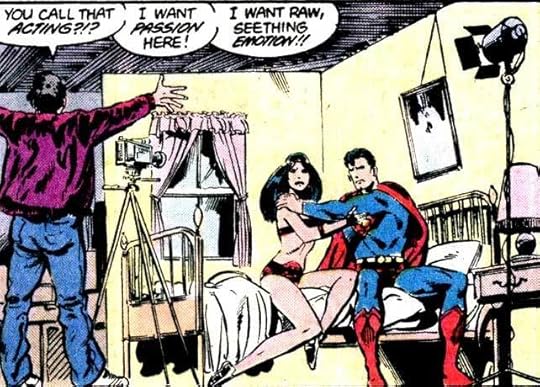
Action Comics at this time was the Superman team-up book, and this volume collects the two-parter with Big Barda and Mr Miracle. Yes, this is the infamous tale where Superman and Barda make a porno. Byrne's rather casual usage of Darkseid is a bit out of character, although I may be looking at that through the lens of 30 years later where Darkseid is much more the ultimate evil incarnate bad guy.
Still, this is enjoyable to read, even with the faults, and the art by Byrne and Ordway is top notch.
Big Barda and Superman shoot porn without consent. Big Barda spends these issues being forced to wear skimpy clothes and being a sex slave (for two whole days before getting ‘rescued’). Once again sexual assault and exploitation is no big deal. How about next time we see Superman naked instead? Not going to happen? Yeah, I wonder why…
I really liked this volume until this disgusting, misogynist story happened. John Byrne needs to go to horny jail. Comics Code Authority, who? Looks like they allowed it because they also needed horny jail. Byrne and DC should be ashamed.
Also, does Superman wear a cape just so it can be destroyed? Because that’s all it does.
Joker (Superman #9). The main Joker story is fairly quick and simple. Still, it's delightful to see Superman fighting Batman's nemesis, and it was particularly delightful in these early post-crisis years. To fill the space, we also get another look at what a dick Luther is ... and Lana gets assaulted yet again [4/5].
Gangwar (AoS #432-434). This is Wolfman's post-Crisis Superman at his best. It has a real Golden Age feel, with the battle against the gangs, and a clearly less powered Superman. Plus, we get the more in-depth introduction of Jose Delgado and the debut of Gangbuster, more great post-Crisis characters. (#433, with its five points of view is also a great use of the supporting cast.) [4+/5].
Sleez (Action #592-593). Any overview of Byrne's work on Superman inevitably comes back to, "And then he wrote a comic where Superman and Big Barda are mind-controlled and shoot a porn video". Which is this arc. Technically, most of the nasty stuff is off-screen, but it's definitely implied that Big Barda, at least, was mind-controlled and sexually molested — and mind-controlled sex slavery is not a good look for a comic writer. This could have been a good comic, it does make good use of the New Gods characters, but instead it's indeed an embarrassment — though not quite as bad as you might think [1/5].
The Super Menace of Metropolis (Superman #10). Superman's powers going out of control are of course the result of Luthor's newest plot. A perfectly OK story that continues the post-Crisis rivalry [3/5].
The Name Game (Superman #11). It's the return of Mr. Mxyzptlk. Of all the classic Superman foes other than Luthor, he seemed to get the most play in the early post-Crisis universe. You could expect him to show up like clockwork every 90 days (longer in real-time), and for a bit it was a nice element of continuity. This first appearance is just random mischief though, with a long Beyonder reference that hasn't aged well [3/5].
The Circle (AoS #435). The Circle has been the worst plot in the Wolfman Superman book, so it's a relief that he decides to close it out somewhat unceremoniously in this dull issue of fighting illusions [2+/5].
Mission 2026: Binge reviewing all previous Reads, I was too slothful to review back when I read them
By Volume 5, Byrne’s Superman feels fully integrated into his world—and that integration is precisely the tension. Power has consequences now. Relationships are strained. Superman’s presence alters political, personal, and ethical balances.
What stood out to me was how often Superman is forced to choose restraint over dominance.
Victory is rarely clean. Byrne emphasizes aftermath: how actions ripple outward, how trust erodes, how certainty fractures.
This volume feels less like origin and more like reckoning.
Superman is no longer proving himself; he is living with what he has already done. That shift adds emotional weight to even routine conflicts.
It’s not the flashiest volume, but it deepened my respect for Byrne’s long-form vision. Superman here is not iconic—he is accountable.
Another fine collection of the late 1980's Post-Crisis era. Clearly this set takes advantage of Superman being serious only attempting to add some of the sillier 1960's era camp. A nice adventure against the Joker. A strange adventure with the New Gods involving Big Barda - who is UNBELIEVABLE in how gorgeous she can be. Plus you can't have silly in Superman without involving Mr. Mxyzptlk.
But there is also plenty of simple strong seriousness. An arc involving Lex Luthor and the crime wave of Metropolis involving the modest hero in Gangbuster as well as Perry White's own delinquent son Jerry White. Interesting development into the Metropolis police detective Maggie Sawyer as well as the continuation of a group of mysterious mystical enemies from year two.
Theres a 2 parter in here where one of Darkseid's minions brainwashes Superman and Big Barda into making pornos. Folks that is not a joke or an exaggeration that is the literal plot. Idk if Byrne was just creatively drained at this point in his career or what but I can't believe they let him do something so stupid and bizarre. The rest of this was solid stuff but that really tanked this one for me.
This is a solidly enjoyable collection but the last issue landed with kind of a thud for me, which is always a bummer. Overall, though, this a good collection of 80s Superman material.
While the last couple volumes were a little weaker, this volume definitely packed a punch. Starting off with a Joker story--and who doesn't enjoy a good villain crossover like that?--the action just kept rolling: (1) A Big Barda/Mr. Miracle team-up that became strangely dark and adult (I'd be lying if I said I didn't raise my eyebrows in shock); (2) A story arc with Lex Luthor using gangs for his own nefarious means--which also had some solid themes about youth/gang violence/etc.; (3) A Mister Mxyzptlk story--which I'd already read, but was certainly fun to flip through again; (4) The end of that weird "circle" story arc that actually did some nice diving into Superman's personality; (5) And a story where Superman's powers went into overdrive and he had find a way to save the day and stop the manipulator behind his power surge--three guesses who that was. Yep. Lex Luthor. Honestly, this was pretty much classic Superman storytelling--that still managed to have some surprises. It definitely kept me turning the page, and now I'm ready for Volume 6!
This volume of John Byrne & Marv Wolfman's run on Superman was extrodinary. Guest apparences by Mr. Miracle and Darkseid, not to mention Superman outwitting the Joker make this volume one of the best.
Wolfman's Gang War story arc is excellent, although Ordway's artwork tends to look ugly in comparison to Byrne's. Byrne's stories are mostly slight, self-contained, and feel like variations on silver age stories. Then there is the totally wrong story in which it's implied that Superman and Big Barda are hypnotized into making pornography. It seems strange that a story like this got allowed in a CCA-approved story, but the code was becoming increasingly ineffectual by 1987. The cleverest thing about it is the outs Byrne left for himself should someone compel him to say that the plot to make pornography was actually successful. Despite Mr. Miracle's shock at seeing the tape (it turns out Tom King didn't invent the idea of multiple panels in a row to show Darkseid's changing expression), he could argue that the tape is of th battle between Superman and Barda (although since she wins, Scott would be unlikely to be that horrified by it, since it's hardly lethal), and the scene in which Morrie Grossman is directing them, their clothes are still on, Grossman complains about their lack of emotional display, and Sleeze is concerned that Superman is resisting the hypnosis because he would never sleep with another man's wife.
Byrne may have been doing exactly what DC wanted for its flagship Superman relaunch, allowing the richer storytelling in the legacy-numbered title and one-offs in the flagship for more commercial reasons. These stories involve Superman encountering the Joker and Mr. Myxzptlk for the "first" (as in post-Crisis) time, and another story involving hypnosis, this time by Lex Luthor. The Action Comics double-header (the only issues of one of the three series that are presented consecutively) seems to imply that Superman and Mr. Miracle and Big Barda are aware of each other but have never met (which they had in pre-Crisis continuity).
The last story is particularly interesting. An alien in a burqa whom Superman apparently encountered previously in Qurac, DC's all-purpose fictitious Arab country, compels Superman through his dreams to help her people, though he tells her that if he had just asked he would be more inclined to help other than to just be rid of her. He dreams of Wonder Woman in that story, and she says, "We're the only two who can love each other," which is clearly contradicted by the Big Barda story, so it's strange that he would dream that and suggests that editorial, that is, Michael Carlin, wasn't paying that close attention. I should probably note here that New York City is presented as an expressly different place than Metropolis because Cat Grant needs to travel to New York City to deal with custody issues with the son, Adam, that she has with her ex-husband. It seems strange that this volume collects only two issues of Action Comics and four of The Adventures of Superman when this last issue doesn't seem to connect to anything (apart from Cat's custody hearings) except maybe a previous story I don't remember--as it's been a few years since I read the previous volumes [it was in volume 3]--but that should be clearer when I read volume six, as there may be internal reasons for doing so just as presenting the two issues of Action back to back was here. No other stories could take place while Superman was in the thrall of Sleeze.
One can only dream that this might have been better if Byrne had been assigned strictly the illustrating while Wolfman did all the writing. Still, the four issues of The Adventures of Superman that are collected here are well worth the read, and even though three tell a complete story, the events seem to occur in such a way, and over enough time that the other stories could easily have happened in the order presented. José Delgado and Perry "Jerry" White, Jr. are really interesting supporting characters. During the Invasion! story arc of 1989, Superman unmasks Gangbuster to find himself (although that's part of a plot by the alien alliance to get him off-planet during the invasion). This earlier story that introduces the Gangbuster shows that rather than being a big reveal of a character whose identity was unknown, Superman, was, in fact, a Gangbuster impostor, which just goes to show how different reading comic books singly (or in this case, as parts of an event) can lead you to see things in a completely different way than when you have the full context.
Este tomo ha tenido un bajón de nivel importante con respecto a los anteriores. En esta recopilación, las cuatro primeras historias implican a la Legión de Superhéroes, que es un grupo de personajes con superpoderes provenientes de diferentes planetas, y un nuevo villano, el trampero temporal. Además conocemos a Superboy y a Krypto. Aunque la selección es correcta porque hay una linealidad temporal entre ellas, la lectura me ha resultado bastante confusa y tediosa. Por suerte, el tomo en el material adicional proporciona unas fichas personales de algunos personajes y villanos, y de esta manera he podido entender algo de lo que tenía delante. En la quinta historieta nos presentan al Doctor Stratos, quien seguramente nos dará más juego en el futuro. El último número del tomo es un cruce entre Superman y Joker en Metrópolis. Esta propuesta es bastante Joker, pero en su lado más juvenil y juguetón. La resolución es un poco sin más. Al final nos dejan unas viñetas de Luthor, que de momento me han servido para montarme mis teorías. En lo relativo a la edición tengo que destacar dos cosas: que las páginas de Legión de Superhéroes #38 son las más bonitas hasta la fecha, y que el diseño de Krypto está más cerca de una oveja que de un perro. La verdad, esta entrega no me ha aportado gran cosa y me he aburrido un poco leyéndolo. Por cierto, si alguien espera encontrar la famosa escena de Superman en una película para adultos, que siga por otro camino, porque desde luego en la publicación para España no la encontrará.
Volume 5 of The Man of Steel gives us some compelling characters and gives us more background on some characters from worlds we have already been introduced to in previous installations.
First of all one of the funniest bad guys in DC comics is in this book so lets start there. The Joker has invaded Metropolis and is trying to frame Superman, will he get away with it? Will Superman save the day and stop the joker with his own last laugh? tune in next week.. (or you could just buy and read this book)
We are also introduced to two characters from Apokolips who have a history with Darkseid which is interesting in its own right. This story ended up being better than I thought it would be when I first started this section of the book.
And then we get to see the pest from the 5th dimension Mr. Mxyzptlk. I always thought this character was funny and I liked how he could change things in the blink of an eye. The only question is can Superman protect the people of Metropolis while he plays Mxyzptlk's game and how can he stop this crazy little man.
Pick this book up if only for the Joker and Mxyzptlk stories but I would say that the Apokolips background stories in the other section and the other stories between these are well worth the time to read.
Another great collection of Superman stories! Volume 5 is a big improvement on Volume 4, being almost exclusively set back in Metropolis (rather than vol 4 which featured a lot of outer space stories which are less strong). It was cool starting off with Superman vs The Joker, and then the return of Lex Luthor in other stories. Something I find really surprising is how awful and horrible Lois Lane comes across as a character. She’s very unlikeable. I am glad the series has gone back to the quality of Volumes 1-3 and am looking forward to Vol 6! Would definitely recommend to any Superman fan!
Volume 5 of Superman's re-imagining from the 80s is a struggle to get through. There are some pretty bizarre tales here that readers are supposed to take serious. For instance, a new villain gains mental control over Superman so obvious he thinks he can make money in porn. The supposed "Gang-War" story is strange since there isn't actually any war...or gangs. The art is really nice especially for the time period but overall the book is full of laughs but none intentional.
Superman races to save Perry's son from a gang he believes is being run by Lex Luthor, but is distracted by the arrival of Big Barda and Mr. Mxyzptlk in Metropolis.
The artwork is still strong and Byrne is working well to update the storylines with an Eighties sensibility. The dialogue is a little stilted, but the stories work reasonably well. Clark Kent is well written and developed.
The John Byrne stuff is outstanding as always, but this volume had too much of Jerry Ordway's terrible art. The "gritty" Adventures of Superman stories have not aged well, and are not nearly as enjoyable as the Action Comics and Superman issues.
OK, things go back to being enjoyable here. Whew! I was worried that I sunk money into 2 books that might suck. Superman #11, with Mr. Mxyzptlk was especially good. I am glad that they phonetically spelled his name, as I had no idea how to pronounce it until now.
The new Superman creative teams continue to tell great stories set indelibly in the 80’s. A couple of cringe moments but very entertaining nonetheless.
Delivers another satisfying collection of stories with a good balance of stakes and spectacle.
This volume continues Superman's struggles as he confronts a twisted clone of Lana Lang, battles Morgan Le Fay's dark magic, investigates an alien invasion linked to Hawkman, and faces the Psycho-Pirate's emotional manipulations.
Well-paced set of tales that keep the momentum of Byrne's run going.
Laugh and Die in Metropolis. Superman vs the Joker.
From the Streets to the Streets. An Intergang Story. A slice of real life set in suicide slum. Highlighting Perry White's son, Jerry, involvement with gangs. 7/10.
A Walk on the Darkside. Superman and Big Barda get involved with the dodgy pornographic industry. Very tame as it's a children's comic book, but very risque precisely because it is a children's comic book. 6/10
The Super Menace of Metropolis. Superman's powers go weird and he ends up fighting a hallucinagenic villain. Mainly fun story, similar to the Golden Age 7/10.
A Tragedy in Five Acts. An Intergang story revolving around Jerry White. Low key character based story with Jimmy and Lois discovering Perry's son in involved with gangs, and the family anguish that follows on. 9/10.
The Name Game. The imp from the fifth dimension is back in traditional style, though re-introduced in a slightly harsher way. 9/10.
Not a great entry. The Superman/Joker issue was fun, but wrappped up too quickly. The Myzlplyk issue was also entertaining. I couldn' get into the Jerry White gang war plot and I've never been a fan of Gangbuster. All in all this was pretty forgettable.
This is one of the strongest trades in the series. The use of Kirby's New Gods was one the collection's highlights. The Wolfman contributions were really strong as well, particularly the gang war stories and his use of Luthor.