Jump to ratings and reviews
Rate this book

Fire in the Sky

Rate this book
In the first two years of the Pacific War of World War II, air forces from Japan, the United States, Australia, and New Zealand engaged in a ruthless struggle for superiority in the skies over the Solomon Islands and New Guinea. Despite operating under primitive conditions in a largely unknown and malignant physical environment, both sides employed the most sophisticated technology available at the time in a strategically crucial war of aerial attrition. In one of the largest aerial campaigns in history, the skies of the South Pacific were dominated first by the dreaded Japanese Zeros, then by Allied bombers, which launched massed raids at altitudes under fifty feet, and finally by a ferocious Allied fighter onslaught led by a cadre of the greatest aces in American military history. Utilizing primary sources and scores of interviews with surviving veterans of all ranks and duties, Eric Bergerud recreates the fabric of the air war as it was fought in the South Pacific. He explores the technology and tactics, the three-dimensional battlefield, and the leadership, living conditions, medical challenges, and morale of the combatants. The reader will be rewarded with a thorough understanding of how air power functioned in World War II from the level of command to the point of fire in air-to-air combat.

723 pages, Paperback

First published January 1, 1999

43 people are currently reading
616 people want to read

About the author

Eric M. Bergerud

6 books14 followers

Ratings & Reviews

What do you think?
Rate this book

Friends & Following

Create a free account to discover what your friends think of this book!

Community Reviews

5 stars
153 (41%)
4 stars
139 (37%)
3 stars
59 (16%)
2 stars
13 (3%)
1 star
3 (<1%)
Displaying 1 - 29 of 29 reviews
Profile Image for 'Aussie Rick'.
435 reviews253 followers
June 21, 2013
Once again Eric Bergerud has produced an outstanding book, this one covering the air war in the Pacific. This is a great companion volume to his last book covering the land campaign, Touched with Fire: The Land War in the South Pacific. This new book offers the reader a great story about air combat in the Pacific and the author's research and passion for the subject shows. It is hard to find a decent one-volume account of this period that covers all combatants, their weapons, tactics and strategy.

I enjoyed reading about the pilots and how they coped in one of the toughest theatres of the Second World War and it was a pleasant change to see that the Australian and New Zealand efforts were not forgotten or lost in within the larger American commitment. I found some the of pilots stories quite funny although I am not too sure what the Aussie pilot would had thought about an Australian flag being painted on an American fuselage after the Yank mistook a Australian Wirraway for a Jap aircraft and shot him down!

This book provided a deeper understanding of what it was like for those young men during the darker days of the war whilst fighting in the Pacific. The story of their efforts and that of their enemies in the Imperial Japanese Army and Imperial Japanese Navy has been presented in a excellent and non-biased account. The narrative flowed along effortlessly but on occasion I felt that the author had diverged off track slightly. Regardless of that it was still an enjoyable book to read and I a now eagerly awaiting his third book. This book and Touched with Fire should be sitting in every serious library about WW2.

One point for both the editor and author, A.I.F. stands for Australian Imperial Forces not Australian Independent Force.
Profile Image for Jesper Jorgensen.
178 reviews17 followers
January 5, 2022
This book is a very, very thorough account on the air battle for the South Pacific 1942-44. Describing anything from tactics, strategy, industrial capacity, logistics, training of personnel, the capacity to develop new, second generation fighters and bombers to diseases and the standard of living for the troops. I really enjoyed reading it.
Profile Image for Nathan.
523 reviews4 followers
May 16, 2010
A dense and lengthy volume that ultimately crumples under its own weight. Every single specific you'd want to know, plus dozens more you'd never even thought of, are here. Seriously; when a specific model of warplane gets upgraded to a bigger engine or gun, Bergerud makes sure we know it. He also has compiled an extensive collection of interviews with former pilots, which, in all seriousness, are invaluable as historical records. That is to say, Bergerud has the material; it's just that he doesn't quite know what to do with it. The book plods along, plane to plane, pilot to pilot for about 650 pages, and then crash-lands (pun fully intended) to an awkward and underwhelming endnote trying to sum up the fire-hose blast of information preceding. If the author had guided us through with solid historical narrative to give us context, this book would have been exponentially more helpful, understandable and compelling. As it is, this should be used as a supplement alongside a more measured and focused text.
Profile Image for C. G. Telcontar.
147 reviews6 followers
September 30, 2025
Encyclopedic and epic, it can wear you out with detail. Taking a sort of survey by topic format he exhaustively breaks down aerial warfare in the South Pacific theater by terrain, machines, men, fighters, bombers, technology and always minding war objectives of the warring nations presents a thorough 3 dimensional picture of the air war there. Takes time and stamina to wade through this beast.
3 reviews
June 23, 2016
The information contained is excellent...The writing needed to have a competent editor
Profile Image for Charles.
618 reviews126 followers
June 22, 2024
Military history with analysis of the air war in the 2-year, WWII South Pacific campaign beginning in March 1942.

description
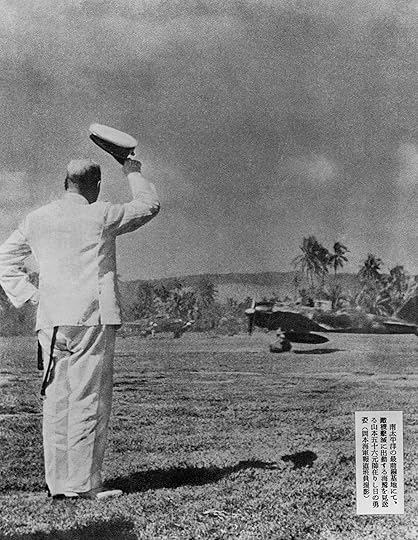
IJN Admiral Isoroku Yamamoto saluting the departure of a Japanese "Mabel" tactical bomber, from the soon to be US Marine Henderson Field on the island of Guadalcanal, 1942

My dead tree copy was a 723 page log. It had a US 2000 copyright. This book includes: a Glossary, Notes, Maps, Photographs, Bibliography and an Index.

Eric M. Bergerud is an author and professor of military and American history. He is the author of four books on primarily WWII history. This is the first book I’ve read by the author.

This was an advanced-level military history on the air war only of the South Pacific campaign of WWII in the Pacific Theater of Operations. A solid knowledge of the Pacific Theater and working knowledge of WWII is needed to read this book. In particular, a reader needs to be familiar with early and mid-20th Century: diplomatic, military history and technology.

TL;DR

The South West Pacific campaign of World War II was a theater of conflict of the Pacific war. It was when the Allies rallied from their initial defeats and began an organized, effective resistance in defense of Australia and then to counterattack in the Pacific. It was a: short (2-year), climactic, unforeseen, and unwanted campaign. In the beginning, the Allies and Imperial Japanese were in rough parity with their forces. For the first year, the battles of the theater were hard fought. Its end was dependent on which side made the fewest mistakes and had the most luck. In the end, the Allies: larger number of more performant, better maintained aircraft, with better trained and experienced aircrews, along with a experience honed doctrine and operational strategy defeated the Japanese army and navy in the theater.

Bergerund opens his book after the fall of the Philippine Islands and ends with the neutralization of Imperial Japanese forces in the Solomon Islands and New Guinea; a necessary step to re-take the Philippines and sever the Japanese home islands from their supply of: oil, rubber and rice from the occupied East Indies.

This book concentrates on the air war over the theater. Although, it ties the air war into the land and naval wars to provide familiar context. It discusses the effect on the theater’s air war coming from: geography and weather; combatant’s mid-20th century aircraft technology; combatant’s military doctrine; US General Douglas MacArthur’s and Imperial Japanese: strategy; air force and squadron operations and tactics; and the organizational behavior of the Allies and Imperial Japanese air forces, navies and armies. In addition, he includes interviews with mostly allied air and ground crews to support the narrative. Finally, he also does a compare and contrast with the air war in the European theater, which was somewhat different.

Interestingly, Bergerund’s historiography was not strictly a time-based narrative, like most histories. It was anchored in the historical, conflict’s events, but heavily leveraged those events to describe the air war principals at work and their evolution as time progressed. For example, the development of allied fighter and bomber doctrine to obtain air superiority first with fighter aircraft and then demolishing: enemy airfields, ports and field units with heavy, medium, and tactical bombers to sever any seaborne supply, and reinforcement was tied to historical operations. He was remarkably successful at that.

Another interesting deviation from the norm, was there was very little discussion of the combatant’s high command. It was not a book about: U.S. General Douglas MacArthur (“a flawed man, but a great general”), U.S. Admiral Chester Nimitz, US Admiral "Bull" Halsey, Imperial Japanese Army (IJA) General Hisaichi Terauchi and Imperial Japanese Navy (IJN) Admiral Isoroku Yamamoto.

The Review

Bergerund’s prose was good. It was well groomed. Although, not without issues. I found several spelling errors and some repetition. For example, “cryptographic” vs. “cartographic” and visa versa appeared more than once. Historically renowned units were unnecessarily and invariably described in a gushing manner. (I recall a squadron being described as “illustrious”.) I also thought that fewer quoted air crew and ground crew interviews could have been used. Not all of these anecdotes were necessary. In addition the greatest majority of these anecdotes were American. This was followed by fewer Australian, less New Zealand, and almost no Japanese. The result as a very American view of the war. Also, the flow of the book’s organization could have been improved with the addition of subordinate subsections, of which there were none. However, these were minor quibbles in the context of the whole work.

The Glossary contained a strange combination of military terms, acronyms and place names. Why an “Bofors” (an antiaircraft gun), RNZAF (Kiwi Airforce), and Rabaul (town on New Britain island in the Bismarck Archipelago) should be listed together was peculiar. Notes were good, albeit brief. Maps adequate. They were self-rendered, with what looked like Powerpoint™. I would have liked more, more detailed maps, using standard military symbols vs. Powerpoint silhouettes. Unfortunately, after 50-years, the colonial-era place names have changed through “localization”, and the jungle and development have (re)claimed a lot of the War’s topography. That made using modern, satellite map usage harder and unsatisfactory. Photographs were very good and there were a lot of them. They were generously annotated too. I would greatly have appreciated, professional, line diagrams to the same scale of the aircraft described to supplement the pictures. The Bibliography was complete. The “Secondary Sources” listed, were a remarkably good collection of military histories, although its 20-years old. The index appeared accurate.

description
Theater Map

Bergerund, provided a particularly good physical description of the theater. The South Pacific is on the equator. At the time, its terrain was mostly undeveloped, disease and pestilance ridden, equatorial jungled, islands are separated by narrow shallow seas. (It’s not much different now.) . Initially, the only maps were 50-year old sea charts. There are few landmarks in the jungle and long stretches of empty sea between islands. Temperature and humidity at sea level were very high. Torrential rains and heavy fog were commonplace. It was the worst place in the world to fight a war. However, at 20,000 feet it was always cold and clear. Pilots could see forever. Note there are no seasons at the equator other than “wet” and “dry’” (less wet). Also, aircraft of the era rarely flew at night, although ground and naval actions were a 24 hour preoccupation. Most of the combat was: aerial, amphibious assault, and naval. Although, heavy and prolonged 24-hour jungle land combat took place on the very large island of New Guinea.

In WWII it still wasn't fully understood that a war of technology depended more on the efficiency and the skill of a relatively small number of people employing powerful weapons, than on the sheer weight of numbers of armed masses.

Aviation was like the present-day semiconductor tech of the post-WWI 20th Century. Military aircraft were the penultimate expression of that tech. During peacetime a military aircraft was obsolescent in four years. During wartime it was obsolescent in two. An experienced aircrew (pilot included) could keep an obsolescent aircraft “competitive” against a state-of-the art aircraft. However, air war was deeply attritive to men and aircraft.

Bergerund delves very deeply into the history of mid-20th century aviation technology to describe the aircraft and their usage for both sides. He does a comprehensive compare and contrast between design, operation and manufacturing of the Imperial Japanese aircraft with Allied aircraft. For example, why an US “High Wing” was a better design for a medium bomber than a Japanese Low-Wing design.

He also ties in how the manufacturing country’s industrial base affects aircraft design and production. The rate of production being very important factor in an attritive form of warfare.

At the beginning of the South Pacific campaign there was rough parity in the number of pilots and aircrews of the combatants. This was to change over the course of the campaign. Both sides always had more pilots than single-engine aircraft. The Japanese had more, smaller multi-engine aircraft (medium and tactical bombers), whilst the allies had heavy, medium, and tactical bombers with both larger aircrews and bombloads. Ground crews were initially about the same.

Japan entered the war with qualitatively better planes and pilots and quantitatively more aircraft than the Allies. This was a legacy of their long war in China. However, Japanese aircraft, doctrine, processes and procedures were developed while fighting their China war. The Allies were not Chinese peasant armies. As a result, for example, Japanese medium bombers were too lightly defended, had too small bomb loads, and were too fragile for missions against defended Allied targets. Important Japanese weapon systems were ill fit for a western opponent. For example, durable, reliable, radio and radar systems usage were either absent or rare in Japanese air, naval, and ground units. Finally, the Japanese supply chain of men and machines pipe from Home Islands was skinnier than the allies'. Their qualitative edge in manpower was worn away by attritive aerial combat with the arrival of the US second generation aircraft and post Pearl Harbor trained aircrews. The Japanese ended fighting the campaign with the inexperienced aircrews and obsolescent aircraft.

Bergerud does not put heavy emphasis on the US cryptographic advantage over the Japanese that dominates many military histories of the Pacific war. However, he does cite all the important uses and cases. For example, the ambush downing of Admiral Isoroku Yamamoto's transport and death over Solomon Islands, through a cryptographic-coup during the South Pacific campaign.

Bergerud also covers the, neglected in the literature, transport and reconnaissance squadrons. They were vital in a region with: (initially) no maps, few roads, no rail, and interdicted seas. The allies eventually had fleets of unarmed cargo aircraft supporting their operations unmatched by the Japanese. Disarmed or lightly armed, stripped for speed and altitude, fighters, bombers and sea planes: mapped terrain, targets and mission success, gave early warning and performed air/sea rescue. Again, Allied recon was unmatched by the Japanese, who never prioriztied the resources for these non-combat missions.

It should be noted that most missions flown by both sides in the South Pacific were over great distances of water, or jungle, against a “take no prisoners” enemy. Shot-up, worn-out, poorly maintained, and out-of-fuel aircraft went down. A large number of inexperienced and a smaller number of experienced aircrews were lost this way. (A surprising large number of aircraft and aircrews were also lost taking off and landing.) If an aircraft went down in the jungle, the aircrew died. Pilots ditched in the ocean, if at all possible within sight of land or a friendly ship. That offered a small chance of survival.

The US army and navy air forces entered WWII with obsolescent aircraft, and aircrews without combat experience. This was likewise for the Australian and New Zealand allies. Although, Anzac aircrews were flying in the European theater against the Germans. Fortunately, the US aircraft were more durable, despite being less performant than Japanese aircraft. That saved a lot of lives. Still, the highly trained, post-Pearl Harbor US pilots and superior aircraft took about a year to arrive together at the Pacific war front. As the campaign progressed, the allies achieved qualitative and quantitative superiority in: aircrews, ground crews and aircraft. This was due to the heavy attrition of the air war affected their combat readiness less, due to the fatter supply chain of men and machines pipe from The States.

The book describes how the war was fought both tactically and operationally. This was described both through aircrew anecdotes and analysis. In particular, it described the evolution of the fighter and bomber doctrine separate and together. For example, there are 5-types of fighter mission: Combat Air Patrol (CAP), Fighter Sweep, Troop Ship Attack/Defense, Bomber Escort, and Ground Attack. There are 3-stages of an air battle: Observation, Initial Maneuver for Attack or Defense, and Melee. Here the anecdotes had true value.
"Every air battle begins with you in formation at altitude, and ends with you on the deck alone."

"In any air battle, there's always a bomber involved somewhere."
Strategically, the Australians wanted to defend Australia, and McAuthor wanted to return victorious to the Philippines. The Japanese viewed the South Pacific Theater as the first of two axis of attack of the Empire’s “Island Shield” from the South. The first being the Central Pacific axis from the East by the USN, which was waiting for the hundreds of ships building on the West Coast of The States. The Southern axis aimed at the Philippines would separate the home islands from their conquered source of oil, rubber and rice. Interestingly, the US Navy’s submarine campaigned beginning in 1943 substantially achieved this without investing the Philippines or New Guinea.

Crucially for the Japanese, the cooperation between the IJN and IJA was never what it should have been. The Japanese high-command was dysfunctional that way—it’s a historical fact. IJN and its air force was first responsible for the South Pacific. However, the commitment of large US Army and Marine formations, drew in the IJA and their air force to the Solomon’s. Australian army divisions to New Guinea resulted same. Command and communications between the ANZAC allies was superlative in comparison to that between the IJN and IJA. This was a large contributing factor to Japanese losses and the overall defeat.

Operationally, the model used was developed by the Allies at Guadalcanal, refined and used in several locations in New Guinea and the Solomon’s. The Japanese attempted a similar model, but not successfully. Air superiority need to be achieved over your airbases and the enemy's. Once air superiority was achieved, "The Grind" started. Bombers with heavy fighter escort would demolish ai airfields and sink all ships approaching or at the base to keep them isolated from supply and reinforcement. Escort fighters would sweep the enemy CAP from the skies. Eventually, an amphibious force would land, attack and capture the airbase. Engineers would quickly refurbish the airfield for fighters to fly bomber escort on the next island airbase closer to the enemy's main base and sources of supply.

The Japanese chose to “hold their ground” in the Solomon's and New Guinea. In retrospect, a rapid retreat of ground and air units protected air would have extended the war. Several times, Japanese airfield/bases were isolated by the air alone, and then bypassed. An isolated Japanese base, cut off from supply and with its aircraft destroyed, would starve, wither and become no longer be combat operational. Whole divisions of the IJA were unrecoverable, cutoff from supply and bypassed. Bypassed units never could contribute to the defense of the home islands or the island bastions like Saipan and Okinawa.

Summary

This book with the right background describes a lot about the WWII air war and in detail the early phase of The Pacific War in the South Pacific.

The South Pacific campaign’s air war decisively tilted the war from the Japanese to the Allies for the first time. It broke the back of the IJN and IJA air forces, before they were put to death by the carrier attacks later in the war. In addition, the South Pacific drew in a substantial proportion of the IJA, isolating large formations from: supply, reinforcement or retreat in a: remote, hostile jungle, or island jungle environment. There, these forces were “out of the war”. In places this book goes into excruciating detail. I found a lot of it to be hugely interesting. Other parts of it, less so. I learned more about WWII aircraft and warfare than I knew to look for. Bergerud analysis of strategy and operations was solid. I particularly liked how the narrative was developed from low on the chain-of-command, with very few admirals and generals in-the-focus. I did think the ANZAC allies, while held in esteem, where given short shrift in the story. Despite an effort, this was still a very American history. I also thought that the number of anecdotes should have been severely culled. I felt the author wanted to reward every well-spoken interviewed campaign veteran by getting their name in print?

However, if you’re a serious armchair air marshal or WWII aviator wannabee this is book worth reading.

Folks interested in particularly detailed description of the IJN, referenced in the book, but with very good diagrams, might want to read Kaigun: Strategy, Tactics, and Technology in the Imperial Japanese Navy, 1887-1941 (my review).
4 reviews
May 5, 2020
This is a title and subject matter that interests me greatly. I've read many books and am quite knowledgeable on the subject and have endured many difficult reads. That said, this book is painful. 250 pages could be eliminated with proper editing.
Profile Image for Emmanuel Gustin.
416 reviews27 followers
April 13, 2014
This is fascinating account of the air war in the South Pacific in World War II. Bergerud offers no mere blow-by-blow account of the battle for Guadalcanal, but expands his history to cover the fighting in the rest of the theatre and investigate the conditions in which the conflict was fought. The challenges of geography, distance, climate, and disease are discussed at length, and the author explains their strategic implications a well as their human, personal implications. The personal recollections of the men who fought there take center stage.

At times the author does show the limits of his knowledge. His technical knowledge of World War II aircraft, for example, is limited and a bit dated, and he repeats old misconceptions such as the belief that the Japanese Ki-61 Hien or "Tony" was a German design. But given the wealth of information that he has collected on other topics, this is easy to understand.

The book does feel a bit too long. Perhaps it is overdoing the search for completeness, and too thorough in offering final conclusions as well as a full history; it becomes a bit repetitive. But nevertheless well worth reading.
Profile Image for Steven Henry.
Author 37 books81 followers
December 17, 2025
It hurts me to rate this only 3 stars, but that's what it deserves.

There's a lot of good stuff in here, particularly the primary accounts of pilots who were there. I learned some things, like the fact that operational (non-combat) losses far exceeded combat losses for American aircraft in the South Pacific. I gained a new appreciation for early-war American aircraft like the P-40.

But this book is poorly structured. It jumps around a lot, going back and forth over the same ground more than once. It's very difficult to gain a full picture of the conflict, even for one like me who is well-versed in WWII. Bergerud has an unfortunate tendency to repeat himself, often using basically the same language over and over.

I'm forced to agree with another reviewer who said 200 pages could have been edited out. This is a big, chunky book (my copy is about 700 dense pages) that could have benefited from being considerably smaller. It feels hastily edited, redundant, and poorly organized.

If you really, really like reading about WWII aviation, you might check this out. Otherwise, go for something a bit more readable and structured.
Profile Image for Neil Albert.
Author 14 books20 followers
July 15, 2024
The author has thought deeply about the Pacific war. He focusses on the key attritional air campaign in the Solomons and New Guinea in 1942-43 and comes to some surprising conclusions. It's not a conventional narrative; it's an analysis of the geography, the respective training, doctrine, and equipment of both sides, and he fits the relatively narrow focus into the bigger picture of the Pacific war. I found many of his observations to be original, and everything is backed up by solid reasoning and data. Just one example--in the preface, he notes that two great industrial powers fought bitterly for a year, to the point of exhaustion for one of them, for an area that was good for nothing except growing cocoanuts. It's the kind of thing that keeps you reading. Based on this I bought his companion volume on the land war in the Pacific, Touched with Fire.
Profile Image for George.
133 reviews
August 17, 2023
A rather dry and deeply technical book that investigates the air war in the South Pacific from roughly 1942-44. Historical data and research findings are stitched together with tales recounted by those who participated. The author spent many years researching the information he presented and it shows. Because the book is broken up into parts that exam different elements or aspects of an event many periods of time are repeated and it can get a bit confusing to remember what date your reading about. If you are interested in a book that looks at most (maybe all) mayor aspects of the fight this will be a good read. Mostly a presentation of facts and figures the book is packed with details but besides the flow of events there is not much story and action.
Profile Image for Don Alesi.
90 reviews43 followers
July 16, 2017
Excellent book with many first hand accounts of what life was like fighting the air war in the pacific.
although the book could be tedious at times I read every word carefully and understood exactly what the Military had to go through.
496 reviews
Read
November 18, 2019
Great research and well written. It is a smooth read, well explained to the novice and not boring to old warriors. He gives credit to all branches of the service and allies. I thought well researched and written. An excellent book.
45 reviews
May 20, 2020
A good history of air way in the Pacific. But it is a bit of a slog. Lots of repetition. Bergerud's writing style is rather verbose and sometimes rather turgid. I think he could have conveyed the same amount of useful information in about half as many pages.
Profile Image for Paul Downs.
496 reviews14 followers
January 29, 2021
Monumental. Covers all the usual action but also quite a lot on subjects not usually covered in WWII history, like the industrial capacity of the various belligerents, and how that affected every aspect of the air war. It's a long book but Bergerud's writing kept me interested. Well done!
40 reviews4 followers
June 24, 2018
Really excellent read.

Flows nicely and balances historical detailed and effect narrative brilliantly.
8 reviews
June 27, 2018
Great book about a little known theater in WWII. This book is filled with interesting details about air combat in the South Pacific.
Profile Image for Wynn B Gordy.
25 reviews
November 15, 2019
Consummate History if air war in South Pacific

This is the most comprehensive and well written history of the air war in this South Pacific I have ever read. Areal joy to read.
17 reviews
July 17, 2021
Excellent examination of the realities of the SP air war.
Profile Image for Rolf Kirby.
189 reviews3 followers
October 27, 2020
A long and highly detailed history covering fighting in the air from the early Japanese raids over Darwin Australia to the decisive defeat of Imperial forces in the South Pacific by 1944. The author discusses everything from the physics of warplane design to flight crew training to organization. He describes in detail the environmental conditions in which the air crews fought. Tactics of individual pairs of planes and up to grand strategy all receive careful attention. Many first hand accounts enliven the text. Highly recommended.

Notes:
Japan - no close air support on air - ground coordination. No organized search and rescue. Radios poor or not carried, so much worse game time coordination by Japanese fighters / escorts. Industrial output / logistics overwhelmed. Spare parts of poor quality and not enough. Many Japanese planes in the South Pacific grounded for want of simple but critical parts. No regular rotation of air crews, they usually fought until dead. After a while in-theater, squadrons were generally decimated by combat losses, accidents, and disease. No regular rotation of combat experienced air crews to train new recruits.

USA - USAAF strafers were B 25s mainly with huge armament in the nose. Conversion of B 25s in theater an example of American ingenuity. American planes much tougher than Japanese planes, and much more able to withstand damage and still make it back to base. A large strategy in the Solomons / New Guinea area was to land and create new air bases closer to the enemy. US engineers much much more capable than Japanese in making new air fields fast. (Japanese strength was defensive fortifications).
Profile Image for Hank Hoeft.
452 reviews10 followers
May 14, 2019
There are too many books in the world that I want to read--more, I'm afraid, than I can read in my lifetime. So it's rare that I read a book more than once. But I recently reread Touched With Fire: The Land War in the South Pacific, and now I've also reread its companion volume, Fire in the Sky: The Air War in the South Pacific. Together, they give a most comprehensive discussion of what warfare was like in the most inhospitable geographical area on the planet, with some of the most savage fighting in all of World War II, chronicling the two year twin campaigns in the Solomon Islands and in New Guinea, which broke the back of the Imperial Japanese military and paved the way for Allied success in the Philippines and across the Central Pacific. (Actually, the two volumes don't quite give a complete picture--author Eric Bergerud has stated his intention to write a third volume devoted to the naval war in the South Pacific to complete the trilogy of warfare on land, air, and sea.)

I appreciated Bergerud's thesis that in the air war with Japan, the Allies eventually overwhelmed the Japanese with quantitative and qualitative superiority, but before the advanced technology was introduced--the F6F Hellcats and F4U Corsairs, the radio and the radar and the proximity fuses, the Essex class aircraft carriers and the Iowa class battleships--the Allies had already turned the tide of war with the first-generation technology and equipment, and superior tactics, strategy, logistics, and planning.
Profile Image for Mark.
1,288 reviews152 followers
May 5, 2020
The South Pacific, as Eric Bergerud points out at the start of this book, was an unlikely place to develop into a battlefield during the Second World War. Lacking natural resources or any geographic significance in its own right, its proximity to the more important locations of Southeast Asia made it the centerpoint in the clash between the Japanese on the one hand and the United States and her allies on the other. And a key aspect of that war was the struggle taking place in the skies between the respective air forces, a struggle that is the subject of Bergerud's weighty book.

In examining the air war, Bergerud eschews a traditional narrative account in favor of a thorough analysis of the various factors involved, an approach that allows him to glean insights that are often missing from most histories of the conflict. He divides this analysis into three parts, focusing on the geographic conditions, the men and equipment, and the tactics and nature of combat in the region. Each chapter is full of Bergerud's well-informed and opinionated explanations of the factors determining the nature of the air war and the advantages and deficiencies possessed by the two sides as they confronted each other. Readers may disagree with some of his conclusions, but there are valuable insights about the air war on nearly every page, ones applicable not just to the battles over the South Pacific but to the war as a whole as well.
15 reviews
July 9, 2020
Wonderful essay on every aspect of air warfare over the main combat area in the Pacific Theatre of Operations during WWII. Everything is covered - geography, maintenance, materiel, training, living conditions, aircraft performance, tactical methods, combat stress, etc. Warning: this is not a narrative of war actions nor a chronology of events.
Profile Image for Steve.
87 reviews4 followers
November 21, 2013
Wow, what an in depth book! This is certainly no book for the light WW II aviation reader. However as a Naval Aviation veteran and big time History Buff, this is the stuff you dig to find. I came across this as a reference source to the book SUNBURST and must say this far surpassed that study of the rise and fall of the Japanese Air arm of 1909 thru 1945.
This is not a book of WWII dogfights nor air stories, although the book does contain numerous first hand veteran accounts as examples offered and referenced, but a detailed study of the AIR WAR fought in the South Pacific. It covers (near) all facets of the Japanese/Allied aviation as a granular build to the final outcome. From engines and airframe details, training, ground support and conditions, logistic to pilot rotation it analytically frames the factors of victory and defeat for that air campaign. Well worth the read IF that is your interest.
611 reviews7 followers
November 18, 2016
This is both a thorough and exhaustive book. The book is very detailed and covers a whole host of aspects of the air war in the South Pacific from the pilots to the aircraft used, tactics, weapons systems, morale and even disease. There are a number of minor factual and spelling mistakes but overall they don't detract from the quality of the research. I did find the book tedious at times, particularly when covering aerodynamics and describing various parts of aircraft.
Profile Image for Steve Alguire.
Author 1 book2 followers
October 24, 2015
The man knows his airplanes. Good anecdotes from vets. Comprehensive. Very readable, if occasionally a touch prolix. Worth reading for the summation alone. Recommended.
Displaying 1 - 29 of 29 reviews

Can't find what you're looking for?

Get help and learn more about the design.