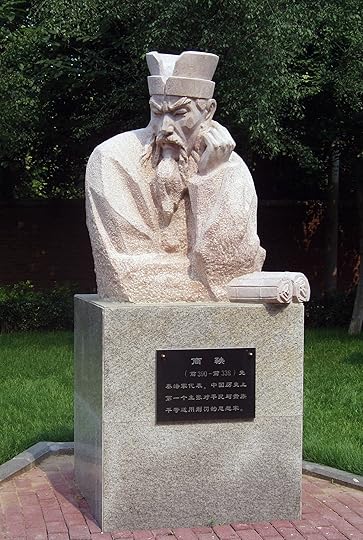
The Book of Lord Shang was probably compiled sometime between 359 and 338 BCE. Along with the Han Fei-Tzu, it is one of the two principal sources of Legalism, a school of Chinese political thought. Legalism asserts that human behavior must be controlled through written law, rather than ritual, custom or ethics, because people are innately selfish and ignorant. The law is not effective when it is based on goodness or virtue; it is effective when it compels obedience. This is essential to preserve the stability of the State. Reprint of Volume XVII in Probsthain's Oriental Series. With a Chinese index and an index of names and references. "The Book of Lord Shang or Shang-tzu is said to consist of 29 paragraphs, of which the text for nos. 16, 21, 27, 28 and 29 being no longer extant. The translation of Prof. Duyvendak therefore covers only twenty-four paragraphs and is based on an edition published by Yang Wan-li in 1793, which was reprinted by the Che-chiang-shu-chu in 1876 in the "Collection of Twenty-two Philosophers." Of all the editions published before or after that date, this is the best known. (...) The Chinese text of the Book, like many other ancient writings, is obscure in some parts and corrupt in others. (...) The reviewer is therefore forcibly struck by the faithfulness, definiteness and clearness of Dr. Duyvendak's translation." --13 Chinese Soc. & Pol. Sci. Rev. 459-460, 462 1929. J.J.L. Duyvendak [1889-1954] was an interpreter for the Dutch embassy in Peking from 1912-1918. In 1919 he became a lecturer in Chinese at the University of Leiden. He was the author of China's Discovery of Africa; Lectures Given at the University of London on January 22 and 23, 1947 (1949) and edited and translated several works, including The Diary of His Excellency Ching-shan; Being a Chinese Account of the Boxer Troubles by Shan Jing (1924). He established the Sinological Institute at the University of Leiden in 1930. It is now one of the leading libraries for Chinese Studies in the Western world."
Shang Yang (390–338 BC), also known as Wei Yang, was Chinese legalist philosopher and important statesman of the State of Qin during the Warring States period of Chinese history. His policies laid the administrative and political foundations that would enable Qin to conquer all of China, uniting the country for the first time and ushering in the Qin dynasty.
Legalism, the harshest of the ancient chinese philosophies, despised by almost everybody and long abandoned after the fall of Qin. The total opposite of confucianism; none of those useless rituals, no music, no aristocracy. It promoted meritocracy and extreme loyalty to the sovereign, filial piety took a backseat, the state went first. Even the most commonest of crimes were to be punished severely. It some how worked for the state of Qin, as they were able to expand and unite all of China under them. But shortly afterwards, the Han replaced the Qin, confucianism triumphed over legalism, and legalism was abandoned forever. Confucianism, out of all the other schools, won the right to be the official state doctrine for the many future dynasties that were to come.
The ability of the well-governed state to fully utilize its land resources and to cause the people to die [for its sake] is due to the name (repute) and benefit that it brings [to the people]. The nature of the people is to seek food when they are hungry, to seek respite when they are belabored, to seek joy when they are embittered, to seek glory when they are humiliated: this is the people’s disposition. In seeking benefit, the people lose the standard of ritual; in seeking name, they lose the constant of their nature.
Yang Shang has had a harsh reputation over the past 2300 years. His reputation was that of unmitigated evil, and his institution of a tyranny so brutal that the Qin Dynasty that he once advised would soon fall in a matter of years after its unification of the whole of China - but it did unify China.
This edition, the second English translation of the Shang jun shu 商君书 since Duyvendak's in 1928, is a serious attempt to reevaluate the text after decades of historical debate. The first part, in four chapters, provides a biography of Shang Yang, a "history, dating, and style" of the text, a chapter on "the ideology of the total state", and the text's reception and impact. Pines notes the relative lack of study of this book in China and elsewhere, with efforts only starting in earnest in the 20th century.
Part two is an annotated translation of the entire text, with duplications, possible errors, and lacunae all noted. I have to admire Pines' effort - when I attempted to follow along reading the original, I found it difficult even by the standards of a classical Chinese text.
There is no rhetoric or literary allusion here. For Shang Yang, the goal of the state is to maximize agricultural production, and raise armies. A system of punishment and reward is needed to make the bureaucracy efficient and the monarch dispassionate. He does talk about rewarding bravery and efficiency - but he has no time for belief systems, intellectual dallying, artistic pursuits, or commerce. I quote from section 3:
Poems, Documents, rites, music, goodness, self-cultivation, benevolence, uprightness, argumentativeness, cleverness: when the state has these ten, superiors cannot induce [the people] to [engage in] defense and fighting. If the state is ruled according to these ten, then if the enemy arrives, it will be dismembered, and [even] if the enemy does not arrive, the state will be impoverished.
[诗、书、礼、乐、善、修、仁、廉、辩、慧,国有十者,上无使守战。国以十者治,敌至必削,不至必贫。]
All that is left is calculating the states resources and efficiency of their use, to develop a 'rich country and a strong army' - to borrow a phrase from a later text. It is astonishing to remember that this was written so long ago, and can so easily be compared to other writing about states. Of course, it would be much to assume that only the state of Qin followed his dictates.
This volume is not only a remarkable translation of an ancient text, but the first part contains thoughtful essays on its history and impact - which I hope will continue to have an impact on scholarship in the history of imperial China and elsewhere.
With a long introduction covering what is said in Chinese history about Lord Shang, and discussion of the text (both in content and existing text) before the translation of this classic of Legalist thought.
Strict, severe, contemptuous of tradition and naively trusting in the power of law to make a man good. . . .
Full of laws that, it assures us, will force people to practice agricultural labor, which much abuse for the "lice" that destroy the kingdom (such as care for the elderly, listening to music, sophistry, and brotherly duty). The importance of severe punishment for minor offenses (to ward off serious offenses), ensuring that punishments outnumber rewards on the order of nine to one, and clarity in law. Much discussion of war.
a profoundly evil work, that makes a person think by presenting such stark contrasts. The reasoning comes on extremely fierce during the opening chapters. By the end it's a patchwork of unfinished chapters and mindless repetition. But overlook that
The chapter “Agriculture and War” from “The Book of Lord Shang” really stood out at me out of all of them from this weeks reading. You can see the results of agriculture being looked down upon today, hardly a fruit tree or vegetable garden in site. It is dangerous when people no longer value something that is an essential for life, over a desire for power. In order for war to be accomplished there has to be strong soldiers. In order for soldiers to be strong, they must be fed well. Lord Shang states this very point: “Where the people are given to such teachings, how can the grain be anything
but scarce, and the soldiers anything but weak?”
If the citizens who stayed in their state do not want to farm because it is seen as demeaning then the war will be lost and being a member of your state in itself will become demeaning. Humans are changing the role of food from a necessity to a luxury. I believe that every house, in every county, should have a garden to grow their food for the house hold. Even if it’s a hanging garden on the balcony or a rooftop garden. I think everyone, rather you are wealthy, and especially if you are not, should in some sense produce their own food. This book opened a deep belief of mine on the concept of self-sustainability and awareness. Though Lord Shang had some extreme views, overly aggressive techniques and some close minded assumptions; I cannot say that I disagree with everything he says. Like any Philosophy, there is bound to be something that you cannot bring yourself to agree with, such as the burning of books due to legalistic fear of intelligent people who may disagree with the rules and have the power to change them. But I can also find qualities I like, such as the importance of agriculture and the use of war as a way to encourage the understanding of the common people.
My rating does not reflect my satisfaction with this translation, but with another one, in German, that does not exist on Goodreads: Shangjunshu: Schriften des Fürsten von Shang, übersetzt und kommentiert von Kai Vogelsang (2017). Kai Vogelsang has discussed the Shangjunshu in detail with Yuri Pines and does not agree on everything with him, e.g. the succession of chapters, I believe.
Kai Vogelsang has a wonderful critical apparatus, one would only desire to have the original text, to make it a bilingual edition. The endnotes are detailed and make the most interesting kinds of comparison with Rome and Greece, as well as medieval and Early Modern Europe, in their laws, political philosophies and military practices. The introduction adds further value, unlike many other introductions to classical texts. It is a history of violence in early China, through societal structure, the military and the bureaucracy. Kai Vogelsang builds on his previous history of China (Geschichte Chinas, 2013), which traces especially well the institutional changes in early China, it, in turn, built on reflections about how not to write a history book that follows a propagandistic narrative consisting of nationalism and - yes - boosterism, that warps our perspective and plays into the hands of the anti-nihilist communist state ideology.
If anyone reads both German and English, go for the German edition.
440-The Book of Lord Shang-Shang Yang-Philosophy-338BC
Barack 2022/10/30
"Book of Shang Jun", created in the Warring States Period. There are 26 existing works, 2 of which have no books. It is one of the representative works of the Legalist School of the Warring States Period. It focuses on the reform theory and specific measures implemented by Shang Yang in the Qin state at that time. It is a compilation of the works of Shang Yang (possibly including his later studies), a representative of Legalism during the Warring States Period. The "Book of Shang Jun" discusses "strong country and weak people", and believes that a country that can defeat a strong enemy and dominate the world must control its people and make them "weak people" rather than "prostitution". Shang Yang believed that the strength of the state and the strength of the people were in opposition. Only by making the people obedient to the law, being simple and honest, will it be difficult for the people to form a strong force against the state and the monarch, so that the state will be easy to govern and the monarch's position will be firm. However, don't interpret "weak people" as "foolish people". In the Book of Shang Jun, it is believed that human nature is inherently evil, and it is necessary to recognize the viciousness of human beings. In order to govern a country, it is necessary to use evil to rule the good in order to make the country strong. In the Book of the Lord of Shang, he advocates heavy punishments and light rewards. He believes that heavier punishments and fewer rewards are because the monarch loves the people, and the people will desperately compete for rewards; if the rewards are increased, the punishments are lightened, because the monarch does not care for the people, and the people will not be rewarded. And fight to the death.
Shang Yang was born in about 390 BC and died in 338 BC. Ji surname, Gongsun family, name Yang, a native of Wei. During the Warring States Period, he was a statesman, reformer, thinker, strategist, representative of Legalism, and descendant of the monarch of the Wei Kingdom. Shang Yang assisted Duke Xiao of Qin and actively implemented reforms, making Qin a wealthy and powerful country, known in history as "Shang Yang's Reform". Politically, he reformed Qin's household registration, military titles, land system, administrative divisions, taxation, weights and measures, and folk customs, and formulated harsh laws; economically, he advocated emphasizing agriculture and suppressing commerce, and rewarding farming and warfare; He led the Qin army to recover the land in Hexi, and was given to the fifteenth town of Shang by Duke Xiao of Qin, named "Shang Jun", known as Shang Yang in history. In 338 BC, after the death of Duke Xiao of Qin, Shang Yang was framed as a rebel by his son Qian, and was defeated and died in Tongdi (now southwest of Huazhou District, Weinan City, Shaanxi Province). The body was transported to Xianyang, where the car cracked and the whole family was killed.
Table of Contents 1. Change the law first 2. Reclamation Order No. 2 3. Agricultural War No. 3 4. Fu Qiang's fourth 5. Say People Fifth 6. Count the sixth 7. Kaisai seventh 8. One Word Eighth 9. Wrong way ninth
The ancients 2000 years ago were talking about reform, and today we are still talking about innovation. People after 2000 still demand change. As long as we look at history a little, we should understand that there is no so-called formula for accomplishing things. Regardless of the changes in the environment of the times, even if the conditions of the times are the same, there will always be better solutions than the present. Problems that were complex to the ancients 2,000 years ago may have very efficient and clear solutions today. In the same way, our difficulties today, in the eyes of people after 2000, also have simple and direct solutions. The material world hasn't changed dramatically, it's our way of thinking that has changed. If we change the way of thinking and the way of doing things, under the same conditions, different effects may be produced. Where is the ancient law? The ancient law of today was also the new law. Isn't it obvious that today's new law will become an ancient law in the future?
The Spring and Autumn Period and the Warring States Period are very interesting periods in Chinese history. Different countries are like different companies. Geographical conditions, resource endowments, and population compositions vary between countries. These factors have an extremely important impact on the strength of a country. If the causal relationship were as simple as this, there would not have been the five hegemons of the Spring and Autumn Period, the Seven Heroes of the Warring States Period, and the first hegemony would have ended the troubled times. So what is it that causes the strong to become weaker and the weak to become stronger? I think one of the important reasons is the different policies adopted by these countries. For example, a company has inherent advantages and naturally takes advantage of its advantages, but whether it can become the leader, in the end, depends on its specific operations.
Legalism can be said to run counter to Confucianism. Confucianism teaches poetry and books, propriety and righteousness, and Legalism teaches legal farming and warfare. Confucianism believes that there is benevolence, righteousness, and morality in order to continue to be strong; Legalists believe that poetry, book, etiquette, and righteousness are empty talk, but instead are scourges, which are the root cause of the country's weakness. Because these things are verbal and lack material basis. Legalism embodies the most incisive utilitarianism, turning the common people into farming machines and war machines. Confucianism, on the other hand, pays attention to the moral cultivation of individuals and seeks to govern without teaching. Which theory is correct? Or, is there a so-called absolutely correct doctrine? Maybe not. The state of Qin grew stronger by relying on legalist thought and finally perished. Confucianism is weak in the way of attack, but it does have advantages in long-term governance. Therefore, it is necessary to choose the method of doing things according to the actual situation, learn from others' strengths, and be flexible.
The Qin state gained practical benefits by relying on the ideas of Legalism and laid the foundation for its power to rule the world. Therefore, when the Qin state was unified, the legalist thought of governing the country intensified. The so-called success is also Xiao He, and defeat is also Xiao He. The Qin State relied on the rule of law to strictly seize the world, but the extremes of things turned against it, and it was too much. When the world was unified, the external threats were greatly reduced, and the internal contradictions were intensified and intensified, the severe laws led to the demise of the state. The foundation of agricultural warfare lies in farming and in warfare. After the reunification of the country, is it because there is not enough food? Is the army not strong enough? Qin Yiqiang died. It is necessary to know how to balance.
The core idea of Shang Yang was actually to block other roads of the people, to make farming the only way to gain benefits, and to make fighting in the army the only way to gain fame. Fame and fortune are what most people pursue, and they control the way the two things are distributed. Isn't the behavior of the common people also controlled? The Legalist method is very extreme, and the extreme method has obvious advantages and obvious disadvantages. It is like a person who gives up everything else and only concentrates on reading, then he will definitely be able to read well, but in other aspects, he may be inferior to ordinary people, or even become a nerd. If a person puts all his energy into making money and gives up everything else, he will surely make money, but there is a risk of becoming a miser. Any method, no matter how effective it is, must pay attention to the environment in which it is used. For a country, it is no longer suitable to adopt such a domineering approach when the world is ruled. Individuals, when the academic qualifications are enough, should focus on improving other aspects. When you earn enough money, you should strengthen your pursuit of the spiritual world. Shang Yang's achievements are undoubtedly shocking, but he himself did not end well. Isn't it also an extreme backlash?
The founding monarchs of the Xia, Shang, and Zhou dynasties relied on the following to seize the world, and after taking the world, they respected virtue; The paths to success vary. History is written by survivors. The Tao of Shang Yang is the Tao of success at any cost. As long as it's useful, there's nothing it can't do. The ancients were able to come up with such eclectic ideas, but it is possible for us today to be self-indulgent, clinging to the old principles, and not changing from the past. Isn’t it ignorance?
People's temperaments and endowments are divided into high and low, and the strength of a country is different. These innate characteristics are difficult to transfer, but acquired practices can be imitated and learned. So we have to focus on the general part so that we can learn from the successes and failures of others. Only things that are general, universal, and replicable can play a greater role. Sages talk about benevolence, righteousness, and morality, but Legalists don’t talk about these, probably because they think that things such as quality vary from person to person and lack universality, so it’s for the sake of Fadu.
My best way to describe this book is Machiavelli's The Prince meets Sun Tzu's The Art of War. It is like an advice column to an ancient Chinese emperor, instructing him on how to keep and gain power and grow his country, keep out invaders, etc. It's an interesting book, though a bit repetitive when it comes to the advice, and a must read for anyone interested in Ancient China.
Whoa Nellie; this guy did not, I repeat not, believe in forgiving and forgetting. Death penalty for this, death penalty for that... Still, his writings were pretty interesting for the reader, so he had that going for him.
I picked this up because I've read some of Yuri Pines' academic articles. Lord Shang is one of the most reviled writers in traditional Chinese thought, usually for the uniform, harsh punishments he recommends for *everything*. What Pines makes clear -- and what you can see in the text -- is that Lord Shang was opposed to a lot of what were considered virtues -- filial piety, family loyalty, even human feeling (ren, 仁) -- because they were used to indulge sloppiness and corruption. He classified the teachers of such virtues -- that is, Confucian scholars -- among the worthless, wandering class, who have to be eliminated or discouraged if the state is to achieved its goal: the establishment of a unified Empire of All-Under-Heaven.
Obviously Confucian scholars, who Lord Shang hated, would more than return the favor of hating him back! But to my reading they also hated him for two additional reasons.
Lord Shang's formula for controlling the people and molding them into an unstoppable military force involved both a carrot and a stick. The stick was a very heavy punishment-based legal code, which everybody talks about in horror. More important to my mind was the system of carrots: cutting off all other methods of social advancement besides through the military, but leaving military success as a *guaranteed* route to social rising, open to foot soldiers on up. *Any* peasant who went to war and was credited with an enemy head got more land. With more success (=heads), more land, more authority, more money -- the prospect of true social advancement was there, for anyone who was willing to fight.
And this leads to the other reason later scholars hated Lord Shang: it worked. This formula to create a motivated rank-and-file military is one reason Qin overcame the other Warring States, to become the first dynasty and set much of the template for future Chinese history.
There's only been study so far comparing Lord Shang to Machiavelli and I haven't been able to read it, but there's a lot to do there. Both men were realists, advising rulers about what *really* works, talking about human behavior as much as possible stripped of their respective cultures' platitudes. Lord Shang's advice is more extreme because the situation he faced was more extreme: states with millions of people, fielding armies of tens or hundreds of thousands, warring against others for the prize of Emperor of All Under Heaven. The stakes for Machiavelli's Prince were minute by comparison, and the level of control he might exert was also limited. And he didn't propose anything as radical as offering a route for social advancement to peasants.
The Book of Lord Shang is a classic of Chinese political thought that ought to stand next to Hobbes, Locke, and Machiavelli on one's political philosophy bookshelf. An important work that, as Pines shows, was likely partly written by Shang Yang and/or his disciples during his lifetime and partly in the century and a half afterwards. Shang Yang was the main reformer responsible for the reforms that enabled the Qin to emerge as a significant political and military power, ultimately enabling universal empire under the Qin dynasty.
The Book of Lord Shang argues for a powerful state to rule on the basis of agriculture and military power. The genius of the well-governed state is to make the people do what they would otherwise hate to do: "Farming is what the people consider bitter; war is what the people consider dangerous. Yet they brave what they consider bitter and perform what they consider dangerous because of the calculation [of a bane and benefit]... When benefits come from land, the people fully utilize their strength; when the name comes from war, the people are ready to die" (6.5). The readiness of people to die for the state (in war) is the true measure of a well ordered state and the strength of the state rests on channeling the selfishness and desires of the people for its own use. Farming and war (often combined and called "the one") should be incentivized through a good name (reputation and high social status) and benefit (riches) - and through the use of a rank merit system.
The state should also use heavy punishments to deter enmity towards the state - with the expectation that such use of punishments will both deter challengers and lead to the rarer use of punishments in the end ("he relies on punishments to eradicate punishments" - 7.6). Sticks should be used much more than carrots: "In the well-ordered state, there are many punishments and few rewards" (7.5) In Lord Shang's political theory, punishments directly lead to the promulgation of virtue: "Punishments give birth to force; force gives birth to strength; strength gives birth to awesomeness; awesomeness gives birth to virtue; virtue is born of punishments" (5:7). Force, not Confucian morality, is what leads to the successful state: "benevolence and righteousness are insufficient to rule All-under-Heaven" (18.8).
Chapter 7 grounds this treatment on historical myth. Society first started with a matriarchal society, where "attachment to relatives" and selfishness were the way of the people. Once the population grew, this attachment and selfishness led to violence, so "the worthies established impartiality and propriety and instituted selflessness," leading the people to elevate the worthy over attachment to relatives. Distinctions among the people and property, prohibitions, officials, and the ruler were then established, leading to "the esteem of nobility" taking over from the elevation of the worthy. The monarch of today rules through esteem, but is not bound by tradition: polities should feel free to establish new rules to govern themselves, albeit those rules should take into account the customs and opinions of the people. Per 5.9: "when [affairs] are determined by a household, you will become a Monarch; when affairs are determined by officials, you will be strong; when [they are] determined by the ruler [himself], you will be weak... Hence, [in the state of] the True Monarch, punishments and rewards are determined by the people's hearts."
The book argues for what the translator calls "the total state" - a state that has complete control of its population, thereby preventing the dismemberment of the state. The people itself are seen as a threat to overcome: "those who were able to regulate All-under-Heaven first had to regulate their own people; those who were able to overcome the enemy had first to overcome their own people... those who excel at orderly rule block the people with law" (18.2). "When the people are weak, the state is strong; when the people are strong, the state is weak. Hence, the state that possesses the Way devotes itself to weakening the people" (20.1).
No separate sphere of activity should exist apart from the state - no private sector: "The state is disordered when the people have too much private justice; the army is weak when the people have too much private courage" (18.6). As described in 13:5: "When benefits come from a single opening [i.e., the state], the state will be without rivals; when benefits come from two openings, the state will half benefit; when benefits come from ten openings, such a state cannot be protected." Indeed, those who act independently of the state are called "villains": "Those who do not work but eat, who do not fight but attain glory, who have no rank but are respected, who have no emoluments but are rich, who have no office but lead-these are called 'villains'" (18.6).
To control the people there must be a "unification of teaching" under the state - meaning that the "educated" and "argumentative" will not be "allowed to become rich and noble, to criticize punishments, or to establish their private opinions independently" (17.4). "When you employ the shi engaged in Poems, Documents, and persuaders' talk, the people will wander and disregard their ruler" (6.6). "If learning becomes habitual, the people turn their backs on farming: they follow talkers and persuaders, speak grand words, and engage in false debates" (3:10). "Hence, when the people are ignorant, they can be overcome by knowledge; when the generation is knowledgeable, they can be overcome by force" (6.7). "If ignorant peasants do not become knowledgeable or fond of learning, they will strenuously devote themselves to agriculture" (2.14). Hence, an ignorance populace is the best basis for the rule of the people: "Clarifying teaching is like arriving at no teaching" (17.4).
Yuri Pines argues in his introductory chapters that "the text's lack of interest in brainwashing makes it insufficiently 'totalitarian'" - in spite of most of the text being quite compatible with totalitarianism. The Book of Lord Shang does not promote an ideological foundation to the rule of the state, instead arguing for the opposite: a doing away with learning and tradition. As states throughout history have found, however, it is much more useful to base one's rule on ideological (and in pre-modern times, usually ideological-religious) foundations. Hence, future Chinese dynasties based themselves on Taoism, Confucianism, and to some extent on Buddhism. From a totalitarian perspective, the absence of an ideological foundation is surely the most significant weakness of the book.
Le livre du Seigneur Shang est un livre qui mélange à la fois la littérature de sagesse sous la forme de proverbes, et un programme de réformes mis en place dans l'état de Qin au IVe siècle, consolidant cet état jusqu'à en faire le fondateur de la ... Chine. Dans ce livre, le principal ministre de Qin défend un système de punition et récompense le plus lourd et automatique possible, pour faire émerger l'ordre à partir du chaos et éviter toute possibilité de corruption. Il reproche lourdement aux lettrés d'être des parasites nuisibles à la société et défend que les seules vocations permises devraient être fermier ou soldat.
Le livre est moins philosophique et général que le Han Fei Zi, mais il permet de bien saisir l'esprit de la philosophie légiste, et l'art du gouvernement impérial chinois. En cette époque de troubles sociaux, où les lettrés sont les premiers corrupteurs du pays, il est l'occasion de beaucoup de réflexions.
The design is pretty weird as there is a waste of paper for the margin. But I suppose the text is really just a repackaged printing of a previous version. Also, perhaps as expected most of the book is framing for the actual text. Most of the text is pretty much what you'd expect it to be. The writing is antiquated so the depth of the concepts is not there -- the writers had to speak in metaphors to get across certain kinds of relationships. All in all, a pretty interesting read, as legalism is often looked at unfavorable when we compare it to Confucianism or the humanist writings of Mencius. Still, the reasoning for how to look at commoners and the state is there, and this is embedded in Chinese culture and thinking. So I'd highly recommend it to anyone looking to gain background of this topic.
An amazing book of some 33k words clearly written by people who understand peasantry as an art and, building on that, understand the government affirs and management of civil service. A great find for those interested in Chinese legalsim, some snippets of ancient Chinese history and in general for those not afraid to spend the same amount of time researching a book as reading it.
Now, obviously it has its faults in that quite a number of characters are always written by their second names, but then again, that was indeed the tradition. Also, a number of ideas seem highly improbable in terms of implementation even for that era, like the idea that making punishments for light crimes great will make people stop committing them, or the idea that attacking the wine producers will stop people from drinking (exactly how moonshine gained popularity).
Despite the obvious horror of this book’s prescriptions (destroying love, virtue, art, and any other activity besides war or agriculture), it does contain nuggets of wisdom; that society should be governed by laws that apply equally to everyone, rather than by the caprice of unaccountable rulers; that officials should be promoted on the basis of well-defined criteria of merit, rather than on the basis of birth or social connections; that people will always follow incentives, and so it’s vital to shape society such that what’s best for the individual is also best for the collective; and finally, that an overemphasis on “words” obscures and distracts from the material and the concrete.
A good companion to this book: Seeing Like a State, by James C. Scott
Lettura molto interessante e dichiaratamente immorale, retorica martellante, ma di semplice comprensione. Letteralmente il contrario più totale del confucianesimo.
Shang Yang gilt neben Han Fei als einer der Mitbegründer des Legalismus, einer philosophisch-politischen Strömung des China der streitenden Reiche und der Qin-Dynastie (ca. 500 bis 200 v.Chr.). Auch wenn die Person Shang Yang das vorliegende Werk aller Wahrscheinlichkeit nach nicht selbst geschrieben hat, sind es doch hauptsächlich seine Ideen, die hier zu Papier gebracht wurden.
Eine harte - heute würde man sagen, menschenverachtende - Einstellung gegenüber dem Menschen an sich, gegen alles, was Leute von Krieg und Ackerbau abhalten könnte, die blinde Bestrafungswut und ein bis dahin nicht gekannter Überwachungswahn zeichnet diese Philosophie besonders aus, die schließlich in der größten Bücherverbrennung der chinesischen Geschichte gipfelte. Diese Einstellung, vom Übersetzer als "kulturfeindlich" umschrieben, löste kurz nach dem Ende der Qin-Dynastie ähnliche Reaktionen aus wie heute: Tiefster Abscheu vor dieser völligen Loslösung des Gesetzes von Moralbegriffen. Bis heute wirkt diese Gegenreaktion in China nach. Gleichzeitig erlaubte sie aber dem Königreich Qin, alle seine Nachbarn in einer atemberaubenden Geschwindigkeit zu unterjochen und China zu einen; es war also eine äußerst erfolgreiche Staatsreform, die durch Shang Yang begann.
Der Text selbst ist wenig berauschend zu lesen - ständige, pausenlose Wiederholung der Wichtigkeit, die Menschen klein und dumm zu halten und jedwede Form der Bildung auszumerzen machen den Text sowohl formal als auch inhaltlich äußerst mühselig, und stellenweise erschrickt man ob des gnadenlosen Zynismus, der von Fürst Shang als Idealbild präsentiert wird: Wenn die Guten regieren, werden sie ausgenutzt und hintergangen; also kann aus dem Staat nur etwas werden, wenn die Verschlagenen an der Macht sind.
Vor den Text hat der Übersetzer allerdings eine äußerst gelungene, sehr lesbare und trotzdem tiefgehende Analyse des Textes selbst, der Wirkung des Legalismus und den Autor Fürst Shang gesetzt (diese Einführung macht mehr als die Hälfte des Buches aus). Die Biografie des Fürsten aus dem Shi Ji des Sima Qian wird ergänzt mit weiteren Textstellen, die den Einfluss dieses außergewöhnlichen Mannes verdeutlichen. Viele zusätzliche Zitate aus den Werken von Han Fei,Mozi und Xunzi lassen den Leser miterleben, wie der Legalismus im antiken China zur Zeit der streitenden Reiche im Königreich Qin auf offene Ohren traf und dort zu einer Blüte des rechtlichen Extremismus fand, die kaum Parallelen in der nachfolgenden Zeit irgendwo auf der Welt hatte. Alleine diese Einleitung ist schon sehr lesenswert und den Kauf des Buches wert.
Die Übersetzung, obwohl von 1928, lässt das Alter des Textes vergessen und gibt dem Text eine moderne Form. Die Romanisierung erfolgt in Wade-Giles.
Eine klare Kaufempfehlung für alle Leser, die sich mit der Zeit der streitenden Reiche, des Königreichs Qin oder mit antiken Philosophien auseinandersetzen wollen.
Жахливі наслідки правління тоталітарних режимів ХХ століття призвичаїли до думки про певну винятковість тоталітарного правління. Натомість тоталітаризм є цілком природною можливістю людських суспільств, не лише сучасних (наприклад, Німеччина), але й давніх. Для його виникнення достатньо простого зміщення акцентів у розумінні загального блага й у практиках співвіднесення колективного й індивідуального. Тоталітаризм неможливий без просвітництва й деякої форми легітимності з боку маси, він засновується на «раціональній» риториці безмежного примату «колективного». На його тлі усі «вільні» суспільства ніколи не мають абсолютного імунітету, грань між солідарністю в досягнення спільного блага й запровадженням тоталітарного контролю іноді виявляється вельми тонкою.
Курс “Скромна чарівливість тоталітаризму і складна свобода" з Олегом Хомою пропонує порівняльне читання відомої «Шан цзинь шу», одного з найдавніших обґрунтувань тоталітарних практик (ІV ст. до н.е.), і творів Фридриха Гаєка, одного з найвизначніших теоретиків лібералізму. Майже дві з половиною тисячі років між появою цих книг, здається, дуже мало позначилися на актуальності їхніх проблематик. Тому їх цілком можна розглядати як учасників багатосотлітньої полеміки між «сильною» і «невидимою» рукою, що нині набуває нових технологічних форм.
Загалом отримав задоволення від читання цієї роботи пана Переломова. Зрозуміло, що основою є сувої Шан Яна, проте вклад у вступ, коментарі та післямову, які разом займають ледь не половину книги, де автор/перекладач розповідає про час коли проживав Шан Ян та наслідки його поглядів та вчень на створення першої китайської імперії під династією Цінь, на розвиток китайської філософії, заслуговують окремої подяки. Також приємне враження залишили порівняння вчень Шан Яна та Конфуція, які, по суті, мали кардинальні погляди на будівництво державного устрою, на взаємовідносини простого народу, аристократії та самого імператора. Це для мене третя по рахунку книга пов‘язана з історією Китаю, і прочитавши її, я зрозумів, що для мене вивчення історії цієі держави тільки розпочинається