Jump to ratings and reviews
Rate this book

Lessons from Everest

Rate this book
"Lessons From Everest: 7 Powerful Steps to the Top of Your World" is "Into Thin Air" meets "The Secret" with a sprinkle of humor. After a devastating failed attempt to climb Mt.Everest and a brief period of mourning, the author became focused on learning the lessons that had been revealed to him while hiking alone in the Khumbu Valley of Nepal. After testing those lessons to within an inch of his life on the worlds highest mountain he realized those same lessons were universal to people seeking to overcome difficulties in life or simply to edge a little closer to their human potential. This inspirational book with high-adventure memoir elements describes these seven lessons.

154 pages, Paperback

First published October 5, 2010

20 people want to read

About the author

Tim Warren

29 books1 follower

Ratings & Reviews

What do you think?
Rate this book

Friends & Following

Create a free account to discover what your friends think of this book!

Community Reviews

5 stars
7 (16%)
4 stars
14 (32%)
3 stars
13 (30%)
2 stars
5 (11%)
1 star
4 (9%)
Displaying 1 - 8 of 8 reviews
Profile Image for Dr. Appu Sasidharan (Dasfill).
1,381 reviews3,658 followers
September 8, 2023
Do we have to call ourselves a failure if we fail in something?


Tim Warren tells us why failing is considered the stepping stone to success. He tells us all the lessons he learned from the failed attempt to climb Mt.Everest and how he successfully used it later in his life.

What I learned from this book
1) What is Khumbu cough?
Khumbu cough is one of the nightmares all mountaineers face on Everest. It is a particular type of high-altitude hacking cough mainly due to the cold air "roughing up" the bronchial mucosa when we are forced to breathe through the mouth when we are breathless at high altitude. Breathing in cold air through the mouth will bypass the nose's humidifying mechanism, which will affect the bronchial mucosa leading to a Khumbu cough.
"In fact, I kept others up at night in the thin-walled rooms with my relentless, rib-rattling "Khumbu cough," caused by many weeks of forcefully sucking in thin, dry, frigid air nearly devoid of oxygen."


2) Why is it said that you can climb Everest only if you are a mentally strong person?
The author is talking about the psychological battles a human being has to face when a person is trying to reach the Everest summit.
"For several days since becoming ill at Base Camp, and as I trudged down the dusty path, I felt Everest looming over me like a giant avalanche about to bury me in its depths. I could not, for the life of me, visualize myself standing on the summit of Everest. There I was, trying to go to a lower elevation to rest and get healthy so I could go to the highest of elevations, but when I thought of going up, I just couldn't "see" myself succeeding. I had lost my mountain mojo."


3) What is the role of Sherpas in climbing Everest?
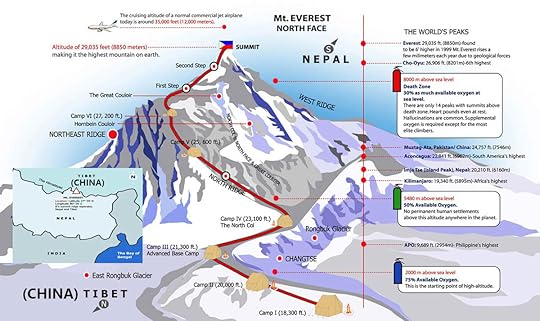
It is said that it is almost impossible to climb Everest if you are not an expert mountaineer familiar with the Himalayan mountains and their extreme weather conditions. Sherpas are accustomed to this weather and will help people climb Everest by acting as a guide and giving all the help while climbing Everest, no matter whether you are taking the South Col Route or the Northeast Ridge approach.
"Sherpas are the ethnic group in the Khumbu Valley and Everest area; they originally migrated from Tibet three to four hundred years ago. They are highly regarded expedition team members and elite mountaineers. We mikaroos (non-Sherpas) would have little chance for success on Everest without their expertise. Sherpas are virtually all devoutly Buddhist, and also believe in numerous gods and demons who reside in the mountains, caves, and forests."


My favourite three lines from this book
“Tibetan Sherpas call Everest “Chomolungma” and Nepalese Sherpas refer to her as “Sagarmatha”; both mean “Goddess Mother of the World.”


"We walk in our moccasins upon the earth and beneath the sky as we travel on life's path of beauty. We will live a good life and reach an old age.” —Navajo Blessing”


“SEVEN STEPS TO THE TOP OF YOUR WORLD

  Step One: "What's your Everest?"

  Step Two: "Love your work."

  Step Three: "Enjoy the ride, because life is the ride."

  Step Four: "Hope: a shred is all you need."

  Step Five: "Thank your way to the top."

  Step Six: "All that exists is this instant; be aware."

  Step Seven: “Find a new Everest.”


What could have been better?
The author is explicitly talking about the teahouses and their hygiene. There is indeed a lot of difference between food preparation in Western countries and Asian countries. The words used by the author will give a generalized impression that all the teahouses in Nepal are unhygienic. I can understand what the author was trying to tell, but he should have shown a little more maturity and used the words more carefully.

Rating
4/5 This is a must-read book if you are a mountaineer or if you are planning to climb Everest in the future.


—————————————————————————
You can also follow me on
Instagram ID - Dasfill | YouTube Channel ID - Dasfill | YouTube Health Channel ID - Dasfill - Health | YouTube Malayalam Channel ID - Dasfill - Malayalam | Threads ID - Dasfill | X ID - Dasfill1 | Snapchat ID - Dasfill | Facebook ID - Dasfill | TikTok ID - Dasfill1
Profile Image for Lisa.
536 reviews6 followers
December 8, 2015
Well, if I ever thought I would actually want to attempt an Everest climb, this book put that notion to bed. Between the fields of human feces, the numerous illnesses, the corpses on the way up and the vomit-fest, I think I'll continue to be an armchair Everest climber. I still am comtemplating Kili, but having read of people "gagging and puking" their way to the top of even that, I'm not sure. In the meantime, I'm content with having conquered Camelback this past weekend! :)
Profile Image for Patrick.
8 reviews1 follower
April 26, 2017
This is a quick easy read, except for the parts that are extraordinarily evocative of exactly how selfish and myopic a person needs to be to want to go spend time in the "Death Zone" in order to have the very short moment 'on top of the world'.
As spectacular as the descriptions of the view here, Warren's prose about his travails getting to the death zone are proper counterweight to those of his 'accomplishments'.
Warren is does a great job of exhibiting all the ways in which we pursue most of our goals without a larger recognition of the full costs to ourselves and others.
This book totally destroyed my respect for those who seek to scale mountains in this manner- especially Everest. It may not land that way with you.
I appreciate his having produced it.
Profile Image for Kim Possible.
50 reviews2 followers
November 8, 2015
I've been reading alot about Everest lately and this was the first book to tell of a successful climb. I really liked the details and hearing about what he saw and experienced along the way. It was good to hear the difference between the first and second attempt, what worked, how he overcame what he needed to to be successful. I wondered how they managed to go to the bathroom :). I listened to the audio and I liked hearing the story in his own words. There were several funny parts too. I highly recommend reading it!
Profile Image for Sean Kenna.
133 reviews5 followers
August 16, 2019
I greatly enjoyed this look at the challenges of struggling to climb Everest. I actually think that reading the epilogue first would give a good framework for the read and ultimately the lessons that are to be gleaned from the experience.
Profile Image for Jean Dupenloup.
475 reviews5 followers
May 13, 2020
A VERY forgettable book.

Naively optimistic, bloated with insupportable pandering, filled with trite clichés, and self-centered in the utmost.

This kind of feel-good jabbering is what’s wrong with mountaineering, mountain literature, and books in general.
Profile Image for Erica.
Author 2 books5 followers
February 13, 2021
Would’ve been a 4 with a little less grossness.
Displaying 1 - 8 of 8 reviews

Can't find what you're looking for?

Get help and learn more about the design.