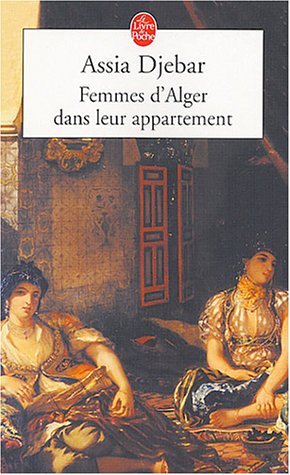
En 1832, dans Alger récemment conquise, Delacroix s'introduit quelques heures dans un harem. Il en rapporte un chef-d'œuvre, Femmes d'Alger dans leur appartement, qui demeure un " regard volé ". Un siècle et demi plus tard, vingt ans après la guerre d'indépendance dans laquelle les Algériennes jouèrent un rôle que nul ne peut leur contester, comment vivent-elles au quotidien, quelle marge de liberté ont-elles pu conquérir ? Dans ce recueil de nouvelles publié pour la première fois en 1980 et ici augmenté d'une longue nouvelle inédite, La Nuit du récit de Fatima, Assia Djebar raconte: le vécu, la difficulté d'être, la révolte et la soumission, la rigueur de la Loi qui survit à tous les bouleversements et l'éternelle condition des femmes. " Langage de l'ombre ", souvent prémonitoire en regard de l'histoire immédiate, Femmes d'Alger dans leur appartement est devenu un classique dans de nombreux pays où il a reçu un accueil exceptionnel.
Assia Djebar was born in Algeria to parents from the Berkani tribe of Dahra. She adopted the pen name Assia Djebar when her first novel, La Soif (Hunger) was published in 1957, in France where she was studying at the Sorbonne.
In 1958, she travelled to Tunis, where she worked as a reporter alongside Frantz Fanon, travelling to Algerian refugee camps on the Tunisian border with the Red Cross and Crescent. In 1962, she returned to Algeria to report on the first days of the country's independence.
She settled in Algeria in 1974, and began teaching at the University of Algiers. In 1978, she made a feature film with an Algerian TV company, The Nouba of the Women on Mont Chenoua, which won the critics' prize at Venice. Her second feature, La Zerda, won a prize at Berlin in 1983. In 1995, she took up an academic post at the University of Louisiana, Baton Rouge, and in 2002 was named a Silver Chair at New York University. She is a member of the Belgian Royal Academy and of the Academie Française.
She published her first four novels in France, between 1957 and 1967. These were followed by her Algerian quartet, of which three titles are complete to date, and by her three "novels of exile." Djebar has also published short stories, essay collections and two libretti. All of her writing is in French.
Well, this is a book that deals with so many issues – feminism, language, nationalism, colonialism, history and place, and how all of these are inter-related. Basically, too much for me to handle without writing some sort of thesis-length paper (and I am sure there are people who have written theses on this book), so I will apologise in advance if this review is partial (in the sense of not enough). Also, I feel like I need to apologise for attempting to write on this book without being familiar with any of Djebar’s other writings or her films. But this book is so, so good that I want to tell everyone how fantastic it is.
My review will be in two parts: Djebar’s story-telling/ the stories in this volume, and Djebar’s ideas. Mostly because I think her beautiful prose and storytelling would be lost in my attempt to sort out her complex interpretations of feminism, colonialism, and subjectivity. But, really, because of views on language, the two elements are importantly connected.
Djebar’s storytelling Djebar's stories in this volume bring us into the daily intimacies of a varied group of mostly women (there are a few male voices, but this is mostly a gyno-centric history of Algeria and its people), replete with all of their relationship-negotiating interactions (so many relationships!!! and so many small ways that we have to negotiate them!!!) and small and large decisions. These are stories of Algerian households and how they are made, remade and how they sometimes, fall apart in times of war and political tumult. Djebar’s time period ranges from pre-colonial, to colonial/ war, to post-colonial/ the aftermath of the war. And her women are just as varied – Educated, illiterate, high social position or abject social positioning, wives, widows, unmarried, mothers, child-less (and she emphasizes the ‘less’ part rather than the increasingly popular term of ‘child-free’ that I know some women today prefer, because this is how these women view themselves)… Their inner lives are vibrant, bursting, constantly pressing against the weight of social constraints. It works against that image of Delacroix’s ‘women of Algiers in their Apartment’ where his women gaze heavy-lidded, soft-bodied and utterly passive. Delacroix’s Algerian women are sultanas, Djebar’s are anything but.
Her story-telling approach consists of sketching out in the vaguest forms the backgrounds of the action we as reader are witness to. We slowly piece together where each character is coming from, what their concerns are, on what their suffering is based. And once the tableau is complete your appreciation of the lives of these characters is somehow enhanced by this slow, discrete and respectful revelatory process.... Yeah, it is hard to describe how deeply her writing affected my in terms of building a connection to the people who inhabit her stories.
Djebar's Ideas As for her perspectives on the social and political worlds and lives of women in Algeria she says this in her preface: "Don't claim to speak for, or worse, speak on, barely speaking next to, and if possible very close to: these are the first of the solidarities to be taken on by the few Arabic women who obtain or acquire freedom of movement, of body and of mind.” The book itself was intended to be read by Algerians, but was not well-received there. Like many of her contemporaries in the genre of contemporary Arab women’s literature, Djebar is faced with censorship and the increasingly potent influence of Islamist groups and authoritarian governments over the dissemination of contrary gender ideologies, especially those which are produced by women themselves. Djebar counter the patriarchal with a gynocentric approach to reconfiguring the socio-historical puzzle. I agree with her that the best way to counter this hegemonic ideology is with a multitude of voices. And yet with all that diversity she still manages to show how Women of Algiers in their Apartment refers to the compartmentalization of women and their neo-harems in a changing Algerian society.
In the interview section of the book Djebar discusses how language is fundamental to her probing of (or is it transgressing?) the patriarchal gender dynamic that she sees and has experienced. She wanted to utilize a colloquial Arabic that she connects to how some of her confined (and ostensibly uneducated?) women speak within their walls. As this is a work translated into English from the French, I am blind to these subtleties of language. She talks about language elsewhere in a way that makes me think I am confused about her position on language in this text.
I am pretty sure that the book is also in part an allegory for Algeria in its post-colonial era, though as usual for me, I only see this allegory in tiny little flashes and would probably need to read it several times (at least) to see it. I am also not very well-versed in Algerian history so...
Probably one of the best books I read this past year. The stories in this are wide ranging, but nearly all of them are concerned with the lives (inner and otherwise) of Algerian women throughout history (though most are rooted in the 20th century, both before and after the Algerian struggle for independence from French colonial rule). The title story was probably my favorite: it's a sprawling story that goes in and out of the consciousness and experiences of different women living in Algiers. There's a particularly poetic passage dedicated to the women who actively participated in the struggle for independence during the revolution, les porteuses de feu, that I really loved
There are books that, once read, prove themselves more yardstick than treasure map. All works are a measure of both, but whether it is due to the simple nature of this work in particular or my still uncomfortable state as an unemployed Bachelor's in English, I fell short of its mark and my goal. While I deeply appreciate the gloriously informative afterword, part review, part biography, part onlooker to a grand and singularly authorial quest, I would have to pretend to graciously accept its enthusiastic answers to the questions I was supposed to have but never managed to ask. Critical rejection of what one has to offer has its uses, especially it if is an understanding and honestly helpful sort, but there is always the matter of putting food on the table, and that as of now is hitting harder than usual.
I have no idea why I added this book. Usually I can parse a clue from a networked review or an entry on an esteemed list, but none of that readily reveals itself on this website's hyperlinks. I ask because, from what I've learned over the years of excavating my tastes, this is one of the worst ways to introduce me to a new author. Short stories are still not my favorite, and while someone like Flannery O'Connor can fly by me on them at first sight, I doubt that would have happened had she needed a translation from a country more foreign than the much northerly-maligned South. Thus, it would have been better for me to go the feminine bildungsroman route of Fantasia, which in addition to being more relatable (to an extent) also is more popular and more reviewed by my on hand associates, allowing for more gazes trained towards the subject than the number that spawned the image that graces both front cover and academic analysis. I've added it accordingly, and refuse to think of it in terms of "too little, too late". That's what rereading is for, even if it takes a succession of such.
While the book and I didn't ride off into the sunset as much as I would have hoped, I'm still disappointed that Djebar did not receive a Nobel Prize for Lit. Those in power could have afforded to understood her aspirations and her life's work far better than I could manage at the moment, and the fact that 78 years wasn't long enough for her to work her way past the mundanities of yet another man and/or white person is shame. Yes, yes, it's all an ivory tower onanism, but much as Christmas still has a special place in my cold and money grubbing heart, the beginning of October is what I will be cheering for after the Olympics and the football season and whatever else the usual folks are cheering about this time. In other words, don't let my hit and miss upset you. Those who aspire to the heights of experimental brutality are in for a treat.
For a long time now, the Western world has seen Arab countries as being this magical place of genies, women who are only there to be sexed, they have basically placed the many countries under their own, man made, veil. This allows for Western leaders to point to Arab countries and say, “Look there, we treat our women so much better.” Those folks point to the “other” to make themselves look better. Those who want to look deeper and think more globally, will turn to novels such as this to leaven truly historical ideas and replace the propaganda that is all too familiar with Arab culture.
Having never been from Algieria, but knowing that it is has been an embattled, and colonized area throughout history, I was cautiously optimistic about this text. This is indeed a fiction, however it is not mystified. Instead Assia Djebar takes the reader through a maze of areas otherwise misrepresented by the Western world. To clarify, this novel shares the same titled as a famous 1834 oil canvas painting titled “Women of Algiers in Their Apartment,” by Eugène Delacroix, who was only a visitor in a home for a brief amount of time. In a rare move, Djebar pushes against this snap shot painting and tells the public there is more than meets the eye.
If you have ever wanted to hear a true story, or a true rendering of facts, this novel is for you. Although Djebar writes about a time in the past, she does so having walked the same ground as her characters have. Knowing that history is too hard and frankly, too boring to consume at one time, she offers short stories that borderline as vignettes. This novel brings to light what has been put in the dark and fills your mind with the kinds of conversations that took place during those moments.
Looking at the cover of the novel alone, you might think that this book is about helpless women. However, this is not the case. This is a book the stretched my mind against my own nuances regarding Arab culture, both historically and presently. This was required reading for my English senior seminar, but this was not the kind of book that I simply rushed through. I took a ride with Djebar and wanted to see if her characters would lift the veil, if you will.
In this poetic rendering of words, Djebar may lose some readers. That is to say that her words seem to float on air. You have to come to this story with an open mind. Hell, bring your preconceived notions too.
I am being very broad, because I really enjoyed this written piece of art and think you too should join. I do not want to ruin the contents by spoiling anything. I cannot say anything more intelligent than is already in the pages of the book. I loved the book, specifically due to its power to transcend a clear language barrier, to speak in the colonizers voice (which causes us to think who her intended audience was/is) and tell a story that without having been in a class I might not have understood.
I would be remiss if I did not at least open up a bit more regarding the content of this fascinating, yet fragmented story. This book is also about love, learning and war in a place that is already very conflicted for women. It challenges the notion of patriarchy and begins to show how, when in a tough spot, women are as useful as men. The narrative shows how forgetful some are of the meaningful contributions of women, especially at war.
This is not intermediary reading. I would not recommend this for anyone who thinks, but does not know a thing about Arab culture. If you do not know words such as patriarchal thinking, colonizers, voice of the colonizers, then you might want to rethink making a purchase or devoting your time.
On the other hand, if you are looking to broaden your horizon and allow fictional narrative to enter your mind and challenge your notions, then this book is a great fit. Reading this story, knowing nothing about Arab lands, helped lift a veil that was in my own mind. It was covered in Western thinking and by the end of this novel, my mind was awakened with knowledge and understanding. Therefore, Djebar’s work, transcended its pages and transformed into useful knowledge. If you’re ready for that journey, then this is for you.
The title of this collection refers to a painting by Eugene Delacroix, which was allegedly inspired by a brief visit inside the harem of a home in Morocco. The painting and the stories in this collection depict the emotional and intellectual state of women hidden within walls and the veil. It is also a collection comprised of haunting, evocative prose which stirs the deepest aspect of the reader's self. The yearnings, fears, coping mechanisms, faith, belief, and suffering of the women in these stories will forever be imprinted in my heart. I have rarely read such a marvelous collection.
Meh. I thinkI needed to know more about the Algerian culture and its history to really appreciate this. It didn't help that I had the most monotone lecturer of my life for this text either. I enjoyed fragments but I felt confused way too much.
3.5 Une superbe plume avec un sujet qui m'intéresse beaucoup. J'ai adoré la première nouvelle mais j'ai trouvé certaines des autres un peu confuses par moment.
"Donne d'Algeri nei loro appartamenti" è una raccolta di sei racconti della scrittrice algerina, Assia Djebar, nei quali sono protagoniste assolute le donne di tutte le età. In essi l'autrice descrive la sua terra, ferita dalla guerra, dall'oppressione e dall'invasione europea, ma fa rivivere anche le tradizioni legate alla religione ed esalta i colori di questa parte di terra d'Africa. Tra tutti racconti, il mio preferito è quello dal titolo "I morti parlano", nel quale, partendo dalla morte di un'anziana donna, l'autrice racconta le consuetudini legate all'evento luttuoso, ma, attraverso il flashback, ripercorre la vita ricca e difficile di questa matriarca rispettata da tutti gli abitanti del villaggio algerino. Libro consigliato a chi ama i racconti e uno stile di scrittura complesso, ma raffinato.
I began this book because the group diversity in all its forms was reading it and I wanted to participate in the discussion about it. I generally love reading novels that are based in countries throughout the world so that I can learn about those cultures. Unfortunately, this collection of short stories was very inaccessible for me. I found that it jumped suddenly from one character to another without indicating that and it was hard for me to follow. It may have been an issue of the quality of the translation into English. Whatever the reason it was very difficult for me to get a grasp of this book.
I am a fan and a champion of francophone literature from Africa, particularly Magrebine stories by women in Algeria, Morocco, or Tunisia written either during or after the French colonial period. Assia Djebar is probably the best-known and respected francophone woman author of Algerian origin, although, fortunately, the list of wonderful Magrebine woman writers grows longer every year. (Some write in French and some in Arabic; Djebar's novels are all available in English translation as are more and more other francophone Magrebine novels). In this watershed work about the ongoing mistreatment and repression of Algerian women, Djebar takes her title from the mid-19th-century painting by Eugene Delacroix that depicts Algerian women in a harem scene. Her point is that even in the decades since Algeria's independence from France in 1962, indigenous women are still cultural prisoners, limited in movement and expression by fathers, brothers, husbands and Muslim laws. Much like in the novel Reading Lolita in Tehran, intellent and educated women find they must express themselves in private and very controlled conditions at the peril of punishment or even their lives. This is not really a novel, but a collection of six stories and an essay that describe various aspects of the contemporary Algerian woman's repression and plight. Djebar's prose is very stream-of-conscious, and even in English translation, she can be a little hard to follow and fathom. Still, this is a challenging, but worthwhile read, if you have the time to read carefully, take notes, and compare impressions with others about the work.
The book is composed by some short-medium lenght novels that focus on women in the times of Algerian independence. Yet, the characters are common women, having common lifes and common problems. Most is about their thoughts and sadness and the same feelings could be applied to many women worldwide. The result is a deeply realistic book, to whom people can relate and recognise the character feelings as human ones.
Euh....... Allez j'ai aimé la première nouvelle. Le reste vraiment j'ai pas du tout du tout aimé. Déjà la plume faisait très film d'auteur (ils parlent en mots clés j'ai rien compris), et puis même le message quoi. Le bouquin termine quand même en affirmant que les tableaux de PICASSO ouvrent une porte pour la libération des femmes. PICASSO???? Un féminisme sur fond d'oriantalisme yeepee 🎉
Potrebbe essere a causa della traduzione italiana, ma ho avuto difficoltà a seguire/apprezzare queste storie. L’intento lo capisco, così come mi è interessato fin da subito l’argomento. Eppure non ho percepito la forza di questi racconti.
E nulla, non mi sono per niente goduta questa lettura. Ho pensato che la ragione fosse la mia ignoranza sull'argomento, ma andando avanti con la lettura si percepisce come queste situazioni descritte mirino a descrivere una situazione universale come tipica delle donne algerine, prigioniere degli invasori del loro paese così come delle loro case. Il racconto più apprezzato è stato "Giorno di Ramadan", ma non sono riuscita a farmi piacere il libro.
Women of Algiers In Their Apartment by Assia Djebar is a complex book.
Because of this complexity readers who are not accustomed to reading serious, Nobel Prize worthy literature will undoubtedly find this a difficult read. And even those who are might find this book more challenging than most, especially if they are not familiar with Algerian history or culture. I am certainly not someone with a literary degree, though I do enjoy reading and analyzing literary fiction, and I readily admit that there are parts of Djebar’s writing that took me a bit to understand and, most likely, even more parts that have probably gone right over my head.
The result was that I found myself stopping my reading to do a quick internet search more than a few times and, ultimately, wishing that I had known the resulting information before I had begun reading. So if you, like me, picked up this book with little knowledge of Djebar’s work and biography or much information about Algeria at all I will mention some of the points I discovered that helped me to better understand my reading. If you do not fit this description, well, you will probably find this review too simplistic and boring to use up your time with.
What is now the country of Algeria has been influenced by many peoples and cultures throughout its history. The indigenous Berber people have inhabited the area for thousands of years and speak the Berber or Tamazight language. Djebar was of Berber descent and was raised with deep indigenous roots.
The area was once part of the Roman and then the Byzantine empires before falling to Arab conquest and then undergoing Ottoman rule. This ended when France invaded in 1830 and eventually incorporated the coastal areas resulting in the confiscation of the majority of land and the systematic suppression of the Algerian people. Djebar was born into this colonized landscape and her work often confronts the pain and devastation caused by colonization.
After World War II the National Liberation Front began the armed fight for freedom in 1954, one year before Djebar left the country to study in France. Many NLF activists, both men and women, were held and tortured at Barberousse Prison where 58 people were guillotined in the main courtyard.
Algeria was declared independent in 1962 and Algerian Arabic (or Darja) became the National language. Despite the revolution’s promise of freedom it did little to advance the rights of Algerian women who remained oppressed under the control of a highly patriarchal society. It is these women, and their suffering, that Djebar passionately gives voice to in her work.
Now having understood more of this history and Assia Djebar’s own personal connections to it I could really start to see how this dynamic of three different cultures - Berber, Arabic, and French - shaped the complexity of her writing.
This push and pull of cultures can be seen in her choice of language when writing Women of Algiers. Not being especially fluent in what she called “colloquial Arabic”, she wrote the majority of her work in French which she labeled as a “poisoned gift”. The language of her education and literary exploration, French was also the language of an invader who caused her country immense pain and her use of it to tell the stories of women that colonization explicitly repressed is, in itself, an act of decolonization.
This cultural conflict can also be seen in the way Djebar intentionally chooses to explore the art of European artists like Delacroix and Picasso. Unlike some marginalized artists and writers who choose to reject all European depictions of their culture in an insistence that only the marginalized themselves have the right to define their own experience, Djebar instead explores and interacts with the work of the colonizers, reappropriating and renaming the images they create. In the painting from which she took the name of her book, she looks past Delacroix’s colonial and male biases to find the Algerian women that she knows to exist.
It took me a while to understand that it was in fact this intentional reshaping of European ideals that caused some of my initial confusion. It is also evident in the way in which Djebar chose to lay out many of her stories. In the longer stories especially, she chose a fragmented and non linear style of narration which mirrored the disconnection felt by her female characters. It’s as if she was intentionally avoiding the narrative style of the colonizer and attempting to create a new, decolonized way of storytelling.
Once I was able to let go of my expectation of having all the pieces of the characters and plot upfront I realized that they were still eventually revealed by Djebar in time as the story went on. It almost felt like she was saying that this is how one would also get to know these women in life - through patience and through listening. By the very necessity of commitment and focus on the reader’s part she is saying that these women deserve this time and respect.
In these stories, the tension between cultures is mirrored by the tension between silence and the spoken word. The women here are silenced by the trauma of war as well as the suffocating law of patriarchy. Djebar captures this silence and societal imprisonment with symbolic imagery - veils and coverings, scarred bodies, and in the many enclosed spaces including the “apartment” mentioned in the book’s title.
Yet she suggests that there is strength in sound AND in silence. Silence can be an act of rebellion when it deprives the tormentor of knowledge or satisfaction. Or it can be a way to preserve a sense of self. Alternatively, she shows that the making of sound, even if that sound is wordless wailing, can be a powerful act. Sharing a story of the past can be an act of agency. This concept is reflected over and over by the gaps and spaces in the text, every once in a while giving way to heart wrenching descriptions of war or beautiful outpourings of poetic prose (the most beautiful of which, in my opinion, can be found towards the end of the titular story).
Another thing that really helped me to visualize the world Djebar describes was discovering her movie “La nouba des femmes du Mont Chenoua” (The Nubah of the Women of Mount Chenoua). (Available on YouTube with English subtitles.) She conceived and filmed this work only one year before Women of Algiers was published and it revolves around many of the same themes. It was shot in the same region of Algeria in which she was raised and includes women from the local community. Partly fictional and part documentary, it is based on Nubah or the “Lament”, a traditional music in Algeria which contains unique phrasing that she mimicked in the writing of her stories.
To summarize, Women of Algiers In Their Apartment is not an easy read, but for those who are willing to commit the time and focus, it will be a very rewarding one.
"I see no other way out for us except through an encounter like this: a woman speaking in front of another one who's watching; does the one who's speaking tell the story of the other one with the devouring eyes, with the black memories, or is she describing her own dark night with words like torches and with candles whose wax melts too fast?"
* Djebar gives a voice to the women and breaks down the barriers of silence. * Djebar shows an array of women to fight the notion that all women should be viewed the same. * Language matters. Using the language of colonizer (French) instead of Arabic to tell the story is reclaiming the language and teaching the colonizer.
Assia Djebar’s Femmes d’Alger dans leur appartement is a powerful and intimate exploration of women living at the intersection of history, patriarchy, and personal memory. Silence becomes both a prison and a strategy of survival throughout the collection. Many of the women in these stories have inherited silence from generations before them: silence imposed by colonial rule, religion, and cultural expectations. However, Djebar refuses to portray these women as passive or voiceless. Instead, she reveals the subtle ways they resist through memory, writing, storytelling, or private acts of defiance such as refusing to get married. Their silence is not emptiness as it carries layered emotion, trauma, and meaning. In exposing what has long been hidden, Djebar transforms silence into a site of tension, pain, and potential liberation. This book shows the humanity of the portrayed women. It gives voice to the traditionally voiceless.
Language plays a crucial role in this unfolding resistance. Djebar writes in French, a language tied to colonial domination. Like other post-colonial authors, she she reshapes it to express Algerian women’s intimate experiences, internal landscapes, and unspoken histories. This linguistic choice is both complicated and intentional: French becomes a tool for reclaiming space rather than submitting to it. Throughout the text, Djebar shows how language can be both a barrier and a bridge, dividing women from their past while simultaneously giving them the power to narrate it. The result is a deeply emotional literary project that amplifies voices previously muted by cultural, political, and patriarchal forces. In giving women the space to speak, Djebar reshapes not only narrative form, but also the legacy of Algerian womanhood.
Assia Djebar was a Muslim feminist writer who wrote about the lives of women in 20th-century Algeria. Her work is brilliant, deep with layers of meaning and thematic elements. They're the kind of stories that you could have long discussions about with a philosophical friend. All that's to say, they're not really plot-oriented or even always comprehensible and there's never a sense of closure. I like this kind of thing, but definitely not everyone's cup of tea. I struggled a bit with Women of Algiers, getting lost in the middle of the book. Fantasia: An Algerian Cavalcade is an easier read, in my opinion.
That said, there's still a lot that's compelling about this work. The stories all center around the theme of the human longing for freedom. Here, most women live the entirety of their lives in their apartments without freedom to leave, except for rare excursions to womens' only spaces. The first story follows a day in the life of modern, liberated women in 1970s Algiers who pursue their urban professional lives and longings while in the apartment complexes rising above them are thousands of women, silent and imprisoned. Sobering, and definitely a reminder of how much I take for granted. The final essay (and the title of the book) engages with Delacroix's famous painting of his glimpse of Algerian women enclosed in their home, invisible to the rest of the world, and the issues of exoticism, male gaze, and the sad reality for women invoked in that painting.
The title of this novel comes from Delacroix’s famous painting created from memory of his stay in Algeria during the early 1800’s. The painting features three Algerian women seated in front of a hookah with a black slave woman looking backwards towards them. The painting becomes a metaphor for Djebar’s six short stories of women’s lives during the time of the Algerian war for liberation from France (1950’s & 1960’s). During this bloody period an estimated one million Algerians were killed. It is out of this struggle that the women of Djebar’s stories speak out and tell their stories. They tell of participating in the fight for freedom, but without a voice. They faced a more deep-rooted oppression than French rule. In the first story, Sarah laments: “For Arabic women I see only one single way to unblock everything: talk, talk without stopping, about yesterday and today, talk among ourselves, in all the women’s quarters, the traditional ones as well as those in the housing projects.” In the Woman who Weeps, the character Leila laments “I was a voiceless prisoner. A little like certain women of Algiers today, you see them going around outside without the ancestral veil, and yet, out of fear of the new and unexpected situations, they become entangled in other veils, invisible but very noticeable ones…Me too: for years after Barberousse I was still carrying my own prison around inside me.”
The ambiguity of the Algerian culture was what made this book so interesting for me. We gain insight into a world we've only ever heard about. We see through the eyes of the oppressed, the silenced, the veiled. We see their triumphs, failures. Their suffering. Each short story was unique and provided a different viewpoint. I wouldn't say this book was fun to read, but it was educational and interesting. I found myself unable and unwilling to put it down. I felt compelled to keep reading until there was nothing left.
The short stories are written in an impressionistic style, at times seeming more like poems in the rhythm and mystery of the language. A very interesting voice of an Algerian woman living in France. The Algerian fight for independence is a backdrop for her stories. This collection also includes an essay about the Delacroix painting and an interview with the author by the editor.
"ليس الاستعمار وحده أصل مشاكلنا النفسية بل كذلك بطون نسائنا المحبطات" الانتقال من قصص نساء الجزائر الأمس الى اليوم و معاناتهم و أحاديثهم و اغانيهم على اختلافهم و تشابههم و ملامحهم التي نراها فينا اليوم كتاب ممتع حقا
This had the most terrible translation (or is it the dreamy stream of consciousness type of writing?) - which is why I only read the introduction, two stories, and the afterword. This anti-colonial book is important as it acts as the medium through which Assia Djebar tried to encourage women to voice and liberate themselves. While the liberation mentioned here operates on multiple levels and part of it is often criticized by Islam (rightly so), some insights are worth paying attention to. Djebar's ideas on language and the voicelessness of women reminded me of Gayatri Spivak's essay "Can the Subaltern Speak?" in which she questions the ability of the subaltern (the oppressed and marginalized groups) to actually voice themselves within the framework of Western (also imperial) discourse. Similarly, the question arises whether women can speak for themselves within the framework of patriarchy - that is, speaking beyond what "supposedly" patriarchal language can offer. But then, how valid is the idea of patriarchy itself, and what are the implicit implications (given its societal specificities) it holds for the Muslim woman? - Although the translation is horrible, the poetic and somehow confusing language of Djebar is apparent (is this the type of language she wants for women?
Large parts of the book - Due to its postcolonial dimension - touches the issue of European urge to unveil women, which is something that IDF soldiers has been seen doing repeatedly over the course of the genocide in Gaza. On one hand, you have numerous feminist thoughts on achieving agency against "the supposedly" male authority, and on the other hand, you have Islamic teachings. While culture - which I think Djebar's work attacks - can truly torture both women and men (but most efficiently women), Islam liberates them both. Despite the connotations of humiliation and disgrace that the word "slave" carries, the concept of servitude in Islam is a source of life for an individual. The servitude of a person to another person or to one's own desires results in degradation and submission, placing the person at the lowest rank and rendering their spirit of a debased essence. However, servitude to God is the ultimate manifestation of freedom; within it lies the potential for true happiness. It elevates a person above the level of disgrace, bestowing a radiance upon their being that astonishes both humans and jinn, and granting them a great triumph.
I am certainly not a woman, but I find the world of "the woman" fascinating not to unveil her but to understand truly her experience, and I'm always moved by the nuances provided by women themselves - specifically through writing. I'd like to add that Islam can never sit side by side with feminist views, and those who try to convince us otherwise have great imagination. Man is undoubtedly full of flaws, but Islam is perfect. Those who deny women their basic rights - but also wrong her in so many ways - have failed to account for Islam. Ali Alija said in a marvelous quote that "the Muslim woman must bear, nurture, and raise a new generation, instilling in them confidence in Islam and the future. She can fulfill this duty only if she is educated and possesses noble character." Where do good character and intelligence come from if she is denied what Allah has allowed her? The result is unfavorable and devastating to the agency of the woman and the moral prospect of society.
I disliked Djebar's use of an unauthentic hadith about the Prophet, peace be upon him, to impolitely assert one of her points, and that tells a lot.