

What do you think?
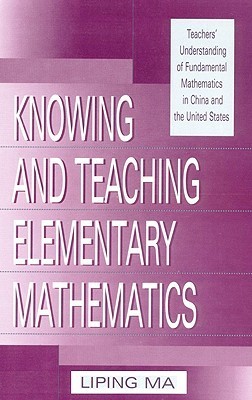
Knowing and Teaching Elementary Mathematics: Teachers' Understanding of Fundamental Mathematics in China and the United States
Chinese students typically outperform U.S. students on international comparisons of mathematics competency. Paradoxically, Chinese teachers receive far less education than U.S. teachers--11 to 12 years of schooling versus 16 to 18 years of schooling.
Studies of U.S. teacher knowledge often document insufficient subject matter knowledge in mathematics. But, they give few examples of the knowledge teachers need to support teaching, particularly the kind of teaching demanded by recent reforms in mathematics education.
This book describes the nature and development of the "profound understanding of fundamental mathematics" that elementary teachers need to become accomplished mathematics teachers, and suggests why such teaching knowledge is much more common in China than the United States, despite the fact that Chinese teachers have less formal education than their U.S. counterparts.
The studies described in this book suggest that Chinese teachers begin their teaching careers with a better understanding of elementary mathematics than that of most U.S. elementary teachers. Their understanding of the mathematics they teach and--equally important--of the ways that elementary mathematics can be presented to students, continues to grow throughout their professional lives.
Teaching conditions in the United States, unlike those in China, militate against the development of elementary teachers' mathematical knowledge and its organization for teaching. The concluding chapter of the book suggests changes in teacher preparation, teacher support, and mathematics education research that might allow teachers in the United States to attain profound understanding of fundamental mathematics.
Studies of U.S. teacher knowledge often document insufficient subject matter knowledge in mathematics. But, they give few examples of the knowledge teachers need to support teaching, particularly the kind of teaching demanded by recent reforms in mathematics education.
This book describes the nature and development of the "profound understanding of fundamental mathematics" that elementary teachers need to become accomplished mathematics teachers, and suggests why such teaching knowledge is much more common in China than the United States, despite the fact that Chinese teachers have less formal education than their U.S. counterparts.
The studies described in this book suggest that Chinese teachers begin their teaching careers with a better understanding of elementary mathematics than that of most U.S. elementary teachers. Their understanding of the mathematics they teach and--equally important--of the ways that elementary mathematics can be presented to students, continues to grow throughout their professional lives.
Teaching conditions in the United States, unlike those in China, militate against the development of elementary teachers' mathematical knowledge and its organization for teaching. The concluding chapter of the book suggests changes in teacher preparation, teacher support, and mathematics education research that might allow teachers in the United States to attain profound understanding of fundamental mathematics.
192 pages, Paperback
First published May 1, 1999
Ratings & Reviews
Friends & Following
Create a free account to discover what your friends think of this book!
Community Reviews
Displaying 1 - 30 of 48 reviews

May 24, 2011
This book is someone's dissertation, and although it's been "dressed up" it still reads like one. However, if you're able to read that kind of dryer content, and especially if you have young children, this book can be valuable on a couple of levels. First of all, it's a good argument for certain changes in our education system. Through interviews with American and Chinese math teachers on four specific math topics, the author demonstrates that a large reason for the disparity in student scores stems from the teachers in the US not having a good conceptual understanding of the material. Apparently, you can't teach something well if you don't understand it yourself! Who knew?
The author is clearly able to explain how the American teachers tend to focus their teaching efforts on the procedures and algorithms to perform mathematical computations, but these are rigid and prone to error because the teachers don't know why the procedures are necessary. The Chinese teachers, in contrast, demonstrate a deep conceptual understanding of the math behind the procedures, and tend to teach to that. This understanding appears to be developed during their teaching careers, as the Chinese teachers tend to behave more like mathematicians than teachers in terms of continuing to study math and work on math problems. They also interact with each other more to help each other learn the concepts and how to teach them, and they receive time to do these things during the work day.
The second way this book is helpful is that it explains the conceptual understanding of the four specific math topics: subtraction with borrowing, multidigit multiplication, division by fractions, and the relationship between the area and perimeter of a shape. Since I have young children that are learning these topics, I feel I can teach these four topics much better to my children now that I know what the important concepts behind them are. For me, the book was worth reading just for that.
This book didn't get five stars for two reasons: the dry writing (not a fault, just not a source of excellence for five stars either), and the author's push beyond a "conceptual understanding" to what she calls a "Profound Understanding of Fundamental Mathematics". The author tries to claim in her conclusion that this is a third level of understanding beyond procedural and conceptual, but I didn't see any solid evidence that her profound understanding was any different from a good conceptual understanding.
The author is clearly able to explain how the American teachers tend to focus their teaching efforts on the procedures and algorithms to perform mathematical computations, but these are rigid and prone to error because the teachers don't know why the procedures are necessary. The Chinese teachers, in contrast, demonstrate a deep conceptual understanding of the math behind the procedures, and tend to teach to that. This understanding appears to be developed during their teaching careers, as the Chinese teachers tend to behave more like mathematicians than teachers in terms of continuing to study math and work on math problems. They also interact with each other more to help each other learn the concepts and how to teach them, and they receive time to do these things during the work day.
The second way this book is helpful is that it explains the conceptual understanding of the four specific math topics: subtraction with borrowing, multidigit multiplication, division by fractions, and the relationship between the area and perimeter of a shape. Since I have young children that are learning these topics, I feel I can teach these four topics much better to my children now that I know what the important concepts behind them are. For me, the book was worth reading just for that.
This book didn't get five stars for two reasons: the dry writing (not a fault, just not a source of excellence for five stars either), and the author's push beyond a "conceptual understanding" to what she calls a "Profound Understanding of Fundamental Mathematics". The author tries to claim in her conclusion that this is a third level of understanding beyond procedural and conceptual, but I didn't see any solid evidence that her profound understanding was any different from a good conceptual understanding.

June 3, 2024
Would recommend if you are homeschooling your kids through at least elementary school. Very useful
March 16, 2011
I realized reading this book that my understanding of arithmetic is very incomplete. I was taught arithmetic in a very procedurally focused way, without a lot of insight into the "why" behind arithmetic operations. The descriptions of the depth of understanding of the Chinese teachers into various ways of presenting and teaching basic concepts of arithmetic was astounding to me. I was never taught this way and although I went on to get a bachelor's and master's degree in statistics, never realized how much I could learn about arithmetic. I am very glad to have read this book. It has opened my eyes to the level of preparation and understanding needed to effectively teach elementary mathematics. I wish our schools had elementary math specialists like the Chinese system has.

August 28, 2026
I think almost all of us, by the time we reach adulthood, completely forget how much complexity there is in we are used to thinking of as "elementary mathematics" (place value, subtraction, multiplication, working with fractions, etc.). Many are inclined to dismiss it as "shopkeeper's math," downplaying it as merely "what you need to know to balance a checkbook" and that sort of thing. This book -- a cross-cultural study of how elementary math is taught in China versus the U.S., packed with a wealth of absolutely fascinating detailed real-life examples drawn from a large number of extended interviews with teachers in both countries operating in diverse settings and with diverse levels of experience -- makes the argument that there is a real difference between knowing elementary mathematics on a tenuous, superficial, purely algorithmic level and knowing it on a deeper level that is always drawing connections between the algorithms and the core concepts, principles, and modes of thinking that undergird them. The book further argues that it makes a substantial difference to the quality of children's education if they learn elementary math from a teacher who knows it on a profound level rather than a superficial one. Mesmerizing and thought-provoking.
August 23, 2018
Or: "What you (I'm looking at you, college-educated American) think you know about elementary math but are really totally clueless about."
Ma demonstrates the difference in teachers' knowledge between China and the US in elementary mathematics. She explains the reasons behind differences in student comprehension and performance both on standardized tests and in life-long mathematical achievement. These reasons boil down to a primarily procedural understanding and explanation of elementary maths procedures, many of which are flawed in addition to their fundamental inadequacy. A deeper reason for the methods is the lack of knowledge inculcated in US teachers with regard to what Ma calls the "Profound Understanding of Fundamental Mathematics." In short, we simply do not give elementary math the credence it deserves. It is as essential as learning and understanding the alphabet and phonics.
I was sobered by my own lack of "PUFM." I was instructed in elementary math in the extremely shallow and sometimes flawed way Ma describes as typical of US classrooms. My own understanding being so limited, I hope to gain deeper knowledge as I seek it and as I strive to teach my own children deeply. I have been motivated to put into practice Chinese teaching techniques, such as class interaction/discovery/discussion, teaching the elemental aspect of a topic thoroughly and slowly the first time (and conceptually!), later to be reinforced as supportive topics are introduced and through the practice involved in perfecting the procedural aspect of the concept.
I also want to plan curriculum as suggested by Chinese instructors, including the incorporation of a standards-manual (I will use the California Math Standards) to guide my use of my chosen math curriculum. I will also seek to make more time to read, understand, and develop math lessons before teaching them.
Key to Chinese instructors is an understanding of the interconnectedness of math concepts as well as the calling-upon of mathematical laws even among the youngest students. Asian teachers also tend to describe their conclusions in "Mathematical language", that is to promote the use of "proofs" at a very young age by walking their students through how to explain their thoughts in the syntax of math.
Ma demonstrates the difference in teachers' knowledge between China and the US in elementary mathematics. She explains the reasons behind differences in student comprehension and performance both on standardized tests and in life-long mathematical achievement. These reasons boil down to a primarily procedural understanding and explanation of elementary maths procedures, many of which are flawed in addition to their fundamental inadequacy. A deeper reason for the methods is the lack of knowledge inculcated in US teachers with regard to what Ma calls the "Profound Understanding of Fundamental Mathematics." In short, we simply do not give elementary math the credence it deserves. It is as essential as learning and understanding the alphabet and phonics.
I was sobered by my own lack of "PUFM." I was instructed in elementary math in the extremely shallow and sometimes flawed way Ma describes as typical of US classrooms. My own understanding being so limited, I hope to gain deeper knowledge as I seek it and as I strive to teach my own children deeply. I have been motivated to put into practice Chinese teaching techniques, such as class interaction/discovery/discussion, teaching the elemental aspect of a topic thoroughly and slowly the first time (and conceptually!), later to be reinforced as supportive topics are introduced and through the practice involved in perfecting the procedural aspect of the concept.
I also want to plan curriculum as suggested by Chinese instructors, including the incorporation of a standards-manual (I will use the California Math Standards) to guide my use of my chosen math curriculum. I will also seek to make more time to read, understand, and develop math lessons before teaching them.
Key to Chinese instructors is an understanding of the interconnectedness of math concepts as well as the calling-upon of mathematical laws even among the youngest students. Asian teachers also tend to describe their conclusions in "Mathematical language", that is to promote the use of "proofs" at a very young age by walking their students through how to explain their thoughts in the syntax of math.

December 5, 2024
I read this because it was recommended in The Well-Trained Mind: A Guide to Classical Education at Home as a book that parents should read before teaching their child math because it will improve their number sense and help them understand why that's important. It certainly does that, but there was also a lot of information that was unnecessary for that purpose. So, if you're picking this book up because the Wises recommended it, just know that you might end up skimming some parts, but there are other parts that you'll want to read super closely because they're fascinating and really instructive.
More generally, this was a very depressing read because it was basically 150 pages of "American teachers can't do basic math, so their students can't either." As an example, Ma interviewed US elementary school teachers who had a reputation as being good math teachers. Two of the questions she asked were "What is 2 3/4 divided by 1/2?" and "If you had to come up with a word problem that would illustrate the meaning of that problem, what would the story be?". I can't remember the exact numbers, but something like 60% of the teachers could not complete the problem correctly, and only one of the teachers came up with a word problem that was actually an illustration of what "dividing by half" means. Of course, the interviews were conducted a few decades ago, and I think there have been big shifts in mathematics teacher preparation since that time, so I expect a few more teachers today would be able to explain the foundational concepts. But not all of them.
Which brings us back to my thoughts about the book in the context of reading it because the Wises said so: elementary math instruction is just one more reason I'm looking forward to homeschooling my children. There are some really good math teachers out there who would do a much better job than I can, but there are also a lot of clueless ones, and in most cases parents don't have any say in which teacher their child ends up with.
More generally, this was a very depressing read because it was basically 150 pages of "American teachers can't do basic math, so their students can't either." As an example, Ma interviewed US elementary school teachers who had a reputation as being good math teachers. Two of the questions she asked were "What is 2 3/4 divided by 1/2?" and "If you had to come up with a word problem that would illustrate the meaning of that problem, what would the story be?". I can't remember the exact numbers, but something like 60% of the teachers could not complete the problem correctly, and only one of the teachers came up with a word problem that was actually an illustration of what "dividing by half" means. Of course, the interviews were conducted a few decades ago, and I think there have been big shifts in mathematics teacher preparation since that time, so I expect a few more teachers today would be able to explain the foundational concepts. But not all of them.
Which brings us back to my thoughts about the book in the context of reading it because the Wises said so: elementary math instruction is just one more reason I'm looking forward to homeschooling my children. There are some really good math teachers out there who would do a much better job than I can, but there are also a lot of clueless ones, and in most cases parents don't have any say in which teacher their child ends up with.

August 23, 2026
A little bit dry and hard to get through sometimes but totally worth pushing through. I mean wow, what an eye opening book. Her thoughts/research on this have really made me glad I’ve chosen to homeschool and take my child’s education in my own hands. I’m thankful I read it prior to starting school, it really impressed upon me the importance of what, how and WHY in mathematics, and I feel more confident in how to go about teaching my girls.

Read
August 28, 2021Why are Chinese students more proficient at math than Americans? Americans spend more time (usually 16-18 years of schooling vs 11-12 in China) and money, with worse results. Ma proposes that it's a cycle: American teachers do not have an understanding of the fundamentals even of elementary math, therefore they do not pass that understanding to students, therefore new teachers do not have that understanding. The other major lack (and how she proposed breaking the cycle) is teacher preparation.
The book examines four elementary math problems: subtraction with regrouping, multi-digit number multiplication, division by fractions, and the relationship between perimeter and area. For her doctoral work, Ma asked questions about these topics to American and Chinese teachers. As a group, Chinese teachers demonstrated a deeper and unified understanding. The Americans understood the procedures, but not why they worked. When a student "doesn't get it", Chinese teachers can find alternate explanations. Part of math is exploration, but that doesn't happen if even the teacher can't leave the trail without getting lost.
For example: 21 - 9. Americans generally explain the solution as "borrowing": you can't subtract 1 - 9, so you borrow a 1 from the 2 and subtract 11 - 9. This algorithm works, but doesn't explain why you can borrow (and never give it back!).
Chinese teachers use the phrase, "decomposing a higher value unit" and explain that the decimal system is constructed on groups of 10. This explains why there are 10 ones in 10 and 10 tens in 100. They connect the idea in a structured web with other ideas such as "addition/subtraction within 10", "addition/subtraction within 20", "composing a higher value unit", "addition and subtraction as inverse operations", etc.
For this simple example, you could argue that these small semantic differences are not *that* important (especially if you, like me, were taught carrying and borrowing and did okay in math).
But math is an exacting discipline. Precision is vital. And perhaps more than any other subject, it is cumulative: a shaky foundation will provide no stability for advanced concepts. American teachers were outperformed by 9th grade Chinese students on the final question about perimeter and area, so even just within elementary mathematics, rigor is necessary.
How can we break the cycle and fix this? Ma suggests better teacher preparation. The Chinese teachers interviewed studied the curriculum intensely, as an actor would study their script. They learned why concepts were taught in certain ways and developed their own ideas. They met with other teachers to discuss math and teaching. They practiced math. They learned by teaching, and by teaching different grades. Even teachers that did not begin with a deep math understanding were able to get to that level from years of study and preparation.
For homeschoolers, parents who don't have that deep math foundation will need to get there by picking a good curriculum (we're using Math Mammoth), reading the textbooks and teacher's materials, and maybe learning ahead of the child. A big task! But one that's more achievable than ever with research like Ma's, a wealth of teaching and learning material, and help from offline and online communities.
The book examines four elementary math problems: subtraction with regrouping, multi-digit number multiplication, division by fractions, and the relationship between perimeter and area. For her doctoral work, Ma asked questions about these topics to American and Chinese teachers. As a group, Chinese teachers demonstrated a deeper and unified understanding. The Americans understood the procedures, but not why they worked. When a student "doesn't get it", Chinese teachers can find alternate explanations. Part of math is exploration, but that doesn't happen if even the teacher can't leave the trail without getting lost.
For example: 21 - 9. Americans generally explain the solution as "borrowing": you can't subtract 1 - 9, so you borrow a 1 from the 2 and subtract 11 - 9. This algorithm works, but doesn't explain why you can borrow (and never give it back!).
Chinese teachers use the phrase, "decomposing a higher value unit" and explain that the decimal system is constructed on groups of 10. This explains why there are 10 ones in 10 and 10 tens in 100. They connect the idea in a structured web with other ideas such as "addition/subtraction within 10", "addition/subtraction within 20", "composing a higher value unit", "addition and subtraction as inverse operations", etc.
For this simple example, you could argue that these small semantic differences are not *that* important (especially if you, like me, were taught carrying and borrowing and did okay in math).
But math is an exacting discipline. Precision is vital. And perhaps more than any other subject, it is cumulative: a shaky foundation will provide no stability for advanced concepts. American teachers were outperformed by 9th grade Chinese students on the final question about perimeter and area, so even just within elementary mathematics, rigor is necessary.
How can we break the cycle and fix this? Ma suggests better teacher preparation. The Chinese teachers interviewed studied the curriculum intensely, as an actor would study their script. They learned why concepts were taught in certain ways and developed their own ideas. They met with other teachers to discuss math and teaching. They practiced math. They learned by teaching, and by teaching different grades. Even teachers that did not begin with a deep math understanding were able to get to that level from years of study and preparation.
For homeschoolers, parents who don't have that deep math foundation will need to get there by picking a good curriculum (we're using Math Mammoth), reading the textbooks and teacher's materials, and maybe learning ahead of the child. A big task! But one that's more achievable than ever with research like Ma's, a wealth of teaching and learning material, and help from offline and online communities.

April 16, 2012
For anyone who doesn't understand why our children are learning "new math", this is a must-read. I spent a Saturday morning intently reading this dissertation on elementary mathematics education. I was interested in this book as a homeschool parent who uses Singapore Math curriculum for my first grader.
Liping Ma's research shows the difference in how we teach math for a conceptual verses a procedural understanding. I had several aha! moments where I realized that my memory of certain mathematical processes were based on knowing the procedure to follow rather than a genuine understanding of the mathematical concepts. I would highly recommend this book to any parent who wants to help their child develop a greater conceptual understanding of basic math.
Liping Ma's research shows the difference in how we teach math for a conceptual verses a procedural understanding. I had several aha! moments where I realized that my memory of certain mathematical processes were based on knowing the procedure to follow rather than a genuine understanding of the mathematical concepts. I would highly recommend this book to any parent who wants to help their child develop a greater conceptual understanding of basic math.

November 17, 2018
This book came out in the late '90s, when lots of energy in the United States was devoted to comparing our educational approach (especially in fields we now call STEM) to that of other nations. (Does this still go on? Part of me suspects I just don't bump into those circles any more; part of me suspects the competitive feelings underpinning that research still exists but is now increasingly focused on differentiating groups within the US.)
The majority of the book is devoted to comparing the pedagogical approach of American and Chinese teachers in four specific topics from grade school mathematics. Those topics are the traditional algorithm for subtracting multi-digit integers, the traditional algorithm for multiplying multi-digit integers, algorithms for and conceptual understanding of division by fractions, and an exploration of perimeter and area that was designed to be at the boundary of the teachers' technical expertise. Inherent in the discussion was some exploration of the topics themselves, but the main focus was on the comparing the approaches and abilities of the two groups. The book closes with a brief discussion of the conclusions Ma draws from her research, and it is worth holding out to (or skipping to) that chapter.
It is difficult not to be appalled at the state of some of the American teachers' mathematical knowledge. It is, paradoxically, also difficult not to get defensive about an "outsider" critiquing "our" system. (This latter point is almost certainly exacerbated by Ma's choice to transcribe every "uh" and "um" when she quotes Americans, while the translations of the Chinese teachers do not preserve such verbal quirks. This point is also exacerbated by my decision to read this in the late 2010s, as increasing media attention is devoted to rivalries between the two nations.)
It turns out Ma is more thoughtful on either point than I am. The final chapter's discussion of the consequences of her research is framed by a sober assessment of the demands on the American teachers' time, both during their training and once they are embedded at a school. She reiterates previously stated points about how the roots of the Chinese teachers' expertise (both mathematical and pedagogical) are laid during their own education, but they don't blossom until after the teachers have actually taught. This is in contrast to American educational culture, where it is assumed that a teacher's mathematical education must be complete at the end of their formal education, and there are no, or maybe even negative, incentives to deepen one's knowledge of an elementary discipline once one has entered the classroom.
One passage that I disagreed with was in the discussion of the fourth topic, in which the teachers are presented with a conjecture about the relation between perimeter and area that lies on the edge of mathematical content they are expected to know. The Chinese teachers were much more apt to approach this like a mathematician would, exploring and playing with examples and sketching out potential arguments generalizing their observations. A nontrivial subset of these came up with "proofs" justifying the false conjecture, and Ma saw this as superior to those Americans who felt themselves unqualified to attempt the problem. While her concern about an unwillingness to even try is warranted, it is problematic to endorse an approach that apes the culture of formal mathematics without understanding why it values rigor so much.
my favorite quote: "Circular foods are considered appropriate for representing fraction concepts."
The majority of the book is devoted to comparing the pedagogical approach of American and Chinese teachers in four specific topics from grade school mathematics. Those topics are the traditional algorithm for subtracting multi-digit integers, the traditional algorithm for multiplying multi-digit integers, algorithms for and conceptual understanding of division by fractions, and an exploration of perimeter and area that was designed to be at the boundary of the teachers' technical expertise. Inherent in the discussion was some exploration of the topics themselves, but the main focus was on the comparing the approaches and abilities of the two groups. The book closes with a brief discussion of the conclusions Ma draws from her research, and it is worth holding out to (or skipping to) that chapter.
It is difficult not to be appalled at the state of some of the American teachers' mathematical knowledge. It is, paradoxically, also difficult not to get defensive about an "outsider" critiquing "our" system. (This latter point is almost certainly exacerbated by Ma's choice to transcribe every "uh" and "um" when she quotes Americans, while the translations of the Chinese teachers do not preserve such verbal quirks. This point is also exacerbated by my decision to read this in the late 2010s, as increasing media attention is devoted to rivalries between the two nations.)
It turns out Ma is more thoughtful on either point than I am. The final chapter's discussion of the consequences of her research is framed by a sober assessment of the demands on the American teachers' time, both during their training and once they are embedded at a school. She reiterates previously stated points about how the roots of the Chinese teachers' expertise (both mathematical and pedagogical) are laid during their own education, but they don't blossom until after the teachers have actually taught. This is in contrast to American educational culture, where it is assumed that a teacher's mathematical education must be complete at the end of their formal education, and there are no, or maybe even negative, incentives to deepen one's knowledge of an elementary discipline once one has entered the classroom.
One passage that I disagreed with was in the discussion of the fourth topic, in which the teachers are presented with a conjecture about the relation between perimeter and area that lies on the edge of mathematical content they are expected to know. The Chinese teachers were much more apt to approach this like a mathematician would, exploring and playing with examples and sketching out potential arguments generalizing their observations. A nontrivial subset of these came up with "proofs" justifying the false conjecture, and Ma saw this as superior to those Americans who felt themselves unqualified to attempt the problem. While her concern about an unwillingness to even try is warranted, it is problematic to endorse an approach that apes the culture of formal mathematics without understanding why it values rigor so much.
my favorite quote: "Circular foods are considered appropriate for representing fraction concepts."
May 23, 2018
Not very helpful. I think people are scared to engage in conversation with children about math and relax, so they make up rules from observations to say one method of teaching subtraction, Multiplying and whatever else I missed in the book before I quit reading it to keep my sanity,is better than another way, leaving out the fact that teachers were put on the spot. I absolutely hate trying figure out why breaking up numbers into parts to make it easier is better than just adding or subtracting the original numbers. I'm glad I only borrowed it from the library.
Reminds me of common core nightmare stories!
Reminds me of common core nightmare stories!

March 30, 2025
I noticed when I was in college that most of my Chinese friends had a better understanding of math than my American friends including me.
This book looks at the mathematical preparation of Chinese elementary teachers as compared to American elementary teachers as a whole. From subtraction with regrouping to dividing by fractions and compares how both groups differ in teaching the same ideas.
It is a worthy read especially for teachers who teach math at the elementary levels and how important that knowledge is in developing the basis for mathematical ideas in young minds.
This book looks at the mathematical preparation of Chinese elementary teachers as compared to American elementary teachers as a whole. From subtraction with regrouping to dividing by fractions and compares how both groups differ in teaching the same ideas.
It is a worthy read especially for teachers who teach math at the elementary levels and how important that knowledge is in developing the basis for mathematical ideas in young minds.
March 31, 2021
This is a dry read, it's a dissertation about math, so that can be expected. I also question some of her research and sampling. But there are some interesting tid bits about the differences in how the Chinese and Americans teach elementary math. I definitely learned some things, like the idea of decomposing over borrowing, brilliant.

April 19, 2022
This is a dissertation on some differences between elementary math education in China and the US, and it reads exactly as you would expect a dissertation to read. Which is to say, it definitely won't be for everyone.
But it is a valuable and enlightening book for anyone who might be involved in teaching elementary math or who might otherwise find the study interesting.
But it is a valuable and enlightening book for anyone who might be involved in teaching elementary math or who might otherwise find the study interesting.
December 16, 2023
This book is excellent. It compares American math teachers with Chinese math teachers and explores why American math students lag behind when compared with other countries. The answer (in summary) is that American teachers were taught how to use formulas but not why they worked, and this is the way they continue to teach their own students. I recognized much of my own math education in this book, and it helped me to understand why I could make good grades in math while simultaneously feeling like I didn’t really understand the material. I highly recommend this book to teachers and parents who want to improve their understanding of math and their ability to teach it.

January 5, 2024
Incredibly helpful book when contemplating how best to approach teaching fundamental mathematics. It is a bit dry in terms of how some of the information is presented, but overall I felt it was a very beneficial read.

May 14, 2013
372.70973 MA(166p)
dividend ÷ divisor = quotient
Multiplier(factor, number of group ) * multiplicand(factor: number in a group) = Product,
google search : devlin on multiplication(Keith Devlin): multiplication is not repeated addition., no mention in this book.
Worth reading for parents try to help their children and teachers try to teach elementary arithmetic(addition, subtraction, multiplication, division). A great insight of elementary math teaching, procedural perspective teaching vs. Conceptual perspective teaching. Some arguments are very strong and persuasive, but I doubt the children can fully standard them.
My reading note:
1)Chapter1 subtraction with regrouping
A:decomposing a higher value unit p7
B:the rate of composing a higher value unit:10, which is 10 lower place value = 1 higher place value and the place value system addressing in chapter 2 are theories underneath addition, subtraction standard carrying or borrowing procedural algorithm, you always deal with number under 20. e.g 1536 - 722, after borrow one from 5, 5 become 4, 3 become 13, which actually 13 hundreds - 7 hundrends. see more on book p 42 - p43(multiplication), which make algorithm always work.
C.my thought of place value: the core of multiplication is another thinking place value idea.In multiplication decimal system unit value change from one unit, to tens unit, .... to justification move algorithm, you can also think as unit is multiplicand
D: Borrowing traditional term will illustrate standard subtraction procedure. lower place is "BORROW" from higher place.
I don't totally agree with author that decomposing should substitute borrowing term. Decomposing emphasis the "no value change" idea, borrowing illustrate subtraction procedure, they are 2 faces of the same thing.
2) Chapter 2: multidigit number multiplication.
p32-35 Ample evidence of teachers own incompetence regarding math subject knowledge. It remind me Finnish teachers high quality with master degree in subject discipline teaching. A huge concern
Observation:
Why my child start doing math from higher value place (left) instead of lower value place?
It puzzles me until I saw explanation on p20. We do it all the time even we are not fully aware of it. Example, how change I can get after paying $2 for something cost 1 dollars 63 cents. We first subtract 1 dollar, then rest 63 cents. That my daughter does whenever doing addition and subtraction, she has a strong concept with carrying and borrowing concept, keeping change value when she found carrying or borrowing happen, she figure out her idea's math operation rule when playing monopoly game. There is a great advantage doing this way, we can quick figure out how big the number is, get a rough idea. But doing in school standard way, when one column value is done it will fixed, it is logarithm, applied to any occasion, a great for computer: fixed prove procedure. but not always a best choice for some problem. That is why computers are best at boring unchanged satiation, such like calculating our bank balance, worse at artificial intelligence, such as pattern recognition, I like computer can be our friend help things our human not good at, instead of enemy.
Summary:
1. High concern about cramming arithmetic teaching (calculation teaching) in elementary school even it could be done correctly. Neuroscience study shows our brain (cortex) dealing with abstract number operations not fully mature until adolescence. Teachers have to use manipulative to address simple math operation, such as 12 - 3. What is so different from take 3 apples from 12 apples to 12 - 3?
Dealing with apples so easy for children instead of purely math? The great invention of mathematics is a huge achievement ever human being made. The map from real world problems to abstract math world is a great leap that distinguish us from other animals. These abstract thinking are last physically developed in our brain. Too early to teach such knowledge not fitted to children brain level can bring a huge damage: lack creativity, less confidence.
2. Stop teaching arithmetic instead of focus on math concept teaching, like ratio, percentage, geometry, graph, even chaos, fractal or basically math history are well within children brain level.
“If you can't explain it to a six year old, you don't understand it yourself.”
― Albert Einstein
Commutative law of addition: m + n = n + m
Commutative law of multiplication: m · n = n · m
Associative law of addition: ( m + n ) + k = m + ( n + k ) = m + n + k
Associative law of multiplication: ( m · n ) · k = m · ( n · k ) = m · n · k
Distributive law of multiplication over addition: ( m + n ) · k = m · k + n · k
Math teaching
1. Why Roman numerical system(I, II, IX,) inferior to Arabic numerical system (1,2 3,4): not straight, involving addition when figure number out, e.g. IX (4) = X(5) - I(1)
2. (a1/b1)/(a2/b2) = (a1/a2) /(b1/b2)
3. rate of higher place value of 10 underline carry, borrowing procedure
3. Chinese number system advantage, forty means five tens in chinese, 五十 五个十
dividend ÷ divisor = quotient
Multiplier(factor, number of group ) * multiplicand(factor: number in a group) = Product,
google search : devlin on multiplication(Keith Devlin): multiplication is not repeated addition., no mention in this book.
Worth reading for parents try to help their children and teachers try to teach elementary arithmetic(addition, subtraction, multiplication, division). A great insight of elementary math teaching, procedural perspective teaching vs. Conceptual perspective teaching. Some arguments are very strong and persuasive, but I doubt the children can fully standard them.
My reading note:
1)Chapter1 subtraction with regrouping
A:decomposing a higher value unit p7
B:the rate of composing a higher value unit:10, which is 10 lower place value = 1 higher place value and the place value system addressing in chapter 2 are theories underneath addition, subtraction standard carrying or borrowing procedural algorithm, you always deal with number under 20. e.g 1536 - 722, after borrow one from 5, 5 become 4, 3 become 13, which actually 13 hundreds - 7 hundrends. see more on book p 42 - p43(multiplication), which make algorithm always work.
C.my thought of place value: the core of multiplication is another thinking place value idea.In multiplication decimal system unit value change from one unit, to tens unit, .... to justification move algorithm, you can also think as unit is multiplicand
D: Borrowing traditional term will illustrate standard subtraction procedure. lower place is "BORROW" from higher place.
I don't totally agree with author that decomposing should substitute borrowing term. Decomposing emphasis the "no value change" idea, borrowing illustrate subtraction procedure, they are 2 faces of the same thing.
2) Chapter 2: multidigit number multiplication.
p32-35 Ample evidence of teachers own incompetence regarding math subject knowledge. It remind me Finnish teachers high quality with master degree in subject discipline teaching. A huge concern
Observation:
Why my child start doing math from higher value place (left) instead of lower value place?
It puzzles me until I saw explanation on p20. We do it all the time even we are not fully aware of it. Example, how change I can get after paying $2 for something cost 1 dollars 63 cents. We first subtract 1 dollar, then rest 63 cents. That my daughter does whenever doing addition and subtraction, she has a strong concept with carrying and borrowing concept, keeping change value when she found carrying or borrowing happen, she figure out her idea's math operation rule when playing monopoly game. There is a great advantage doing this way, we can quick figure out how big the number is, get a rough idea. But doing in school standard way, when one column value is done it will fixed, it is logarithm, applied to any occasion, a great for computer: fixed prove procedure. but not always a best choice for some problem. That is why computers are best at boring unchanged satiation, such like calculating our bank balance, worse at artificial intelligence, such as pattern recognition, I like computer can be our friend help things our human not good at, instead of enemy.
Summary:
1. High concern about cramming arithmetic teaching (calculation teaching) in elementary school even it could be done correctly. Neuroscience study shows our brain (cortex) dealing with abstract number operations not fully mature until adolescence. Teachers have to use manipulative to address simple math operation, such as 12 - 3. What is so different from take 3 apples from 12 apples to 12 - 3?
Dealing with apples so easy for children instead of purely math? The great invention of mathematics is a huge achievement ever human being made. The map from real world problems to abstract math world is a great leap that distinguish us from other animals. These abstract thinking are last physically developed in our brain. Too early to teach such knowledge not fitted to children brain level can bring a huge damage: lack creativity, less confidence.
2. Stop teaching arithmetic instead of focus on math concept teaching, like ratio, percentage, geometry, graph, even chaos, fractal or basically math history are well within children brain level.
“If you can't explain it to a six year old, you don't understand it yourself.”
― Albert Einstein
Commutative law of addition: m + n = n + m
Commutative law of multiplication: m · n = n · m
Associative law of addition: ( m + n ) + k = m + ( n + k ) = m + n + k
Associative law of multiplication: ( m · n ) · k = m · ( n · k ) = m · n · k
Distributive law of multiplication over addition: ( m + n ) · k = m · k + n · k
Math teaching
1. Why Roman numerical system(I, II, IX,) inferior to Arabic numerical system (1,2 3,4): not straight, involving addition when figure number out, e.g. IX (4) = X(5) - I(1)
2. (a1/b1)/(a2/b2) = (a1/a2) /(b1/b2)
3. rate of higher place value of 10 underline carry, borrowing procedure
3. Chinese number system advantage, forty means five tens in chinese, 五十 五个十
January 21, 2016
This book is a comparison of how teachers from the US and China understand various basic concepts in elementary mathematics. What is shocking is that the US teacher do not understand how to effectively teach these concepts, even though they have had more training than the average elementary school teacher in China. One reason for this discrepancy is the focus on the US on procedural knowledge. We want to rely so much on simple formulas and algorithms, handed to us to memorize and then "plug and chug," without really ever knowing what they are about. This doesn't help anyone learn math, it only helps us to memorize information that will be forgotten too soon down the road. What's worse is that as the math presented to the teachers in the book gets harder, the US teacher's procedural knowledge is also lacking. So not only are the US teachers unaware of how to effectively teach the concepts behind the formulas, but sometimes they don't even know how to teach the formulas themselves.
This book is a wonderful resource to use in order to learn about some more effective ways to teach math, conceptually, as well as a resource that points to many things that are not running as well as they should in math education in the US today.
This book is a wonderful resource to use in order to learn about some more effective ways to teach math, conceptually, as well as a resource that points to many things that are not running as well as they should in math education in the US today.

June 28, 2020
I feel like Liping Ma's big idea could be summarized as: "The real mathematical thinking going on in a classroom, in fact, depends heavily on the teacher's understanding of mathematics" (p. 153). Ma shows that the "basic" arithmetic taught in elementary schools is anything but basic by comparing interview responses from US elementary teachers with those of Chinese elementary teachers. The contrast is both illuminating and frightening, as the American teachers in the study demonstrate a woeful lack of understanding of mathematics. To be fair, I learned new ways to think about elementary mathematics from the Chinese teachers. I was assigned three chapters of this book for a course on Developing Professional Development for Math Educators, and I opted to finish the rest of the book this summer. The chapters following those first three were pretty dry and data-focused (lots of percentages etc.) BUT I would definitely recommend the first few chapters to anyone who dares to say elementary math is easy, and especially teachers!

June 23, 2007
This is a really interesting investigation into the differences between Chinese and American math teaching and teacher preparation. For me, this book opened up and excited me about the nuances of teaching arithmetic. There are a huge amount of analogies, comparisons, and various mental models in play when we teach even simple math, and they are strongly affected by language. The teacher's deep level of understanding of the math is critical to sorting through the possible misconceptions and guiding students to their own deep understanding. The translated discussions with the Chinese teachers are amazing in this area. So, the book is kinda dorky, but pretty interesting if you are into math, cultural differences, or thinking about the role of analogies in learning.

February 10, 2011
This book was fantastic. Every elementary math teacher should read it. In China, elementary math teachers only teach math. They have discussions and shared planning time. They actually spend a lot of time studying math. They don't assume they know it and are done. Because American elementary teachers teach all subjects, we don't have time to do what they do, which is a shame. We are so worried about math scores and international competition, but we don't make the changes that would truly make a difference. I have never talked to someone who understood math the way the Chinese teachers do. This book was inspiring because it shows how math can be taught. Unfortunately, we can't do all of what they do.

December 9, 2012
Well, this was excellent. My anger at Mathematics education in the states is melting into sadness and despair. When almost 20% of elementary school math teachers surveyed don't know the formulas for area and perimeter of a rectangle, we face a more deeply ingrained, entrenched, intractable problem than I ever could have imagined.
It also pained me to hear the Chinese teachers describe learning from their colleagues, solving problems together and spending time discussing pedagogy. If teachers here had that sort of free time and group dynamic, I wonder if they'd relish the opportunity to develop themselves, or instead, opt for an early homeward-bound journey.
Le sigh.
It also pained me to hear the Chinese teachers describe learning from their colleagues, solving problems together and spending time discussing pedagogy. If teachers here had that sort of free time and group dynamic, I wonder if they'd relish the opportunity to develop themselves, or instead, opt for an early homeward-bound journey.
Le sigh.

August 16, 2015
Deeply insightful. Helped me realize that although I have some strengths as a math teacher, I have so, so much to learn! So many of Ma's insights, or really, the insights of the teachers she interviewed, are directly applicable to my work with struggling mathematicians. Favorite quote - "The reason that one problem can be solved in multiple ways is that mathematics does not consist of isolated rules, but connected ideas. Being able to and tending to solve a problem in more than one way therefore reveals the ability and the predilection to make connections between and among mathematical areas and topics."

March 5, 2011
I know of many teachers who could have explained this math with more conceptual understanding than the teachers who were presented for the United States in this book. This book has made me look differently at my teacher's editions, and I have noticed how limited the instruction is and the strong focus on procedure. I am more aware of how I present math lessons now. I was especially interested in the end chapter comparing U.S. teachers prep time with that of their Chinese counterparts. I'm a little jealous.
February 24, 2012
Liping Ma's research (the book is based on her dissertation at Standford University), shows how math teachers in the US consistently demonstrate a fragmented, shallow understanding of math concepts in comparison to their Chinese counterparts. This knowledge gap is likely a significant contribution to the perpetual lag in US public school math performance. Very compelling and highly recommended for teachers, homeschoolers, teacher educators and parents fed up with public school mathematics education.

July 28, 2016
This reads very much like the dissertation it was originally, but that doesn't take away from it's great content. There is a clear distinction between the process based American math teacher perspective and the conceptual based Chinese math teacher perspective. The process dependent approach sadly leaves many students (and teachers) unable to explain, expand, understand the concepts behind the process. The conceptual based approach leads students and teachers to develop a wide variety of processes to exemplify and enliven the concepts. So much to consider here.

April 5, 2024
If I didn't have other reasons to homeschool, this book would have convinced me. I learned a lot about math itself from this book and how to teach it. I also saw a lot of failings in the U.S. university-level teacher education system and its impact on teaching math in elementary schools. Really interesting stuff. Repetitive in some places (it's a dissertation converted into a book, and the end-of-chapter summaries and the analysis in chapter 5 are redundant), but still worth the read for any teacher of math.
August 31, 2008
It was both enlightening and discouraging to read this book which compares the teaching of mathematics in the US and China. It was written almost 10 years ago and I'd like to think US teachers have improved their teaching of math in that time. Still, many of the quotes from teachers in the discussion groups sounded real and could have come from me. It was interesting to see the different ways of thinking about how teachers do what they do.

June 10, 2009
It is fascinating to see the degree of understanding of fundamental math processes and the differences between Chinese and US teachers. I think some of the curricula I have dealt with are trying to address this problem (Everyday Math, in particular), but too often the teachers teaching EM lack the understanding that the curriculum is attempting to impart, so they skip over or slight the fundamental understandings. It is hard to pull yourself up by your own bootstraps.
April 28, 2011
The author has done extensive interviews of American and Chinese math teachers concerning 4 or 5 fundamental topics in math. The chapter on subtraction with "borrowing" is really great--full of good ideas about teaching. She finds that many many (75%) of American teachers don't really understand why the subtraction algorithm works, in contrast to about 75% of Chinese teachers who do. She goes much beyond those statistics though, by providing the meat of the interview transcripts.
Displaying 1 - 30 of 48 reviews