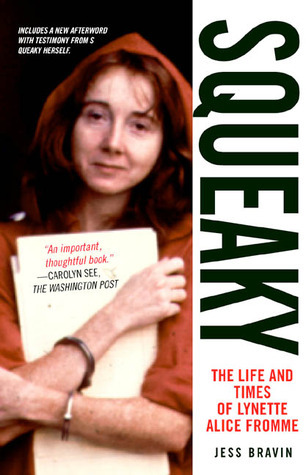
This is a chronicle of a wasted life. In her late teens, Lynette “Squeaky” Fromme was a high school dropout from a troubled family. When she met Charles Manson he treated her the way she wanted to be treated and told her everything she wanted to hear. He became a father figure just when she desperately needed one. In Squeaky: The Life and Times of Lynette Alice Fromme, Jess Bravin tells the story of her life from her promising childhood to time spent with the Manson Family, her attempt at shooting President Gerald Ford, and her strange court case. This is the portrait of a young woman in which the tracks of good and evil ran parallel to each other while it was certain that whatever train she was riding on those tracks would end in a wreck.
Bravin’s book opens with the morning when Fromme showed up in a crowd wishing to see Gerald Ford for one moment as he visited California’s state capitol, Sacramento. She aimed an antique pistol at the President before being tackled by the secret service and taken away to prison. Then we get the story of her life.
Lynette Fromme grew up in conservative California, having an unstable relationship with her family. The author claims she was abused by her father, although Ms. Fromme denied this allegation when asked to comment on this biography. In any case, she had a talent for the performing arts and when she got to high school, like so many other artistic type teenagers, she began writing poetry. She was smart and attractive but had trouble keeping up with her studies, eventually dropped out, and got involved with bikers, hippies, and the drug scene. Thirty years later, there would have been nothing unusual about this but back then she was a kind of pioneer in the art of being an adolescent screw-up with no direction in life.
But then she met a man who gave her direction in life. Unfortunately, that man was Charles Manson who appointed her to be the number two leader in his death cult, the Manson Family. Fortunately, for those of us who have been around long enough to have heard the story of the Family and the Tate-LaBianca murders, Bravin does not dwell too long on this chapter of Fromme’s life, and why would he? We’ve all heard the story a sufficient number of times. But with Fromme in the foreground of this telling, we do see another angle. She acted as the mother hen of the cult and helped to hold the whole thing together. Fromme was charming, waifish, and cute; her caring, loving, and nurturing attitude towards the other members provided a distinct contrast to the things that made the Manson Family notorious. With her articulate and imaginative mind, she probably also fed Manson a lot of ideas that became part of his philosophy, if you want to go as far as calling it that. She certainly doesn’t come across in these pages as a murderer, but then again she didn’t participate in the murders anyhow. Manson sent his more disposable followers to do those deeds.
Although Fromme didn’t kill anybody, she did continue to defend the Tate-LaBianca murders after the trial. From that point on, she was on a mission and her mission was to save the planet from ecological disaster and teach the world about how Charles Manson was the only messiah who could do so. Aside from the Manson crap and her association with a bunch of criminals, Bravin portrays her almost as a sympathetic character. She had good relations with everybody around her, committed herself to the cause of world peace, and educated herself extensively on environmental sciences. But then again, she also had a strange tendency to send death threats to the CEOs of corporations that were doing things to damage the Earth. She never acted on these threats, though, and in the end, they make her look like a scared and vulnerable person with a childish mind, Hiding her fear and insecurity behind a fierce mask of viciousness and violence...kind of like a lot of people on the internet.
Jess Bravin spends almost half the book describing the trial for attempted murder of the president. At a certain level, this seems excessive and unnecessary. But from Bravin’s point of view it makes some sense; the author is a journalist who covers court trials and Squeaky is his first published book. You can deduce that he was assigned to cover Fromme’s trial, found it interesting enough to write into a book, and then realized the trial coverage on its own was neither long enough or enteraining enough to fill out a whole book and therefore decided to make it into a complete biography instead.
Saying that the trial wasn’t interesting enough doesn’t mean the trial wasn’t interesting at all. In fact, it was a unique trial for a number of reasons. One is the relationship between the judge and Lynette Fromme. The judge was a principled man who was deeply committed to ensuring that she receive a fair trial. There were times when they related to each other like father and daughter. Another interesting aspect was Fromme’s behavior. First she wanted to fire her attorneys and represent herself in court, then she refused to be present during the trial. During the examination, it also came out that she hadn’t actually wanted to kill Gerald Ford. What she really wanted was to be taken to court so she could address the world via the media to explain the urgent need to save the planet and how Charles Manson was the only one who could do that. The judge refused to allow her to use the courtroom as a space for activism and so she refused to attend her own trial. Also of interest was the trouble the prosecution had in conducting their case against her.
Overall, this isn’t a biography of major interest. Lynette Fromme probably didn’t do enough of anything to be more than a footnote in the Manson Family chronicles and an oddity of a courtroom drama. Some details of the trial were trivial. Do we really need to know what TV shows the attorneys liked or what the jurors ate for breakfast? There were a lot of little details that added nothing to the story. The passage about how much fan mail Ford got after the assassination attempt was a torturous read. This is almost balanced by the fact that another woman and one man tried to assassinate Ford on later dates. If it wasn’t embarrassing enough that Ford is the only president who ever had an assassination attempt made against him by a woman, it is even worse that the attempt was made by two different women on two different occasions. And then he lost the election to Jimmy Carter. Gerald Ford gets my vote for the dopiest president ever. But if Bravin’s main preoccupation was with the trial, then he was wise to make this a full biography because getting to know about Fromme’s personality and earlier life does a lot in explaining her motivation for the assassination attempt and her behavior in court.
Lynette “Squeaky” Fromme, in the end, emerges as a complex character. She cared about people but believed in mass murder. She had intellectual strength and creativity but was emotionally stunted in early childhood. When she wasn’t being eccentric she could be surprisingly down to earth. One minute she was cute and charismatic, then the next she could be equally repulsive. It is hard to imagine what she would have become if she hadn’t gotten lost in the world at such a young age, but she certainly had the potential to be a lot more than what she became. For this reason, Jess Bravin’s Squeaky portrays her in a partially sympathetic light. Even if this isn’t a work of major importance, it still provides an interesting character study of a woman with a singular, and unusually complex personality.