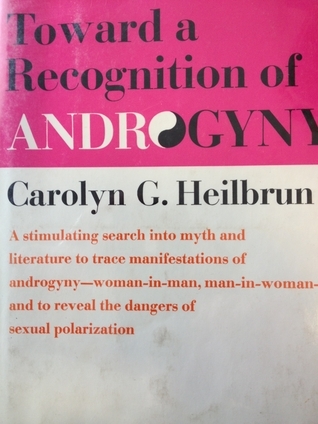
Toward a Recognition of Carolyn G. Toward a Recognition of Alfred A. FIRST First Edition, First Printing. Not price-clipped. Published by Alfred A. Knopf, 1973. Octavo. Hardcover. Red topstain. Book is very good with previous owner name on flyleaf and slight spine lean. Dust jacket is very good with shelf/edgewear and small nicks. 100% positive feedback. 30 day money back guarantee. NEXT DAY SHIPPING! Excellent customer service. Please email with any questions. All books packed carefully and ship with free delivery confirmation/tracking. All books come with free bookmarks. Ships from Sag Harbor, New York.Seller 322452 Philosophy & Psychology We Buy Books! Collections - Libraries - Estates - Individual Titles. Message us if you have books to sell!
Carolyn Gold Heilbrun (January 13, 1926 – October 9, 2003) was an American academic and prolific feminist author of both important academic studies and popular mystery novels under the pen name of Amanda Cross.
Heilbrun attended graduate school in English literature at Columbia University, receiving her M.A. in 1951 and Ph.D in 1959. Among her most important mentors were Columbia professors Jacques Barzun and Lionel Trilling, while Clifton Fadiman was an important inspiration: She wrote about these three in her final non-fiction work, When Men Were the Only Models We Had: My Teachers Barzun, Fadiman, Trilling (2002).
Heilbrun taught English at Columbia for more than three decades, from 1960 to 1992. She was the first woman to receive tenure in the English Department. Her academic specialty was British modern literature, with a particular interest in the Bloomsbury Group. Her academic books include the feminist study Writing a Woman's Life (1988). In 1983, she co-founded and became co-editor of the Columbia University Press's Gender and Culture Series with literary scholar Nancy K. Miller. From 1985 until her retirement in 1992, she was Avalon Foundation Professor in the Humanities at Columbia.
It has been on my wish list since my Uni-graduation days back in 1996 and I recently found a copy of it, second hand, online. I just couldn’t resist buying it!
Reading this in this day and age with the background that I have, so many years after its original publication, makes it quite a dated read; nothing new in the terms of literary criticism, gender study or even feminism is brought to my attention. I've moved beyond this already.
Still, I think that this book has some merit today, especially for younger students of literary criticism and gender. Though I have to say that when picking it up, in order to get the most out of it, you would need to be well versed in the writings of Jane Austen, Emily Brontë,Virginia Woolf, Peter Abelard, George Eliot, Henry James, E.M. Forster just to name a few.
weaves a beautiful argument for the necessity of androgyny/androgyny as a utopia where masculine and feminine energies harmonize.
i didn’t expect such heavy analysis of classic literature but it was a welcome surprise.
to the lighthouse is presented as an allegory for androgyny (the lighthouse as the goal and the goal as androgyny). mr and mrs ramsay representing the poles of masculinity and femininity and the lighthouse being both in its guiding light (feminine) and solid structure (masculine). it’s so funny because i just read that book for the first time very recently and had no idea this book would break it down. this perspective was enlightening and affirming for me. it spoke to something i hadn’t quite made sense of but had felt.
also funny that even before reading this i had decided to read wuthering heights as my next classic, which is mentioned here as another example of an androgynous novel. love that!
Heilbrun (who was mystery writer Amanda Cross) uses examples from literature to show patterns of androgyny. She also has a chapter on the Bloomsbury group, focusing primarily on Virgina Woolf. Austen, Bronte, Eliot, James, Hardy and many others are mentioned.
Androgyny: an ancient Greek word defining a condition under which the characteristics of the sexes, and the human impulses expressed by men and women, are not rigidly assigned. Androgyny seeks to liberate the individual from the confines of the appropriate.
I enjoyed this immensely...and will read the great classics through different eyes because of it. See also Yentl, My Brilliant Career and Tootsie.
I read this because Phyllis Webb mentioned reading it in Talking. In that book, Webb called it an “essay”, and that’s what it is, but it is also a 172-page book. When I think essay, I think a piece of writing I can get through before falling asleep at night. Androgyny was hard work, and I wasted my time. I say that because Heilbrun spends most of the text dissecting literature that is required reading, and I was unfamiliar with most of it.
Fortunately, I was able to get the gist of what she was saying: male novelists should seek inside themselves to temper their creative output with femininity, and female novelists the converse. I’m at a crossroads with my own work where I question the value of this, and of how far I should lean into my understanding of the feminine when writing. This is not something I’m conscious of in the first drafting stages: it comes out in editing. And I’m only conscious of it these days because it was so prevalent in the social media content I was poisoning my brain with for so many years.
I think, as a writer, that if one writes for men, one will get an audience made up of mostly men. If one writes for women, one will get an audience made up of mostly women. And if one tries to write right down the middle… what kind of audience will that produce? If I’m to write for myself, a man, then the choice for me is obvious. Anything else would require degrees of creative artifice that go beyond the basic energies expended in normal drafting, and it’s hard enough for me to muster even those precious sparks. Not only that, but such work would be inevitably disingenuous, to the point of pandering. I don’t think I’d like that one bit.
Perhaps it is enough simply to write, and let the cards fall where they may. If we, as a species, are destined to move towards a sexless, androgenous society that fully embraces the masculine and feminine to such a degree that the product becomes a perfectly balanced creature of aggression held in check by gentleness, then so be it. But that’s not the world we live in, not yet anyway.