

What do you think?

An American Dream
In this wild battering ram of a novel, which was originally published to vast controversy in 1965, Norman Mailer creates a character who might be a fictional precursor of the philosopher-killer he would later profile in The Executioner’s Song. As Stephen Rojack, a decorated war hero and former congressman who murders his wife in a fashionable New York City high-rise, runs amok through the city in which he was once a privileged citizen, Mailer peels away the layers of our social norms to reveal a world of pure appetite and relentless cruelty. One part Nietzsche, one part de Sade, and one part Charlie Parker, An American Dream grabs the reader by the throat and refuses to let go.
288 pages, Paperback
First published January 1, 1965
About the author
Norman Mailer
366 books1,484 followersNorman Kingsley Mailer was an American novelist, journalist, essayist, poet, playwright, screenwriter, and film director.
Along with Truman Capote, Joan Didion, and Tom Wolfe, Mailer is considered an innovator of creative nonfiction, a genre sometimes called New Journalism, but which covers the essay to the nonfiction novel. He was awarded the Pulitzer Prize twice and the National Book Award once. In 1955, Mailer, together with Ed Fancher and Dan Wolf, first published The Village Voice, which began as an arts- and politics-oriented weekly newspaper initially distributed in Greenwich Village. In 2005, he won the Medal for Distinguished Contribution to American Letters from The National Book Foundation.
Along with Truman Capote, Joan Didion, and Tom Wolfe, Mailer is considered an innovator of creative nonfiction, a genre sometimes called New Journalism, but which covers the essay to the nonfiction novel. He was awarded the Pulitzer Prize twice and the National Book Award once. In 1955, Mailer, together with Ed Fancher and Dan Wolf, first published The Village Voice, which began as an arts- and politics-oriented weekly newspaper initially distributed in Greenwich Village. In 2005, he won the Medal for Distinguished Contribution to American Letters from The National Book Foundation.
Ratings & Reviews
Friends & Following
Create a free account to discover what your friends think of this book!
Community Reviews
Displaying 1 - 30 of 370 reviews

April 14, 2013
“Twenty five whores in the room next door, twenty five floors and I need more…” Sisters of Mercy – Vision Thing.
If there are dreams then, according to the law of opposites, there should be counterdreams… Can reality be considered as a counterdream? Or is it paranoia?
Norman Mailer suggests a poisonous mixture of both.
Is it a dream or is it paranoia?
Is it reality or is it a dream?
Anyhow dreamers don’t like An American Dream. It is not for dreamers.
“We are few and far between, I was thinking about her skin… Love is many a splintered thing… Don’t be afraid now, just walk on in. Flowers on the razor wire… Walk on in…” Sisters of Mercy – Ribbons.
Some dreams we dream are called nightmares.
If there are dreams then, according to the law of opposites, there should be counterdreams… Can reality be considered as a counterdream? Or is it paranoia?
Norman Mailer suggests a poisonous mixture of both.
So I stood on the balcony by myself and stared at the moon which was full and very low. I had a moment then. For the moon spoke back to me. By which I do not mean that I heard voices, or Luna and I indulged in the whimsy of a dialogue, no, truly it was worse than that. Something in the deep of that full moon, some tender and not so innocent radiance traveled fast as the thought of lightning across our night sky, out from the depths of the dead in those caverns of the moon, out and a leap through space and into me. And suddenly I understood the moon.
Is it a dream or is it paranoia?
No, men were afraid of murder, but not from a terror of justice so much as the knowledge that a killer attracted the attention of the gods; then your mind was not your own, your anxiety ceased to be neurotic, your dread was real. Omens were as tangible as bread. There was an architecture to eternity which housed us as we dreamed, and when there was murder, a cry went through the market places of sleep. Eternity had been deprived of a room. Somewhere the divine rage met a fury.
Is it reality or is it a dream?
Anyhow dreamers don’t like An American Dream. It is not for dreamers.
“We are few and far between, I was thinking about her skin… Love is many a splintered thing… Don’t be afraid now, just walk on in. Flowers on the razor wire… Walk on in…” Sisters of Mercy – Ribbons.
Some dreams we dream are called nightmares.

January 25, 2020
2020 view: So reading this 15 years after reading it the first time, nothing changes from what I wrote below (in 2005) bar that I should mention he throws in a lot of 1960s New Age nonsense about moons, totems, dreams etc. oh, and that it is even more misogynistic than I remembered! It's because of stories like this, that I crave 'new stories', if you start your story with an empowered privileged male, you've already lost me, probably is that the people most likely to get a career and success in writing our White privileged males. who'll write what they know. One of the saddest things is not even about gender or race, we just don't get enough stories published from/by the working-class or less privileged men! Back to the book, I probably need to read another Mailer for context. 6 out of 12
Norman Mailer and Mohammed Ali
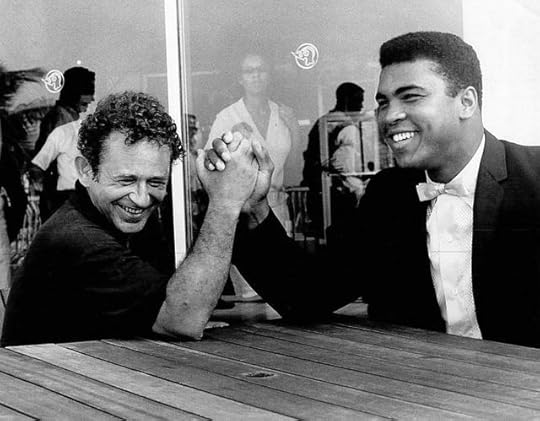
2005 view: Finally got round to reading Mailer's one-time highly controversial book ... white privilege male goes on the rampaged with hatred of the norms he has been forced to adhere to - you know like controlled drinking, not taking drugs, not killing people etc. Not sure what to make of it, or as Mailer as a great American writer. He surely puts across well just how destructive men can be ... and more essentially the huge hypocrisy at the heart of America?
2020 read; 2005 read
Norman Mailer and Mohammed Ali
2005 view: Finally got round to reading Mailer's one-time highly controversial book ... white privilege male goes on the rampaged with hatred of the norms he has been forced to adhere to - you know like controlled drinking, not taking drugs, not killing people etc. Not sure what to make of it, or as Mailer as a great American writer. He surely puts across well just how destructive men can be ... and more essentially the huge hypocrisy at the heart of America?
2020 read; 2005 read

October 8, 2014
A mind-numbingly idiotic book that totes its title without the slightest hint of irony, Norman Mailer's An American Dream asks the most pertinent question of our times (i.e. the United States circa the early 1960's): What, oh what, is the tough, masculine white man to do in a world full of bitches and black men who may be more virile than he is? Really groundbreaking work here, Norm. This novel follows the adventures of a renowned TV personality who, having had a little too much to drink at a party, receives instructions from the moon (in the voice of a woman) to kill himself. Naturally, we readers would hate for our white and wealthy male hero to kill himself, so we cheer the poor guy along as he seeks to reclaim his autonomy (his masculinity) by murdering the wife, sodomizing the family maid (she resists but then quickly relishes in the act), making the wife's murder look like a suicide, banging the maid again before the police arrive, tricking the cops, immediately falling in love with a sleazy nightclub singer, beating up her black boyfriend, and gifting her with her first real orgasm: all in under 24 hours. Just another day in the life for the Mailer male, I guess.
Not a lick of humor or satirical depth alleviates the obvious repulsiveness of this all (but our hero does respect black men as being men, and he wants to believe that a good woman surely exists in the world), but instead Mailer wastes page after page with pseudo-New Age nonsense about lunar energies, thought projectiles, personal demons, as well as the ability to impregnate a woman in just one try (the woman can tell she's pregnant immediately because the sex was just that fucking on point). Mailer tries to spruce this all up with a heightened prose style, which entails endless run-on sentences composed of throwaway imagery, pulpy narration, and vapid interior whining. The "pulpiness" is the only redeeming quality of this book, and if Mailer hadn't decided that his neurotically misogynistic bullshit was the stuff of high art, he may have been a pretty good crime writer; he certainly can write dialogue for tough-guy cops. As someone who loved the brisk, testosterone-driven prose of Hemingway as a reader aged-18, I wonder if this book or any of the other of Mailer's "Men with Dicks" lit would have struck a similar chord at the time? I pray to the murderous moon goddess in the night that this isn't the case.
Not a lick of humor or satirical depth alleviates the obvious repulsiveness of this all (but our hero does respect black men as being men, and he wants to believe that a good woman surely exists in the world), but instead Mailer wastes page after page with pseudo-New Age nonsense about lunar energies, thought projectiles, personal demons, as well as the ability to impregnate a woman in just one try (the woman can tell she's pregnant immediately because the sex was just that fucking on point). Mailer tries to spruce this all up with a heightened prose style, which entails endless run-on sentences composed of throwaway imagery, pulpy narration, and vapid interior whining. The "pulpiness" is the only redeeming quality of this book, and if Mailer hadn't decided that his neurotically misogynistic bullshit was the stuff of high art, he may have been a pretty good crime writer; he certainly can write dialogue for tough-guy cops. As someone who loved the brisk, testosterone-driven prose of Hemingway as a reader aged-18, I wonder if this book or any of the other of Mailer's "Men with Dicks" lit would have struck a similar chord at the time? I pray to the murderous moon goddess in the night that this isn't the case.

November 16, 2020
Ideally, I would have loved The Executioner's Song to be my first crack at Norman Mailer, but seeing as I'd just started a door stopper of a book I didn't really want two on the go, so opted for this novel instead. An American Dream covers thirty-two hours in New York, and to begin with at least, had a frantic pace about it that grabbed hold of me and jolted me about. The first 30 pages or so - which sees Stephen Rojack choking to death his bitchy heiress wife in a moment of enormous exhilaration during a violent tussle - was one of the most chilling opening moments in a novel I'd come across in ages. The thing I didn't expect to happen next though was for Rojack to gallop off to the maid’s room and get down and dirty with her. Ok, so he's having an affair with the maid, and couldn't resist that one final intimate moment before he even gave himself up or went on the run, I thought. But no, there was no affair. Simply put - killing got him sexually excited. So what's next? I bet he goes back to the scene of the crime and throws his dead wife out the tenth-floor window, claiming it was suicide and hoping for the best. And that's precisely what he did! The thing that was interesting in this novel from here on, is that along with the crime going unpunished, the actions of Rojack are without any form of consequence. The ex-Congressman and professor of existentialist psychology isn't portrayed as someone insane - just inspired by his act. The cops leading the case are damn well sure he did it, after examinations of his wife's body reveal some injuries that wouldn't have occurred from the fall, but after a call from Washington: we would also learn that his wife Deborah was involved in espionage, Rojack is released without charge. After his girlfriend Cherry is introduced, and Rojack engages in heavy drinking, brawling, and having sex with two different woman, the novel just petered out for me somewhat, after it's really engaging first half. Some of the lesser characters - including a hipster singer and his mysterious father-in-law - are more in tune with reality that the protagonist Rojack, who as a central character doesn't truly come to life. Overall, this doesn't read like a thriller at all, nor is it meant to be. Even though we learn of hidden espionage, Mailer only uses this as a contrived plot device to establish Rojack in his existentialist freedom whilst at the same time confirming his ecstasy for violence and sex. I would imagine this novel shocked quite a few people back in the mid 60s, and although it might feel less so now, it does still retain some of its power. Not a bad place to start, but I'm hoping some of his other novels are better.

February 23, 2011
Serial Reading and Writing
I re-read this novel straight after “The Deer Park”, so I could compare two successive Mailer novels, even though ten years separated them.
“An American Dream” is a much more tightly structured novel. It’s not as discursive as “The Deer Park”. Instead, it’s divided into eight set pieces, which reflect the fact that it was originally designed and published as eight monthly installments in “Esquire” magazine in January to August, 1964. It was Mailer’s attempt to replicate the works of writers like Dickens and Dostoyevsky (the latter of whose “The Brothers Karamazov” was published in serial installments).
Mailer reworked the novel before publication, but it retains the immediacy of his prose. The characters, descriptions and action are much more skillfully drawn. Stylistically, it’s not as self-consciously literary. Constructed around a crime of passion, it has more in common with the fiction of Raymond Chandler and James M. Cain.
To this extent, it remains a powerful and enjoyable read that has stood the test of time.
The Birth and Death of the Cool
The problem, however, as with “The Deer Park”, is the subject matter.
Yet again, it concerns sexuality and the relationship between the sexes. This time it’s located within a violent context. Mailer uses the crime and its aftermath to explore male sexuality and how women fit into it.
If it was simply a crime novel, we might be able to tolerate some of the attitudes that are conveyed in the novel. It might be arguable that they are simply those of the perpetrator of the crime and should be understood in that context.
However, it’s hard to avoid the conclusion that the first person narrator, Dr. Stephen Rojack, is a vehicle for Mailer to express his worldview.
Yet again, he seems to be striving for a definition of the Zeitgeist. He wants to embody everything that is hip. He sees himself as a contrarian, a maverick, a dreamer, a seer, a revolutionary, the essence of cool.
Even if he might have been persuasive or convincing at the time, now, with the benefit of hindsight, it’s pretty hard to prove your case. In the words of Elvis Costello, “Yesterday's news is tomorrow's fish and chip paper”.
Why'd Ya Do It ?
As you would expect, the first chapter contains the set up of the novel. Any one sentence summary of the novel will reveal this aspect of the plot, so if you don’t want to know anything about the novel, please stop reading now, or forget what you are about to read.
Mailer made the stylistic decision to tell a murder story from the point of view of the perpetrator. Rojack kills his wife, Deborah, by throwing her off the balcony of their apartment on page 35. Thus, almost from the beginning, we know what happened and whodunit. When the novel was in galleys, the novelist E.L. (Ed) Doctorow moved to Mailer’s publisher and became his editor. He felt that the knowledge of the murder should have been withheld until later in the novel, so that there would be greater tension. However, by then, it was too late. If Mailer had changed it, it would have been a different novel, perhaps a better novel, perhaps a greater novel. However, as it stands, the novel focuses attention on two issues: why did Rojack do it, and did he get away with it?
It’s this approach that, for better or worse, differentiates the novel from those of Chandler and Cain. It also, arguably, adopts a similar approach to Camus’ “The Stranger”.
Mailer takes himself far more seriously than Chandler or Cain. So why’d he do it?
There is Superstition
Rojack is no mere hoodlum. He is a 45 year old half-Jew, half-Gentile, a Professor of Existential Psychology (the author of “The Psychology of the Hangman” and proponent of the thesis that “magic, dread and the perception of death are the roots of motivation”), the host of a TV show, a former Member of Congress (a potential Presidential rival to JFK, “Prince Jack”, the first of three Princes – one Catholic Establishment, one Mafia and the other Black - he will encounter over the course of the novel) and a war hero who singlehandedly killed four German soldiers on a full moon-lit night in Italy.
Rojack is haunted by these murders, and continues to believe that the moon, in the guise of a female apparition, speaks to him at times of conflict or crisis. It represents his Id or Thanatos, a Death Instinct, which battles with his more rational Self, his Ego or his Life Instinct, Eros. Mailer uses rudiments of Freud as a coat hanger upon which to hang some pretty crazy threads. It’s never clear how much is inspired by psychoanalytical theory and how much by sheer superstition.
Deborah is an English heiress. Sex with her is “a carnal transaction with a caged animal”. She is a witch, she believes in demons, she hunts with spirits. She is controlled by an evil power. Even Rojack comes to believe in spirits and demons. Their marriage fails after eight years: “Living with her was murderous; attempting to separate, suicide came into me…Instinct was telling me to die.” He looks over balconies and feels “the itch to jump”.
Within minutes of killing Deborah, Rojack has sex with their German maid, Ruta (someone he thinks of as a Nazi), before he even has a chance to deal with the police. Within 24 hours, he falls in love with a 27 year old nightclub singer called Cherry and gifts to her her very first orgasm, as you do.
Still, he sees his love of Cherry as “deranged and doomed”. He craves the ability to “love her and be sensible as well”. But the moonlit voice in his head warns, “The sensible are never free.”
The Black Prince
Rojack soon learns that Cherry has just broken up a relationship with the famous black singer, Shago Martin, who discovers the new relationship and threatens Rojack with a knife.
Rojack has to fight Shago for Cherry’s love. Shago is the epitome of cool, “a prince in his territory”, “the Big Beat in Show Biz”. It isn’t said explicitly, but perhaps Shago represents Rojack’s Instinct or the Id, as well as his irrational fear of black men, the Other.
Rojack is wearing Shago’s robe during the fight, thus giving him the chance to win not only Cherry, but Shago’s mantle. If Rojack wins, he will defeat the feared Black Prince and effectively become the “White Negro” anticipated in Mailer’s essay of the same name published in “Advertisements for Myself”.
Although Shago is described as a singer, the details suit the trumpeter Miles Davis. As it turns out, Cherry is based on Mailer’s fourth wife, Beverly, who had actually had an affair with Davis before meeting Mailer.
A Dance Around the Parapet
At the end of the day, Rojack must confront Deborah’s father, Kelly (initially perhaps somewhat of a Super Ego, although later we perceive him as just another uncontrollable male Id), both in relation to whether he killed Deborah and whether he will attend her funeral.
Rojack learns much about the family history that created Deborah’s demons, but Kelly also challenges him to confront his own demons, by walking around the parapet of his apartment.
By the end of the novel, Rojack seems to have dealt with all of his internal conflicts, even the pull of the moon, and might even have embraced the relative rationality of his own Ego. He is ready to start again.
Are We Our Own Demons?
The main problem with the novel for me is just how seriously to take these demons. Are they Rojack’s or Mailer’s? Are they typical of the community? Are they ours? Does each of us have some version of these demons, these irrational fears?
At times (if not most or all of the time), the demons seem to be ridiculous and/or offensive. So many of them seem to be locked up with the private concerns and preoccupations of the Great Male Mailer Ego.
You have to question his attempt to make his own demons seem representative of society’s in some personalized version of Freud’s psychoanalysis.
I’ve never been a fan of the concept that we have demons anyway. It seems to elevate personal weakness to some supranatural force that we can’t grapple with, manage or control. It seems to suggest that our weakness is caused by something other than what is in us, and therefore to give us an excuse for the failure to confront it. Ultimately, it’s up to all of us to master ourselves and our weaknesses.
Only when we achieve this, when we love ourselves, can we love others.
Relatively early in the novel, Rojack/Mailer says:
“The only true journey of knowledge is from the depth of one being to the heart of another…”
Much occurs after this statement, but I cling to the hope that this might be his message, that when you crawl out of your own depths, what is waiting for you at the peak, is other people, love.
Only then can the sensible be truly free.
The Full Humanity of Women
Ultimately, “An American Dream” is a very male dream, a male nightmare even, whether or not Rojack/Mailer believes he might have woken up to a new sunrise. However, what of the role of women?
Mailer’s attitude to women in this novel forms the basis of Kate Millett’s attack on literary misogynism in “Sexual Politics”.
He attempted to respond in a later book, “The Prisoner of Sex” (which I haven’t read yet).
However, I find in Diana Trilling’s assessment of his response something that helps me to define my lingering ambivalence about the social ideas embodied in Mailer’s novel (even if I still rate it as exceptional writing):
"Biology is all very well, Norman. All these women have biology and they might be happy to celebrate it with you. But they have, as well, a repressive, life diminishing culture to contend with. Your book ‘The Prisoner of Sex’ has your always-beautiful intention of life enhancement and also, in its own particular way, a splendid imagination of women: I suppose we could describe it as the imagination of women in love. It nonetheless fails in its imagination of the full humanity of women, and this is a charge which no one would be impelled to level against your imagination of men."
SOUNDTRACK:
Marianne Faithfull – “Why D'ya Do It?”
https://www.youtube.com/watch?v=3mvAM...
Marianne Faithfull – “Why D'ya Do It?” [Live at ''Bitch! Dyke! Faghag! Whore!'' in 1993]
https://www.youtube.com/watch?v=cSCMS...
Stevie Wonder – “Superstition”
https://www.youtube.com/watch?v=wDZFf...
Stevie Wonder – “My Cherie Amour”
https://www.youtube.com/watch?v=b0Gu-...
”My cherie amour, distant as the Milky Way”
Miles Davis– “My Funny Valentine” [Live at Teatro dell'Arte, Milan, Italy on October 11, 1964]
https://www.youtube.com/watch?v=QKEfy...
I re-read this novel straight after “The Deer Park”, so I could compare two successive Mailer novels, even though ten years separated them.
“An American Dream” is a much more tightly structured novel. It’s not as discursive as “The Deer Park”. Instead, it’s divided into eight set pieces, which reflect the fact that it was originally designed and published as eight monthly installments in “Esquire” magazine in January to August, 1964. It was Mailer’s attempt to replicate the works of writers like Dickens and Dostoyevsky (the latter of whose “The Brothers Karamazov” was published in serial installments).
Mailer reworked the novel before publication, but it retains the immediacy of his prose. The characters, descriptions and action are much more skillfully drawn. Stylistically, it’s not as self-consciously literary. Constructed around a crime of passion, it has more in common with the fiction of Raymond Chandler and James M. Cain.
To this extent, it remains a powerful and enjoyable read that has stood the test of time.
The Birth and Death of the Cool
The problem, however, as with “The Deer Park”, is the subject matter.
Yet again, it concerns sexuality and the relationship between the sexes. This time it’s located within a violent context. Mailer uses the crime and its aftermath to explore male sexuality and how women fit into it.
If it was simply a crime novel, we might be able to tolerate some of the attitudes that are conveyed in the novel. It might be arguable that they are simply those of the perpetrator of the crime and should be understood in that context.
However, it’s hard to avoid the conclusion that the first person narrator, Dr. Stephen Rojack, is a vehicle for Mailer to express his worldview.
Yet again, he seems to be striving for a definition of the Zeitgeist. He wants to embody everything that is hip. He sees himself as a contrarian, a maverick, a dreamer, a seer, a revolutionary, the essence of cool.
Even if he might have been persuasive or convincing at the time, now, with the benefit of hindsight, it’s pretty hard to prove your case. In the words of Elvis Costello, “Yesterday's news is tomorrow's fish and chip paper”.
Why'd Ya Do It ?
As you would expect, the first chapter contains the set up of the novel. Any one sentence summary of the novel will reveal this aspect of the plot, so if you don’t want to know anything about the novel, please stop reading now, or forget what you are about to read.
Mailer made the stylistic decision to tell a murder story from the point of view of the perpetrator. Rojack kills his wife, Deborah, by throwing her off the balcony of their apartment on page 35. Thus, almost from the beginning, we know what happened and whodunit. When the novel was in galleys, the novelist E.L. (Ed) Doctorow moved to Mailer’s publisher and became his editor. He felt that the knowledge of the murder should have been withheld until later in the novel, so that there would be greater tension. However, by then, it was too late. If Mailer had changed it, it would have been a different novel, perhaps a better novel, perhaps a greater novel. However, as it stands, the novel focuses attention on two issues: why did Rojack do it, and did he get away with it?
It’s this approach that, for better or worse, differentiates the novel from those of Chandler and Cain. It also, arguably, adopts a similar approach to Camus’ “The Stranger”.
Mailer takes himself far more seriously than Chandler or Cain. So why’d he do it?
There is Superstition
Rojack is no mere hoodlum. He is a 45 year old half-Jew, half-Gentile, a Professor of Existential Psychology (the author of “The Psychology of the Hangman” and proponent of the thesis that “magic, dread and the perception of death are the roots of motivation”), the host of a TV show, a former Member of Congress (a potential Presidential rival to JFK, “Prince Jack”, the first of three Princes – one Catholic Establishment, one Mafia and the other Black - he will encounter over the course of the novel) and a war hero who singlehandedly killed four German soldiers on a full moon-lit night in Italy.
Rojack is haunted by these murders, and continues to believe that the moon, in the guise of a female apparition, speaks to him at times of conflict or crisis. It represents his Id or Thanatos, a Death Instinct, which battles with his more rational Self, his Ego or his Life Instinct, Eros. Mailer uses rudiments of Freud as a coat hanger upon which to hang some pretty crazy threads. It’s never clear how much is inspired by psychoanalytical theory and how much by sheer superstition.
Deborah is an English heiress. Sex with her is “a carnal transaction with a caged animal”. She is a witch, she believes in demons, she hunts with spirits. She is controlled by an evil power. Even Rojack comes to believe in spirits and demons. Their marriage fails after eight years: “Living with her was murderous; attempting to separate, suicide came into me…Instinct was telling me to die.” He looks over balconies and feels “the itch to jump”.
Within minutes of killing Deborah, Rojack has sex with their German maid, Ruta (someone he thinks of as a Nazi), before he even has a chance to deal with the police. Within 24 hours, he falls in love with a 27 year old nightclub singer called Cherry and gifts to her her very first orgasm, as you do.
Still, he sees his love of Cherry as “deranged and doomed”. He craves the ability to “love her and be sensible as well”. But the moonlit voice in his head warns, “The sensible are never free.”
The Black Prince
Rojack soon learns that Cherry has just broken up a relationship with the famous black singer, Shago Martin, who discovers the new relationship and threatens Rojack with a knife.
Rojack has to fight Shago for Cherry’s love. Shago is the epitome of cool, “a prince in his territory”, “the Big Beat in Show Biz”. It isn’t said explicitly, but perhaps Shago represents Rojack’s Instinct or the Id, as well as his irrational fear of black men, the Other.
Rojack is wearing Shago’s robe during the fight, thus giving him the chance to win not only Cherry, but Shago’s mantle. If Rojack wins, he will defeat the feared Black Prince and effectively become the “White Negro” anticipated in Mailer’s essay of the same name published in “Advertisements for Myself”.
Although Shago is described as a singer, the details suit the trumpeter Miles Davis. As it turns out, Cherry is based on Mailer’s fourth wife, Beverly, who had actually had an affair with Davis before meeting Mailer.
A Dance Around the Parapet
At the end of the day, Rojack must confront Deborah’s father, Kelly (initially perhaps somewhat of a Super Ego, although later we perceive him as just another uncontrollable male Id), both in relation to whether he killed Deborah and whether he will attend her funeral.
Rojack learns much about the family history that created Deborah’s demons, but Kelly also challenges him to confront his own demons, by walking around the parapet of his apartment.
By the end of the novel, Rojack seems to have dealt with all of his internal conflicts, even the pull of the moon, and might even have embraced the relative rationality of his own Ego. He is ready to start again.
Are We Our Own Demons?
The main problem with the novel for me is just how seriously to take these demons. Are they Rojack’s or Mailer’s? Are they typical of the community? Are they ours? Does each of us have some version of these demons, these irrational fears?
At times (if not most or all of the time), the demons seem to be ridiculous and/or offensive. So many of them seem to be locked up with the private concerns and preoccupations of the Great Male Mailer Ego.
You have to question his attempt to make his own demons seem representative of society’s in some personalized version of Freud’s psychoanalysis.
I’ve never been a fan of the concept that we have demons anyway. It seems to elevate personal weakness to some supranatural force that we can’t grapple with, manage or control. It seems to suggest that our weakness is caused by something other than what is in us, and therefore to give us an excuse for the failure to confront it. Ultimately, it’s up to all of us to master ourselves and our weaknesses.
Only when we achieve this, when we love ourselves, can we love others.
Relatively early in the novel, Rojack/Mailer says:
“The only true journey of knowledge is from the depth of one being to the heart of another…”
Much occurs after this statement, but I cling to the hope that this might be his message, that when you crawl out of your own depths, what is waiting for you at the peak, is other people, love.
Only then can the sensible be truly free.
The Full Humanity of Women
Ultimately, “An American Dream” is a very male dream, a male nightmare even, whether or not Rojack/Mailer believes he might have woken up to a new sunrise. However, what of the role of women?
Mailer’s attitude to women in this novel forms the basis of Kate Millett’s attack on literary misogynism in “Sexual Politics”.
He attempted to respond in a later book, “The Prisoner of Sex” (which I haven’t read yet).
However, I find in Diana Trilling’s assessment of his response something that helps me to define my lingering ambivalence about the social ideas embodied in Mailer’s novel (even if I still rate it as exceptional writing):
"Biology is all very well, Norman. All these women have biology and they might be happy to celebrate it with you. But they have, as well, a repressive, life diminishing culture to contend with. Your book ‘The Prisoner of Sex’ has your always-beautiful intention of life enhancement and also, in its own particular way, a splendid imagination of women: I suppose we could describe it as the imagination of women in love. It nonetheless fails in its imagination of the full humanity of women, and this is a charge which no one would be impelled to level against your imagination of men."
SOUNDTRACK:
Marianne Faithfull – “Why D'ya Do It?”
https://www.youtube.com/watch?v=3mvAM...
Marianne Faithfull – “Why D'ya Do It?” [Live at ''Bitch! Dyke! Faghag! Whore!'' in 1993]
https://www.youtube.com/watch?v=cSCMS...
Stevie Wonder – “Superstition”
https://www.youtube.com/watch?v=wDZFf...
Stevie Wonder – “My Cherie Amour”
https://www.youtube.com/watch?v=b0Gu-...
”My cherie amour, distant as the Milky Way”
Miles Davis– “My Funny Valentine” [Live at Teatro dell'Arte, Milan, Italy on October 11, 1964]
https://www.youtube.com/watch?v=QKEfy...

May 7, 2011
should be subtitled a book of smells. never read so many smells in my life. all of them bad. seriously, either mailer has the most sensitive nose on the planet, like a bloodhound-level smeller, or this is some really weird experimental thing where all the emotional interactions are couched in terms of theoretical odors given off by people on a second-to-second basis? does this exist? (i don't have much of a sense of smell, and after reading this, am very happy about it.)
anyway. yeah, so, this book: well, norman mailer's a genius. i've resisted it for a long time now but there's no denying it after this book. he reminds me a lot of james ellroy here; same kind of manic all-embracing love-and-hate driven will to macho power, only he's much much much much much smarter than ellroy (who's already pretty fuckin' smart), sees more clearly into human behavior and culture and every sentence is brilliantly cut (if often on the verge of incomprehensible). on the other hand, this book is laughably dated and, well, trash (even more trash than early ellroy), and after about the halfway point it just dissolves into a bunch of incredibly boring dialogues about god knows what, spades with shivs and mobster molls with hearts of gold and evil incest-driven millionaires out to rule the world yammering on and on and on and on... GET BACK TO THE MOON TELLING THE GUY TO DO THINGS my brain kept yelling but the book didn't listen... anyway, i don't know what the fuck was going on through most of it, but man was it electrifying! i mean when it wasn't dull as shit. american psycho thirty years earlier would be a pretty good description. only somehow this book is for real. this isn't a joke (though it's often ridiculous).
jesus christ, what a loon! i had no idea. must read more.
"Son of a bitch," I said, "so that's what it's all about."
anyway. yeah, so, this book: well, norman mailer's a genius. i've resisted it for a long time now but there's no denying it after this book. he reminds me a lot of james ellroy here; same kind of manic all-embracing love-and-hate driven will to macho power, only he's much much much much much smarter than ellroy (who's already pretty fuckin' smart), sees more clearly into human behavior and culture and every sentence is brilliantly cut (if often on the verge of incomprehensible). on the other hand, this book is laughably dated and, well, trash (even more trash than early ellroy), and after about the halfway point it just dissolves into a bunch of incredibly boring dialogues about god knows what, spades with shivs and mobster molls with hearts of gold and evil incest-driven millionaires out to rule the world yammering on and on and on and on... GET BACK TO THE MOON TELLING THE GUY TO DO THINGS my brain kept yelling but the book didn't listen... anyway, i don't know what the fuck was going on through most of it, but man was it electrifying! i mean when it wasn't dull as shit. american psycho thirty years earlier would be a pretty good description. only somehow this book is for real. this isn't a joke (though it's often ridiculous).
jesus christ, what a loon! i had no idea. must read more.
"Son of a bitch," I said, "so that's what it's all about."

January 12, 2012
A bizarre and riveting, albeit incomplete and even too short-sighted, micro-odyssey. First off let me say I have a soft spot/fondness/whatever you want to call it regarding Norman Mailer. He's by no means the greatest man of letters whoever put pen to paper, and his public persona was definitely anything but conducive to admiration (though really really fun to watch, check out his 'debate' with Gore Vidal on the Dick Cavett show). And I will admit that his brilliance as a writer doesn't match his arrogance or loud mouthed nature (whether or not this persona was the 'real' Mailer is up for debate and a question I can't even begin to answer). But the distance between his arrogance and literary skill is not so far as some or most might think.
Reading this book I picked up bits and pieces of Hemingway (the stoicism, the machismo, the male gaze) along with more than a few swathes of Faulkner (the ad infinitum descriptions of everything, from physical objects, to patterns of thoughts, to sensations and feelings, running the gamut from the naturalistic to the romantic and even up to the symbolic and surrealistic and and at some supreme moments the mythic, the superstitious and parable-like) Mailer bathes to the point of literary hedonism in so many different pools of thought that the result is at once a beautiful symphonic harmony and a mud slop puddle of what could have been achieved.
Therein lies the main weakness of the book, Mailer collapses under the weight of his own boldness and arrogance. His descriptions while powerful and telling, are near abject blocks of text that slow the rhythm of the story to the point of clogging its arteries and killing it. The feeling that Mailer is flexing his literary muscles, showing off his vast knowledge born from pages, is evident to the point of nausea in some stretches of the book. If the fat had been cut more like Hemingway, or more preferably had Mailer focused the weight of his ideas in a few well placed sections, more like Faulkner, the effect would have been augmented considerably.
But the positives of the book definitely outweigh the negatives. Reading this book I felt echoes of not only Shakespeare's Antony and Cleopatra, but of the fall of decadence, of a grand and grandly hollow empire (Rome came to my mind but I think any could suffice, including the upper echelons of the USA referred to by Mailer) on the verge of a cataclysm paradoxically never before seen but equally inevitable in the face of historical precedent and the weight of humankind and its sins, of decadence and otherwise.
Rojack, the protagonist (tough to call him hero or anti hero), is essentially a defrocked general of a once grand regime, and is hearing voices and seeing images. The easy reading would be is that he's losing his mind due to the nature of his success and ascension to said success and the book is a polemic against the excesses of America's ruling class. Too easy.
The book, to me, is actually a complex telling of intelligent and powerful people being confronted with the supernatural and the unknowable. Some are attempting to either cling to their power within that confrontation and even use that power to their betterment (almost always at the cost of others happiness or lives), and the others are trying to remain human within this, the superstitious, the tribal, the primal world wending its way through the halls of iniquity and power as it nears collapse. Rojack was once the former and is now the latter.
The pulses of sex and avarice pound through this book, constantly challenging our definitions of humanity and morality. Is the image of a 'good' and 'successful' person correct because this is the image put forth by those in charge, the ruling elite, the masters and singers of 'do as we say not as we do'? The book asks this and answers with a resounding no, but offers no consolation, which I think is the perfect and only intellectually truthful way to respond to the question.
I said before that the book was incomplete and shortsighted, and considering the density of the book's descriptions coupled with the relatively basic nature of the story, this makes it a long winded story that just sort of exhales slowly in conclusion, a deep breath with little follow through or resolution in the end, the latter is understandable and even inevitable, but the former is just poor writing.
So, overall, a difficult but more than worthwhile read. Bombastic and over the top like its author but evidencing all the power, the wit, and yes, the brilliance that made him infamous and, once again yes, one of the greater literary minds to have left a signpost for others to follow, ignore, revere or jeer at, questioning our knowledge and our haughtiness, mocking us our complacency and our readiness to assume.
Reading this book I picked up bits and pieces of Hemingway (the stoicism, the machismo, the male gaze) along with more than a few swathes of Faulkner (the ad infinitum descriptions of everything, from physical objects, to patterns of thoughts, to sensations and feelings, running the gamut from the naturalistic to the romantic and even up to the symbolic and surrealistic and and at some supreme moments the mythic, the superstitious and parable-like) Mailer bathes to the point of literary hedonism in so many different pools of thought that the result is at once a beautiful symphonic harmony and a mud slop puddle of what could have been achieved.
Therein lies the main weakness of the book, Mailer collapses under the weight of his own boldness and arrogance. His descriptions while powerful and telling, are near abject blocks of text that slow the rhythm of the story to the point of clogging its arteries and killing it. The feeling that Mailer is flexing his literary muscles, showing off his vast knowledge born from pages, is evident to the point of nausea in some stretches of the book. If the fat had been cut more like Hemingway, or more preferably had Mailer focused the weight of his ideas in a few well placed sections, more like Faulkner, the effect would have been augmented considerably.
But the positives of the book definitely outweigh the negatives. Reading this book I felt echoes of not only Shakespeare's Antony and Cleopatra, but of the fall of decadence, of a grand and grandly hollow empire (Rome came to my mind but I think any could suffice, including the upper echelons of the USA referred to by Mailer) on the verge of a cataclysm paradoxically never before seen but equally inevitable in the face of historical precedent and the weight of humankind and its sins, of decadence and otherwise.
Rojack, the protagonist (tough to call him hero or anti hero), is essentially a defrocked general of a once grand regime, and is hearing voices and seeing images. The easy reading would be is that he's losing his mind due to the nature of his success and ascension to said success and the book is a polemic against the excesses of America's ruling class. Too easy.
The book, to me, is actually a complex telling of intelligent and powerful people being confronted with the supernatural and the unknowable. Some are attempting to either cling to their power within that confrontation and even use that power to their betterment (almost always at the cost of others happiness or lives), and the others are trying to remain human within this, the superstitious, the tribal, the primal world wending its way through the halls of iniquity and power as it nears collapse. Rojack was once the former and is now the latter.
The pulses of sex and avarice pound through this book, constantly challenging our definitions of humanity and morality. Is the image of a 'good' and 'successful' person correct because this is the image put forth by those in charge, the ruling elite, the masters and singers of 'do as we say not as we do'? The book asks this and answers with a resounding no, but offers no consolation, which I think is the perfect and only intellectually truthful way to respond to the question.
I said before that the book was incomplete and shortsighted, and considering the density of the book's descriptions coupled with the relatively basic nature of the story, this makes it a long winded story that just sort of exhales slowly in conclusion, a deep breath with little follow through or resolution in the end, the latter is understandable and even inevitable, but the former is just poor writing.
So, overall, a difficult but more than worthwhile read. Bombastic and over the top like its author but evidencing all the power, the wit, and yes, the brilliance that made him infamous and, once again yes, one of the greater literary minds to have left a signpost for others to follow, ignore, revere or jeer at, questioning our knowledge and our haughtiness, mocking us our complacency and our readiness to assume.

September 9, 2007
ah... mailer at his worst. throwaway prose, boring characters, obvious plotting and tired themes (amongst mailer's 'important' themes is the whole american masculinity/infantliazation thing that hemingway did with considerably more force and thought a few decades earlier). at his best, mailer is a god. at worst - as is evident here - he's not fit to write a cheap pulp novel.

July 30, 2007
I'm not sure where to begin with this book. On the one hand, it's well written and rife with promiscuity, devious sex, murder and booze. All of which sort of kicks ass. On the other hand, Norman Mailer has succeeded in writing a story that actually made me wish there was LESS testosterone and more actual insight. (Yes I know that the beatniks didn't write to provide insight, they just wrote matter-of-fact-ly and made a mark by letting the readers find their own insight, but fuck that. The beatniks can suck it. Oh, and On The Road sucked.)
The main character is a German-stomping war hero, a former college football star, a former Senator, a TV talk show host, a close friend of JFK and an existential philosophy professor. You know, your typical Average Joe. But wait, it gets better. He murders his wife (who he says is sucking the life out of him but makes no noticeable effort to explain how), is called a sexual 'genius' after he has anal sex with the maid, sleeps with another woman and gives her her first orgasm, drinks like a fish, fights like a drunk and stares down police officers and professional boxers with naught but his toughness. His father in law thanks him for murdering his daughter, and then he beats his father in law in the head with an umbrella. In the end, he drives to Las Vegas, wins a shitload of money and flees to Mexico to evade the law.
This book could be seen as tongue in cheek, an ironic glimpse into a twisted 'American dream' of roided-up masculine fantasies, except for one major problem, MAILER STABBED HIS WIFE IN REAL LIFE. So the dude tries to kill his wife and then writes a book about getting away with murdering your wife. Right. Real tongue in cheek there Norman.
It's a masturbatory fantasy and nothing else. With every word that Mailer writes he is jerking himself closer and closer to climax until at the end of his fantasy all you can picture is a walking, talking, throbbing vein-bulging erection occupying the pages of the book.
Even given all of that, I'm still giving it 3 stars, because after anally violating his wife's maid, which she loves, he demands that she take a shower. He then sleeps with another woman without actually showering himself. In fact, he does not take a shower for the remainder of the book. Which is sort of gross and hilarious.
The main character is a German-stomping war hero, a former college football star, a former Senator, a TV talk show host, a close friend of JFK and an existential philosophy professor. You know, your typical Average Joe. But wait, it gets better. He murders his wife (who he says is sucking the life out of him but makes no noticeable effort to explain how), is called a sexual 'genius' after he has anal sex with the maid, sleeps with another woman and gives her her first orgasm, drinks like a fish, fights like a drunk and stares down police officers and professional boxers with naught but his toughness. His father in law thanks him for murdering his daughter, and then he beats his father in law in the head with an umbrella. In the end, he drives to Las Vegas, wins a shitload of money and flees to Mexico to evade the law.
This book could be seen as tongue in cheek, an ironic glimpse into a twisted 'American dream' of roided-up masculine fantasies, except for one major problem, MAILER STABBED HIS WIFE IN REAL LIFE. So the dude tries to kill his wife and then writes a book about getting away with murdering your wife. Right. Real tongue in cheek there Norman.
It's a masturbatory fantasy and nothing else. With every word that Mailer writes he is jerking himself closer and closer to climax until at the end of his fantasy all you can picture is a walking, talking, throbbing vein-bulging erection occupying the pages of the book.
Even given all of that, I'm still giving it 3 stars, because after anally violating his wife's maid, which she loves, he demands that she take a shower. He then sleeps with another woman without actually showering himself. In fact, he does not take a shower for the remainder of the book. Which is sort of gross and hilarious.

December 16, 2008
An utterly ridiculous, oftentimes despicable novel. Its greatest merit is that it is short. Offensive attitudes toward women (as is true of pretty much all of Mailer), toward the underclass, toward sex and violence, toward everything. Ugh. But compulsively readable. And, if its title is taken to mean anything, this violent, soft-porn soap opera of a novel is intended as a portrait of America's dream of itself in the mid-sixties, and its hero someone males of the time might secretly aspire to be. Though here, of course, Mailer takes every cliche of spy fiction, thrillers, soft-core whatever, and blows it out of proportion to make it all near pornographic. If this is the American dream, we're a pretty sick country.
That's the generous read of this. The less generous read is that Mailer's issues are the same as the novel, and that the title is a way to cloak those issues with a portentousness that will redeem the work. But whether or not Mailer is as guilty as the reader of the book, the title does call into question scores of assumptive behaviors from genre novels of the sixties, things people gobbled up without a thought.
So it's either brilliant or repulsive though likely, being Mailer, a perfect mix of both.
That's the generous read of this. The less generous read is that Mailer's issues are the same as the novel, and that the title is a way to cloak those issues with a portentousness that will redeem the work. But whether or not Mailer is as guilty as the reader of the book, the title does call into question scores of assumptive behaviors from genre novels of the sixties, things people gobbled up without a thought.
So it's either brilliant or repulsive though likely, being Mailer, a perfect mix of both.

January 31, 2014
If you can stomach the brutal violence and the hysterical anti-woman diatribes, Mailer actually makes some pretty good points about racial, sexual, and cultural hypocrisy in America. He knows how to write tough cops and the sordid underbelly of big city America. And he writes soaring prose, which represents an enormous effort of will.
Oh, and not that it makes the book any better, but if you're a fan of MAD MEN, it's easy to picture Jon Hamm as Rojack, January Jones as Deborah, and Christina Hendricks as Cherry.
Oh, and not that it makes the book any better, but if you're a fan of MAD MEN, it's easy to picture Jon Hamm as Rojack, January Jones as Deborah, and Christina Hendricks as Cherry.

December 9, 2020
Norman Mailer. Was he just a bad man, misogynist, and curmudgeon? Or was he a deep thinker, great writer and possible genius? I think probably both. He was full of himself as a younger man and he liked to antagonize anyone he could. He certainly had trouble with females. Do I read him because it is sensible to know the enemy? No, I think he was so perceptive concerning American society. I aways get insights from his books.
An American Dream was his fourth novel and came ten years after his third. It is a day in the life of Stephen Richards Rojack in which he murders his wife, makes it look like a suicide, faces the cops, starts an affair with another woman, confronts his enormously wealthy father-in-law, while staying drunk the whole time and facing all his demons.
The story is gritty, violent, sexy and psychological in the extreme. I don't particularly recommend it to anyone, but perhaps some men who read it will see themselves and some women will go, umhum, yes, that is what we are up against. In other words, read it at your own risk.
An American Dream was his fourth novel and came ten years after his third. It is a day in the life of Stephen Richards Rojack in which he murders his wife, makes it look like a suicide, faces the cops, starts an affair with another woman, confronts his enormously wealthy father-in-law, while staying drunk the whole time and facing all his demons.
The story is gritty, violent, sexy and psychological in the extreme. I don't particularly recommend it to anyone, but perhaps some men who read it will see themselves and some women will go, umhum, yes, that is what we are up against. In other words, read it at your own risk.

June 3, 2012
I'm really sorry to say that I did not like this book at all. I've had it on my shelf for four years, and I was really excited to finally read a full-length work by the late, great Norman Mailer.
To cushion the review I'm about to give, let's just put some things into perspective (facts I myself only looked up after reading the book and seriously disliking it): this particular novel, his fourth, was actually initiated as a series of installments in Esquire magazine. Now that I know this, I'm somewhat more forgiving about the profusion of misogynistic sex, heteropatriarchal myopia, and manipulative, promiscuous women who permeate the book. (But isn't that also a sad thing, to learn a book like this was published in Esquire in the 1960s, and then be able to say, "Oh, well, all that makes more sense then"?)
I also have a feeling that my reasons for disliking it might pertain almost solely to women and extremely sensitive/feminist men. So maybe don't bother reading this if you're a guy who plain likes graphic sex, violence, wealth, and intrigue; you might think this book is swell. And, let's keep in mind, I'm usually totally enthralled with sexual deviance and graphic sex as literary themes.
Now, on the one hand, I do understand that this book is intended to be satirical in the extreme, and so a lot of the really problematic portrayals of racialized and female characters should probably be read with a slant in mind. That said, intention only gets you so far.
In the most basic sense, I was so distracted with the egregious unlikability of absolutely every character in the book that I only pushed myself through to the end of it in the hopes that the conclusion would rectify pretty much everything. While I won't spoil what happens, I will say that it didn't change my opinion at all.
What we have here is a dystopic, rich New York City of the 1960s. Wealthy and quasi-famous professional kills supposedly crazy and pernicious wife, Deborah (although, since we only have her perspective from people who seem to hate or fear her, we don't really know very much about her). I think the first half, when Stephen, our narrator, is staring down the barrel of criminal arraignment, is more interesting; in those scenes, we see his utter vulnerability and his insanity.
It's not long after until he skirts the protocol of the entire criminal justice system, is free on the streets, and "falls in love" with a lounge singer who he met just moments after staging his wife's death. He becomes obsessed with Cherry, and Cherry, like Ruta, the maid who Stephen nails just after murdering his wife, and Deborah, has a long history of sleeping with dangerous men who think very little of her for the sake of social status.
There are various rendezvouses with Cherry's exes, cops, and Deborah's mourners, scuffles in bars, and generally a lot of drinking and lunatic streams-of-consciousness. The plot just becomes increasingly less believable, and the writing itself is sometimes beautifully imagistic, but sometimes dense and verbose. I finished this book and felt like it was little more than the pathetic ravings of a petty, weak, overprivileged white man.
To cushion the review I'm about to give, let's just put some things into perspective (facts I myself only looked up after reading the book and seriously disliking it): this particular novel, his fourth, was actually initiated as a series of installments in Esquire magazine. Now that I know this, I'm somewhat more forgiving about the profusion of misogynistic sex, heteropatriarchal myopia, and manipulative, promiscuous women who permeate the book. (But isn't that also a sad thing, to learn a book like this was published in Esquire in the 1960s, and then be able to say, "Oh, well, all that makes more sense then"?)
I also have a feeling that my reasons for disliking it might pertain almost solely to women and extremely sensitive/feminist men. So maybe don't bother reading this if you're a guy who plain likes graphic sex, violence, wealth, and intrigue; you might think this book is swell. And, let's keep in mind, I'm usually totally enthralled with sexual deviance and graphic sex as literary themes.
Now, on the one hand, I do understand that this book is intended to be satirical in the extreme, and so a lot of the really problematic portrayals of racialized and female characters should probably be read with a slant in mind. That said, intention only gets you so far.
In the most basic sense, I was so distracted with the egregious unlikability of absolutely every character in the book that I only pushed myself through to the end of it in the hopes that the conclusion would rectify pretty much everything. While I won't spoil what happens, I will say that it didn't change my opinion at all.
What we have here is a dystopic, rich New York City of the 1960s. Wealthy and quasi-famous professional kills supposedly crazy and pernicious wife, Deborah (although, since we only have her perspective from people who seem to hate or fear her, we don't really know very much about her). I think the first half, when Stephen, our narrator, is staring down the barrel of criminal arraignment, is more interesting; in those scenes, we see his utter vulnerability and his insanity.
It's not long after until he skirts the protocol of the entire criminal justice system, is free on the streets, and "falls in love" with a lounge singer who he met just moments after staging his wife's death. He becomes obsessed with Cherry, and Cherry, like Ruta, the maid who Stephen nails just after murdering his wife, and Deborah, has a long history of sleeping with dangerous men who think very little of her for the sake of social status.
There are various rendezvouses with Cherry's exes, cops, and Deborah's mourners, scuffles in bars, and generally a lot of drinking and lunatic streams-of-consciousness. The plot just becomes increasingly less believable, and the writing itself is sometimes beautifully imagistic, but sometimes dense and verbose. I finished this book and felt like it was little more than the pathetic ravings of a petty, weak, overprivileged white man.

February 14, 2016
I used to think Norman Mailer was a bit, um, overrated. This book is at times shocking and profane populated with characters that will make you squirm. But the writing, OMG, this is why they call it literary fiction.

July 14, 2019
Not sure how or what to review in this book. Except that the writing style just kept me going to the end.
The story is manic. The hero does everything in a span of 24 hours - kills his wife ( from who he is separated) makes out with his maid. Finds a girlfriend in a bar and makes out with her ( and also gives her a child ... not sure how one can know just after the event ). Tricks the police and gets away from suspicion of killing his wife. And so on. Not likely to be believable at all. But this did not sound like fantasy as well.
But the language was was everything about this book. Eloquent?!!! Very involving. His own voice telling him what to do... or not.... before he did it. And how. The sheer prose keeps you engaged. Agnostic of the completely irrelevant and chaotic storyline. I guess maybe this is what makes Norman Mailer a hit. Will find out by looking for more of his work. Not sure I recommend. But what a ride !!
The story is manic. The hero does everything in a span of 24 hours - kills his wife ( from who he is separated) makes out with his maid. Finds a girlfriend in a bar and makes out with her ( and also gives her a child ... not sure how one can know just after the event ). Tricks the police and gets away from suspicion of killing his wife. And so on. Not likely to be believable at all. But this did not sound like fantasy as well.
But the language was was everything about this book. Eloquent?!!! Very involving. His own voice telling him what to do... or not.... before he did it. And how. The sheer prose keeps you engaged. Agnostic of the completely irrelevant and chaotic storyline. I guess maybe this is what makes Norman Mailer a hit. Will find out by looking for more of his work. Not sure I recommend. But what a ride !!

August 24, 2017
Quase inteiramente escrito na primeira pessoa, em que o narrador é, também, o fulcro de todo o livro, este é mais um magnífico livro que pertence ao legado negro dos anos 60 do século passado,nos EUA.
A facilidade com que Mailer choca, provoca e nos agarra pelo pescoço - para não mais largar- tornam a negritude de todo o enredo tão hipnótica quanto inebriante.
O mobil é semelhante aos que fizeram de tom wolfe ou Sinclair Lewis referencias incontornáveis dos escribas americanos- a denúncia da ilusão frágil em que se erigiu a sociedade americana na golden era.
Mas Mailer é infinitamente mais contundente, agressivo e incisivo. Mas também mais íntimo, complexo e dubitativo.
A acção decorre em apenas 2 dias, mas o frenesim mental em que a personagem central entra no primeiro terço desdobra se, diluindo concepções de tempo e ritmo de forma inelutável.
O espaço, esse,não se dilui: nova Iorque, EUA, é um ataque cerrado ao capital, às relações de conveniência e á podridão em que se movem as classes altas da sociedade.
A facilidade com que Mailer choca, provoca e nos agarra pelo pescoço - para não mais largar- tornam a negritude de todo o enredo tão hipnótica quanto inebriante.
O mobil é semelhante aos que fizeram de tom wolfe ou Sinclair Lewis referencias incontornáveis dos escribas americanos- a denúncia da ilusão frágil em que se erigiu a sociedade americana na golden era.
Mas Mailer é infinitamente mais contundente, agressivo e incisivo. Mas também mais íntimo, complexo e dubitativo.
A acção decorre em apenas 2 dias, mas o frenesim mental em que a personagem central entra no primeiro terço desdobra se, diluindo concepções de tempo e ritmo de forma inelutável.
O espaço, esse,não se dilui: nova Iorque, EUA, é um ataque cerrado ao capital, às relações de conveniência e á podridão em que se movem as classes altas da sociedade.

January 3, 2016
Norman Mailer wrote a lot of bad books including this one in which he is at his self-centred and misogynist worst. The Naked and the Dead is a good enough book but there is little to be gained from going too far into the Mailer catalogue.

March 27, 2008
Mailer's meditation on violence and evil will not be everyone's idea of a good novel to read on the beach, but An American Dream is a fully realized male fantasy wherein one set-upon, White, alcoholic , protagonist berserks himself into sequential delirium fueled rages to rid himself of the crushing banality of the culture that he feels is killing him by the inch. To do this, he commits a series of violent and insane acts, in an alcoholic haze; challenges sent him by the moon (really) whose successful completion might give him a hint of the freedom he dreams is beyond the neon-lit tarp of the Manhattan skyline. This pilgrim's progress is nothing short of an obscene fantasy, wherein our hero, a decorated war hero, former congressman and talk show host, strangles his maddening estranged wife, buggers the German maid, steals a Mafia Don's girl friend, and proceeds, in 24 hours, to lie and deceive the New York City Police Department, the Mob, with intimations that the FBI and CIA are involved invisibly in the mess he created. The plot, of course, is lurid, absurd and the product of a particular time, but Mailer's novel comes at a time when the Hemingway cult of quiet, manly stoicism managed through a singular, privately held code of honor was exhausted of compelling narrative potential. Mailer’s idea was to see what would happen if the man who might have been the Hemingway hero, suffering his hurts in some poetic privacy, had instead a psychotic break.

December 15, 2025
First off, I'd like to point out I really found Mailer's writing style to be captivating, yet ever so slightly obnoxious. However, I kind of enjoyed how much it revels in its own glory, metaphors, and cleverness. The only issue I have here is the plot, some stuff just seemed really strange, the dialogue is flat sometimes and overall underwhelming. But I kept reading as I was so intrigued, but sadly the ending is anticlimactic. This felt very otherworldly, dreamlike and Incessantly 60s, I enjoyed myself but found myself alot wondering where an earth is this going... and sadly... it went nowhere. Yet I'm throughly glad I read it, I don't think I loved it, but I definitely did not hate it. There's one chapter in here which was amazing, and a few other pages which really jumped out at me. But all in all, a tiny bit underwhelming.
Mailer is very clearly saying something about the Middle-Class of white America, but alot of it is surrounded by crazy metaphors and the MOON. It's not as interesting as Easton-Ellis' critique but alas, it's pompous and full of itself on purpose
Mailer is very clearly saying something about the Middle-Class of white America, but alot of it is surrounded by crazy metaphors and the MOON. It's not as interesting as Easton-Ellis' critique but alas, it's pompous and full of itself on purpose

July 27, 2014
"Знаете ли вы, что такое психоз?"
Лучше бы не знали.
Иногда кажется, что мужчинам все позволено. Их вариант "дамского" романа: секс, убийство, политика, снова секс, опять убийство, ЕЕ ДУША ПОХОЖА НА КОМОК ЧЕРВЕЙ!, политика, немного инцеста, я прозрел и познал любовь, она умерла, я уехал в степь.
Чуваки, это стыдно.
Нельзя, забыв о персонажах, сюжете и композиции, замешать в одну кучу войну, конгресс, JFK, пьянство, анальный секс, чувство вины и чернокожего джазмена, снабдить все метафорами жизни, смерти и кары небесной и считать, что ты написал заебись мощный роман-откровение.
Читать его с пиететом тоже нежелательно.
Лучше бы не знали.
Иногда кажется, что мужчинам все позволено. Их вариант "дамского" романа: секс, убийство, политика, снова секс, опять убийство, ЕЕ ДУША ПОХОЖА НА КОМОК ЧЕРВЕЙ!, политика, немного инцеста, я прозрел и познал любовь, она умерла, я уехал в степь.
Чуваки, это стыдно.
Нельзя, забыв о персонажах, сюжете и композиции, замешать в одну кучу войну, конгресс, JFK, пьянство, анальный секс, чувство вины и чернокожего джазмена, снабдить все метафорами жизни, смерти и кары небесной и считать, что ты написал заебись мощный роман-откровение.
Читать его с пиететом тоже нежелательно.

January 7, 2013
A writing style that at first seems like a good easy read, but upon closer study, shows a unique voice in its rhythm and imagery. The story was simplistic, but at times quite engaging.

May 30, 2025
Every time I pick up a Norman Mailer book, I'm shocked anew at his audacity (the staid writing of contemporary fiction surely enhances the effect). Mailer is nothing if not unapologetically brave. Should a person say the things that Mailer says in his books? Definitely not. But should a person write these same things? Definitely yes. I would put a cigarette butt out on my tongue before I'd say the "n" word in any other way than academically. I would jump off of a 3rd story balcony before I'd slap a woman; however, an author's responsible use of same is necessary for her art to have social impact and credibility. Norman Mailer writes as if every sentence has importance. Some call that hubris or an overinflated ego but I call it artistic. Create as if you are a god and let each consumer decide where to place you on their "full-of-shit" scale. Mailer is often full of shit and incontrovertibly full of himself but he is also empty of fear and I am thankful for his observations
An American Dream is not his best, nor even among them but it is important and worthy of being read
An American Dream is not his best, nor even among them but it is important and worthy of being read

September 30, 2024
Where Brodkey’s Wiley thought he was a genius because everyone around him convinced him that he was, Mailer’s Rojack looks in the mirror and just thinks he’s “him”.
Where men write beautiful prose when women are involved, Mailer likes to write about what he finds attractive and if they have ugly feet, he can look past that. However, it is clear Rojack would have slept with his step daughter if she had the qualities he enjoyed.
Mailer is an author who uses full authority to be a murderer, misogynist, and the main character. Everyone was okay with him stabbing one of his wives and everyone was okay with publishing this book.
Fights a man of color and pushes him down the stairs.
The mind of a man with nothing to say will find something to say and come off not convincing.
At least Brodkey could write about nothing and make it feel like every word mattered.
Where men write beautiful prose when women are involved, Mailer likes to write about what he finds attractive and if they have ugly feet, he can look past that. However, it is clear Rojack would have slept with his step daughter if she had the qualities he enjoyed.
Mailer is an author who uses full authority to be a murderer, misogynist, and the main character. Everyone was okay with him stabbing one of his wives and everyone was okay with publishing this book.
Fights a man of color and pushes him down the stairs.
The mind of a man with nothing to say will find something to say and come off not convincing.
At least Brodkey could write about nothing and make it feel like every word mattered.

April 8, 2020
Nä denna bok var verkligen inte bra. Riktigt vidrig huvudkaraktär och för det mesta en väldigt tråkig handling med onödiga ”filosofiska” utläggningar. Enda räddningen är ett vackert språk.

October 28, 2025
Una historia de personajes desequilibrados. Tipos asintomáticos ante la capacidad de llevar una vida plana. Decisiones cercenantes. Una historia que camina hacia las verdades más ocultas del horror. Rara vez no he tenido el valor para continuar con un libro, pero gracias a esta obra, fue un día en el que terminé lleno de temor y perplejidad.

August 16, 2014
A tirade of unhinged masculinity, at times deliciously enjoyable, others a conundrum.
There is rot in the ostentatious world of the privileged: the moneyed autocrats who jostle for their perceived entitlements. Here, the will is king; outside of morality, of destination, of thought. There is some gloriously described psychopathic sex early on. Here Mailer runs rampant and with much relish decimates the female flesh. Steady on, Norman! Everything of note plotwise happens in a vomiting ejection at the beginning of the novel. This leads to the reader chasing echoes, wandering through aftermath looking for an anchor which Mailer is too spent to set for us.
The grandiosity of language is something to behold and justified as a method to convey a very direct representation of character. There is an attempt to bring the world of psychoanalysis and Freud into the equation. This, however, is largely unsuccessful and only emphasises the lack of anything but a superficial insight. The reflections on devotional religiosity embolden the allusions to unrestrained inner forces searching for outwards justifications.
I couldn't help but think that Mailer was doing a great deal of zeitgeist chasing. There are constant ticks and shorthands that may have been relevant to the time, though '65 may have been a little late for some of this stuff, but is grating and vacuous. I can see I need to read more Mailer, who is extraordinary stylistically. Not sure if I like the bombast enough to call it anything but a bluff, albeit an invigorating and amusing one. The jury is out.
There is rot in the ostentatious world of the privileged: the moneyed autocrats who jostle for their perceived entitlements. Here, the will is king; outside of morality, of destination, of thought. There is some gloriously described psychopathic sex early on. Here Mailer runs rampant and with much relish decimates the female flesh. Steady on, Norman! Everything of note plotwise happens in a vomiting ejection at the beginning of the novel. This leads to the reader chasing echoes, wandering through aftermath looking for an anchor which Mailer is too spent to set for us.
The grandiosity of language is something to behold and justified as a method to convey a very direct representation of character. There is an attempt to bring the world of psychoanalysis and Freud into the equation. This, however, is largely unsuccessful and only emphasises the lack of anything but a superficial insight. The reflections on devotional religiosity embolden the allusions to unrestrained inner forces searching for outwards justifications.
I couldn't help but think that Mailer was doing a great deal of zeitgeist chasing. There are constant ticks and shorthands that may have been relevant to the time, though '65 may have been a little late for some of this stuff, but is grating and vacuous. I can see I need to read more Mailer, who is extraordinary stylistically. Not sure if I like the bombast enough to call it anything but a bluff, albeit an invigorating and amusing one. The jury is out.
August 31, 2012
A book that's hard to categorise and hard to quantify. It's like a modern Crime and Punishment, written by a possessed Ira Levin, maybe in collaboration with Nelson Algren. In essence the plot is simple, but whirling around the plot and enhancing it is a mad vortex of imagery and musings, on death, fate, sin, god and the devil, sex, power, money and magic. It's an intoxicating, at times breath-taking work. Parts of it no doubt went over my head, as sometimes almost entire paragraphs of mind-wandering passed me by, but I still found it one hell of an impressive acheivement. Dark, brooding, nightmarish, exhilarating, booze-soaked, it's also like American Psycho in the lyrical syle of Blood Meridian. I don't know what the overall message was, but I enjoyed the sermon immensely. Very fine.
One of many potential favourite quotes, selected because it's near the end: The Irish are the only men who know how to cry for the dirty polluted blood of the world.
One of many potential favourite quotes, selected because it's near the end: The Irish are the only men who know how to cry for the dirty polluted blood of the world.

December 5, 2013
The human capacity for violence and depravity is intertwined with the toxic effect certain people can have on one another. The result is a psychological thriller with complex themes. What effect does incest have on the victim over time? Does it increase their capacity for utter cruelty? Are we all capable of unspeakable acts of violence if pushed far enough? This book was met with great controversy when it was written. Mailer was not exactly known as Mr. Nice Guy and his reputation with women shadowed him his entire life. However, like all Mailer's work, there is a thread of brilliance and insight in this book that makes it a harrowing read. Unlike some readers who seemed focused on the "filth", I found the story to be an excruciating exploration of the human quest for signs and indicators. It is also a story of resilience and the desire most of us have to keep going - no matter what.

October 6, 2021
According to Cherry, a character in Norman Mailer’s An American Dream, people are either “souls” or “spirits”. The souls are those that are powerful enough to run America and the spirits are merely everybody else, the ordinary people who don’t. The people who are worst off are the souls who fell and became spirits because they are able to remember what it meant to have influence. This is the main thrust of this novel. Almost all of the main characters are people who pursued the American Dream, maybe got a taste of it, and then fell into obscurity.
Stephen Rojack is the main character, an ex-congressman, a talk show host, a college professor, a decorated war hero, and a man who once was on a first name basis with John F. Kennedy. His life starts to go to hell when he realizes he doesn’t fit in with the upper crust of American society and everything then gets worse when he kills his wife then tries to make it look like a suicide.
As the novel opens he is having a conversation with the moon. The moon tells him to kill himself but he doesn’t and goes after his wife Deborah instead. The moon serves different purposes throughout the novel. First, it is a reference to the moon goddess and the muse of poetic inspiration, a literary tradition that goes as far back into history as the written word itself. The contrast between the moon’s elevated position in the sky and the symbolism of falling run through the whole story. At a primal level, the moon is also associated with witchcraft and magic; references to the occult permeate the narrative. The moon also indicates Rojack’s mental instability, hence the word “lunatic”. His delusional belief in the powers of magic ambiguously demonstrate the possibility that Rojack can not face reality, possibly due to mental illness. The moon talks to him and tells him what to do, acting as his conscience and guide but the question pf whether he is sane or not, a psychotic man hearing voices, is a constant theme, a question that only gets answered in the epilogue. Finally, the moon moves the story along as a literary device the same way that the witches function as a chorus in Macbeth. Mailer semiotically invokes literary tradition but the character of Rojack also represents the end point of this traditional line of symbolism; he is a man who wants to leave his past behind and start his life over again.
Rojack’s wife, Deborah, plays a prominent role at the start of the novel. She is a wealthy, well-connected, high society woman. She has a social life that is both active and secretive as she and Rojack are separated. Not only is he of lower social class than her but she also belittles him, plays with him, and emasculates him with insults and cruel put downs. When he goes to visit her in her apartment, she demands a divorce so he strangles her and tries to make it look like a suicide by throwing her out the window. Notice the symbolism of falling.
While this murder is the main event of the story, what happens next plays a symbolic role in showing where Rojack’s life is heading next. Rojack seduces the German maid Ruta. While having sex with her, he alternates between penetrating her vagina and anus. This takes on significance as his own inner conflict between good and evil. When he is in her vagina, the sensation is described as Heaven and when he is in her ass it is described as being in Hell. He is faced with the choice of ejaculating in her vagina and getting her pregnant, this option of following the path of good, but ejaculating in her ass means choosing evil and following the path of Satan. Rojack chooses evil and therefore lies about his wife’s death to the police, reusing to admit that he murdered her, despite the obvious evidence against him.
Stephen Rojack later goes to a secretive after-hours bar to meet up with Cherry, a mafia princess and mediocre nightclub vocalist. Despite her less-than-stellar singing abilities, she proves to be a strong woman. She bosses the mafiosos in the bar around and it is clear that she holds power over them. She takes Rojack back to her apartment for sex but through their dialogue, the crux of their life situation is revealed. Cherry is romantically involved with an up and coming African-American singer and Harlem gang leader named Shago Martin but she wants to get rid of him. In fact, she wants to leave her whole past behind. She is tired of the mafia and craves an ordinary existence without all the violence. Rojack, showing no remorse, admits that he killed Deborah because he also feels empty and wanted to leave his old life behind. Both of them have become yet two more people who are lost in the world. They quickly fall in love and start making plans for the future. You have to wonder if they are just drunk and caught up in the heat of the moment or if they are serious but naive in regards to their circumstances,
A lot more gets revealed when Cherry’s boyfriend, Shago Martin shows up to confront Rojack. Shago comes at him with a knife but tensions ease and Rojack listens as the singer explains his point of view. He once had ambitions to be a prominent Civil Rights activist, going on Freedom Ride demonstrations in the South but upon returning to Harlem, jealous people accused him of being interested in publicity only after his picture appeared on the front page of the newspapers. Nonetheless, he continued trying to climb out of the ghetto by pursuing his career as a jazz singer. Shago actually hated Rojack’s wife, Deborah, because he once sang at a charity event and she was so patronizing to him, insulting him for being Black that he, ironically, wanted to see her dead. Both Rojack and Cherry listen to his story attentively and with some sympathy, but Shago again insists on fighting Rojack. The altercation ends with Shago being thrown down the stairs. Again, notice the symbolism of falling.
But it is not Shago’s fault that he descends so brutally down the stairs. He is thrown down by a white man. This is Mailer’s acknowledgment that the white power structure is holding the Black people down. The fist fight between Rojack and Shago is further emblematic of the statement Mailer makes about violence. The two men, while being angry and confrontational with each other, also display some mutual admiration for each other. This respect is not enough for them to resolve their conflict in an intelligent way though, so they resort to violence instead. If you read carefully, Rojack’s act of violence is ultimately a failure. If W.E.B. DuBois had read this novel, he might say that their fight resulted from a mutual incomprehension because Black and white people don’t know how to get along. That isn’t inherently bad, as he would have it; it just means that they haven’t learned enough about each other to have a constructive dialogue.
In regards to this fight as a variety of failure, at first Rojack feels triumphant for having won but this sensation is a short-term, fleeting stimulation. What happens next is that Cherry loses respect for him. She wants to leave her mafia life behind but at that point Rojack just looks like another violent mobster to her. The long term effects also have deadly consequences for Cherry later in the novel and Rojack loses her forever. Mailer is pointing out the futility of using violence as a means of solving problems.
The fight with Shago Martin is not the only act of violence that fails to solve problems. Returning to Rojack’s murder of his wife, he seems elated at first but as the novel goes on, he finds that no one believes his story about her suicide. Since the incident was reported in the news, everyone he meets brings up the subject, honestly telling him that they believe he murdered her. Rojack is the O.J. Simpson of the 1960s. He wants to escape from his past but people keep reminding him of it over and over and over again. To make matters worse, the negative publicity costs him his teaching job and his TV show gets cancelled, ironically replaces by a music show hosted by Shago Martin. The murder of Deborah has caused his life to collapse. Again, the act of violence leads to failure for Rojack, not success.
While on the subject of symbols, it must be pointed out that falling plays a key role in unpacking the meaning of this novel. Falling is what most of the characters have in common. As the novel opens, Rojack is vomiting off a balcony, onto the parapet below, an image that foreshadows the path everyone he encounters is on. The suicidal Rojack prepares to jump from that same balcony but changes his mind and instead throws Deborah out her window. Then Shago Martin gets thrown down the stairs. Finally Rojack flirts with death by walking along a tenth story balcony railing in the rain, risking a final, mortal fall. This falling symbolism is an echo of Satan’s fall from Heaven in Milton’s Paradise Lost. Remember that Rojack chose the path of evil when he sodomized Ruta. But Rojack had begun his fall before that. He fell out of favor with his wife and became an outsider in the privileged social life he strove to be part of. Her murder started an avalanche that took him further downwards, straight into hell. His subjective thoughts are permeated with images of loneliness and despair and he wanders in a fog of bad smells and fetid odors that he can’t escape from. As Rojack moves around New York City, his life just keeps getting worse.
Deborah is also a fallen character. When Rojack married her she was glamorous, charming, and pretty. By the time he kills her, she is a mean-spirited, overweight alcoholic. After the murder, he finds himself entangled in a web involving big corporate business, the mafia, and the CIA. He learns that Deborah was extremely promiscuous, working as a spy and having sex with men in exchange for intelligence. She was a low level agent, not taken seriously by others, and there is an implication that spies were feeding her false information so they could use her for sex. The more we learn about Deborah, the more her glamorous image is tarnished. Her darkest secret is revealed when Rojack meets with her powerful father at the end.
Shago Martin also falls while he is climbing. Not only does Rojack throw him down the stairs, but Cherry also dumps him after he insists she have an abortion. His desire to be a political activist got cut short because of the members in his community, while being a prominent gang leader in Harlem who gets beat up by a middle-aged white man can not be anything but humiliation. This is even worse because Rojack’s wife insulted him when he sang at her charity ball.
Cherry is also a character on the decline. Her ambition was to escape from a small-town life of poverty by getting cozy with the mafia. While she gained a high degree of respectability in that crowd, she still ended up being a small time lounge singer, more respected because of her beauty than her talents. Her dream of escaping the gangster life leads her into a relationship with a man who had just murdered his wife.
All of these characters are people who strove after fame, wealth, power, privilege, and everything that we think of as The American Dream. None of them made it there. Some of them came close but then fell. Rojack and Deborah were souls, as Cherry would say, who fell and became spirits like everybody else. Cherry and Shago wanted to to become souls but never made it. They never reached The American Dream and instead were living the titular An American Dream. The shift from the definite article “the” to the indefinite article “an” signifies a lot. The American Dream is a singular, sovereign goal while an American dream is just one dream out of a multitude of dreams. It is random, anonymous, and ordinary. Like the Deborah’s large number of sexual partners, Rojack declines to being just another ordinary partner in bed; he became a dream rather than The Dream. The characters in this novel are all living this ordinary dream; they all became nothing more than the masses of plain people, wandering like lost ghosts through the American landscape, chasing after something they don’t know how to get. Mailer is saying The American Dream is nothing but an empty illusion that fades away more and more the closer you get to it.
In the end, though, Rojack does achieve freedom. He gets away with murder but to be free of the consequences and the memories, he has to leave the America, supposedly the freest country in the world, and escape to Guatemala. He chose to follow the path of evil. He achieves freedom by running away from responsibility. It is a hollow victory. The American Dream for him has been reduced to nothing but a part of his past he wants to leave behind.
In this novel, Norman Mailer juggles some important themes but it is a mixture of powerful and flawed writing. The subjective inner monologue of Stephen Rojack does a lot to carry the story. In a lot of ways, this inner voice expresses the whole significance of the book, more so than the events and plot twists but the stream-of-consciousness style varied widely from being brilliant to being vague. But the characters are well-drawn and indicate social issues that were fiercely debated at the time of its writing. Unfortunately, this also makes the novel a little dated. When Rojack brings Cherry to orgasm, Mailer is acknowledging a feminist issue that was on the table in its day. The meaning of this will probably go right over the heads of younger readers, but people who are knowledgeable about that time will recognize that the female orgasm was considered an important current issue in popular culture back then. In our times, after standards and mindsets have changed, it just unfairly comes off as sounding crude. The biggest problem with this novel, though, is that Mailer does not take it far enough. It is about a desperate man in the grips of despair but the narrative is too detached to really drive this point home effectively. Mailer was too stoic, too unemotional, too cold, and too macho to be able to plumb the depths of misery in this story so Rojack does not strike the reader as strongly as he should.
It is hard to imagine An American Dream being remembered as a classic novel. The themes and style are out of touch with the direction our society is heading in now. But it does have some elements that still make it worth reading. One question remains: why did Norman Mailer write this? In real life he stabbed his wife during a psychotic breakdown and spent a couple years in a psychiatric hospital. Fortunately, she survived. Mailer, however, lived in this shadow of this crime while struggling with mental illness for the rest of his life. Did Mailer write this in an attempt to come to terms with his own violence? On the surface, the answer appears to be no. Rojack shows no remorse. But Mailer also portrays Rojack as an antihero, an unhappy loser, living with symptoms of schizophrenia and psychosis. If you read this novel carefully, he almost sounds as if he is offering a quiet apology but this apology is too subtle for your average reader to see at first glance. Then again, maybe this theory is all wrong. Norman Mailer is dead and we can never ask him now.One thing is certain though, An American Dream is a critique of American masculinity and its problematic nature.
https://grimhistory.blogspot.com/
Stephen Rojack is the main character, an ex-congressman, a talk show host, a college professor, a decorated war hero, and a man who once was on a first name basis with John F. Kennedy. His life starts to go to hell when he realizes he doesn’t fit in with the upper crust of American society and everything then gets worse when he kills his wife then tries to make it look like a suicide.
As the novel opens he is having a conversation with the moon. The moon tells him to kill himself but he doesn’t and goes after his wife Deborah instead. The moon serves different purposes throughout the novel. First, it is a reference to the moon goddess and the muse of poetic inspiration, a literary tradition that goes as far back into history as the written word itself. The contrast between the moon’s elevated position in the sky and the symbolism of falling run through the whole story. At a primal level, the moon is also associated with witchcraft and magic; references to the occult permeate the narrative. The moon also indicates Rojack’s mental instability, hence the word “lunatic”. His delusional belief in the powers of magic ambiguously demonstrate the possibility that Rojack can not face reality, possibly due to mental illness. The moon talks to him and tells him what to do, acting as his conscience and guide but the question pf whether he is sane or not, a psychotic man hearing voices, is a constant theme, a question that only gets answered in the epilogue. Finally, the moon moves the story along as a literary device the same way that the witches function as a chorus in Macbeth. Mailer semiotically invokes literary tradition but the character of Rojack also represents the end point of this traditional line of symbolism; he is a man who wants to leave his past behind and start his life over again.
Rojack’s wife, Deborah, plays a prominent role at the start of the novel. She is a wealthy, well-connected, high society woman. She has a social life that is both active and secretive as she and Rojack are separated. Not only is he of lower social class than her but she also belittles him, plays with him, and emasculates him with insults and cruel put downs. When he goes to visit her in her apartment, she demands a divorce so he strangles her and tries to make it look like a suicide by throwing her out the window. Notice the symbolism of falling.
While this murder is the main event of the story, what happens next plays a symbolic role in showing where Rojack’s life is heading next. Rojack seduces the German maid Ruta. While having sex with her, he alternates between penetrating her vagina and anus. This takes on significance as his own inner conflict between good and evil. When he is in her vagina, the sensation is described as Heaven and when he is in her ass it is described as being in Hell. He is faced with the choice of ejaculating in her vagina and getting her pregnant, this option of following the path of good, but ejaculating in her ass means choosing evil and following the path of Satan. Rojack chooses evil and therefore lies about his wife’s death to the police, reusing to admit that he murdered her, despite the obvious evidence against him.
Stephen Rojack later goes to a secretive after-hours bar to meet up with Cherry, a mafia princess and mediocre nightclub vocalist. Despite her less-than-stellar singing abilities, she proves to be a strong woman. She bosses the mafiosos in the bar around and it is clear that she holds power over them. She takes Rojack back to her apartment for sex but through their dialogue, the crux of their life situation is revealed. Cherry is romantically involved with an up and coming African-American singer and Harlem gang leader named Shago Martin but she wants to get rid of him. In fact, she wants to leave her whole past behind. She is tired of the mafia and craves an ordinary existence without all the violence. Rojack, showing no remorse, admits that he killed Deborah because he also feels empty and wanted to leave his old life behind. Both of them have become yet two more people who are lost in the world. They quickly fall in love and start making plans for the future. You have to wonder if they are just drunk and caught up in the heat of the moment or if they are serious but naive in regards to their circumstances,
A lot more gets revealed when Cherry’s boyfriend, Shago Martin shows up to confront Rojack. Shago comes at him with a knife but tensions ease and Rojack listens as the singer explains his point of view. He once had ambitions to be a prominent Civil Rights activist, going on Freedom Ride demonstrations in the South but upon returning to Harlem, jealous people accused him of being interested in publicity only after his picture appeared on the front page of the newspapers. Nonetheless, he continued trying to climb out of the ghetto by pursuing his career as a jazz singer. Shago actually hated Rojack’s wife, Deborah, because he once sang at a charity event and she was so patronizing to him, insulting him for being Black that he, ironically, wanted to see her dead. Both Rojack and Cherry listen to his story attentively and with some sympathy, but Shago again insists on fighting Rojack. The altercation ends with Shago being thrown down the stairs. Again, notice the symbolism of falling.
But it is not Shago’s fault that he descends so brutally down the stairs. He is thrown down by a white man. This is Mailer’s acknowledgment that the white power structure is holding the Black people down. The fist fight between Rojack and Shago is further emblematic of the statement Mailer makes about violence. The two men, while being angry and confrontational with each other, also display some mutual admiration for each other. This respect is not enough for them to resolve their conflict in an intelligent way though, so they resort to violence instead. If you read carefully, Rojack’s act of violence is ultimately a failure. If W.E.B. DuBois had read this novel, he might say that their fight resulted from a mutual incomprehension because Black and white people don’t know how to get along. That isn’t inherently bad, as he would have it; it just means that they haven’t learned enough about each other to have a constructive dialogue.
In regards to this fight as a variety of failure, at first Rojack feels triumphant for having won but this sensation is a short-term, fleeting stimulation. What happens next is that Cherry loses respect for him. She wants to leave her mafia life behind but at that point Rojack just looks like another violent mobster to her. The long term effects also have deadly consequences for Cherry later in the novel and Rojack loses her forever. Mailer is pointing out the futility of using violence as a means of solving problems.
The fight with Shago Martin is not the only act of violence that fails to solve problems. Returning to Rojack’s murder of his wife, he seems elated at first but as the novel goes on, he finds that no one believes his story about her suicide. Since the incident was reported in the news, everyone he meets brings up the subject, honestly telling him that they believe he murdered her. Rojack is the O.J. Simpson of the 1960s. He wants to escape from his past but people keep reminding him of it over and over and over again. To make matters worse, the negative publicity costs him his teaching job and his TV show gets cancelled, ironically replaces by a music show hosted by Shago Martin. The murder of Deborah has caused his life to collapse. Again, the act of violence leads to failure for Rojack, not success.
While on the subject of symbols, it must be pointed out that falling plays a key role in unpacking the meaning of this novel. Falling is what most of the characters have in common. As the novel opens, Rojack is vomiting off a balcony, onto the parapet below, an image that foreshadows the path everyone he encounters is on. The suicidal Rojack prepares to jump from that same balcony but changes his mind and instead throws Deborah out her window. Then Shago Martin gets thrown down the stairs. Finally Rojack flirts with death by walking along a tenth story balcony railing in the rain, risking a final, mortal fall. This falling symbolism is an echo of Satan’s fall from Heaven in Milton’s Paradise Lost. Remember that Rojack chose the path of evil when he sodomized Ruta. But Rojack had begun his fall before that. He fell out of favor with his wife and became an outsider in the privileged social life he strove to be part of. Her murder started an avalanche that took him further downwards, straight into hell. His subjective thoughts are permeated with images of loneliness and despair and he wanders in a fog of bad smells and fetid odors that he can’t escape from. As Rojack moves around New York City, his life just keeps getting worse.
Deborah is also a fallen character. When Rojack married her she was glamorous, charming, and pretty. By the time he kills her, she is a mean-spirited, overweight alcoholic. After the murder, he finds himself entangled in a web involving big corporate business, the mafia, and the CIA. He learns that Deborah was extremely promiscuous, working as a spy and having sex with men in exchange for intelligence. She was a low level agent, not taken seriously by others, and there is an implication that spies were feeding her false information so they could use her for sex. The more we learn about Deborah, the more her glamorous image is tarnished. Her darkest secret is revealed when Rojack meets with her powerful father at the end.
Shago Martin also falls while he is climbing. Not only does Rojack throw him down the stairs, but Cherry also dumps him after he insists she have an abortion. His desire to be a political activist got cut short because of the members in his community, while being a prominent gang leader in Harlem who gets beat up by a middle-aged white man can not be anything but humiliation. This is even worse because Rojack’s wife insulted him when he sang at her charity ball.
Cherry is also a character on the decline. Her ambition was to escape from a small-town life of poverty by getting cozy with the mafia. While she gained a high degree of respectability in that crowd, she still ended up being a small time lounge singer, more respected because of her beauty than her talents. Her dream of escaping the gangster life leads her into a relationship with a man who had just murdered his wife.
All of these characters are people who strove after fame, wealth, power, privilege, and everything that we think of as The American Dream. None of them made it there. Some of them came close but then fell. Rojack and Deborah were souls, as Cherry would say, who fell and became spirits like everybody else. Cherry and Shago wanted to to become souls but never made it. They never reached The American Dream and instead were living the titular An American Dream. The shift from the definite article “the” to the indefinite article “an” signifies a lot. The American Dream is a singular, sovereign goal while an American dream is just one dream out of a multitude of dreams. It is random, anonymous, and ordinary. Like the Deborah’s large number of sexual partners, Rojack declines to being just another ordinary partner in bed; he became a dream rather than The Dream. The characters in this novel are all living this ordinary dream; they all became nothing more than the masses of plain people, wandering like lost ghosts through the American landscape, chasing after something they don’t know how to get. Mailer is saying The American Dream is nothing but an empty illusion that fades away more and more the closer you get to it.
In the end, though, Rojack does achieve freedom. He gets away with murder but to be free of the consequences and the memories, he has to leave the America, supposedly the freest country in the world, and escape to Guatemala. He chose to follow the path of evil. He achieves freedom by running away from responsibility. It is a hollow victory. The American Dream for him has been reduced to nothing but a part of his past he wants to leave behind.
In this novel, Norman Mailer juggles some important themes but it is a mixture of powerful and flawed writing. The subjective inner monologue of Stephen Rojack does a lot to carry the story. In a lot of ways, this inner voice expresses the whole significance of the book, more so than the events and plot twists but the stream-of-consciousness style varied widely from being brilliant to being vague. But the characters are well-drawn and indicate social issues that were fiercely debated at the time of its writing. Unfortunately, this also makes the novel a little dated. When Rojack brings Cherry to orgasm, Mailer is acknowledging a feminist issue that was on the table in its day. The meaning of this will probably go right over the heads of younger readers, but people who are knowledgeable about that time will recognize that the female orgasm was considered an important current issue in popular culture back then. In our times, after standards and mindsets have changed, it just unfairly comes off as sounding crude. The biggest problem with this novel, though, is that Mailer does not take it far enough. It is about a desperate man in the grips of despair but the narrative is too detached to really drive this point home effectively. Mailer was too stoic, too unemotional, too cold, and too macho to be able to plumb the depths of misery in this story so Rojack does not strike the reader as strongly as he should.
It is hard to imagine An American Dream being remembered as a classic novel. The themes and style are out of touch with the direction our society is heading in now. But it does have some elements that still make it worth reading. One question remains: why did Norman Mailer write this? In real life he stabbed his wife during a psychotic breakdown and spent a couple years in a psychiatric hospital. Fortunately, she survived. Mailer, however, lived in this shadow of this crime while struggling with mental illness for the rest of his life. Did Mailer write this in an attempt to come to terms with his own violence? On the surface, the answer appears to be no. Rojack shows no remorse. But Mailer also portrays Rojack as an antihero, an unhappy loser, living with symptoms of schizophrenia and psychosis. If you read this novel carefully, he almost sounds as if he is offering a quiet apology but this apology is too subtle for your average reader to see at first glance. Then again, maybe this theory is all wrong. Norman Mailer is dead and we can never ask him now.One thing is certain though, An American Dream is a critique of American masculinity and its problematic nature.
https://grimhistory.blogspot.com/

December 12, 2022
Fascinating blend of Jazz, existentialism and occult themes, and also an excoriation of the sociopathic rot at the heart of the "American Dream." Mailer is one of the great prose stylists of Postwar America, and he's really on his game here, giving us as many nimble, complex sentences and creative metaphors as bludgeoning bits of gut-grabbing tension and bursts of violence.
Displaying 1 - 30 of 370 reviews