In early May, Dean Karnazes finished his triumphant run across America live on national television. “Seventy-five days ago I dreamed of standing right here,” he said inside the television studio of the show that had sponsored his trek. By any account, his was an amazing run. He traveled more than 3000 miles on foot on the official route, not counting multiple fundraising 5Ks and a visit to the White House. His journey was well documented by the folks at the Regis and Kelly show, blogged and Facebooked and tracked by millions of Americans. It also coincided with the release of Dean’s third book, “Run! 26.2 Stories of Blisters and Bliss.” The book delivers exactly what the title says: stories of running. Specifically, stories of Dean running. From his early days running with his friend Topher to the “Best Race of My Life”—running a 10K with his daughter, Dean recounts some of his biggest successes, and some of his most daunting failures. One of the most spectacular ones came when he ran the Leadville 100 "Race Across the Sky." Somewhere around mile 61, the altitude finally got the better of him and he collapsed on the course with potential high altitude edema. He was rushed to a lower altitude and was unable to finish the race. "Failure rocks!" he writes. "You cannot grow and expand your capabilities to their limits without running the risk of failure." Which is what Dean does. He tests the limits of his own power, of his own body, of his own will. He pushes himself beyond what most of us think is even possible, and then he pushes further. As an ultrarunner he's had tremendous success. As a person, he's at a place in his life many of us only dream of being. He does exactly what he loves to do, he gets paid to do it, and he's quite successful at it. Run! is not as good as Confessions, in my opinion. It's more disjointed, and he writes a lot about his friend and protege, Topher. While Topher's story is compelling, it's not enough to drive the book. For those of you who are or want to be ultrarunners, there's a great chapter written by Dean's wife, Julie. It's required reading for the non-running spouse of a runner. Still, there is something missing in this book that I can't quite put my finger on. Maybe it's the idea that the book just seems like more publicity for the man, which means publicity for the America run, which means publicity for the book. I'm a big fan of Dean, not only for his running but also for the message he seeks to share that has nothing to do with running. His message is simple: pursue your dream. Find what you love and do it, give it everything you've got. You can be successful at anything you do, as long as you work hard and train hard to do it.
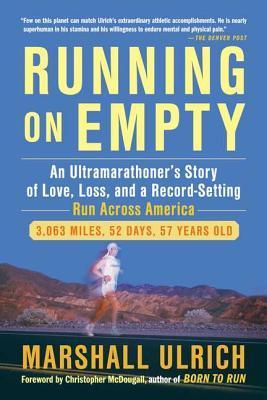
Marshall Ulrich's book is not as uplifting as Dean's. Ulrich is a legend in the ultrarunning and adventure race community. He famously ran the Badwater Ultramarathon four times at once (he refers to it as his Badwater Quad). Ulrich has run across the Sahara and been capsized in a boat on the first day of an adventure race. Plagued all his running life by toenail problems (common for runners), he had them surgically removed. Problem solved. Sometimes referred to as "the tank," Marshall is a machine when it comes to running. And this book shows just how much of a determined machine he is. Ulrich's book is not so much about the run as it is about why Marshall Ulrich runs.
Contrasting these two books is easy. Within the first ten pages of Ulrich's book, I was in tears. This is not an uplifting tale of man overcoming obstacles to achieve greatness. This is a cautionary tale about a man running to escape his demons, running to escape himself. When tragedy strikes Marshall Ulrich, he does the only thing he's known how to do for years: he runs. It's an out that served him well, until he decided to run across America. Unlike Dean, who performed his run with the full support of a well financed crew of at least 15 people, Ulrich operated on a shoestring budget. He rented his RV himself, and though his run was sponsored by sports companies and therapeutic device manufacturers, the fact is that Ulrich ran across the country on a tight budget. He had a small and unpaid crew working for him, led by his wife, Heather, without whom Ulrich states throughout the book he would not have been able to finish the run. Early on, he intimates at the interpersonal difficulties that arise towards the end of the run. However, when that climactic scene finally takes place, when the two runners confront each other, the details are decidedly lacking. At that point, Ulrich had run nearly 3/4 of the way from San Francisco to New York and his brain probably wasn't functioning at a level that would have allowed him to remember word-for-word the conversation that transpired. (Ulrich states that since the run was being filmed for a documentary, the conversation can be seen there and there's no need to rehash it here. I disagree.) Once Ulrich makes the decision and starts planning the run, he talks about a lot of drama that takes place, but he doesn't show any of it.
What the book lacks in drama, though, it certainly makes up for in the compelling tale of Marshall Ulrich the man, his body and his record-breaking run across America. Where Dean ran 40-50 miles per day, Ulrich tackled upwards of 60 miles per day. Unlike Karnazes, Ulrich pays a hefty price. He suffers from plantar fasciitis, tendonitis, sore back, sore knees, sore quads, sore hamstrings. After stepping wrong off a curb, Ulrich's leg is manipulated by the doctor on his crew, Dr. Paul, who adjusts something and then much later informs him that he had dislocated his fibula and that Dr. Paul had "relocated" it. For Ulrich, running across America meant pain so bad that at one point he simply decided to disown his own foot, to ignore the pain. It was the only way to go on.
Ultimately, Ulrich learns that he can't run away forever, that running only prolongs the agony. His realization of all that he's been running from, and the amazing love and support he received from his wife, Heather, during the course of his journey, help him to stop running--at least emotionally.
If Karnazes's book is about chasing your dreams, Ulrich's book is the warning the government makes companies apply to those dreams. It's the tale of Icarus who flew too high. "Yet how else would he feel the warmth of the sun?" Ulrich writes. "Half the fun [of life] is venturing into the unknown, taking on the difficult task that yields new knowlede, doing more and testing your limits."
Therein lies the similarity in these books. Both men want their readers to push themselves and to see how far they can take their bodies and their spirits. That's what living is all about.