Walter Farley's love for horses began when he was a small boy living in Syracuse, New York, and continued as he grew up in New York City, where his family moved. Young Walter never owned a horse. But unlike most city children, he had little trouble gaining firsthand experience with horses-his uncle was a professional horseman, and Walter spent much of his time at the stables with him.
"He wasn't the most successful trainer of race horses," Mr. Farley recalled, "and in a way I profited by it. He switched from runners to jumpers to show horses to trotters and pacers, then back to runners again. Consequently, I received a good background in different kinds of horse training and the people associated with each."
Walter Farley began to write his first book, THE BLACK STALLION, while he was a student at Brooklyn's Erasmus Hall High School and Mercersburg Academy in Pennsylvania, and
finished it while he was an undergraduate at Columbia University. It was published by Random House when he was 26. He used his first advance to go traveling and after that hardly stopped longer than it took him to write another book. He traveled and lived in Mexico, Hawaii, the South Seas, most of the South American countries, the Caribbean Islands, and Europe.
The appearance of THE BLACK STALLION in 1941 was hailed by enthusiastic boys and girls all over the country. An avalanche of mail urged Mr. Farley to write more about Alec Ramsey and the Black. But World War II intervened. Mr. Farley went into the US Army, where he spent the next five years. Most of the time he was assigned to Yank, the army weekly magazine, and he was also trained in the Fourth Armored Division.
After the war Walter Farley resumed the adventures of Alec and the Black with THE BLACK STALLION RETURNS. This was followed by SON OF THE BLACK STALLION. Then Mr. Farley tried his hand at a story about a new boy, Steve Duncan, and a new horse, Flame, in THE ISLAND STALLION. Mr. Farley's readers were just as delighted with this book as his others.
Mr. Farley went on to write many more stories about the two stallions, and about other horses as well. Children of all ages have found Farley titles to enjoy, since many of the later stories were written for Mr. Farley's own children when they were too young to read his Stallion novels. And older readers and adults have been gripped by his fictionalized biography of America's greatest Thoroughbred, Man O'War. Walter Farley's titles reached a grand total of 34. The 21 Black Stallion and Island Stallion stories are still in print and selling steadily. His readers respond with passion, writing him thousands of letters and emails every year. In May 1949, the first Black Stallion Club was founded, in Kentucky. Mr. Farley designed a membership button for it; the button was in constant demand among his readers for years. The Black Stallion books were so popular in the late 1940s and '50s that they York Times annual list of best-selling children's books. Three nationwide Black Stallion contests were held. Walter Farley's books have been published abroad in more than 20 countries, including Austria, Czechoslovakia, Denmark, England, Israel, Finland, France, Germany, Holland, Iceland, India, Indonesia, Italy, Japan, Malaya, Norway, Russia, Saudi Arabia, Sweden, and Switzerland, as well as in the United States and Canada.
All his life Walter Farley remained a keen spectator of the racing scene, and he enjoyed nothing more than hobnobbing with horse trainers and other professional horsemen. It is thanks to these people that his books are so full of authentic details of raising and training horses. When not busy working or traveling, Mr. Farley liked to ride dressage and high school Lippizaner horses. He also sailed and sometimes raced his 35-foot auxiliary sloop "Circe."
Mr. Farley and his wife Rosemary, had four children: Pam, Alice, Steve, and Tim, whom they raised on a farm in Pennsylvania and in a beach house in Florida. In addit
"And the world was gone" Pretty much sums up everything. Whatever else he may have done or been trying to do with his final three books, Farley carefully (and, I think, deliberately) pulls apart the world he spent so many years building. In Ghost, he destroys Alec as a boy we once knew. In The Girl, he destroys Alec as a jockey, Henry and the magical relationship between Alec and the Black we all loved. In Legend... he destroys whatever remained of the world of The Black Stallion. Whether he was just tired of people wanting more of this series or if it was a form of self destruction brought on by grief or old age, Farley -in a surprisingly detail oriented way- carefully and masterfully tore apart the whole fictional world he'd built. In fairness, his daughter died and it's obvious he was trying to deal with that and come to terms with it in Ghost, The Girl and Legend... but these were books he shouldn't have given to the public. He should have written them, yes, goodness yes, but not inflicted them on the world. As a book in itself, The Girl wasn't THAT bad in comparison to the others, but if you take it as part of the series, it's clear Farley has made alterations to characters and the world just to suit his purposes. Not that he hadn't done that before, but I think he went too far that time, especially when you realize that it was literally just the setup for this mess of a book. Since we got here, let's talk about Legend for a minute. As a book, it is awful. It's incoherent, meandering and never really quite hits its stride. It begins with jockeys and racing, leaves that begun plot unresolved in favor of a story about grief, which wanders off into the desert to become a story about prophecy. These three stories do not intersect, and only one of them is even slightly resolved (despite the fact that Farley tells us Alec has somehow resolved his grief in some meaningful way that doesn't actually make sense). And then the world ends literally (not even joking, that's what happens), where before it had only been figurative with the grief-centered plotline. What happened, you ask? Did everyone die? Did Alec die? Did the Earth explode? Well darned if I know, because Farley left us hanging, though it was clearly his intent that this be the final book in his series because he'd pretty much obliterated every part of it we might've still cared about. See Ghost wasn't entertaining, The Girl was barely even a story (he didn't even really use it as an excuse to actually talk about sexism, which seems like it should be a major topic in the book, but really he just barely touches on it) and Legend was practically incoherent. But that all has to do with story and plot progression. What Farley does to his characters and world in these three books is not half so disjointed and aimless as the story of Legend makes it seem. His purpose, to me, seems quite clear: to destroy the world. He accomplished that nicely in Legend. As I said, I think these were important for him as a person to write, but he'd have been doing us all a big favor if he'd made Challenged! his final published work. So I end where I began, because it's still the best way to describe what happened here: "I blinked... and the world was gone."
Seriously, this was as if you had taken a room full of people who had read the Black Stallion books many times, so they were familiar with the story lines, and had them round-robin writing a book. It was just absolutely wacko.
The shrink mentions, those I could accept. Given the supposed time period, and the fact that when you step back and think about it, the whole SERIES only takes place over the course of maybe, MAYBE, 7 or 8 years... Alec has gone through some SERIOUS traumas.
Shipwrecked, desert island, wild horses (multiple, since Satan was wild when he arrived too), the loss of a friend and the return of the Black, incurable disease threats, forest fires, buying a horse farm, riding several different horses to win in races, suddenly becoming a champion sulky driver, multiple plane crashes, losing and finding his horse over and over, severe amnesia, death threats from someone he thought was a friend, abduction by several different people, losing his girlfriend...twice...
I'd agree that all of that could be grounds for worrying about someone's sanity.
So I have less trouble with Alec not remembering loading up his horse and leaving home after horrible news that he found out in the newspaper. But from there it just all spirals down into what feels almost like someone was writing an acid trip or some other drug dream. None of the characters seemed right, the story was just absolutely bizarre, and I can honestly say that I will not read the book again.
My only guess is that Mr. Farley had not written a Black Stallion book in about 20 years, and perhaps had forgotten some of the characterizations from when he had written most of them. Combine that with old age, fatigue, and the loss of his daughter, and yeah, maybe it's explainable, even understandable... but that does not make this a good book.
This entire review has been hidden because of spoilers.
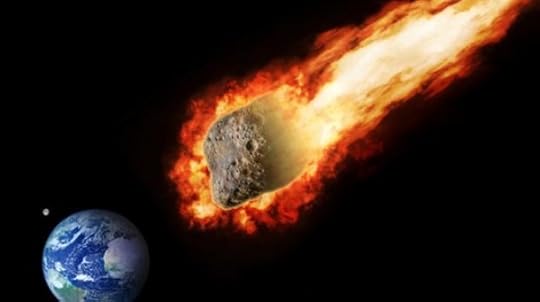
For a horse book, and for a "Black Stallion" book, this story is pretty ridiculous. I had no idea that there was an apocalyptic Black Stallion story, but there is, and this is it. I see now here on Goodreads that this was the 19th book in this series, so maybe the author was running out of ideas for things that could happen to his characters, but seriously, a worldwide apocalyptic disaster (meteors, massive worldwide earthquakes, massive destruction, volcanic eruptions, etc) just seems a bit out there. And I love apocalyptic stories, it is one of my favorite genres, but it just didn't fit in a "Black Stallion" story.
As a book in a series about a horse, this is lousy. As a father's meditation on what the world looks like after he's lost his daughter, this is powerful. The story, as story, isn't much- it's implausible and goofy and nonsensical in the extreme. But the central theme, how to go on living after the death of someone deeply beloved, redeems this in my eyes, at least. This last of the Black Stallion books has no races, no Henry to speak of, but most of all, it has Pam's ghost in every word. I can't recommend it, but neither can I recommend against it.
Okay. I'm editing this whole review because I just realized that this is a nineteen-book series, and all the other books are a whole new series that I might read one day, but not now. For now, I can easily say that this is one of the most fascinating series I've ever read in my life. These books ranged from being downright bad to being genuinely amazing. I am going to do a definitive ranking of all nineteen books from worst to best, just in case anyone's interested.
19. The Black Stallion Mystery. 18. The Black Stallion Returns. 17. Man O' War. 16. The Horse Tamer. 15. The Island Stallion. 14. The Black Stallion and Satan. 13. The Black Stallion's Sulky Colt. 12. The Island Stallion's Fury. 11. The Black Stallion Legend. 10. The Black Stallion. 9. The Black Stallion's Blood Bay Colt. 8. The Black Stallion and Flame. 7. The Black Stallion Revolts. 6. Son of the Black Stallion. 5. The Black Stallion's Courage. 4. The Black Stallion Challenged!. 3. The Black Stallion's Filly. 2. The Black Stallion and the Girl. 1. The Island Stallion Races.
Honestly, those last two are tied for the top spot. I just put Races in first place because a book about horse-loving aliens is insane in the best way possible.
Well, this was not at all what I expected. It's dark, dystopian, and Alec goes out of his mind, literally. Alec grows up over the course of the series, which I appreciate but things take a dark turn in this book. If you're been reading the series in order, you had some warning, but not a lot; if you're reading out of order, you're taken completely by surprise.
The book combines mysticism, dystopia, mental health issues, sudden death and oh yes, horses. Specifically the Black; we get a glimpse of mustangs but horse-wise, the focus is on the Black. Story-wise, the focus is grief and death and the end of the world with a large helping of mysticism.
Alec spends time with some American Indians up in high hills out west; Farley's portrayal is a mix of accuracy and stereotypes.
If you're looking for a book about a boy and his horse, the story has hints of that; if you want a book about horse racing, skip this book.
This, too, was terrible. , and while that doesn't bother me at all, Alec is crushed. So what do you do when something like that happens?
Well, I don't know what you would do, but I know that I would not pack my horse onto a trailer and drive off without telling anyone and without any clear idea of where I was headed.
Which is what Alec did. Because he's crazy, apparently.
Oh, and then they meet up with Native Americans who, improbably, believe Mighty Whitey is their one and only savior from the end of the world because of the fact that he brought his horse with him. Or something.
The ending is left open, which was the only semi-cool part, but then it's closed in Young Black Stallion, so it has no redeeming features.
This has to be the strangest of the Black Stallion books - and so is my favourite! Alec faces a huge personal tragedy and can't cope, so loads up the Black and starts driving. He ends up in the desert, with a vague idea of turning the stallion loose and then letting himself starve to death. Instead, he meets a tribe of secretive Indians, who have a legend that says a man on a black horse will lead them to safety on the day that the world comes to an end.
Ok, the plot line is faintly ridiculous, the science behind the 'end of the world' is all wrong, but you know what - I didn't care. I was swept along in the story and enjoyed every minute of it. You have to admire an author that is writing a good series and then chooses to throw in such a random story, but it works.
The best thing about this book is the cover. I used to have a first edition of this, but I wound up giving it away. Pretty lousy book overall but with some nice prose passages here and there. An incredibly disappointing entry in the Black Stallion series.
It's hard not to read this without wondering what possibly could have gone on in Farley's head while he was writing it. Walter Farley seemed to have major anger issues against the Black, Alex and the whole world... to put it politely.
I really don't care for cliffhangers, which is what happened in the end of this book. However other then that I truly enjoy reading the final fully written book of Walter Farley. The end of the world concept was just as strong back then as it is today. Walter Farley's writing will truly be missed.
It is interesting to see the development of the character of Alex over the years. Here there is acknowledgement of just what an extraordinary life and trauma Alex has had and just how important the Black is to him.
I hated this book. I don't even understand what the hell happened in this book. I honestly feel like I was punished as a reader for sticking with this series to the end. This book was a slap in my face.
I understand that Farley's daughter died a tragic death, and these last two books in the series are an ode to her (Pam's) life. As such, I strongly believe that the last book was stage one of grief: denial. Pam was still alive, she was falling in love, everything was fine.
This book is all about stage 2, anger, and WOW is there rage in this book. It's absolutely all over the place, doesn't properly end and doesn't really have a coherent narrative. This book should have stayed unpublished and instead functioned as a coping, and private mechanism for Farley's coping with his personal tragedy. A book ready for his dedicated viewers to experience, absolutely not.
I don't recommend reading this book, and I especially don't recommend reading this if you've read and enjoyed the series. I recommend only books 1-3, 5 9 and 12, and if you're really adventurous, book 13. The rest are not worth the time.
Ohhhhhhhhhhh boy. I literally struggled to find something positive. (Any time anybody mentions the swiss alps, I'll think of this) But, I still liked it, so I mildly recommend it.
Summary:
After Pam's death of plunging into an abyss, Alec flees Hopeful Farm with the Black to distance himself from the pain. He travels to the desert, and ends up wond up in a Native American legend. Apparently, him and the Black will lead them to safety. The world is coming to an end, they say. (And it almost did). Eventually, Alec and the Black do it and save the native American tribe.
Alec and Black are riding around the desert in this book, which always struck me as odd that he just took off on a million dollar race horse and went off doing whatever. At any rate, he and Black find themselves main characters in a Native American legend about the end times and a savior on a black horse. I wasn't terribly impressed by this book. It seemed like the last few in the series weren't up to the same level as the first half.
If you're looking for a way to absolutely TORCH a beloved series, Farley presents you with a blueprint with this one. I don't believe in spoilers, even on an over 40yo book, but having read the entire series between the ages of 10-13 I was really devastated and let down by this and the book that preceded it. I can only assume Farley was sick of writing the series, but this book is a middle finger to young fans everywhere.
I don't think I've read any other Black Stallion books. This was an enjoyable and easy read, but not my favorite. I was rather angry that Alec ran away so haphazardly with Black. However, that is the plot for the whole book and what happens. I wish the ending had a little bit more resolution with Alec returning to his family and Black to the barn.
I always enjoy reading the stories of Alec Ramsay and his black stallion, his best friend. In this book the world is turned upside down for Alec in many ways. But as always in these books, there is hope of a better future. I think that both children and adults can enjoy this book, if they love to read about adventures and horses.
Anyone growing up in the eighties, nineties, or even before has heard of the Black Stallion. It was such a popular book series that everyone had at least one of the books. This book, The Black Stallion Legend, is actually the last book in the series (there was one written after but it's a prequel) and it was written over forty years after the first book was. Which may account for why it's such a drastic change from the original tone of the series. And while you don't necessarily have to read the rest of the series to understand this book, it does help for character background.
Alec has been a bit distracted lately because of all the pressures of home. Sure he's a well known jockey. He's ready for a vacation and the distraction of his girlfriend, but when he learns that she has been killed in an auto accident, he loses it. Headed West, with his horse The Black Stallion in a trailer, he keeps driving and driving until he comes to a desert. There he stops and turns himself and The Black free only to discover that among the Native Americans in the area, they are the stuff of legend.
Alec is very very dark in this book. He ranges between grief, and rage, and hopelessness and it's sad and disturbing all at the same time. And it's actually pretty realistic of real grief and the range of emotions a person will experience when losing someone important in their lives. He has his horse, but even that is sporadic, especially out in the wild. His trainer, who features at the beginning of the book, is gruff and none to nice and I couldn't bring myself to like him in this book. Same with his dad, who seemed very indecisive and ineffective. Even the Native Americans weren't described that well. We had no sense of what kind of people they were, only that in their limited interaction with Alec they thought he was the person from their legend.
The plot was reaching a bit. It moved way too fast and there needed to be more detail for what Farley was trying to pull off with this novel. All the events and the way things happened just didn't seem quite right and the only way I could make them line up in my head was to imagine that Alec had gone into shock and was actually dreaming everything that happened. Otherwise, it just didn't make sense. This book, as said before, was decidedly gruesome and sad compared to the hopeful tone the other books seemed to carry. But it did contain a good lesson grief.
For an avid lover of the Black Stallion series, this book is going to be a shock and perhaps even a disappointment. It was almost as if Farley's personal grief was too much for him, and he poured it all out into his writing.
The Black Stallion Legend Copyright 1983 177 pages
Well that was quite possibly the weirdest Black Stallion book I've ever read... and I remember thinking the Island Stallion book with the aliens was pretty weird as a kid.
It wasn't horrible, nor was it great. It went from Alec's disjointed flight of insanity and depression in a heartbreaking study of despair and what people go through with the loss of a loved one. This aspect of it made it compelling. The journey of a soul crushed to the bone then heal from it has a strange pull for me.
The journey, however, to heal was where it got a little weird. Alec went from a despair maddened journey across the country to... a little dash of white savior to.... disaster story?
The completionist in me had no idea Farley had written more books after Black Stallion and the Girl which was the last book I read in the series as a kid so upon discovering this, I finally got round to picking it up.
I will say, though, it was kinda nice to revisit Alec and the Black after so many years. Like visiting an old friend who'd been with me growing up. That said, I'd much rather return to the magic of the rest of the series versus this book but at least I can say I read it.
It was a compelling story to see Alec's rebirth and just how much the Black has pulled him through an enormous pile of crazy but it definitely has its weird flaws.
This entire review has been hidden because of spoilers.
"Running away, like dying, is easy. It’s the living that’s hard."
So I like that we get to see more of an Alec and Black adventure more reminiscent of The Black Stallion, but it's got more otherworldly themes then I prefer in a horse book (see: The Island Stallion Races).
But, on the reverse side, I understand that this book was more cathartic for Farley than anything else. Pam's life starting in The Black Stallion and the Girl and ending here are reflections of Farley's own daughter. And Alec dealing with Pam's death is a direct correlation to Farley dealing with his daughter's death. So I can forgive the strange plot and accept the writing for what it is: saying goodbye.
WEIRD!!!!!!!!! In the beginning, after heaaring about Pam's death, Alec goes into a weird, state. Almost like he was asleep. He loads the Black into a trailer with hay, bedding, etc. and gets into a truck without even knowing it, regaines "conciousness" at the steering wheel, and drives away without even knowing he has a trailer behind him.
He drives, and drives, and drives and ends up in the middle of no whare. He rides the Black away, lets him go and pretends he's a horse thinking that sinc he is going to die anyway it didn't matter how he spent the last few of his hours. He ends up meetig this indian and learns that this is the "fourth world" and the end is coming soon, and the sign that it is coming is a black horse. He ends up thinking it is the Black. He leaves the next morning leaving Alec to find his way to the village himself. He gets there and in the midle o the night he wakes up to find Pam there. He "hears her" say that he needs to leave now for there is danger. Later he wakes up and the earth is shaking, the sky is changing colors, and the Black is freaking out! Turns out the whole earth is in this weird "holocaust" as he called it. WEIRD book!!!
Finding out about a car crash in another country doesn't really seem newsworthy, even if they're American, but that was how Alec discovered Pam had died. I can believe loading the Black without remembering, grief does weird things to the mind, but I had a hard time slogging through his mind from then on. It made very little sense after that, as well, following Alec as he drove to Arizona, then rode the Black through the desert, then wandered through the desert and suddenly there was a kid with a prophecy. The village already knew where to go, but needed to be led? There was so much focus on that that I lost interest and just finished it because it's a short book, and I'm kinda glad I did because where did that post-apocalypse come from and why didn't we ever get more of that part of the story? That last chapter was the most interesting part of the book!
There are not words awful enough to describe this book. Clearly Farley had no more heart for writing after the tragic death of his young daughter. This is the last book in The Black Stallion series, though I think he co-wrote a few more with his son, who continued on with "The Young Black Stallion" series. In this book, a grief-stricken Alec takes his horse out to the middle of the southwest (Seriously? From New York to New Mexico nobody notices?) and gets involved with a tribe of Native Americans that seems more like some extremely uncivilized tribe of rain forest primitives. A sacred legend (of course) makes them think Alec and The Black are the sign of the end of the world and a violent earthquake seems to reaffirm that fact. Awful book.
I remember this book being very, very different from what it actually is. I also didn't remember the blatant cliffhanger which left me quite confused. I mean do they survive? Do they get home? Does the world go on from this apocalypse that came out of nowhere? Does his dad die from this mysterious illness? The next book in the series is a prequel to the very first book which helps absolutely none and it was written in 2011. As the author is now dead, there is absolutely no way of knowing what is going to happen. I gave the book 3 stars because I enjoyed the first half, but definitely a one star for the ending.
This is the point where I realized I should stick to reading just the earliest books (up through about "The Black Stallion's Sulky Colt") because after that it just gets increasingly weird. This is the nadir. After this, it couldn't possibly get less plausible or out of this world. It's easier to pretend this has nothing to do with the first few books, which were at least remotely plausible.