

What do you think?
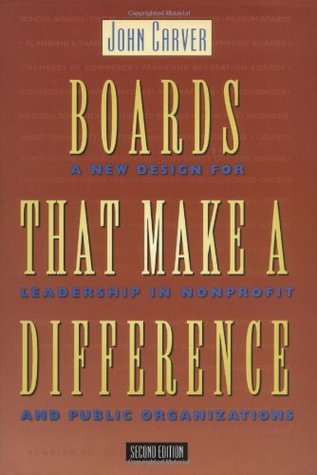
Boards That Make a Difference: A New Design for Leadership in Nonprofit and Public Organizations
"This book should be in the library of everyone who serves--or aspires to serve--on the governing board of any organization, large or small, nonprofit or corporate. Better than any other available resource, it tells what the roles of board members are and what they must and shouldn't do. An indispensable guidebook to leadership excellence."
--George Weber, secretary general, International Federation of Red Cross and Red Crescent Societies, Geneva "John Carver's Boards That Make a Difference was required reading for board members of the Calgary Philharmonic Society. It provided a clear and concise road map with which we carried out significant governance restructuring of the society."
James M. Stanford, president & CEO,, Petro-Canada, and past chairman of the Calgary Philharmonic Society, Calgary, Alberta, Canada John Carver's groundbreaking Policy Governance model has influenced the way public and nonprofit boards operate around the world. Now, as widespread experience with the model continues to grow, Carver enriches his definitive exposition with updated policy samples, a new chapter on the process of policy development, and additional resources for various types of boards. He debunks the entrenched beliefs about board roles and functions that hamper dedicated board members. With creative insight and commonsense practicality, Carver presents a bold new approach to board job design, board-staff relationships, the chief executive role, performance monitoring, and virtually every aspect of the board-management relationship. In their stead, he offers a board model designed to produce policies that make a difference, missions that are clearly articulated, standards that are ethical and prudent, meetings, officers, and committees that work; and leadership that supports the fulfillment of long-term goals.
--George Weber, secretary general, International Federation of Red Cross and Red Crescent Societies, Geneva "John Carver's Boards That Make a Difference was required reading for board members of the Calgary Philharmonic Society. It provided a clear and concise road map with which we carried out significant governance restructuring of the society."
James M. Stanford, president & CEO,, Petro-Canada, and past chairman of the Calgary Philharmonic Society, Calgary, Alberta, Canada John Carver's groundbreaking Policy Governance model has influenced the way public and nonprofit boards operate around the world. Now, as widespread experience with the model continues to grow, Carver enriches his definitive exposition with updated policy samples, a new chapter on the process of policy development, and additional resources for various types of boards. He debunks the entrenched beliefs about board roles and functions that hamper dedicated board members. With creative insight and commonsense practicality, Carver presents a bold new approach to board job design, board-staff relationships, the chief executive role, performance monitoring, and virtually every aspect of the board-management relationship. In their stead, he offers a board model designed to produce policies that make a difference, missions that are clearly articulated, standards that are ethical and prudent, meetings, officers, and committees that work; and leadership that supports the fulfillment of long-term goals.
241 pages, Hardcover
First published November 30, 1989
Ratings & Reviews
Friends & Following
Create a free account to discover what your friends think of this book!
Community Reviews
Displaying 1 - 25 of 25 reviews

March 23, 2012
John Carver's work is a conundrum. In one way, his policy governance theory makes complete sense. Boards of directors of nonprofit and governmental organizations should focus on the big picture, on defining results, and leave operations (how to) to their staff. With this clear focus, boards no longer have to struggle with the question of where rubberstamping ends and micromanaging begins. They are working on their responsibilities and staffs are working on theirs, which are separate but complementary. This Policy Governance model is also packed with all kinds of mechanisms for making boards more productive, and therefore more high-achieving, than current commonly-accepted practices allow for. Truly, I would like to live in a world where boards of directors behaved as Carver describes.
The problem is that they don't... and they won't. Few will accept Carver's insistence that the Policy Governance model be taken in toto. Unless and until an organization is in a free-fall, there is no motivation to adopt such a wholesale change in how they do business. At best, they will accept some suggested incremental improvements (especially, and ironically, if they come from a highly trusted CEO.) Some may say they have adopted Policy Governance, even go through the training and write some policies... but in the few cases I am familiar with in which this has happened, the boards soon revert to adopting outcome statements and plans that are put in front of them by staff, go back to organizing their meetings around agendas developed by the CEO. They may be effectively staying out of operations, but they wouldn't adopt a goal the CEO didn't want to save their lives.
So Carver's model fails for lack of practical application. Which is too bad. I wish he had devoted his considerable talent and high-quality thinking to providing his readers with a series of ideas for how and when to use some of his techniques. He could have been a real help to consultants like me who support others to improve. Those of us on the ground working with modern nonprofits are successful at introducing new governance practices one at a time. I just don't see it working otherwise.
The problem is that they don't... and they won't. Few will accept Carver's insistence that the Policy Governance model be taken in toto. Unless and until an organization is in a free-fall, there is no motivation to adopt such a wholesale change in how they do business. At best, they will accept some suggested incremental improvements (especially, and ironically, if they come from a highly trusted CEO.) Some may say they have adopted Policy Governance, even go through the training and write some policies... but in the few cases I am familiar with in which this has happened, the boards soon revert to adopting outcome statements and plans that are put in front of them by staff, go back to organizing their meetings around agendas developed by the CEO. They may be effectively staying out of operations, but they wouldn't adopt a goal the CEO didn't want to save their lives.
So Carver's model fails for lack of practical application. Which is too bad. I wish he had devoted his considerable talent and high-quality thinking to providing his readers with a series of ideas for how and when to use some of his techniques. He could have been a real help to consultants like me who support others to improve. Those of us on the ground working with modern nonprofits are successful at introducing new governance practices one at a time. I just don't see it working otherwise.
August 27, 2020
I am in the process of learning more about board governance and how to be a better board member and chair. (This is in hopes of turning these experiences into a book someday.) This book is an excellent, comprehensive, and detailed book about how boards should be run. The author has clearly done much thinking of how boards should be run, how they should govern, and what they should be doing. There are many examples given, which makes the sometimes erudite and cerebral explanations more accessible.
In addition to the somewhat academic explanations that can be difficult to follow, I also think the author operates in a utopian vacuum. If you were starting a board from scratch, this book gives you excellent advice on how to operate. But changing the culture of an already existing board to the ideal presented in this book is often difficult, time-consuming, and impractical. I also think the author oversimplifies and glosses over the differences between being a board member of a non-profit and being a board member of a for-profit. Goals, metrics, and resulting issues can be very different. And, of course, the author has full faith that his approach is the right one for all organizations.
Despite these shortcomings, the author has clearly done much deep thinking and worthwhile analysis on the subject. I think this is an excellent reference book for people interested in how boards of organizations should work.
In addition to the somewhat academic explanations that can be difficult to follow, I also think the author operates in a utopian vacuum. If you were starting a board from scratch, this book gives you excellent advice on how to operate. But changing the culture of an already existing board to the ideal presented in this book is often difficult, time-consuming, and impractical. I also think the author oversimplifies and glosses over the differences between being a board member of a non-profit and being a board member of a for-profit. Goals, metrics, and resulting issues can be very different. And, of course, the author has full faith that his approach is the right one for all organizations.
Despite these shortcomings, the author has clearly done much deep thinking and worthwhile analysis on the subject. I think this is an excellent reference book for people interested in how boards of organizations should work.
January 22, 2022
Very helpful, Very practical.

August 22, 2020
Yawn but fine.

May 15, 2024
This book revolutionized how I think about board structure and the role of boards. I was unfamiliar with the literature on governance and read this as training for a non-profit board I serve on. Carver’s model of governance and board roles and responsibilities is succinct and precise. I believe it truly offers a method of governing that is superior to the boards I’ve seen/worked on.
I disagree with some reviews that knock off a star saying the theory is not applicable. I don’t think the theory should be judged by the inability of people to enact it, but by the results it generates when implemented. Carver admitted the literature is essentially non-existent (at least from 2006, I’m not sure about today), so I’d be curious to know if any robust studies have provided more insight.
I do knock a star off for the sheer boredom I experienced in the reading the book. It’s a dry book and not particularly engaging. It feels more like reading a textbook than anything else to me. But, overall, I find the theory set forth as laudable.
I disagree with some reviews that knock off a star saying the theory is not applicable. I don’t think the theory should be judged by the inability of people to enact it, but by the results it generates when implemented. Carver admitted the literature is essentially non-existent (at least from 2006, I’m not sure about today), so I’d be curious to know if any robust studies have provided more insight.
I do knock a star off for the sheer boredom I experienced in the reading the book. It’s a dry book and not particularly engaging. It feels more like reading a textbook than anything else to me. But, overall, I find the theory set forth as laudable.

November 21, 2024
This was recommended or name-dropped in one of my Master’s of Public Financial Management classes at the University of Kentucky, so yet again I bought a book to gain guidance for job-related activities (2020ish) and then promptly got busy with whatever crisis of the day landed on my plate. I picked it up recently hoping it would help me with a volunteer community council I have been elected to a leadership position on (and will be filling in for the President during her maternity leave), but the Policy Governance model that the author discusses is really meant for a CEO/Board relationship that exists in a vacuum and without Kentucky politics, apparently. There were a few good points about trying to craft guiding policy statements and leading a board with a unified voice, but unfortunately reading this reminds me of the many reasons I quit that last job, the abundance of incompetent and dysfunctional governing boards being just one of them. The author also mainly references his previous work, so I think I’ll be trading this in for something else.

January 30, 2022
I read this book in advance of an all-day workshop with a governing board on which I serve. I'll admit it was like going back to college 50+ years after the fact and was NOT an easy read for me. Lots of theory and while it makes a lot of sense, I have my doubts that it can easily - or willingly - be accomplished. I'll be keeping an open mind and hope that some of these ideas sink in with our group.
May 11, 2017
For those of us that work for, with or serve on boards, this is truly refreshing.

February 23, 2018
Every board member should read this!
December 2, 2018
A good argument on how to organize a board. It is a little bit repetitive and cites himself a lot. Overall, I enjoyed the book, but it is not for everyone.
January 11, 2020
Good ideas, worth considering, though they will encounter heavy resistance in many non-Western cultures with different leadership structures.

May 8, 2020
Not a difficult read, and it covers a lot of ground where it comes to how to run a board using the policy governance model.
October 23, 2020
I love the theory behind the book, but you have to set aside the author's arrogance in tone to find the gems in this book.
April 11, 2026
I give this book 4 stars because I think everyone on any board should read it. It's not very exciting to read but it's necessary to learn for effective governance.

February 19, 2024
A very detailed theoretic text on Board Governance. Carver explicitly explains his philosophy on “Policy Governance” as a model for organizational efficiency, with boards that delegate power to management, then allow management to work within board set guidelines to ensure ethical and prudent practices. Much well thought out advice, with multiple examples, but very wordy. Clearly passionate about his work, Carver goes long and deep with high aspirations for the reader to follow through on his advice. The use of many self citations for reference is a bit unusual. I managed to condense close to 400 pages into 20 slides, several specific to his model, and many with good general advice for board members. A great philosophic resource for those serving on a board.
May 6, 2021
I read this as part of my effort to review governance theory as a refresh for my continued involvement in an association board I serve on. The content is thought provoking. Unfortunately the narrative is difficult to wade through. Took me longer to read than I had hoped. The author is guilty of the use of excess detail that he accuses most governing bodies for. Would have preferred this in a more efficient format.

August 22, 2008
For school but I ended up enjoying it because I didn't take it all at face value- more with a grain of salt, because the idealist way of Carver's thinking just doesn't happen. Although, those working in local government often wish that boards and committees would think this way!

April 10, 2009
This book is vaguely interesting, but I really don't feel it is the best governance model for every board out there. Organizations with small staffs often don't have the luxury of confining the board members to policy-only roles.

June 27, 2007
I had to read this for work. I barely skimed it. Very painful. Sorry if you are reading/have read this.
February 11, 2008
My dog's name is Daffy.
September 15, 2008
Right idea...EXTREMELY boring - had to read for the Governing Board at the kids school.

December 14, 2009
Fortunately I was reading this for a purpose. It reads like oatmeal, probably good for you but pretty boring.

September 29, 2012
This is a very fine book on boardsmanship. Carver has an unrelenting grasp of the difference between principles and methods. Really fine work.

January 6, 2013
This book contains important ideas, but makes it sound too easy ... focusing on only the big ideas for board work.

March 4, 2015
Good book, great theory, too long.
Displaying 1 - 25 of 25 reviews