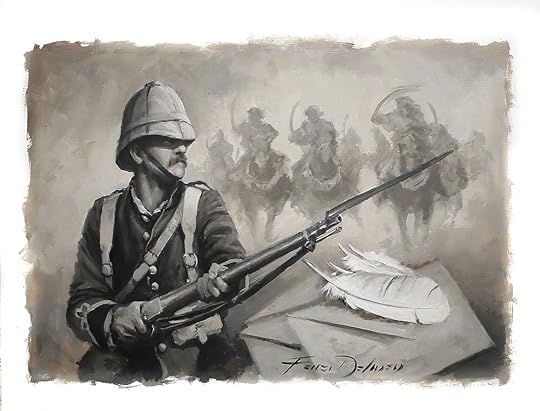
Harry Feversham, a young British officer descended from a long line of soldiers, resigns his commission on the eve of his regiment going off to war in Egypt. Three fellow-officers send Feversham white feathers, a symbol of cowardice; his fiancé breaks off their engagement and hands him a fourth feather. Feversham, shamed and depressed almost to the point of suicide, travels incognito to Egypt and the enemy-occupied Sudan to redeem his honor by the performance of brave deeds.
There’s a theme to this story that was derived from Shakespeare’s Hamlet: “…conscience doth make cowards of us all.” Conscience, in the context of the famous quote, means thinking, or more specifically overthinking a difficult problem. Overthinking can delay action with predictably bad results. For an officer, being paralyzed in combat with what the British soldiers of that day called “funk" is the worst thing imaginable. Harry Fevershem is, Hamlet-like, far more imaginative than his stolid retired general father and his “stiff upper-lip” peers. Fevershem’s dilemma is not that he’s a coward; in fact, he’s very brave. His misfortune is that a vivid imagination has led Harry to fear that he’s a coward who will fail the test when the time comes.
The Hamlet reference comes up in a conversation between Harry and Lieutenant Sutch, an old retired naval officer and friend of Harry’s father. Sutch takes a fatherly interest in Harry, and it’s implied throughout the novel that the lieutenant was at one time in love with Harry’s long deceased mother.
"Did you ever read 'Hamlet'?" he asked. "Of course," said Harry, in reply.
"Ah, but did you consider it? The same disability is clear in that character. The thing which he foresaw, which he thought over, which he imagined in the act and in the consequence—that he shrank from, upbraiding himself even as you have done. Yet when the moment of action comes, sharp and immediate, does he fail? No, he excels, and just by reason of that foresight.”
My brief synopsis should be familiar to anyone who has seen a film version—there are several—of Mason’s novel. While the synopsized plot is essentially the same, the screenplays differ, to a greater or lesser extent, from each other and the novel. Many novels are difficult, and in some cases almost impossible, to faithfully adapt for the screen; “The Four Feathers” is difficult at best.
“The Four Feathers” is more early Edwardian literary fiction than Kiplingesque adventure. A strictly faithful screen adaptation would probably have bored audiences. My favorite version, the 1939 Technicolor epic, took liberties with the characters and their relationships as well as the historical setting while adding plenty of action; these changes contributed to making the film a perennial classic and a box-office hit.
The screenwriters simplified and stream-lined the story, changing, combining or eliminating key characters. They also transferred the historical timeline to place the action in the 1890s, culminating in the Battle of Omdurman, a great British victory, rather than the less inspiring 1880s. This isn’t surprising. The film was released in the UK in April of 1939 when Europe was on the brink of war.
One of the most striking changes, and there are indeed several, from novel to screen, is the relationship among Harry Fevershem, Jack Durrance and Ethne Eustace (Ethne Burroughs, In the film) and Mrs. Adair, a character who was trimmed from the screenplay. Most interesting to me was the change in Jack Durrance. While he was portrayed sympathetically in the film, a great performance by Sir Ralph Richardson, Durrance is more prominent in the novel, arguably a co-hero to Harry Feversham, and a tragic one at that.
Mason’s literary style was pre-cinematic and will be familiar to readers of Victorian and Edwardian literature. He used poetic descriptions of the Irish countryside and the Sudanese desert to set a mood that reflected his character’s thoughts and emotions; films accomplish that visually, without the need for words. Mason also spent a great deal of time on both physical and psychological descriptions of his characters, exploring their motives, contradictions and misunderstandings at great length. A film must rely primarily on showing as opposed to telling and the emphasis on showing rather than telling had a significant impact on the development of 20th century fiction. In addition, the film used action and fast pacing throughout, building up to a rousing climax; in the novel, the pace and the action pick up, but only in the climactic scenes near the novel’s end.
A brief word about Ethne’s violin playing. Thankfully, it was left out of the film. Mason used it as Ethne’s means of non-verbal “spiritual” communication to both Feversham and Durrance. Other reviewers have commented on it and her favorite piece, the so-called “Musiline Overture”. This obscure, or more likely non-existent piece plays an important role in the narrative. Don’t waste time trying to look it up. Mason might have been referring to a violin arrangement of Mendelsohn’s “Fair Melusine Overture,” but that’s just a guess. At any rate, it’s a vestige of Victorian sentimentality and melodrama that was already going out of fashion when the novel was published in 1902.
I wouldn’t judge the film by the novel or the novel by the film; they are products of different media made for different times. While the novel lacks much of the action and adventure of the film, it still held my interest and kept me engaged throughout. Mason’s “word painting” descriptions are excellent, his characters psychologically complex; all things considered, it’s a good read.