This book is an excellent, up-to-date reassessment of the Byzantine empire during a crucial phase in the history of the Near East. Well illustrated with original maps, it covers the last decade of the Roman empire as a superpower of the ancient world, the crisis of the seventh century, and the means whereby its embattled Byzantine successor hung on in Constantinople and Asia Minor until the Abbasid Caliphate's decline opened up perspectives for Christian power in the Near East.
The University Lecturer in Byzantine Studies and a Fellow of Corpus Christi College, Dr Whittow is a medieval historian and archaeologist, specialising in the Mediterranean and Byzantine worlds, AD 500-1300, with particular emphasis on landscape and settlement patterns, and the social and political forces that shaped them. Recent publications range in topic from Romans and Arabs before the rise of Islam, via bad mothers in Byzantium and China, to the relative significance of local, regional and long-distance trade in the medieval economy. His next book will be The Feudal Revolution (looking at the transformation of Europe and the Near East between 950-1250 though the evidence of material culture and landscape change as well as texts), followed by the Oxford History of Medieval Europe, vol. 5: The Eleventh Century and a book, now in planning stage, that puts the history of Late Antique and Early Medieval Western Eurasia in a Global context. He is also part of the Oxford / Kings College, London team that directs the Prosopography of the Byzantine World. Current field work in Turkey is focused on Miletus in the Byzantine period, and future plans include survey work in Cappadocia.
In Oxford, he convenes the Masters courses in Late Antique and Byzantine Studies, (with Chris Wickham) the Medieval research seminar, and (with Marc Lauxtermann) the Late Antique and Byzantine seminar. Interested in all aspects of Byzantine history and topics that relate to his wider medieval interests, current doctoral students work on debt in Late Antique Egypt, the archaeology and history of the early medieval Caucasus, Byzantines and Turks in medieval Anatolia, the reign of John II Komnenos (1118-43), and a comparative study of the North Sea Region in the early middle ages.
Chair of the Faculty's Development Committee, convenor of the Faculty medievalists, and currently serving on the Faculty Board, he is also editor of The Oxford Historian.
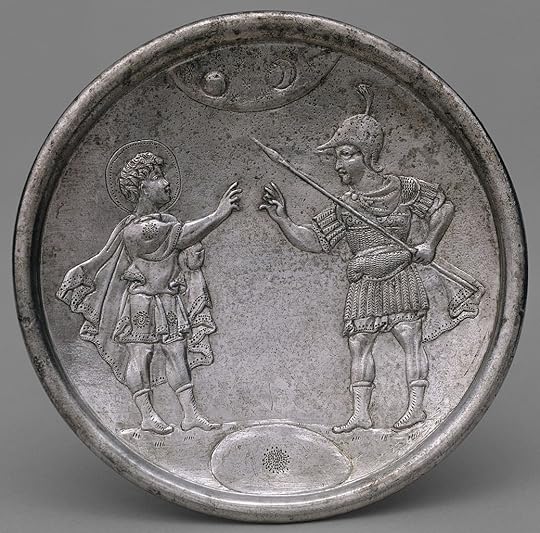
David's confrontation with Eliab, one of six silver plates depicting early scenes of the life of David. Constantinople, c. 629-30; in the collection of the Metropolitan Museum of Art
Mark Whittow begins his The Making of Byzantium, 600 - 1025, (1996) (*) by making clear the challenge faced when trying to understand early Medieval Byzantium. Of the certainly tens of thousands, and very probably millions of documents produced to carry out the business of state, religion and commerce during the time in question, almost none of them have survived the burning and looting Constantinople was subjected to over the years, not to mention the centuries of Ottoman rule, where they, too, needed to store their bureaucrats' records somewhere. I'm sure that clearing out stacks of moldering Byzantine documents onto the fires didn't cause the Ottomans any second thoughts. Whittow asserts that even Anglo-Saxon England has left us more of its documents than has early medieval Byzantium; in light of the incomparably greater import Byzantium had, that is a remarkable fact. Even the surviving Byzantine chronicles are few and patchy; many more chronicles have survived from the early medieval Franks than from Byzantium. However, there does seem still to exist a huge number of texts from the period dedicated to the lives of saints...
As if that were not enough, Whittow goes on to explain at length how unreliable or irrelevant the surviving written documents are. Unlike some of the other reviewers of this book, I find his analysis of the motives of the respective authors and the interrelatedness of their (now lost) sources very interesting. He very compellingly dismantles the historical authority of the Arabic sources concerning the 7th century Islamic conquest, among others. So he relies as much as possible in this book on sources of physical, as opposed to written information, even though, as he writes, "Medieval Byzantine archaeology hardly exists." If that is the case, then with what does he fill 400 pages of actual text, you ask? (**)
Well, he carefully sets Byzantium into its geographic context in a very Braudellian manner and spends a large portion of the book (100 pages!) describing what is known about the Byzantines' non-Muslim neighbors, from the Avars, Rus and the Bulgars through the Khazars, Kurds and Armenians. I appreciate understanding things in a larger context, and these matters are more interesting to me personally than any retailing of dynastic conflicts can be.
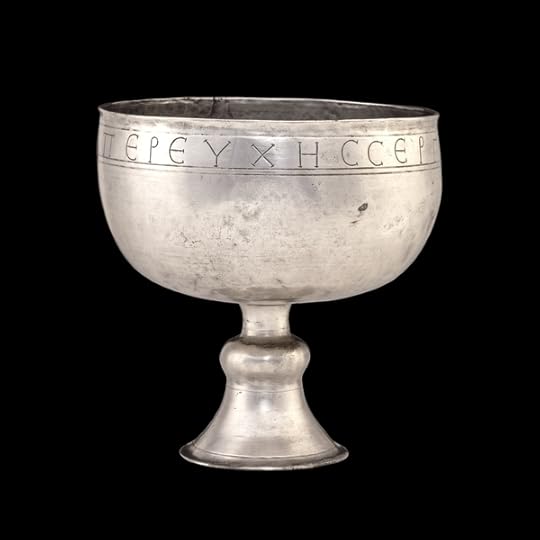
Byzantine silver chalice, early 7th century CE Probably made in Antioch; Found at Stuma, northern Syria; in the collection of the British Museum
Whittow also sets the stage of the Roman world in the year 600. Due to the efforts of Justinian and his finest general, Belisarius, the Vandals, respectively Goths, had been thrown out of North Africa, respectively Italy, in the mid 6th century, and Sicily, Sardinia, Corsica, even a small strip of Spanish coast around Cartagena were Roman again. Towards the rising sun, the Roman Empire was extended far to the east of the Black Sea and included all of present day Turkey, Syria, Jordan, Palestine and Egypt. But the Lombards were pressing in Italy, the Slavs and Turks were pushing from the north and the Persians were, as always, threatening from the east. And the 7th century opened up with a mutiny of the Roman army resulting in the deposing and massacre of Emperor Maurice and his family and a lengthy civil war with Maurice's remaining son aided by the Persians...(***) Sensing weakness, Byzantium's neighbors piled on. By 621 Egypt, Syria, Palestine, Turkey, the Balkans, etc. were lost to the Persians and Avars, and the Byzantines had dragged yet another Emperor's naked corpse through the streets. The Avars were kept from Constantinople's walls by handing over all the silver in the city. In 626 the Avars and Persians besieged the city simultaneously. By 628 the Avars were on the run and the Persians were split and fighting among themselves - they executed their own Shah, Khusro, who had led them to the amazing string of victories I mentioned above. I guess "What have you done for me lately?" has a long history itself.
And so went Byzantium's history - up and down and up and down. These ups and downs, as important as they were to the participants, are not what I consider the most significant aspect of history. I find myself close to Jacob Burckhardt's view that history is not the story of "great men" and unique, one-off events - they make good stories; it's just that after a while the stories seem to be rather similar - but is rather the study of that which changes only slowly - culture understood in the broadest sense.
In the 7th century the Arabic tribes - many former clients of the Roman Empire and previously Christian - swept away both Byzantine and Persian armies, setting up a new status quo that really did change cultures. By the early 10th century the Byzantines were left with a rump state consisting of the southern tip of Italy, the southernmost Balkans, Greece and Turkey - and this after an extended period of reconquest. Already by the end of the 7th century the Muslims held the richest provinces of the Empire and, as Whittow repeatedly emphasizes, without their economic basis Byzantium was doomed to, at best, slow decay. Whittow cites archaeological evidence that at least the economic prosperity of the former Roman provinces continued and in some places was even enhanced under the Muslim rule, whereas the provinces still under "Roman" rule, now cut off from the major trade routes, suffered a severe recession. In Constantinople itself great public buildings were allowed to fall into ruin - even Hadrian's aqueduct, the city's main water supply, was left unrepaired for more than a century - and agriculture was carried out within the city walls.
Nonetheless, as already indicated, partial recoveries were made and further setbacks were experienced. By the end of Whittow's synthesizing survey, one of Byzantium's greatest emperors, Basil II, who reigned from the age of 18 in 976 till 1025 (!), began another period of recovery. This time, however, he chose to make the expansion to the north and west, largely leaving the Near East to the Muslim Caliphate. With Bulgaria and most of the Balkans in his hands and with firm allies in the Rus, Basil assured that Byzantium would remain a Greek-speaking, orthodox Christian state. Before it stood the betrayal by the Roman Catholic crusaders and the ultimately doomed struggle for survival against the Ottoman Turks.
Though few archaeological digs aimed expressly at medieval Byzantine sites have been carried out, still, at important sites like Ephesos one has uncovered one of the Patriarchal Sees of early medieval Byzantium on the way down to the classical and archaic levels, and Whittow has been able to capitalize upon such information. But also coins,(4*) silver plate, pottery and ruins can, in the right hands, reveal much of interest, which Whittow relays to the reader.
I very much appreciate Whittow's skepticism, as well as his sober and intensely informative style of writing. Regrettably, this appears to be the only book he has written to this point; according to his own publication list, his other contributions are articles for specialist journals and chapters for collective books. But his Oxford website announces no fewer than three projected books. I hope they come to completion.
(*) Originally published under the title The Making of Orthodox Byzantium, 600 - 1025.
(**) The notes, bibiography and index comprise the last 100 pages of the book.
(***) This is the same Maurice who during the last two decades of the 6th century had gained the Roman Empire great advantages militarily and diplomatically.
(4*) Coins and few ruins are nearly the only tools available to understand post Alexandrian Bactria: The Greek Kingdom of Bactria: From Alexander to Eucratides the Great. It is surprising how much information one can milk from them.
I picked up this book hoping to fill a gap in my knowledge. I'm well versed in Medieval West Europe and very well in the Crusades and the whole of the Middle East, but was supremely lacking Byzantine history. So I picked up what was sold to me as the penultimate in Medieval Byzantine literature. If that's the case I would hate to have to read all those others that are apparently worse than this piece.
Whitlow is unbelievably dry, making the effort in finishing the damn thing extremely difficult. The book is academic to the max, with examination and defense of the literature and supporting material taking up most of the page. Whitlow also manages to make a chronological mess of Byzantine history, going forward and backwards with no anchoring subject or context. He randomly pulls out dates, digs up and quote from sources that leave the whole reason behind their use very obscure. While there is a great deal of information hidden in this beast Marky Mark manages to water it down with droll grammer and dry writing.
I would definitely not recommend this bad boy unless you A: had a solid grounding in and/or hard-on for Byzantine history or B: have trouble getting to sleep at night.
The most valuable second survey that students of the Byzantine world are welcome to read. Should not be the first because Whittow approaches Byzantine history from a surprisingly non-Byzantine perspective: there is much more the world around Byzantium than internal developments. It is, however, a most precious tool to place the empire within the larger global context, to make sense of the challenges emperors and other governors faced but of the challenges too much reliance on Byzantine narrative sources poses too. Whittow is surprisingly well-informed of the Bulgarian topics, which implies he might as well be a reliable reference on the Transcaucasian and Near Eastern ones too.
This is a masterfully Byzantine work about the Byzantine world. It covers periods where we know less about Byzantium than we do Anglo-Saxon England, and other periods where there is much more information available, particularly the Tenth Century.
Whittow provides two chapters that set Byzantium in context. One explains the geography of the surrounding world. To be a major empire it was critical to control the agriculturally fecund land of Egypt or Mesopotamia. Having wrestled Persia to the ground in an ebb and flow series of wars, Byzantium looked set for prosperity. However the flood of Muslim armies shattered the late Roman Empire and forced it back to modern day Turkey, Greece and parts of the Balkans.
The other context is a long chapter detailing the history of the surrounding peoples with whom Byzantium had to contend. Often making alliances to prevent any one power becoming over strong, there was a continuing thrust of nomadic groups moving West from Mongolia and Central Asia, just as had happened during the Third and Fourth Centuries. Now it was the time of the Bulgars, Khazars, Magyars, Pechenegs, and from the north the Rus - initially Vikings but then Slavs led by Vikings. The history of Armenia/Georgia, the gateway to the south, is provided in considerable detail. One interesting factoid is Whittow's dating of Armenia's official proclamation of Christianity to 314 AD.
The tendency of nomad hordes to settle down and lose their military edge is a repeated theme.
Lacking any other major city, the focus of all was Constantinople. Whittow does a superb job of explaining how maintaining monetary taxation which was disbursed to senior officials in the city prevented the slide into land-based feudal kingdoms that occurred in Western Europe. This came under threat when division amongst Muslim Caliphates enabled Byzantium to recover some of its territories in the Near East, catalysed by a recovery of influence in Armenia, the gateway to Syria. This generated a class of prosperous, military landlords who posed a threat to the city Emperors and produced two soldier emperors who were detested by Constantinopolitans. A return to a city based Emperor, Basil II, whose priority was to limit these proto-feudal magnates which explains why the opportunity to conquer more of the Near East was not taken.
Instead Basil waged war against the Bulgars for a quarter of a century. Their short-lived empire was annihilated and Byzantine rule in the Balkans was restored.
It is interesting to reflect how few years were free of warfare and critical threats somewhere in the Empire. Our long period of peace in the West is an historical anomaly for which we should be profoundly grateful.
My only criticism would be the sections relating to the iconoclastic dispute. Admittedly this is one period for which sources are sparsest. Whittow does not attempt theological analysis other than to make the surprising claim that the use of images had not previously been an issue in Christianity! For instance, there is the well known story of Fourth Century bishop Epiphanius of Salamis destroying a wall hanging that showed an image of Christ.
Iconoclasm arose in the wake of the successes of Muslims and the Emperors who embraced it considered Byzantium was being punished by God for their breach of the Second Commandment. Military successes followed.
Both times iconoclasm was reversed by Empresses who, in Whittow's view, used iconophilic supporters to consolidate their fragile power base.
This is a detailed book requiring some concentration amidst the many figures with similar names and a huge roster of individuals, as can be expected over 400 years. As always with Byzantium one is left with, 'what if?' What if Basil had struck East and down to Palestine and maybe Egypt?
Whittow has written an illuminating book about a far away place at a far away time. Highly recommended.
The western half of the Roman empire fell but the east survived. Mark Whittow’s book The Making of Byzantium covers the period when the eastern Roman empire changed from being what could simply be considered a continuation of the Mediterranean wide empire of the 4th Century to a much smaller and more insular state in the middle ages. It starts not long after the last attempts to reconquer swathes of the western empire have come to a halt having succeeded in Tunisia, but only made limited progress in Italy and even less in Spain. The west becomes less important with a focus firmly to the East. Persia nearly defeats Byzantium in a long war in the 7th Century, followed by a collapse in the Byzantine position with the Arab conquest of the Middle East. This decline of the last element of the Roman Empire is followed by a rebirth as the Byzantium of the middle ages with a revival in the10th and 11th centuries.
The Making of Byzantium is largely a history with a focus on politics and international relations between byzantium and its neighbours. There are however other elements covered; organisation and governance of the empire, strategy and religion.
This is an interesting bit of history about which I know little so learned a lot from this book. It should be a great narrative, but Whittow points out there are not the sources for it which often results in the narrative aspect just being a flimsy outline - or as there are often conflicting accounts a couple of different outlines of the events with almost no detail. This means it can be quite confusing. Whittow tends to give the different possibilities and does not always give us views on which is more likely. This is good history, but less so from the perspective of telling a compelling story; the reader is surely in an even worse position than Whittow to determine which version to believe.
Whittow does sometimes dive into topics that seem to have little obvious relevance to the core of the book, most notably on the Rus where half the chapter supposedly on their interactions as a neighbour of Byzantium has nothing to do with Byzantium at all but is all about their prehistory; where they came from, which from a Byzantine view is surely irrelevant. At variance with this sometimes seemingly pointless detail in the section on neighbours is how little is included on Byzantium in the west - just 12 pages compared to 20 for other neighbours and this is despite actual control of considerable territories in the area, moreover there is a mention of the remaining byzantine territory in Spain in 600AD with no indication given of relations with the visigoths in Spain or what happened to it (p.298).
While The Making of Byzantium has its flaws it is still worth reading if you are interested in Byzantine history, or the history of mediaeval Europe more generally. How Byzantium survived is important for the west as well as the east. But as it is not always the easiest read I doubt it is likely to have much wider appeal.
This is a wide-sweeping narrative and thematic survey of middle Byzantine history. Whittow does an excellent job both briefly sketching out the story of what happened and supporting it with a great deal of solid analysis. While the narrative is sufficient, one should not look to this book if imperial politics and war is merely what one wants to read about. Although badly dated and lacking serious analysis, John Julius Norwich's trilogy still fills that gap rather well. The strength of this book is how Whittow manages to hit so many themes in so few pages and yet do the vast majority of them justice. As the title suggests, the major current that runs through this work is the changes to state, society and worldviews from the time of the end of the era of Justinian and his immediate successors to the beginning of the end for the Macedonian dynasty. Whittow deals with the rise of Islam and how the Byzantines attempted to deal with that challenge imperially, intellectually, and religiously. This is all tied in closely to the changes that took place in the economy with the decline of cities at the end of antiquity. As an archaeologist, Whittow can certainly (and rightly, I would argue) be accused to placing too little emphasis on literary materials at times, and especially in arguments where he deals with questions like the end of ancient cities, but all the same it remains an extremely refreshing view of the Byzantine world. He spends a good portion of page space on geography, and this goes a long to establishing Byzantium in its physical context, something that he is keen to do as an archaeologist and something that more textual historians should do. He also devotes a solid hundred pages or so to the various neighbours of the Eastern Roman Empire such as the Rus, the Armenians, and the peoples in the Balkans. The Khazars also get a particularly interesting section. My own problem with the book is that Whittow sometimes puts a little too much emphasis on purely archaeological evidence rather than exploring the issues with both archaeological and textual evidence. His treatment of the plague of Justinian is a good example of this, in which he posits the rather extreme position that the plague's effects were nil and that the literary sources have embellished the event. That the literary sources cannot be trusted is accepted, and the problems that the contradictory evidence from the plague is noted, but more nuanced arguments exist. The article in 'The Cambridge Companion to the Age of Justinian' is a good example of this, as are some of the articles in Little's 'Plague and the End of Antiquity'. Another case where Whittow takes the archaeological evidence too far is during his section on Basil II's wars with the Bulgars, where he appears to argue that the given the numbers in the texts the wars and the ability of the two states to support them, some of the events must not have happened as they were described. Much of Whittow's scholarship on Basil suffers from not being updated with the latest research, so if you want to read a much more complex view towards Basil's campaigns in Bulgaria and how they were likely quite limited, check out Stepheonson's The Legend of Basil the Bulgar-Slayer. However, these points are minor considering the book in its entirety, but the four-star rating remains to serve as a warning in this regard.
The core of the book deals with how the Empire survived and the changes that the nature of such survival wrought, and I have yet to read a better summary. Although Haldon's Byzantium in the Seventh Century: The Transformation of a Culture is far more detailed, and his Byzantium in the Iconoclast Era, c.680-850: A History expands upon it chronologically, neither have the succinctness or all-encompassing view that Whittow has. This is one of the best introductions to middle Byzantium and the changes that took place at the end of antiquity from the eastern perspective available. A few minor reservations have been noted above, but they are small points and do not detract from this important book, which effectively challenges many conventional ideas about this dynamic era.
Good overview of the era based on the historical sources we do have, but it feels dated after reading Anthony Kaldellis’s more recent work, so perhaps it is unfair to compare the two given the time gap between them, but I was hoping for a more religiously oriented book that could tell me more about religion (based on religious works, not just the chronicles) in the Eastern Empire’s later history (given the books’s title), but I suppose it was my fault for not reading the description more closely.
I had to read this for my Historical Methods class... that was the only reason I even picked it up in the first place. Byzantium history is not interesting to me at all. That might be why this book was so very hard to get into... it was dry and very, very boring.
One of the few history books that I couldn't get into or even enjoy, for that matter.
Pretty tedious. One chapter, the one focusing on the "neighbors" of the Byzantine's, is more than double the length of any other chapter. In it, I felt that Whittow lost touch with the main subject of the book many times as he focused on other groups. But pretty dry overall. I don't know how it would read to someone with more of a background in Byzantine history.