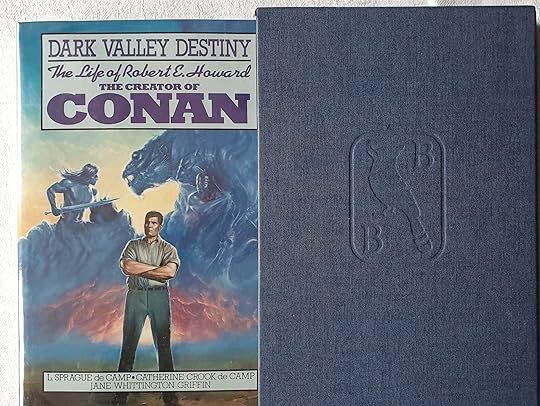
This is the definitive biography of Robert E. Howard, a giant of the pulp era, who created the archetypal brooding fantasy figure. To the general public, he is virtually unknown, but millions are familiar with the name and exploits of his most famous Conan, the barbarian.
Lyon Sprague de Camp was an American author of science fiction, fantasy and non-fiction literature. In a career spanning 60 years, he wrote over 100 books, both novels and works of non-fiction, including biographies of other fantasy authors. He was a major figure in science fiction in the 1930s and 1940s.
Interesante en cuanto a las citas y referencias que contiene, no tanto en cuanto a las conclusiones, que sitúan esta biografía en las lindes del psicoanálisis. El libro se lee con la sensación continua de que Sprague de Camp arrima el ascua a su sardina ideológica. Su historial previo de toqueteo a la obra de Howard no anima a tomarse ciertas aseveraciones sobre el carácter y la manera de ser del malhadado maestro del pulp muy en serio. Aun así, en el terreno de los hechos, una aproximación interesante.
L. Sprague de Camp, his wife Catherine and Jane Whittington Griffin ( who grew up in East Texas and provided a lot of history and contacts ) construct a bio on Robert E. Howard published in 1983 that is equal parts history of Texas as it is the history of Conan creator Howard. We do get a wealth of Howard's family history and upbringing including a family tree and all the places that Bob and his parents have lived over the years of his life before settling in Cross Plains, TX. His father, Isaac, is a stern traveling doctor who de Camp says that Robert may have based some of Conan on. His mother is portrayed as a selfish domineering woman adored by Robert throughout his whole life. Robert is portrayed as eccentric and odd. Him being a writer of pulps while living in a town that isn't described as being too literate or understanding. A very paranoid Robert would sing out loud to no one and always had mostly imagined "enemies" to confront throughout his life. The parts of the book I enjoyed most were Howard's letters to Lovecraft and the origins of Howard's heroes such as Solomon Kane, Kull, and Conan. I also liked that de Camp gave Howard's poetry its due diligence which it deserves. Lovecraft had said Howard should be thought of as a poet anyway.
Pretty much a piece of character assassination masquerading as a "biography". De Camp isn't a trained psychiatrist and yet he doesn't feel constrained in offering his own opinions concerning Howard's mental and psychological makeup which he bases on the flimsiest of evidence. In addition De Camp seems to have a long held bias against both Howard as a person and his writing. This bias shows through with on every page. On the other hand there is one aspect of the book that De Camp can't be held responsible for. Howard, for all of the great fiction he wrote, led an incredibly uneventful and boring life. Truth to tell, the book doesn't start to get interesting until Howard's dead and we get to read about how his literary legacy went from being virtually unknown to world famous. If anyone wants a well balanced biography of REH they should check out Mark Finn's Blood and Thunder which is a much better book.
I can understand why so many fans of Robert E. Howards work hate De Camp and this book. It's full of seemingly pulled out of his ass speculation on what Howard did, weird psychoanalysis on him, at times a condescending attitude on Howard as a man and his writings, even though De Camp himself made a living off his own reworkings of Howards stories and the Conan character.
That said if you cut the wheat from the chaff in this book you get so much great stuff about and insight into Howard. De Camp after all did meet face to face with and talk to several people that knew Howard well as well as having access to many of his private letters and correspondences that he wrote during his lifetime. So in spite of this books obvious flaws it is a must read for any fan of REH's work.
4 out of 5 stars just ignore the psychoanalytic bullshit and the at times condescending if not insulting trash that says more about De Camp than REH that was interjected
This is a biography of a very unpleasant man who lived a boring life and committed suicide at the age of 30. He wrote a pile of pulp fiction. He is best known for his Conan the Barbarian stories.
Robert E Howard lived his life in rural Texas. He was a racist. He lived in a fantasy world of violence. He collected knives and guns and always carried them but , as far as can be discovered, was never in a fight. He lived most of his life with his parents. His mother dominated him. His father does not appear to have much use for him.
Howard was considered weird, odd and/or antisocial by most people who knew. The closest relationships he ever formed were by letter with other pulp writers. He and H. P. Lovecraft had a close epistolary friendship, but they never met.
I have tried the Conan novels a few times. They are not for me. They are overwritten in a ponderous diction. They glorify silly violence. The characters are mostly stock and the stories are largely standard pulp ones, lots of monsters. The allure seems to be the tough guy, direct, no bullshit character of Conan. Conan was, evidently, sheer wish fulfillment for a lonely guy in Texas.
This is not a very good biography. L Sprague DeCamp was a Howard professional. He finished several of Howards books and he was active in bringing them back in press. This is a soup to nuts biography. We get long genealogies of both parent's family. Every neighbor and childhood friend is talked to. We don't get to Howard's first published story, at the age of 18, until half way through this 370 page book. (The co-author Jane Whittington Griffin evidentially did most of the deep background research.)
We get about twenty five pages for a summary of Texas history starting in 1727. We get detailed descriptions of each of the dead end clerical jobs Howard held. On the other hand, it is surprising that de Camp really doesn't give much of a sense of the pulp magazine world where all of Howard's stories where published. "Weird Tales" was pretty much the only reliable market for his stories. de Camp has an unfortunate tendency to psychoanalyze. He speculates, for example, that Howard's violent poetry is attributable in part to "his childhood rejection by infant playmates."
The big problem is that Howard lived a boring life. His trip to Austin was a big event in his life. He spent most of his time pumping out stories in his bedroom.
Howard was personally rude. Many of his stories were explicitly racist and his personal letters are worse. He may have died a virgin. He certainly had a terribly difficult time dealing with woman.
The best I can say about this book is that for some reason I do not understand I did read it all the way to the end.
Esta biografía sobre Robert E. Howard contiene una gran cantidad de datos sobre la época en que vivió el autor y sobre los hechos de su vida que se conocen. Por ese lado, es un libro interesante para sus seguidores, entre los que me incluyo.
En el debe pondría el gran número de interpretaciones sobre el carácter de REH y la forma en que se juzgan su vida y sus motivaciones, a menudo basándose en hechos poco convincentes y simplificando los hechos. Dicho en pocas palabras, el autor afirma saber más de lo que sabe.
Por otra parte, las valoraciones de las obras de Howard son escasas y, aunque esto es cuestión de gustos, en muchos casos opuestas a mi valoración de las mismas. Sí hay un pequeño comentario sobre la forma de escritura de REH que es interesante.
En resumen, un buen libro para saber más del mítico autor tejano, pero cuyas opiniones no deben tomarse como verdades absolutas.
For a long time this was the only biography we had of Robert E. Howard, but there is a lot better stuff out there now, particularly Rusty Burke's "Short biography" and Mark Finn's "Blood and Thunder."
Dark Valley destiny is flawed in many ways, although basic dates of events and of publications are mostly accurate. The main problem is how it spread the rumor of Howard as a neurotic mama's boy.
The De Camps love their Freud just a tad too much, as any time they don't have actual evidence or proof of something, they throw in psychoanalytic babble. It's informative for some of its facts (and at the time of its publication, there weren't that many other sources of information), but its suppositions and extrapolations keep this from being a solid reference.
Not the best biography of Robert E Howard. DeCamp spends too much time psycho-analyzing Howard and not enough time on his life and creations. Made for a rather dark and unsatisfying read. For a better bio of Howard read the "Blood and Thunder" by Mark Finn. Absolutely the definitive bio, well researched and respectful without trying to posthumous psychoanalysis.
Well, this book, or rather the author made me so angry when I first started reading it. What a load of bull****. I just had to put it on the shelf again, I was almost going to burn it...
Started reading the book again and since this is a biography about Robert E. Howard, I felt the need to read it and see what it was all about.
The author can write and is clearly a storyteller. You have to read between the lines and just pick what is the truth and throw the personal thoughts and amateur psychoanalyzing that the author does in the toilet.
Interesting to read some of the history and some of the statements, but be aware that many of these "facts" are no longer considered facts at all.
Not every Howard fan hates this book. De Camp's view was that REH was a great storyteller and a great poet but a flawed human being. Like most people who think suicide should be unthinkable de Camp thinks about why REH did it. You either find that interesting or you don't. Several REH fans are riled up just by speaking about the suicide. It is a little embarrassing to the macho fans that the creator of Conan the Badass shot himself in the head when his mother went into a coma. De Camp tries his best to understand a sad event. He praises REH as a storyteller and has some keen insight into REH's themes. It is a GREAT book.
Often ridiculed, I found this REH biography to be engrossing, informative, and entertaining. As with most of its naysayers, I was also often annoyed with deCamp's frequent, armchair, Freudian, pop-psychological analyses. But the subject matter was interesting enough for me to chug past all of this.
News is that Mark Finn's newer biography is far superior. I hope to read that next. But til then, I think this biography is worth reading.
Es interesante en cuánto es muy detallado en el entorno geográfico e histórico de la vida de REH, sin embargo es hiriente en como trata de justificar de manera inventada e interesada por Sprague de Camp haciendo a REH un inadaptado, un reprimido y obseso suicida. Abunda en forzados análisis psicológicos de la mente del REH en función de sus relatos.
Ojalá hubiese una obra psicoanalizando a Sprague de Camp, buscando las razones de su ruindad y mezquindad.
Very detailed and fascinating to read, but extremely biased. The authors make a lot of assumptions about Howard's mental state based on '70s pop psychology, and spend an entire chapter patting themselves on the back for completing and rewriting much of his material under the assumption that Conan was his only worthwhile creation. Should definitely be read with a critical eye.
I bought this book in early 1984 and read it almost immediately. I do not recall what I thought of it. Reading it again forty years later, I have strong opinions of it.
It has a great deal of information that is missing from the recent biography by Willard Oliver. De Camp spends more time on Howard’s father afterwards than does Oliver.
De Camp also give a short account of the publishing history of Howard’s work after his death, including De Camp’s and Lin Carter’s part in the publication of the twelve book series of Conan books published by Lancer in the 1960s which lead to renewed interest in Howard at that time.
The authors spend little time on Novalyn Price. She had not yet published her own memoir in 1983.
The authors present Howard as a fragile, volatile, delusional weakling. We are told that REH was pampered and indulged by his mother. Everything scared him, he was bullied. To complicate matters, they did move a lot when he was very young. They claim Texas weather made him a fatalist. They report that he thought the universe was out to get him. They also say that his parents did not get along. They also were in the practice of denying the various parts of reality that disappointed them.
He was under chronic emotional stress due to his mother’s illness.
This is an irritating book, seemingly written by authors who could find very little positive to say about their subject, as if he were an uneducated rube who wrote minor stories which became popular forty years after his death.
This is a fascinating biography of Robert E. Howard. It's remarkably well-researched, and the depth and detail are amazing. It's an excellent portrait of the tragic life of one of the major icons of the fantasy field.