Jump to ratings and reviews
Rate this book

Second Variety and Other Stories

Rate this book

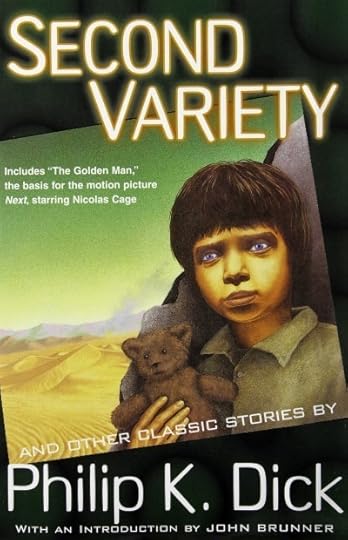
When asked by an interviewer 'Why is there Science Fiction?' Phillip K. Dick responded 'There is SF because the human brain craves sensory and intellectual stimulation before anything else, and the eccentric view provides unlimited stimulation, the eccentric view and the invented world.... The function of SF psychologically is to cut the reader loose from the actual world that he inhabits...' And cut us loose he does. But never disappoints. This collection of five stories from early in his career casts a spotlight on Dick's incredible imagination. In 'Second Variety' robot warriors appear to have given one side the advantage in a devastating war. But a small band of soldiers begins to question just what the robots' endgame truly is. In 'Beyond Lies the Wub' a member of a spaceship's crew buys a Wub ('a huge dirty pig!') for fifty cents, thinking it might be a good source of meat for the long journey home. Then the Wub speaks. In 'The Eyes Have It' a man's imagination gets the best of him, as he takes the words in a paperback novel a bit too literally. In 'Piper in the Woods' a doctor attempts to unravel the mystery of why workers on an asteroid base begin to behave as if they have become plants. In 'The Variable Man' giant computers indicate earth will likely win an interstellar war that will free it from the limits imposed by an aging Centauran empire. Plans are disrupted, however, when a man from the past arrives and throws off all calculations.

MP3 Book

Published April 21, 2011

3 people are currently reading
156 people want to read

About the author

Philip K. Dick

2,018 books22.6k followers
Philip Kindred Dick was a prolific American science fiction author whose work has had a lasting impact on literature, cinema, and popular culture. Known for his imaginative narratives and profound philosophical themes, Dick explored the nature of reality, the boundaries of human identity, and the impact of technology and authoritarianism on society. His stories often blurred the line between the real and the artificial, challenging readers to question their perceptions and beliefs.
Raised in California, Dick began writing professionally in the early 1950s, publishing short stories in various science fiction magazines. He quickly developed a distinctive voice within the genre, marked by a fusion of science fiction concepts with deep existential and psychological inquiry. Over his career, he authored 44 novels and more than 100 short stories, many of which have become classics in the field.
Recurring themes in Dick's work include alternate realities, simulations, corporate and government control, mental illness, and the nature of consciousness. His protagonists are frequently everyday individuals—often paranoid, uncertain, or troubled—caught in surreal and often dangerous circumstances that force them to question their environment and themselves. Works such as Ubik, The Three Stigmata of Palmer Eldritch, and A Scanner Darkly reflect his fascination with perception and altered states of consciousness, often drawing from his own experiences with mental health struggles and drug use.
One of Dick’s most influential novels is Do Androids Dream of Electric Sheep?, which served as the basis for Ridley Scott’s iconic film Blade Runner. The novel deals with the distinction between humans and artificial beings and asks profound questions about empathy, identity, and what it means to be alive. Other adaptations of his work include Total Recall, Minority Report, A Scanner Darkly, and The Man in the High Castle, each reflecting key elements of his storytelling—uncertain realities, oppressive systems, and the search for truth. These adaptations have introduced his complex ideas to audiences well beyond the traditional readership of science fiction.
In the 1970s, Dick underwent a series of visionary and mystical experiences that had a significant influence on his later writings. He described receiving profound knowledge from an external, possibly divine, source and documented these events extensively in what became known as The Exegesis, a massive and often fragmented journal. These experiences inspired his later novels, most notably the VALIS trilogy, which mixes autobiography, theology, and metaphysics in a narrative that defies conventional structure and genre boundaries.
Throughout his life, Dick faced financial instability, health issues, and periods of personal turmoil, yet he remained a dedicated and relentless writer. Despite limited commercial success during his lifetime, his reputation grew steadily, and he came to be regarded as one of the most original voices in speculative fiction. His work has been celebrated for its ability to fuse philosophical depth with gripping storytelling and has influenced not only science fiction writers but also philosophers, filmmakers, and futurists.
Dick’s legacy continues to thrive in both literary and cinematic spheres. The themes he explored remain urgently relevant in the modern world, particularly as technology increasingly intersects with human identity and governance. The Philip K. Dick Award, named in his honor, is presented annually to distinguished works of science fiction published in paperback original form in the United States. His writings have also inspired television series, academic studies, and countless homages across media.
Through his vivid imagination and unflinching inquiry into the nature of existence, Philip K. Dick redefined what science fiction could achieve. His work continues to challenge and inspire, offering timeless insights into the human condition a

Ratings & Reviews

What do you think?
Rate this book

Friends & Following

Create a free account to discover what your friends think of this book!

Community Reviews

5 stars
28 (19%)
4 stars
76 (52%)
3 stars
35 (24%)
2 stars
5 (3%)
1 star
0 (0%)
Displaying 1 - 11 of 11 reviews
Profile Image for Apatt.
507 reviews938 followers
March 3, 2018
“It only takes one of them. Once the first one gets in it admits the others. Hundreds of them, all alike. You should have seen them. Identical. Like ants.”

Second Variety was first published in 1953, but halt! Please stay tuned, this oldie is not moldy! Second Variety, like a lot of PKD’s fiction, still holds up well today, which is why they are still being adapted into movies and TV shows. However, stylistically Second Variety is a little different from PKD's more famous works like Do Androids Dream of Electric Sheep?, Ubik, and The Three Stigmata of Palmer Eldritch. Nobody uses or even mention hallucinogenic drugs in this story. Having said that, there are some surreal hallucinatory scenes in this story which depict actual events rather than drug-fueled trips.

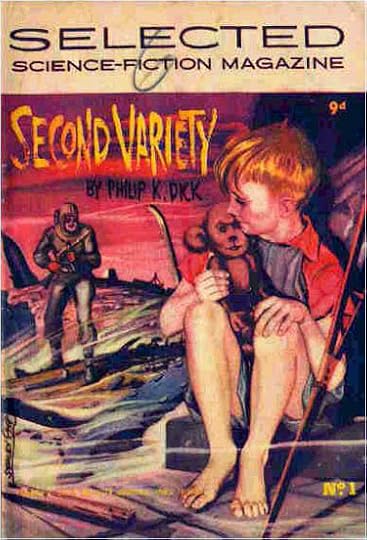
Second Variety is set in a post-apocalypse Earth that has been mostly reduced to ashes by a war between the US and Russia. Conditions are so terrible on Earth that the US government has relocated to the moon to direct the military action from there. The war was going badly for the US until they turned the tide by introducing robots to the warfare. These robots are constantly developed and improved until they reach the point where they are able to repair and improve themselves, and so true AI is born. The primary function, perhaps the only function, of these robots is simply to destroy all human lives they come across, except American human lives. The Americans can be distinguished by a device they carry, a tab that emits a short hard radiation which neutralises the robots. The robots are developed and assembled in underground factories which are, of course, autonomously operated by the robots themselves. They are so effective in the performance of their job that the Russians eventually contact the Americans to discuss terms of surrender. This would have been great news for the US if not for the fact that the robots have become so sophisticated that they are no longer content to operate within the purview of destroying only Russian humans.

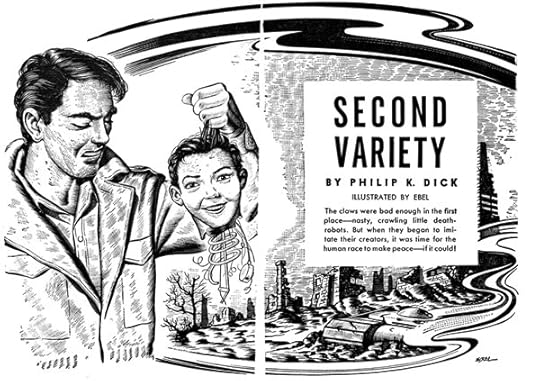
50s Art by Ebel

I suspect that Second Variety may be the inspiration for the Terminator movies, certainly, it is the best “robot uprising” story I have ever read, far superior to the clumsily written Robopocalypse. It is also a cautionary tale about letting technology go out of control, not to mention the ultimate futility of war. In fact, this would have been a depressing read if it was not so much fun! I was riveted by Second Variety from beginning to end. While it is not wonderfully trippy and mind-bending like Ubik etc. it is furiously paced and has a humdinger of an ending. Better still, Second Variety is in the public domain and can be read online for free or download as e-books (see links below).

So, given that it is great, not long (about 60 pages) and free to read, I can heartily recommend it for everybody (except people who dislike sci-fi but then these people don't read my reviews).
Teddy line
Notes :
• I have not read (or posesss) the entire Second Variety and Other Stories book, sorry.

• Download e-book or read online at Project Gutenberg

• Free audiobook version also available from Librivox.

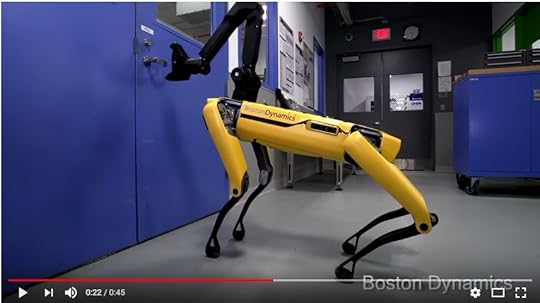
• Robot uprising is not as ridiculous as you think, see video clip below.

You Boston eggheads, stop it!


From Optipress


(Click on image for full size)
Profile Image for hawk.
484 reviews86 followers
November 8, 2022
good collection of stories, all interesting. all pretty skillfully written. many ask/explore interesting questions/possibilities.

some carry some outdated language and/or opinions (eg sexist, but not misogynistic - comes across as 'of the time' and unquestioned by the author, compared to some other authors from a similar back when who seem more actively bigoted).

loved "Piper in the Woods" - a story about becoming a plant 🌱🌿

and enjoyed "The Variable Man" - a man pulled out of one time into another, and the impact on the time awa the man, and the man's reactions and resilience.
Profile Image for Jay French.
2,163 reviews89 followers
May 7, 2015
This collection contains 6 short stories of varying lengths. I had recently listened to three of these stories, so I really focused on the others. I found the first story, “The Second Variety”, and the closing story “The Variable Man”, to be the best of the bunch. These were also the longest of the bunch. Both really dealt with some deep questions. In “The Second Variety”, the Turing Test comes to its ultimate test during a battle with the remains of humanity. Darn those robots. In “The Variable Man”, Dick touches on the increasing specialization of humans as time goes on. I had read a similar discussion a few years ago about baseball players. In this one, a time travel mishap brings a WWI-era repairman with a sense of entire systems into the future where only specialists reign. Nice set of stories, worth the time.
Profile Image for Yeshi Dolma.
101 reviews62 followers
December 15, 2017
This was actually my first audio book, and I had fun listening to Philip K. Dick. I am not sure if I would have enjoyed reading it as much though, but overall it was good. 3.5/5 for the story, the added 0.5 for the last ending line! Blurring lines between machines and human, the first half was very engaging, the second half slightly predictable. Overall, nice audio book experience. Making Bangalore traffic feel good.
Profile Image for Predrag Ilić.
Author 7 books3 followers
April 21, 2023
"Second Variety and Other Stories" is a collection of science fiction short stories written by Philip K. Dick. This book presents a fascinating look into the mind of a brilliant author who was ahead of his time.

The book contains a total of fifteen stories, each of which offers a unique perspective on the future and humanity's role in it. Some stories are set in dystopian worlds where technology has run amok, while others are set in more utopian societies where people have found a way to coexist with machines.

One of the standout stories in the collection is the titular "Second Variety," which presents a chilling vision of a world where humans have created intelligent machines that are capable of replicating themselves and evolving beyond their initial programming. Another noteworthy story is "The Defenders," which explores the idea of a post-apocalyptic world where a group of robots is tasked with defending the last surviving humans from an alien threat.

Dick's writing style is both accessible and thought-provoking, and he excels at creating fully realized characters who are flawed and relatable. His stories are filled with philosophical musings on the nature of humanity and the role of technology in society.

Overall, "Second Variety and Other Stories" is an excellent collection that is sure to satisfy fans of science fiction and anyone interested in exploring the possibilities of the future. Dick's stories are timeless, and his insights into the human condition are as relevant today as they were when they were first written. Highly recommended.
Profile Image for Doug Lewars.
Author 34 books9 followers
November 8, 2025
*** Possible Spoilers ***

These stories were written in the early 1950s but they've stood the test of time well. In the first on we have sentient robots trying to wipe out the human race. The author had never heard of the term 'AI' but you get the idea. There is also one of the best satires I've read of a certain genre of fiction. Altogether this book contains some great tales and is well worth reading.
Profile Image for Jessie Palmer.
72 reviews1 follower
May 28, 2023
The average of my rating for each of the stories ended up being 3.65. Besides Second Variety and The Variable Man, there’s not really a need to go out of one’s way to read these stories though they are quite enjoyable. Classic PKD.
156 reviews4 followers
April 7, 2025
3.5*. It's a bit like "Black Mirror", but less modern. I prefer Ray Bradbury.
Profile Image for Jennifer Nanek.
661 reviews4 followers
April 2, 2019
This book was a fun listen to. I listened to the audio of this. These are a series of sci-fi stories that were written back in the 50s I think. They are each very enjoyable and a few I kind of wished would continue a little bit especially the first one. The first one, Second Variety, is a story about robots or Androids taking over the world and imitating humans to do so.

One of the shortest stories called Beyond Lies the Wub about under estimating alien creatures. This story was kind of cute.

I liked the last story the Variable Man where he helps our future selves to imagine an entirely different possibility for their future. I could think it's funny that nobody in the future knows how to fix things except for I don't know how to fix anything either. But the idea that we lose something as we progressed with our technology is important to consider.
Profile Image for Don Iskanderoff.
55 reviews4 followers
May 27, 2013
Наконец-то, после долгого перерыва сподобился прочесть небольшую повесть Филиппа нашего Дика. Повесть - лютый вин (тому свидетельство снятый фильм под названием "Крикуны"). Не в моих обычаях пересказывать сюжет и спойлерить, так что если у вас есть время и вы не знаете что почитать, возьмитесь за "Вторую модель". З.Ы. Концовка - радует и доставляет)
Profile Image for Ryan.
1,408 reviews201 followers
February 8, 2016
A collection of 6 short stories -- Second Variety was the best, Variable Man was very good. These were mainly early works by PKD, and it's interesting foreshadowing of later themes.

(Audible audiobook)
Displaying 1 - 11 of 11 reviews

Can't find what you're looking for?

Get help and learn more about the design.