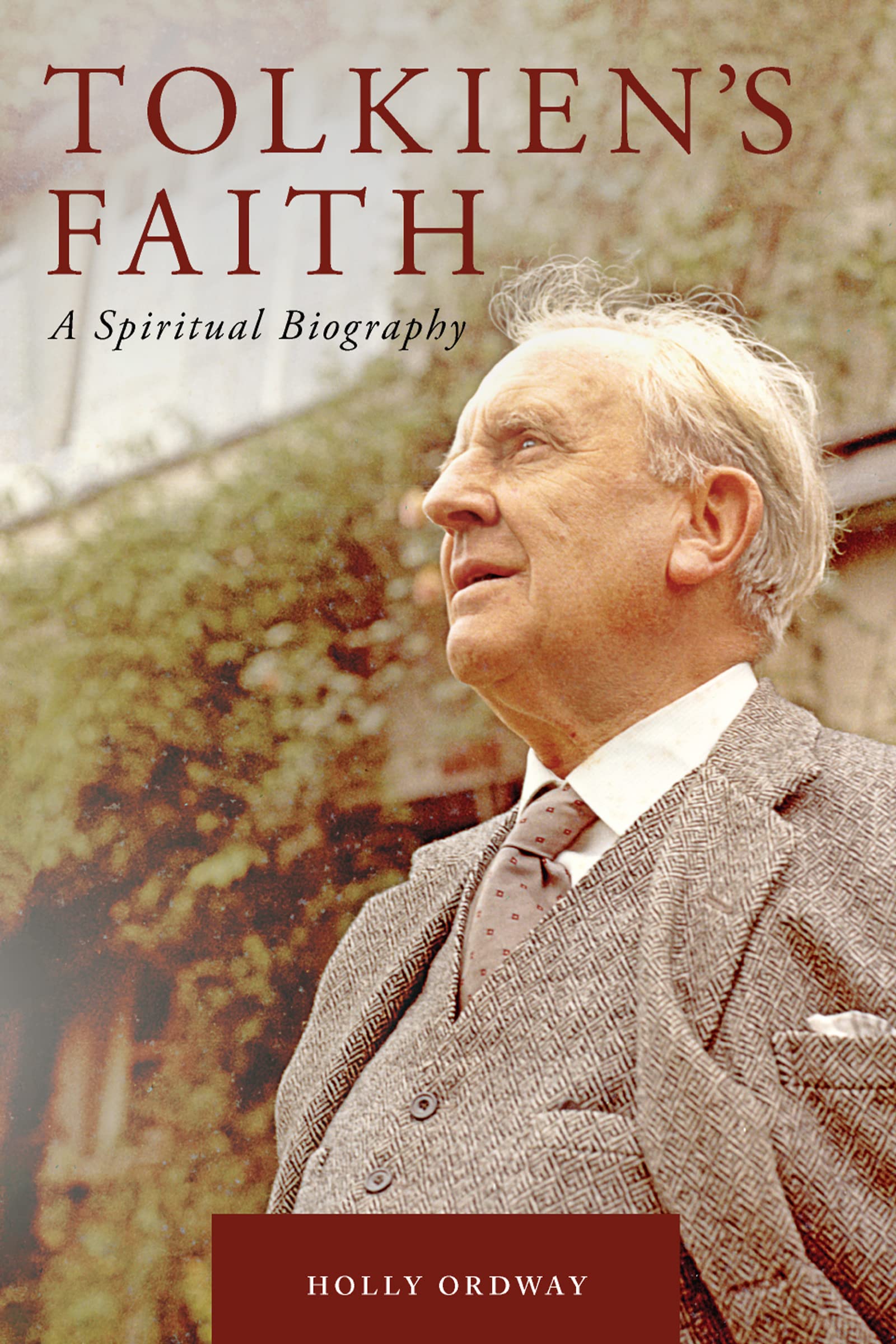
Tolkien described The Lord of the Rings as “a fundamentally religious and Catholic work” and declared, “I am a Christian (which can be deduced from my stories).” Yet he insisted his writings were not allegories, and Middle-earth is loved by millions who do not share his religious beliefs. How were his faith and his fiction related? Holly Ordway answers that question biographically, focusing on Tolkien’s spiritual development, a dramatic story that previous accounts of his life have left largely unexplored. Here we find Tolkien’s faith was hard-won. His Anglican upbringing was overturned when his mother converted to Catholicism. Soon afterwards, she died, leaving Tolkien under the guardianship of a Catholic priest, who forbade him for three years to see his Protestant sweetheart, he eventually married her nonetheless. The Great War, in which most of his close friends were killed, deepened Tolkien’s reliance on his faith, but then, for nearly a decade, he “almost ceased to practise” his religion. Friendship with C.S. Lewis and success with The Hobbit were followed by another war and by turmoil in the Church that sternly tested Tolkien’s commitments. The challenges and triumphs in his religious life are reflected in his masterpiece, The Lord of the Rings , that epic tale of endurance against the odds. As Ordway shows in her expertly researched and richly illustrated study, Tolkien’s faith and Tolkien’s fiction are intimately related, though in subtle and complex ways. This long-overdue spiritual biography gives new insight into his works by shedding fresh light on their author’s deepest-held convictions.
Holly Ordway is the Cardinal Francis George Professor of Faith and Culture at the Word on Fire Institute, and Visiting Professor of Apologetics at Houston Christian University. She holds a PhD in English from the University of Massachusetts Amherst and is a Subject Editor for the Journal of Inklings Studies. Her literary-critical study Tolkien’s Modern Reading: Middle-earth Beyond the Middle Ages received the 2022 Mythopoeic Scholarship Award in Inklings Studies. Her book Tolkien’s Faith: A Spiritual Biography (Word on Fire Academic) is being published in time for the 50th anniversary of Tolkien’s death.
A book-length treatment of Tolkien's faith is long overdue, and this volume is to be welcomed for finally tackling what other biographers have been strangely reticent about. It's thoroughly researched, carefully footnoted, consistently readable, and takes pains neither to critique nor recommend Tolkien's religious commitments but simply present what he himself believed in terms that he would recognise. Whether the consequent portrait strikes the reader positively or negatively is not Ordway's concern; her aim, which I think she hits marvellously well, is just to gather the relevant information and convey it accurately and accessibly, leaving evaluation of its substance to one side.
In addition to the main body of the text, there's a brilliantly selected, sequenced and captioned photo gallery, a couple of extremely helpful appendices, and a handy glossary. It's hard to imagine that this volume will not become an indispensable contribution to the field of Tolkien studies.
Full disclosure: I've read this book prior to publication because the author is a friend and colleague, but I should add that I have lots of friends and colleagues who write books and I don't always choose to review let alone actively promote their work. But this volume is exceptionally good, and therefore I'm happy, indeed enthusiastic, to encourage anyone and everyone with an interest in Tolkien to read it. However much you know about him and his life and works, you'll find new and surprising material in these pages, I'm sure. I certainly did. It's instructive, absorbing, outstanding.
This spiritual biography will be of interest to fans of Tolkien (and CS Lewis), and one does not need to be Catholic to appreciate the great work Ordway has done here. It functions as a standard biography covering his childhood, experience in WWI, marriage, academic career at Oxford, friendships—especially with CS Lewis, the Inklings, and of course his literary masterpiece, The Lord of the Rings. The focus throughout is on his deep and abiding faith. He was a staunch and thoughtful Catholic during a period at Oxford —and in England in general—when they were a small minority often viewed with suspicion, or worse.
Ordway plays it straight—this is no mere hagiography. She details Tolkien’s beliefs with neither promotion nor disparagement, and explains the doctrines underlying his religious practices which is particularly helpful for non-Catholic readers. Very well done.
And thank you for the gift, Keaton!
Quotes:
‘But we need not choose between seeing Tolkien either as an ordinary man capable of astonishing brilliance or as a world-shaking genius content with humdrum routine; Rayner Unwin gives us a glimpse of a more integrated personality. Thinking back on twenty years of friendship and (sometimes tumultuous collaboration over the publication of The Lord of the Rings, he describes Tolkien as "an author of unwavering integrity, who was never tarnished by the fame that ultimately engulphed him, courteous even in exasperation, joyous in good company, wracked by private despairs and sustained by faith."’ [p 357]
‘Thirty years earlier, he had written to his son Michael with advice about marriage, cautioning him that the tradition of chivalry—which idealizes the man as a knight in shining armor, serving his perfect lady love—is good insofar as it encourages "fidelity ... self-denial... courtesy, honour, and courage," but it has a serious weakness, in that even a Christianized chivalry "is not perfectly theocentric." Without being centered on God, a man tends to make the beloved "a kind of guiding star or divinity" rather than seeing that she is "another fallen human-being with a soul in peril." Women, he says, are "companions in shipwreck not guiding stars."’ [p 349]
Excellent examination of Tolkien's life through the lens of his faith. Holly Ordway has gifted both fans and scholars of Tolkien a wonderful, engaging resource, shining a light on an aspect of Tolkien's life that was extremely important to him but is far to often glossed over as a footnote. Though he never was explicit about his Christian faith in his legendarium, it is the glue that holds it together. This book is not about the Lord of the Rings, though, but about Tolkien's life (a biography) looked at by means of his faith throughout his life. When applicable, the Lord of the Rings is considered, which is enough to please any Tolkien fan, though.
Dr. Ordway also is very playful in her writing, which a son of St. Philip Neri as Tolkien was would appreciate, specifically in Chapter 22 which concludes with Tolkien's view of Guardian Angels, that, in Tolkien's words "only one's guardian Angel, or indeed God Himself, could unravel the real relationship between personal facts and an author's works." Ordway then concludes with a cautionary reminder "of the limits of biographical-literary analysis" and "a salutary caution to everybody, and especially to the biographer seeking to understand a long-dead writer's faith and the influence it may have had on his works..." (p. 208).
I’ve loved Tolkien’s work for a good while now, and as I’ve gone deeper into his writing, my interest in the man has only grown. It’s never been the mythical aspects of Middle Earth or the nuances of the elven languages that have commandeered my attention. It’s the story - the myth itself - and all that it has to share. It was Tolkien who helped me see that stories have an ability to convey truth in a way that other kinds of communication cannot. And it was Tolkien whose work helped me see a Christian perspective of the world through narrative. It’s a beautiful and captivating approach, not only to life, but also for evangelism and the life of faith. The mines of Moriah are cool and all, but they’ve got nothing on the remarkable gift of friendship and the virtue of humility.
That being said, my hope in reading this “spiritual biography” was to gain a better understanding of Tolkien’s life as a Christian. That’s exactly what I found here in Holly Ordway’s book. In these pages is the story of a man who lost both parents before the age of 13, served in the Great War and contracted trench fever, became a Catholic on the far side of the high tide of English Protestantism and Roman Catholic persecution, helped bring C.S. Lewis to the Faith, wrote one of the most widely published fiction stories in world history, was faithfully married for over fifty years, and kept the Faith unto the very end. In fact, his dependence upon Christ and the grace upon grace which He gives us is clearly what sustained Tolkien in every season, no matter what came.
Now, I’ll be very candid - the four stars does arise out of the fact that this is a work published by Word on Fire Press, a Roman Catholic evangelistic ministry. I am very much a Reformed Protestant who didn’t align with everything shared across these pages, whether it be the way certain arguments were framed or the frequent Roman Catholic asides that occurred a little more often than what I would’ve liked. The book certainly isn’t an attempt to approach Tolkien’s faith critically, but it isn’t hagiographical, either. Ordway is honest about her Catholicism and it comes out in her work reflecting upon Tolkien’s share in the same tradition, which I think is appropriate for the task at hand. There was a great deal in this spiritual biography which I found deeply moving and quite edifying. Even the definitively Roman Catholic points and emphases ended up helping me see this great slice of the Faith in a fresh way, surely something I’m grateful for. Such is the fruit of Ordway’s giftedness as a writer as much as Tolkien’s sincerity of faith.
Tolkien loved Jesus and sought to follow him with everything he had. His life is a Witness of a remarkable kind, and I am simply one of what I trust to be a great many who’ve benefitted as a result. If you haven’t yet read any of Tolkien’s work, or better yet, if you don’t know much about the man behind the Rings…take and read. You may just so happen to find that you have quite the friend in John Ronald Phillip Reuel Tolkien.
Ahora, alegremente, puedo decir que por fin reconozco la verdadera hondura y profundidad más profunda de la obra de Tolkien. Es fácil reconocer las maravillas que dejó con su tinta, universalmente alabadas. Pero, a no ser que uno acuda a la mirada que tuvo hacia la trascendencia, no podrá verdaderamente absorber la vida espiritual de este hombre y lo que esta refleja en las raíces del mundo literario que creó. Creó un mito. Un mito cuyo fin no era caer en la analogía, sino regarlo con sus creencias, para que, desde las imágenes más bellas y las historias más impresionantes jamás contadas (esta afirmación no es subjetiva), el lector intuya a Dios a lo largo de cada una de las historias que tratan de explicar el mundo en el que vivimos. Un hombre con una vida sencilla y cotidiana, asemejada a la de cualquier habitante de Bolsón Cerrado, explora el reino más preciado —la imaginación— y lo lleva al nivel más alto posible: aquel que se encuentra rozando el cielo.
Out of the darkness of my life, so much frustrated, I put before you the one great thing to love on earth: the Blessed Sacrament"- Tolkien
“If more of us valued food and cheer and song above hoarded gold, it would be a merrier world," - Thorin (the Hobbit)
These two quotes sum up the saintly simple beautiful life of JRR Tolkien. This biography on Tolkien’s spiritual life is the first of its kind. His life is filled with tragedy, love, and the normalcy of domestic life. This book gives a beautiful backdrop to the mind behind the greatest fantasy of the 20th century. This is more than just a nerdy book to read for those who love Lord of the Rings, but a spiritually inspiring book on striving for sainthood in the modern world.
"Tolkien's Faith: A Spiritual Biography" by Holly Ordway is a beautifully written and captivating exploration of J.R.R. Tolkien's spiritual journey. Ordway's skillful storytelling draws readers into the rich tapestry of Tolkien's life, while the accompanying photo gallery adds a visually appealing dimension to the book. Beyond being an insightful analysis of Tolkien's spiritual formation, the book also provides a thorough historical context of Catholicism in England. Ordway's comprehensive research and eloquent prose make this biography a must-read for anyone interested in Tolkien's life and the profound influence of faith on his works.
Furthermore, the inclusion of Appendix A, a timeline of Tolkien's life, is a valuable resource that enhances our understanding of the author's life events and their impact on his faith and creative work. Appendix B, featuring prayers and liturgical extracts, adds a deeply personal touch to the biography, allowing readers to connect with Tolkien's spirituality on a profound level. These well-crafted appendices not only complement the main narrative but also serve as essential reference points, making this book an indispensable resource for Tolkien enthusiasts and those interested in the intersection of faith and literature.
I have always suspected that there is an ineffable resemblance between poetry and music, the perfect exemplar of which is perhaps J. R. R. Tolkien's life, with whom I found a soul-shaking resonance. Indeed, the dramas in his life is no less intense and fascinating than his fantasies - he who invented the concept of 'mythopoeia' is himself the embodiment of mythopoeia. But behind all the billows and thunderstorms of life, the one thing that upholds him throughout is undoubtedly his authentic Catholic faith, which Ordway has shown by her comprehensive research into this legend - nay, more: not childish, but childlike; not a saint, but saintly. May he remember us when his ship finally reaches the shores of Valinor, where sorrows and joys are reconciled into eucatastrophe...
Very very interesting and well researched. It's so good to read about Tolkien and his faith which was a very important part of his life as a devout Catholic. What a good and learned man he was. I shall re read this book!
If I'm being honest, I'm not fully convinced by the notion of a spiritual biography. A spiritual autobiography like Lewis's Surprised by Joy or Augustine's Confessions works because the individual best knows what his or her own faith journey has been. Trying to write the spiritual biography of someone else is like trying to use random clues to piece together their innermost thoughts and feelings. It can be done, but only with a lot of conjecture, gaps, and uncertainties.
Ordway certainly makes the most of the material she's given. There is a fair amount of conjecture here, but most of it seems like safe assumptions. But a book of safe assumptions isn't really what I'm looking for in literature or in scholarship.
I appreciate Ordway's attempt to bring the spiritual side of Tolkien to life, since it quite often is underplayed these days. But I can't help but wonder if she course corrected to the wrong extreme. Her explicit focus is on the spiritual part of Tolkien's life, only referencing other aspects where it seems relevant. But I just don't think people are that compartmentalized. Probably every aspect of Tolkien's life had some connection or other to his faith, and I think this book comes dangerously close to implying that faith can be a separate thing from the rest of life.
Honestly I would rather see a biography that more closely integrated the usual details with Tolkien's spiritual journey. That would give a more complete view of his life without any of the awkward compartmentalization.
Nevertheless, this was well written and very well researched. I'm not sure that I approve of what it is, but for that thing it is still pretty good.
A very important book, but also a very preliminary one. As a biography of Tolkien's faith, this book does a fair job of presenting the general facts and making the argument that Tolkien was a religious man. That much is plainly obvious to see from even a cursory examination, and it is absurd that we still have to argue the point. Ordway's book is, however, a bit too surface. She spends too much time explaining aspects of Roman Catholicism without getting into the depths and presents basic facts of Tolkien's life without really engaging it. She presents information instead of analysing it, almost as one might to a 101 class in college.This method actually works against her in that it seems like she is searching for evidence to prove her point and therefore is making mountains out of molehills.
Ordway also misses a lot of writing that could help her points, especially Tolkien's theological writing, especially the Athrabeth Finrod ah Andreth in Morgoth's Ring. Nor does she engage with other authors who have written about religious themes in Tolkien's work. All this makes Ordway's work a decent biographical text that can serve as a foundation, along with a lot of other important works, to continue to prove that Tolkien and his work are essentially Christian work.
Holly offers a comprehensive and engaging look into the life and spirituality of JRR Tolkien. This delightful read taught me so much about the world and faith surrounding this very important man. We bought extra copies to gift to family, knowing how edifying it would be for them. Thank you to Holly for taking on such a monumental research project. What a beautiful labor of love! Tolkien’s Faith is a must-read
A very engaging and readable portrait of JRR Tolkien's spiritual life. If you are really into Tolkien or really into biographies of religious or spiritual people I highly recommend it.
Gran trabajo el realizado por Holly Ordway para exponer la fe de Tolkien a través de los momentos más importantes de su vida. No es una biografía al uso, sino que muestra cómo vivió Tolkien su católica una vez convertido del anglicanismo. El material está excelentemente organizado y se lee muy bien, a pesar de que la edición española deja mucho que desear, con faltas de ortografía, malas traducciones (espero que la revisen para fitureas ediciones). Acerca a la figura de uno de los escritores más importantes del siglo XX. Altamente recomendable
Very thorough and interesting look at the religious beliefs and spiritual practices of JRR Tolkien. In addition to the text itself, which is very readable and informative, there is a glossary and a couple of appendices that will be especially helpful to any reader unfamiliar with some of the religious terms used through the book.
I highly recommend this book. It is a great addition to Tolkien scholarship and well worth reading for anyone interested in the subject.
I'm going to say right off the bat that this book is most definitely a slog. But it's a good slog, if you have the tenacity to get through it. I think that Holly Ordway has done an excellent job of putting together this "spiritual biography" of JRR Tolkien. But it is not for just everyone. It almost wasn't for me. And, in trying to be fair about it, I gave it a higher star rating than I would, normally, simply because I think it is a worthy book.
There is not a lot of material about LoTR in here, because that's not what the book is about. There is a lot of material about the Catholic Church, because Tolkien was an extremely devout Catholic. I learned a lot about the Catholic Church, reading this. Some of it was moving, some of it not so much. I, myself, am a Southern Baptist recently turned Lutheran, which is, in some ways, the antithesis of Catholic. And there are some things that Catholics believe that I definitely do not believe, much of which revolves around Mary. But this is a book review, not a religious critique.
Ms. Ordway takes us from the beginning to the end of Tolkien's life (spoiler alert, he dies). The text of the book is divided into three parts, Beginning, Middle, and End. In addition, there are two appendices and a glossary. Yes, I read the glossary, much to the surprise of one of my library friends. I really enjoyed one of the appendices. Actually, I rather enjoyed both of them. The first one is a timeline of Tolkien's life (actually starting before his life) which includes major events in the Church along the way. The second appendix contains texts from many of the liturgical elements that he enjoyed in his worship, and I really enjoyed reading those. They were presented in both Latin and English. I only read the English parts, because, unlike John Ronald, I cannot read Latin.
My favorite part of the whole book though . . . okay, there are two. The first is the part where Tolkien and Hugo Dysan took a walk with C.S. "Jack" Lewis, and engaged in a conversation that resulted in Lewis becoming a Christian. The second was the last chapter of the book, in which his death and funeral mass was recorded (there were so many flowers sent that they had to stack them around the outside walls of the church). This chapter included a section that was called "Friend of God." I found this particular section to be extremely moving and inspiring.
Out of everything, Tolkien loved Christ, and he loved the Blessed Sacrament. As a result of reading this book, I find that I want to re-read LoTR, along with The Hobbit, and I also want to run down a copy of The Fall of Gondolin and Mythopoeia.
I wouldn't recommend this book to a lot of people. It's really more like a textbook, but it is a very well-done textbook, and if one is an avid student of all things Tolkien, then I would highly recommend picking this book up.
For me, this is THE book on Tolkien’s life, the one book to rule them all. As a lifelong Devotee to Tolkien’s Legendarium, I found this book to be more illuminating than any other biographical work. As a practicing Catholic, I also admit that those without a real interest in Catholicism or religion in general may not find this to their taste. But for me, this will go on the shelf right next to The Hobbit, LotR, and The Silmarillion. Thank you Holly Ordway!
I greatly enjoyed this book and found Holly Ordway’s look into J.R.R. Tolkien’s life through the lens of his Catholic faith, something he held dearly and has not been covered by many Tolkien scholars, to be both fascinating and enriching. Ordway’s research was fantastic and provided insights to Tolkien’s life that any fan, Catholic or not, will certainly enjoy learning about. By chronicling his life from beginning to end, the reader witnesses an intimate look into Tolkien’s life as they travel alongside him, are immersed in the experiences that shaped him, and witness him grow and mature throughout his life. This ultimately paints a beautiful portrait of Tolkien as a modern day saint, both incredibly approachable after living a life similar in many ways to the common, everyday man while also being quite inspiring for his sanctity as well as his many incredible accomplishments. Ordway strikes a fair balance of highlighting his faithfulness and virtue while also not shying away from his faults, and in doing so shows Tolkien in his full humanity in a way that readers will be able to relate to while also be inspired by. I most enjoyed the sections highlighting the many relationships he had, whether they be with his family, friends, chaplains, coworkers, and students. Seeing his impact on those around him and the way his faith shaped these relationships was inspiring and provided great insight into the man he was. The snippets Ordway pulls from his personal letters show a man who deeply knew and loved the Lord and also cared deeply for the friends and family he held dear to him. The way Tolkien writes about our Lord and the Church is quite beautiful and is reminiscent of the Saints in their wisdom, humility, and faithfulness. It is fascinating to hear him talk so explicitly about his faith when it is nearly always subliminal in his works of fiction. The sections on his love for the Blessed Sacrament, his life of prayer and various devotionals, the Second Vatican Council, and the way he shared the faith with others shine light on important aspects of his life that many readers will be unaware of.
Ordway’s prose is very readable and engaging, balancing well professional scholarship and creating a readable story of Tolkien’s life. Additionally, the book is greatly accessible to non-Catholics by providing in-depth explanations for Tolkien’s various devotions and even providing a glossary for specifically Catholic terminology. Although this took up unneeded space for myself as a Catholic reader, the consideration and outreach to non-Catholic readers showed a care for ecumenism and evangelism that Tolkien would certainly have appreciated. While I enjoyed the vast majority of the book, my only gripe was the few sections that were more scant in specific insights from Tolkien’s life and simply described basic elements of the Catholic faith that Ordway assumes Tolkien would have participated in. This painted a much more generic, one-dimensional picture of Tolkien’s faith than the many other sections that provided specific details of Tolkien’s life that showed a more dynamic and complete portrait of Tolkien. Overall, this was a work that I enjoyed tremendously and which I hope to revisit later to even more fully appreciate Tolkien’s life and his inspiring witness to his faith. (4.5/5)
Buen libro, emocionante a ratos, sobre todo al final, sobre el itinerario espiritual de Tolkien. No va de sus libros, aunque inevitablemente salen por un lado y por otro. Un gran complemento a "Tolkien, man and myth" de Joseph Pearce. Podría parecer a veces que explica demasiado aspectos que podrían darse por sabidos del catolicismo, pero me parece una buena decisión pensando en los aficionados al autor que no compartan su fe o que se hayan educado en una época más reciente.
I read this book a year ago at this time. I forgot about it, but it was a good and thorough analysis of his life looked at through the lens of faith from birth to death.
A book on Tolkien’s religious life has been long overdue, however, I find this book lacking in many of the key areas that would make it most interesting. I honestly wish this book could have been better, however it is still a worthy and welcome addition to the field of Tolkien studies. It feels stretched thin, like butter scrapped over too much bread at times, however, where it is good it makes up for the lackluster sections.
A sad and unresolvable issue with the biography is that, at least as far as the research goes, there just isn’t enough evidence and sources that bear on Tolkien’s religious life. Many topics covered here end with Ordway analyzing a few possibilities of what could be surmised about a topic before resolving that there isn’t a real way for us to know. The greatest example that comes to mind is a statement from one of Tolkien’s letters to his son Michael where he states that, at a certain period of his life immediately following WWI, he “almost ceased to practice my religion.” It’s a concerning statement from such a devout man, yet we, as Ordway shows, have no real way of knowing in what manner Tolkien “almost ceased to practice” his religion. Ordway posits that possibly he didn’t attend mass as often, neglected to practice going to confession, had not been diligent in keeping the Eucharistic fast, or didn’t feel spiritually prepared to receive it, but then concludes by saying “we do not know.” This, of course, is not Ordway’s fault, it is just the sad fact of the matter that Tolkien’s spiritual life isn’t as well documented as many of us (including Ordway herself) would like. It also felt as if there was just a great deal of filler in the book. The appendices at the end seem rather forced, usually offering little more than the order and prayers of the Latin Mass in Tolkien’s day. Then there are the cringey attempts to relate something Tolkien wrote in Lord of the Rings to an event in his life that only seems tangentially related. It all comes off as a bit too much. (Although there are a few good sections where the comparisons hold water.) Further, it seems as if Ordway downplayed a great deal of Tolkien’s personality to paint him in a more favorable light. In 365 pages of text there is fleetingly few (only one by my recollection) references to Tolkien’s well-known borderline curmudgeonly personality. Ordway, however, does a spectacular job of showing all of Tolkien’s (sadly often-overlooked) saintliness, patience, kindness, and forbearance, however it seems odd that a notable aspect of his character that sticks out like a sore thumb in many other biographies is overlooked or downplayed in this one. (A good defense of this, however, would be that Tolkien’s personality is not the subject of the biography, but rather his spiritual life, which is an argument that has some, yet not overriding, merit.) The book however does do a wonderful job of historically contextualizing the Catholic world at the time of Tolkien’s life and Ordway goes to great lengths to examine the spiritual milieu he experienced during his early years. Ordway also does a good job of explaining Catholic doctrine as if the reader knows nothing about the subject, which can be refreshing if you are reading the book purely for academic (and not spiritual) interest. Ordway also excels at expanding the readers knowledge of many lesser-known parts of Tolkien’s spiritual and literary life, such as his translating the Book of Jonah for the Jerusalem Bible, his devotion to different saints, and his ecumenical friendships with many non-Catholics. Here, and in other chapters like it, Ordway’s work I think is the strongest and it is nice to have so much information condensed into a single place. Ordway should also be praised for bringing Tolkien to life in this work. Although I’ve wrote at length about the problems I perceive in the work, Ordway has truly done all lovers of Tolkien a service by compiling all the religion-related writings and events in his life into once place. The book saves many of us the laborious task of reading through several biographies in order to piece together a motley string of factoids of what we can extrapolate of Tolkien’s spiritual life. Further, as I read the book I began to develop a kindly devotion to Tolkien. I began to view him as a fellow traveler who has joined the great cloud of witnesses the Book of Hebrews speaks of, and, as a Catholic, I have began to have some devotion to Tolkien as a possible saint. That alone is the highest praise I can give it.
I preface my review by saying that I did enjoy reading much of this work, but, in the end, I found that it fell short of my hopes for the project.
Much in this is fascinating. After submitting my graduate thesis on Newman, of course, I reveled in the numerous connections between Tolkien and Newman. From my readings of both authors, I'd heartily agree with Ordway that evidences of Newman's spirituality undergird Tolkien's writing. I found these insights often incredibly fascinating.
My main concerns with this work have to do with methodology and genre. Since this is a spiritual biography of a historical figure who worked in linguistic and literary fields, one could approach the project from many directions - which Ordway did. As result, the work is split. Historical, literary, and theological arguments are spliced together in ways that undermine the arguments themselves, since each field requires a different methodology. The audience of the book is also unclear. The text's tone oscillates between academic and popular, resulting in long explanatory sidetracks that feel unnecessary (though perhaps helpful for a popular audience).
Although there is much to commend here, I wish the book were shorter, with fewer emphases. For instance, I think by condensing the research and emphasizing the literary (Ordway's PhD is in English) over the historical, this book could be an excellent exposition of the Oratorian influence on Tolkien's writings. That said, there are many gems hidden in this text, and I enjoyed the gleaning. And with my love of Newman, I am optimistic that this text might introduce some Tolkien fans to the mighty words of a favorite theologian.
Este libro es una verdadera joya para cualquier tolkiendil y una lectura imprescindible para los tolkiendili que también sean católicos, como era Tolkien. Estamos a una lectura que se disfruta de la primera a la última página, el estilo de Holly Ordway conjuga perfectamente la claridad expostiva con la belleza estilística y el rigor científico con la emoción. Además, mientras profundiza en la forma en que la Fe sustentó la vida, la cosmovisión y la obra de Tolkien, suscitando sendas profundas y sensibles reflexiones en el lector en torno a la íntima relación que existe entre la Trascendencia y el Arte y en torno a la propia Fe católica.
The first takeaway is all of the detail and amount of research completed by Holly Ordway. I believe it’s a great source for the Tolkien community. Tolkien was taught by the Birmingham oratory to value a sense of humor and live humbly. His love of the Eucharist and influences from men like Father Francis had large impacts on his personal faith and his writings. Read this book and you’ll have a greater appreciation for Tolkien’s faith, how his faith inspired his writings, and how he lived a life of faith with those around him.
I loved the story of his life! It was an easy read, & also found the references to his books & explanations helpful! I also liked the timeline at the end! Thank you!
A sympathetic treatment of the Catholic faith that nurtured the spiritual vision of one of the greatest story tellers of the 20th century. While previous biographies about Tolkien are referenced, this includes much new material and spiritual material gleaned from his correspondences. C. S. Lewis fans will enjoy the friendship and exchanges with Tolkien recorded here too. Thoroughly enjoyable.
This was an intriguing look at Tolkien's faith life. Highly recommended to those who are strongly interested in this topic; more casual readers may find it too detailed.