

What do you think?

Witnesses to a World Crisis: Historians and Histories of the Middle East in the Seventh Century
James Howard-Johnston provides a sweeping and highly readable account of probably the most dramatic single episode in world history - the emergence of a new religion (Islam), the destruction of two established great powers (Roman and Iranian), and the creation of a new world empire by the Arabs, all in the space of not much more than a generation (610-52 AD). Warfare looms large, especially where operations can be followed in some detail, as in Iraq 636-40, in Egypt 641-2 and in the long-drawn out battle for the Mediterranean (649-98). As the first history of the formative phase of Islam to be grounded in the important non-Islamic as well as Islamic sources Witnesses to a World Crisis is essential reading for anyone wanting to understand Islam as a religion and political force, the modern Middle East, and the jihadist impulse, which is as evident today as it was in the seventh century.
612 pages, Paperback
First published January 1, 2010
Ratings & Reviews
Friends & Following
Create a free account to discover what your friends think of this book!
Community Reviews
Displaying 1 - 3 of 3 reviews

Read
August 6, 2015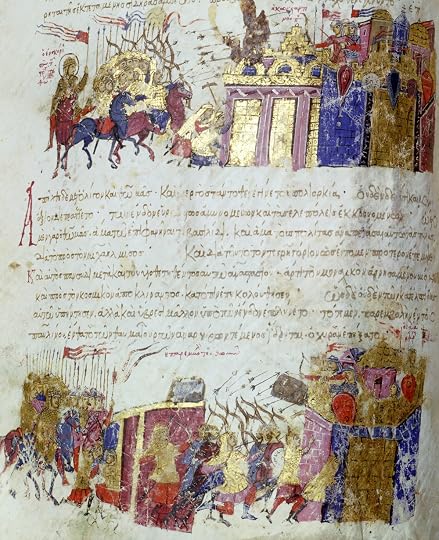
Byzantine manuscript illustrating one of the 7th century Arab sieges of Constantinople
...the wrath evoked from on high and the anger flaming below; the torrents of fire and blood, and the raids of brigands; the death-bringing attacks, the cry of demons and the roar of dragons... From the History of Khosrov, describing the Persian invasion of the Roman Empire
The eastern Mediterranean and the Middle East in the 7th century - terribly far away and long ago. At the beginning of the century two centuries-old Great Powers close to the heights of their strength and extent - (eastern) Rome and (Sassanid) Persia - entered into their fourth, and last, great war (603-628), and by the end of the century the Roman Empire was a rump state holding on only because of the incredible fortifications of its capital, Constantinople, and the Persian Empire was gone, both replaced by the new world power - the Islamic Caliphate - soon to stretch from Spain to northern India and pressing even the formidable T'ang armies back into China's interior.
A remarkable period in world history and one for which modern scholarship has only in the past few decades been closely examining the apparently massive sources available in the many languages of the cultures located in that vast expanse of Eurasia and proposing some rather radical revisions to the received stories.
Witnesses to a World Crisis: Historians and Histories of the Middle East in the Seventh Century (2010) is the result of James Howard-Johnston's close examination of the sources - partly based upon the preceding work of other scholars - but also presents the history he derives on the basis of this examination. And so, though history is most definitely told in this book, most of the text is devoted to that close examination, that painstaking, critical analysis of the extant sources to determine which is reliable and which are less so, and why and to which degree.
Such analysis is very likely not everyone's cup of tea, so in his Introduction Howard-Johnston suggests a high road through his book for those who are primarily interested in the results for history that avoids two-thirds of the text. But I like to know the why's and wherefore's of historians' reasoning, because I have read enough history to realize that without knowing how this particular kind of sausage is made one is likely to find oneself stricken with a bad case of ptomaine poisoning.
Remarkably, the most reliable and important sources turn out to be texts by the Byzantine poet George of Pisidias (died ca. 633), two idiosyncratic chronicles (the Greek Chronicon Paschale and the Syriac Chronicle to the Year 724) and a history written in the mid-7th century by an unknown Armenian churchman which is referred to by Howard-Johnston as the History of Khosrov. The reliability of a few other minor texts is established, as well, but it is in terms of the landmarks of these four texts that all the rest are mapped and tested. I'm not going to try to summarize the careful, complex and flexible reasoning Howard-Johnston employs in analyzing dozens of texts from all over the region written over a period of a few centuries, but I shall briefly remark that in the recent past the canonical texts of the Islamic tradition have been submitted to the same kind of careful textual analysis leading to rather sweeping and crushing conclusions about their reliability as historical sources. Howard-Johnston examines the early Islamic texts in two chapters and does a certain amount of reserved rehabilitation of them for historical purposes.
In the last three of the sixteen chapters in this book the author "pull[s] some substantive history together out of the full set of relatively fruitful sources analysed and evaluated in the preceding chapters." As I so briefly indicated above, this tumultuous age was one of the most important periods of transition in world history; we all live with its significance daily. Constantinople was besieged multiple times, by Avars, Persians and Arabs, and the Roman Empire was twice nearly snuffed out. The long Roman/Persian war had exhausted both empires, but when the Arabs came boiling out of their deserts with whipping green banners, their remarkable and sudden successes were not due merely to their opponents' exhaustion. Egypt fell into their arms with barely a struggle; after a few battles, so did Palestine, Roman Mesopotamia and Syria. It wasn't until Anatolia and then Constantinople itself were threatened that the Romans stiffened.
This is partly due to the apparent fact, confirmed by these sources, that wide swathes of the Roman population - even the Armenian churchman who authored the History of Khosrov - accepted that the Prophet was talking about the same God the Christians were and that the Arabs had His blessing, not the Christians. A related factor was the widespread anticipation of the imminent and strongly desired Apocalypse throughout the Middle East, since it inclined people to accede and accept what came instead of resisting it.(*) The Zoroastrian Persians were relatively untouched by such ideas and resisted the Arabs with more vigor until their morale broke for a few other reasons. Then, as is the way of our sad species, the victorious Arabs were sidetracked by the first of a number of civil wars. Muslims are still murdering each other in the name of that conflict.
(*) Apparently, Mohammad's earliest religious utterances were of this type. Indeed, a good part of the urgency of the Islamic conquest was due to this belief in the imminence of the Last Judgment.

December 19, 2022
I came onto this book by reading Howard-Johnston’s magnum opus The Last Great War of Antiquity – an outstanding book, which is an absolute must read if you have any interest at all in the 7th century and end of Rome as an empire. And seriously, if you aren’t interested in that topic why would you be looking at this book? In that book he described this one as a supplement/broader version of that one. While that book was a narrative account of the last Romano-Persian War, this one is all about the sources. The essence of the book is an in-depth source critique and summary of coverage and reliability. A big part of what makes his other work so accessible is that it eschews most of the source criticism in favor of a straightforward narrative. This is where the heavy lifting gets done.
The 7th century is pretty obscure, so this is a monumentally important task. The wide range of sources and locations is staggering and like nothing else in Roman history. Or really any era prior to the Age of Discovery. Roman, Syriac, Coptic, Armenian, Arabic, Iranian, Chinese, etc. Really fantastic stuff, and difficult for any scholar to handle without a lifetime of study. There is no one book that provides a narrative framework either, except late sources like Theophanes who he distrusts intensely. His views on these sources are pretty decisive. George of Pisidia for example is the greatest literary genius of his age. And his tracking of the various source traditions that make up a work like that of Theophanes may or may not convince. This opinionatedness makes the book easier to read, but will undoubtedly raise disagreement among scholars.
This book is essentially a string of abbreviated source studies. There are downsides and benefits to this. The key downside is that this means there is no overarching narrative to grip onto. If you’re looking for an account of this period you may be better off looking elsewhere (Haldon’s Byzantium In The Seventh Century is a somewhat dry account, or see Hugh Kennedy’s The Great Arab Conquests for a Muslim approach). You can get only a vague idea of broader events from the individual perspectives. On the more positive angle, this means that instead of a single narrative you get dozens, as the life and perspective (as best we can understand it) of each author. Each author’s section is relatively short and the limited broader narrative means you don’t need to read up to remember where you were. You can pick the book up and put it back down with little difficulty. The narrow focus on authors also means (as captured by the title) that we get to witness world events from as seen by humanized individuals. And of course this is amazing for anyone working on the period who needs a summary of any key source’s strengths/defects.
The biggest goal of this work is to get a sense of how reliably we can treat later Muslim material, which consists of facts passed down orally for generations in numerous traditions. His solution to this thorny question (and Arabic historiography is one of those areas in need of massive scholarly attention) is to try to build up a picture of the 7th century from reliable outside sources and then see whether it lines up. Reliability is defined first and foremost as being contemporary – if you lived through events you’d be hard pressed to convince your peers of broad facts that didn’t happen. There are a lot of these contemporary sources from a lot of different places and he follows them one at a time until he reaches the great compilations of sources from later in the Middle Ages. By the time he gets to the Arabic sources he’s given a pretty clear image of what we can and cannot know about the era from outside sources and that we can use to compare them with.
His conclusions are that the early Arabic sources are actually pretty reliable on the whole. As he points out repeatedly, it was antithetical to Muslim religious views to deliberately distort the past of their triumph. On the whole, obvious sidelining of defeats aside, he sees them as devoted historians. The only exception is when religious truth conflicts with historical truth. Even this is not deliberate, for since Islam is truth any data which contradicts it must be a misunderstanding on the historian’s part. As he sees it there are four main religious truths that distort the Arabic accounts of the Islamic Conquest:
The first of these is based on the idea that Mecca’s central role was a compromise – the Umma essentially lost their war, but could not be fully defeated, so instead Muhammad declared the Ka’aba Abraham’s temple and the holiest site in Islam. This let him come to terms with the Meccans, at which point his still-compelling ideas began to take wider root. You can imagine why the idea that Muhammad changed the words of God for political reasons would be anathema to any Muslim. The second reflects the fact that the conquest of the Holy City was in reality a minor event not befitting of its holy status, so it has thus been pushed forward in time to appear at the end rather than in the early days of their conquest. The final two concern both Shia and Sunni justifications for their respective doctrines – if the first Fitna could continue after Ali’s death and the second is unrelated it starts to look more like a squalid battle of warlords. You can see why Arabic historiography is so undercooked: if they knew about them, the views expressed here are probably worth a fatwa from (still too common) Muslim extremists. History can be a surprisingly dangerous profession!
As you can tell, another big difference between this and his other book is that it doesn’t end with the last Romano-Persian War but goes straight on through the Arab Conquest. The final hundred pages or so take the source analyses and build a solid (if abbreviated) historical narrative from them. If the other book has a fault it’s that the conclusion of the last Romano-Persian War really doesn’t signify anything permanent but is merely a prelude to much wider matters. I disagreed with his claim there that Rome and Persia were not weakened by the war, but his analysis here acknowledges the points I’d make: that in Rome particularly there was an exhaustion and war weariness that, combined with the fact that local elites had grown accustomed to negotiating their own safety over the war years and a feeling that the conquests represented God’s will in the lead up to the End Days, left the communities too listless to resist. I still disagree with his claims that while the timing was propitious it was not unduly so. It’s true a few years earlier would have been better, but with regards to overall eras I can think of no better time for an outside invasion. And in truth the distraction of the war was necessary for Muhammad to gain power in the first place, so it’s not as if the pace could have gone much faster. I would very much love for Howard-Johnston to write a sequel finishing up the story in his other book by giving us a full narrative of the Islamic conquests of Persia and most of Rome, but I doubt it will happen. Howard-Johnston is retired and starting a book of such ambition at his age makes its completion questionable, especially given that he doesn’t speak Arabic and regards the early Islamic sources as more difficult than the late Roman ones. So we will likely have to settle for this book.
This is an excellent book. It’s readable enough that I don’t think nonspecialists would struggle, but I still suspect that the topic (and price tag) is enough to limit it mainly to specialists. It offers clear guides and accounts for an often fragmentary and confusing era and does so in a way that makes further building possible. As with his other works, Howard-Johnston’s main issue is his unshakeable confidence in his conclusions. This is some pretty tendentious material, full of a wide variety of viewpoints and biases, yet he’s very confident in tracing lost sources throughout based solely on the facts shared. I’m still a bit disheartened by the variant accounts in Arabic sources – how can you pick between such different stories? – but I am glad to see some acknowledgement of their general reliability and I love how he tries to prove which variants are reliable by looking to outside sources. He strongly emphasizes the extraordinary and worldshaking nature of the period (a point with which I wholeheartedly agree) and the personal experiences of the authors and analysis of their perspectives really brings something unique to the table. It’s not for everyone, but if you feel you’re in the target audience you shouldn’t miss it.
The 7th century is pretty obscure, so this is a monumentally important task. The wide range of sources and locations is staggering and like nothing else in Roman history. Or really any era prior to the Age of Discovery. Roman, Syriac, Coptic, Armenian, Arabic, Iranian, Chinese, etc. Really fantastic stuff, and difficult for any scholar to handle without a lifetime of study. There is no one book that provides a narrative framework either, except late sources like Theophanes who he distrusts intensely. His views on these sources are pretty decisive. George of Pisidia for example is the greatest literary genius of his age. And his tracking of the various source traditions that make up a work like that of Theophanes may or may not convince. This opinionatedness makes the book easier to read, but will undoubtedly raise disagreement among scholars.
This book is essentially a string of abbreviated source studies. There are downsides and benefits to this. The key downside is that this means there is no overarching narrative to grip onto. If you’re looking for an account of this period you may be better off looking elsewhere (Haldon’s Byzantium In The Seventh Century is a somewhat dry account, or see Hugh Kennedy’s The Great Arab Conquests for a Muslim approach). You can get only a vague idea of broader events from the individual perspectives. On the more positive angle, this means that instead of a single narrative you get dozens, as the life and perspective (as best we can understand it) of each author. Each author’s section is relatively short and the limited broader narrative means you don’t need to read up to remember where you were. You can pick the book up and put it back down with little difficulty. The narrow focus on authors also means (as captured by the title) that we get to witness world events from as seen by humanized individuals. And of course this is amazing for anyone working on the period who needs a summary of any key source’s strengths/defects.
The biggest goal of this work is to get a sense of how reliably we can treat later Muslim material, which consists of facts passed down orally for generations in numerous traditions. His solution to this thorny question (and Arabic historiography is one of those areas in need of massive scholarly attention) is to try to build up a picture of the 7th century from reliable outside sources and then see whether it lines up. Reliability is defined first and foremost as being contemporary – if you lived through events you’d be hard pressed to convince your peers of broad facts that didn’t happen. There are a lot of these contemporary sources from a lot of different places and he follows them one at a time until he reaches the great compilations of sources from later in the Middle Ages. By the time he gets to the Arabic sources he’s given a pretty clear image of what we can and cannot know about the era from outside sources and that we can use to compare them with.
His conclusions are that the early Arabic sources are actually pretty reliable on the whole. As he points out repeatedly, it was antithetical to Muslim religious views to deliberately distort the past of their triumph. On the whole, obvious sidelining of defeats aside, he sees them as devoted historians. The only exception is when religious truth conflicts with historical truth. Even this is not deliberate, for since Islam is truth any data which contradicts it must be a misunderstanding on the historian’s part. As he sees it there are four main religious truths that distort the Arabic accounts of the Islamic Conquest:
1. Muhammad’s incorporation of Mecca’s pagan sanctuary into his new faith
2. Jerusalem’s capture as the culmination of first campaign of conquest
3. Ali’s death at beginning (not end) of first Fitna
4. Husayn’s death at end of first (not second) Fitna
The first of these is based on the idea that Mecca’s central role was a compromise – the Umma essentially lost their war, but could not be fully defeated, so instead Muhammad declared the Ka’aba Abraham’s temple and the holiest site in Islam. This let him come to terms with the Meccans, at which point his still-compelling ideas began to take wider root. You can imagine why the idea that Muhammad changed the words of God for political reasons would be anathema to any Muslim. The second reflects the fact that the conquest of the Holy City was in reality a minor event not befitting of its holy status, so it has thus been pushed forward in time to appear at the end rather than in the early days of their conquest. The final two concern both Shia and Sunni justifications for their respective doctrines – if the first Fitna could continue after Ali’s death and the second is unrelated it starts to look more like a squalid battle of warlords. You can see why Arabic historiography is so undercooked: if they knew about them, the views expressed here are probably worth a fatwa from (still too common) Muslim extremists. History can be a surprisingly dangerous profession!
As you can tell, another big difference between this and his other book is that it doesn’t end with the last Romano-Persian War but goes straight on through the Arab Conquest. The final hundred pages or so take the source analyses and build a solid (if abbreviated) historical narrative from them. If the other book has a fault it’s that the conclusion of the last Romano-Persian War really doesn’t signify anything permanent but is merely a prelude to much wider matters. I disagreed with his claim there that Rome and Persia were not weakened by the war, but his analysis here acknowledges the points I’d make: that in Rome particularly there was an exhaustion and war weariness that, combined with the fact that local elites had grown accustomed to negotiating their own safety over the war years and a feeling that the conquests represented God’s will in the lead up to the End Days, left the communities too listless to resist. I still disagree with his claims that while the timing was propitious it was not unduly so. It’s true a few years earlier would have been better, but with regards to overall eras I can think of no better time for an outside invasion. And in truth the distraction of the war was necessary for Muhammad to gain power in the first place, so it’s not as if the pace could have gone much faster. I would very much love for Howard-Johnston to write a sequel finishing up the story in his other book by giving us a full narrative of the Islamic conquests of Persia and most of Rome, but I doubt it will happen. Howard-Johnston is retired and starting a book of such ambition at his age makes its completion questionable, especially given that he doesn’t speak Arabic and regards the early Islamic sources as more difficult than the late Roman ones. So we will likely have to settle for this book.
This is an excellent book. It’s readable enough that I don’t think nonspecialists would struggle, but I still suspect that the topic (and price tag) is enough to limit it mainly to specialists. It offers clear guides and accounts for an often fragmentary and confusing era and does so in a way that makes further building possible. As with his other works, Howard-Johnston’s main issue is his unshakeable confidence in his conclusions. This is some pretty tendentious material, full of a wide variety of viewpoints and biases, yet he’s very confident in tracing lost sources throughout based solely on the facts shared. I’m still a bit disheartened by the variant accounts in Arabic sources – how can you pick between such different stories? – but I am glad to see some acknowledgement of their general reliability and I love how he tries to prove which variants are reliable by looking to outside sources. He strongly emphasizes the extraordinary and worldshaking nature of the period (a point with which I wholeheartedly agree) and the personal experiences of the authors and analysis of their perspectives really brings something unique to the table. It’s not for everyone, but if you feel you’re in the target audience you shouldn’t miss it.
September 7, 2024
táto kniha bola pre mňa tak trochu krok vedľa... Totiž myslel som si, že bude to súhrn historických záznamov interpretovaných autorom, no bola to kniha historických záznamov jednotlivých historikov. Polovica knihy je preto stále o tom istom z pohľadov rôznych dobových historikov, ktorí sa niektorým témam venovali všetci a niektorým zas nik. Hoci autor vyvodzuje z textov závery, nedáva tomu chronológiu ako v predchádzajúcej knihe. Napriek množstvu strán sa už zainteresovaný čitateľ nedozvie veľa nového. Chýbal jednoducho chronologický koncept diania z pohľadu autora, ako to vo väčšine kníh o histórii býva.
Displaying 1 - 3 of 3 reviews