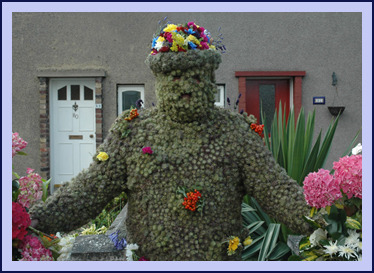
The second classic whodunnit starring Dandy Gilver . Summer 1923, and as the village of Queensferry prepares for the annual Ferry Fair and the walk of the Burry Man, feelings are running high. With his pagan greenery, his lucky pennies and the nips of whisky he is treated to wherever he goes, the Burry Man has much to offend stricter souls like the minister or temperance pamphleteer. And then at the Fair, in full view of everyone including Dandy Gilver, invited to hand out the prizes he falls down dead. If he has been poisoned then the list of suspects includes anyone with a bottle of whisky in the house, and, here at Queensferry, that means just about everyone.
Catriona McPherson (she/her) was born in Scotland and immigrated to the US in 2010. She writes: preposterous 1930s private-detective stories about a toff; realistic 1940s amateur-sleuth stories about an oik; and contemporary psychothriller standalones. These are all set in Scotland with a lot of Scottish weather. She also writes modern comedies about a Scot-out-of-water in a “fictional” college town in Northern California.
She has won multiple Anthonys, Agathas, Leftys and Macavitys for her work and been shortlisted for an Edgar, three Mary Higgins Clark awards and a UK dagger
Catriona is a proud lifetime member and former national president of Sisters in Crime.
Once or twice I fancied I heard footsteps, but then I was just as sure that I heard breathing, and THAT could hardly be so. Oh, for Bunty! The value of a dog, when one is walking through the woods getting spooked for no reason at all, is that a dog has keener hearing but a much duller imagination than oneself and so will mooch along nose to the ground no matter what horrors one's fancy conjures, and it is only when the ears prick and the nose quivers that one can be sure there is something going on outside one's own head, even if it is most likely a rabbit.
Well, I'm so glad I stuck with the series. This book is scads better than the dismal first entry, After the Armistice Ball.
Dandy (Dandelion) Gilver is a bored 1920s rich lady turned detective. In this novel, she travels to her friend Buttercup's (Frederica's) huge Scottish castle. There they are celebrating Burry Man Day, in which a man dressed in a suit of burrs walks slowly through the town while people give him coins and whiskey. However, everyone is surprised when he falls down dead at the end of the day. Even though the coroner rules it a heart attack, Dandy's friends suspect foul play and it's up to Dandy to get to the bottom of things.
...
This is much better than the first Dandy Gilver novel. For one thing, the first four chapters are blissfully Alec-free. Alec is Dandy's partner(?)/assistant(?) in solving crimes. He got on my nerves in the last book for his tendency to talk down to Dandy and because Dandy has rather a crush on him, and that makes me rabid - she's married. ...
PROS: 1.) The first four chapters are without Alec. Just Dandy living and observing and being funny.
2.) When Alec DOES show up, he is markedly improved from the previous novel. I didn't even tell him to 'fuck off' once, compared with the 8 times in Book One. He still sneers a bit at Dandy sometimes, but barely.
3.) Dandy is actually clever (or at least of average intelligence) in this novel, unlike in the first book where she was pretty dumb.
4.) At one point in the novel, Dandy is afraid that Alec won't show mercy to someone who needs mercy, and Alec totally comes through. I love when people are merciful. ...
CONS: 1.) There's still this sexual tension between Dandy and Alec that makes me extremely uncomfortable because Dandy is a married woman. Sure, her husband is oblivious, dense, and boring - but he's not a bad person. It makes me feel icky when Dandy talks about Alec.
Buttercup smirked at me, adding to the ruffled and slightly foolish feelings which were whisking around me like the tails of hungry cats around one's ankles.
"Alec," said Buttercup. "I meant to ask you: how did Dandy persuade you off the moor in the end?"
The tension is subtle - almost invisible - but I still don't like it.
2.) The mystery is pretty far-fetched. And the conclusions Dandy and Alec jump to are beyond my understanding. They make the most bizarre theories and act as if it makes perfect sense. The author does, I mean. McPherson has this nonsensical and strange way of getting the mystery solved and I can't follow it. I think she thinks it's normal or logical, but it's not. ...
Tl;dr - This second novel in the series is an improvement over the first one, but still has its flaws. But I was MUCH happier.
Not quite Josephine Tey or Agatha Christie, but definitely good enough to be going on with. Thankfully, Dandy is beautifully and believably flawed, and no twee Mary Sue horror like Daisy Dalrymple or Phryne Fisher. This book balances charm and humour with bleak tragedy beautifully, the author plays fair with the puzzle and the writing and handling of class and gender issues, especially Dandy's voice, are pitch perfect.
Dandy Gilver and her friend Daisy are invited to visit an old school friend Freddy who has married an American (Cadwallader) and returned to Queensferry where the two of them have rebuilt a ridiculous castle, complete with dungeons. Their visit coincides with the centuries old Ferry Fair, a tradition which is the cause of much strife since it involves a local resident donning a costume made of burrs and walking around the town taking a nip of whisky at every stop. For some reason, although they are newcomers to the town and there are several other families with more right to host the Fair, Freddy and Cad have been invited by the townsfolk to open the Fair and hand out prizes for bonniest baby and best fancy dress costume etc. Their sudden elevation may have something to do with the vociferous protests of the local temperance supporters and as a consequence Robert Dudgeon, Burry Man for the past 25 years, has come to Cad the night before the Ferry Fair to resign. Cad and Dandy manage to persuade Robert to continue but that could have been a mistake when Robert drops dead from alcohol poisoning at the end of the day.
At first Dandy feels guilty about persuading Robert to be the Burry Man with such tragic results but a series of strange incidents suggest there may be more to his death than first suspected.
I am really pleased because I guessed part of the plot quite early on, but I didn't guess all the elements (or indeed the murderer) and what makes these stories so good in my opinion is the way that the clues are scattered through the book, there to be picked up by the discerning reader or to be recalled ruefully when their relevance is disclosed later in the book - I'm thinking specifically of the two Conshies.
What I also love is the ring of authenticity about these books, if I didn't know better I would believe that they were written in the 1920s. Now I'm not claiming any great knowledge of the period, the books may be completely anachronistic, but they feel real. The attitudes of the landed gentry, the way in which Cad behaves quite reasonably but is looked at askance by the locals, the interactions between rich and poor etc.
Written in a very strange way that I just could not get my head around, or get into the book. If I'd been able to get into the book, it would have been a very enjoyable read, as it is set in my hometown of South Queensferry. Unfortunately, simply not for me.
I like protagonists who ... don't quite know what they're doing, but still manage to do what doesn't need to be done. Dandy is a little less bumbling in this one, because she has done this once before, in After the Armistice Ball. This book falters a little in the middle, but I still found it interesting. The potential personal complications hinted at in the first book still loom, and the juxtaposition of the life of upper class Scots with that of ordinary Scots continues. For me these are soothing and interesting to read, but they're probably not for everyone. I'm not sure when I'll continue this series, as it turns out that my library doesn't have most of the rest of the following books.
A mystery that focuses on an obscure folk practice in South Queensferry, Scotland sounds like it would probably be a cozy one. Like most cozies, there is a great deal of small town life with the usual sorts of characters. I expected the folklore content to be the aspect of this novel that I would find most interesting. Yet there was more simmering beneath the surface of South Queensferry than I had imagined. The Burry Man is a man covered with burrs who walks about the town of South Queensferry once a year receiving offerings of money and whiskey. This is an actual folk practice that is still alive in South Queensferry. Catriona McPherson portrays the Burry Man as a subject of controversy. In her book, some citizens of South Queensferry disliked the Pagan nature of the practice. Temperance advocates objected to all the quaffing of alcohol. In an author's note McPherson states that this opposition to the Burry Man was her invention to add drama to her tale. In the 1920's, when this novel took place, the festivities were also dampened by the losses that many families suffered in WWI. For this reason, The Burry Man's Day shares common themes with some of the Maisie Dobbs novels by Jacqueline Winspear that also deal with the impact of WWI, and can therefore be considered somewhat darker than the typical cozy mystery.
A second outing for Dandy Gilver in this series of 1920s mysteries. Dandy is on the opposite bank of the Forth Bridge an edifice she blames, in part, for her marriage this time, visiting a friend who, with her American husband, has just become chatelaine of a small but functional castle and has been shanghaied into patronage of the local fete, an event which focuses on the progress around the town of the Burry Man - http://193.62.154.38/celtica/Burryb.htm. Dandy, much to her horror, is deputed to judge the Bouncing Baby contest, but worse is to come when the Burry Man himself drops down dead at the end of the day. Was it the day-long consumption of whisky that killed him, or is there something more sinister afoot? This series is quite delightful: Dandy is an engaging heroine, the supporting cast is eccentric without devolving into caricature the period detail, though extensive and convincing, is not intrusive, and, although the mystery itself is quite low-key and undramatic, it still has enough twists and turns to entertain.
I had read the first in the series, After the Armistice Ball, which was pleasant reading if not as suspenseful as other mysteries. However, about half way into The Burry Man's Day, Dandy the detective had made no significant progress on the murder and the characters were no more compelling to me than they had been at the start of the book.
I did something I have done very rarely in my reading life, and rarer still with a mystery -- I skipped to the end. I feel guilty about this, and yet relieved. For me personally, the solution would not have been worth more precious hours of reading time. The author's writing is crisp and humorous, and I'm glad to have spent the time I have in these Scottish villages. I hope others will also read these mysteries, and perhaps discover what I seem to have missed.
I read the first book in the series, and wasn't terribly thrilled - but I really liked the premise, so I figured I'd give it another go with the second. Unfortunately, the second wasn't any better. Dandy is just too twee for my taste, and the story is too twining and incoherent. I'll have to pass on the rest of the series.
Dandy and her dear friend Daisy are off to Queensferry to reconnect with an old classmate and to go to the Ferry Fair. Freddy, nicknamed Buttercup, has finally returned from her sojourn in America with her new husband Cad in tow. Cad has lived his entire life in America and upon inheriting Cassilis he has decided to come to Scotland to play lord of the manor. Because in Dandy's eyes that's what the newlyweds are doing. They don't quite understand their duties to their people. You don't just get to live in a castle and while away the day lounging about. Take the fair for example. Freddy has agreed to open the fair and judge various competitions, like "The Bonniest Baby," when anyone who knows Freddy sees that this is the worst idea possible. Indeed Dandy gets a bit of a sinking feeling that perhaps the invitation extended to her and Daisy had ulterior motives...
Dandy is quickly thrown right into the middle of everything as Freddy does indeed expect Dandy's help. Not only is the fair a big to-do, there are factions within the small community that are at war. The local folk tradition of the Burry Man is the focal point of this struggle. A local man is covered from head to toe in Burdock burrs and he parades about the town being given sips of whiskey and coins. The three local churches view this as paganism and superstitious nonsense. On top of that, the temperance league led by the local schoolmaster, doesn't approve of the alcoholic aspect of the Burry Man, which is a bit ironic because bottling whiskey is the main source of income for the villagers. Yet for a short while, it looks like there might not even be a Burry Man this year. Mr Robert Dudgeon has declared the night before the fair that he will not be able to do his Burry Man duties, though he has successfully done it for 24 years. Dandy carefully talks him around but has deep regrets when the next day, after the fair has opened and the Burry Man's procession is done, Robert Dudgeon dies while participating in the greasy pole competition. The coroner quickly passes it off as a heart attack brought on by too much drink and exertion, but can that really be true? Cad and Freddy, hearing from Daisy about Dandy's previous sleuthing success, beg her to look into the case, because they think it might just be murder.
With The Burry Man's Day, which for some reason whenever I try to say it comes out as "The Burry Man's Dray," as if a man covered in burrs could ride a dray horse... is certainly a far more cohesive and satisfying book then After the Armistice Ball. There was a satisfying beginning, middle, and end, that didn't leave me floundering for pages upon pages wondering who everyone was or where the book was taking place. From the outset we are given a distinct place and time, the second week in August after the bank holiday in Queensferry, Scotland. As Dandy journeys there, she reminisces on her past, so we get some nice exposition. Ah, if only the first book had been so well structured, much of my issues would have been washed away down the Forth as we stand on the impressive bridge that inadvertently led to Dandy marrying Hugh and becoming a Gilver.
Though, now that structure has finally been imposed, Dandy's character flaws come a bit more to the forefront. At times I was wanting to just smack dumb dumb Dandy for not noticing obvious things. I'm not saying that I would have solved it faster if I where in her shoes, I'm just saying, dear lord, that took a long time. Cut out about a hundred pages and Bob's your uncle. Her stupidity was too much to be born, and it didn't help that Alec seemed more then a little useless this time around. Yet, I will say, that at least it didn't take them months, the murder happened on a Friday and by, what, Wednesday, Thursday it was solved. So, good job there. Yet Dandy wasn't the only one with flaws... there was a pervasive flaw in all the lower caste of characters. I don't remember a single character in the first book talking in dialect, but here we have dialect up the wazoo. And not consistent dialect either. It's all over the place. The thing that really got me was that the Widow Dudgeon at one point totally drops out of dialect and is speaking just like Dandy. That made it seem a little fake and forced... which applies to all those speaking as such. If you can't do dialect right, don't do it.
The thing I loved about this book was the Burry Man. I mean, I cannot say how much I loved this. The fact that this is a real tradition that McPherson was able to weave into her book and hang her mystery off of made it just fascinating to me. If I had the time and money I would quite literally be getting on a plane to Scotland to celebrate this interesting event which is happening so soon! I mean I could not have read this book at a better time. I have also now started to troll the net reading more about the Burry Man. There is nothing more magical then when a book inspires you to search out more knowledge and more information. Of course, I now might have nightmares because Dandy doesn't understate the kind of horrific aspect of the Man himself.
If you look closely you can see the eyes! There is a person in there! As Dandy said:
"I do not know what I had been expecting, and I felt foolish for being surprised. After all, I had known that the Burry Man was a man covered in burrs and here was a man covered in burrs, but the effect was staggering... Mouldy, encrusted, vegetative and obscene, when he walked it was the stuff of nightmares... I saw with a shudder that his hands were bare and somehow this evidence that there really was a man in there was the chillingest of all."
Yes, I can see nightmares in my future... also, as a side note, because my bookclub just read The Shining... topiary coming alive, not that scary... if King had used this, absolutely terrifying!
Going beyond just the Burry Man, I love how the local folklore and scary stories the village children told each other was incorporated into the truths and therefore lent itself to the solving of the crime. Most people will just push away fairy tales and folklore as the stuff of children, but those gifted few know that the simple truths, distorted through tall tales, are real. These stories were written originally to teach morals and give warnings. But what it all boils down to is that Fairy Tales are real. Terry Pratchett comes back to this again and again in his writing, and I think that's why The Burry Man's Day reminded me of his Tiffany Aching series. While we have fetes and fairs and stories around the fire, it all comes down to truths that can not be overlooked. Listen to the stories, they might just solve a mystery for you.
Dandy finds that solving mysteries is a great antidote for the fashionable woman, especially one whose worthy Scottish husband rambles on about drains. Sipping cocktails and sleuthing--what a lark! Good!
Dandy is back. The boys are at the seaside with the nanny, and Hugh is busy with contractors and estate business. Dandy's school friend Buttercup and her American husband have moved into the family castle in South Queensferry. Since Buttercup is more comfortable in a speakeasy than a Scottish burgh, Dandy and her friend Daisy are called in to assist with Burry Man's Day, part of the Ferry Fair. As the big landowners, Buttercup and her husband Cad are in charge of entertainment, judging bonny baby contests and passing out small gifts to the village children. There's a hitch in the program when Robert Dudgeon, reigning Burry Man, decides he doesn't want to participate. No one can blame him. He dresses up with burrs covering his body, going around to pubs for whisky and small tips. But Cad and Dandy talk to Robert, and he changes his mind, donning the burry man suit, scaring and thrilling children in a very superstitious community. At the end of the day, Robert participates in the greasy pole climbing contest and drops dead. Weak heart and too much whisky take the blame, but Dandy isn't satisfied. Why, after 25 years, did Robert Dudgeon hesitate to act as Burry Man? And why did one of the pub owners and his daughter react so oddly when the Burry Man visited? Dandy calls in Alec, and the pair of them work to find out how and why the Burry Man met his death.
This book was so much better than the first, and I really enjoyed the inclusion of the local customs and problems - the teetotalers and the men who drink whisky like milk - as well as post-war sentiments. Thoroughly enjoyable.
Verdict: Dandy and Alec hit their stride, and The Burry Man's Day is a success.
The Burry Man (actually exists) is a man covered from head to toe in burs. He is a feature of the Queensferry Ferry Fair in Scotland and the tradition is that he walks through the town and collects coins and sips of whiskey from the people along his route. Wealthy socialite, Dandy Gilber has come to queensferrry to visit her friend Buttercup who resides with her husband, Cad, in the castle and are in charge of the Ferry Fair events. She witnesses the walk of the Burry Man as he travels through the town. But then the Burry Man drops dead right after the walk is finished and Dandy, Buttercup, Alec and Cad look to find out what happened to him and if there was foul play at work. This was a fun story. I heard about the Burry Man while I visited Scotland several years ago and was surprised and pleased to see him in a mystery.
I'm still reading this -- I'm just about to begin Chapter 9; since I haven't read the first in the series, I feel a bit at times clueless to who some characters are. For one, who is Hugh? --EDIT--Finished. So, Hugh is her (Dandy's) husband? How does Alec figure into this? Still confused. I wish the library had bought the first book in this series.... That aside (it wasn't that much of a distraction), I just could not get into this book; I guess it's simply not for me.
There's probably a lot I'm missing, not understanding the intricacies of British social class and customs between the wars. It seems as if Dandy and Alec are awfully cozy for a married woman (and how much of the disparagement of her husband is real and how much just for show?), but maybe I'm reading too much into all the "darlings." A bit murky, but I was glad when I reached the end that I had kept going.
Light but true to the time and setting-worth the time spent reading it. Can't really ask for more than that. Did figure out "who done it" before the denoument. The second in a series-testament to the debut book, After the Armistice Ball is that you can't find one for love or money at retail prices, and the used prices are exorbitant. It is on all my wishlists on trading sites.
A complex tale about superstition, small town family politics and morals. It raises questions about loyalty and family connections while illuminating a feel of post-war Britain (or rather between the wars).
I really enjoyed this second Dandy Gilver mystery, and look forward to more sleuthing in Scotland.
It was very different to anything I've read before but I found it enjoyable. It's set in the 1920's & is about an amateur sleuth who happens upon a mysterious death & sets about trying to find out if there is more to it. Based in Scotland, it took some getting used to the dialect the author was depicting but the story took quite a few twists & turns.
Fun mystery set in Scotland in the early 1920's. Dandy is visiting her friend and attending the annual fair which involves someone dressed as the Burry Man who wanders town all day long taking shots of whiskey. When the Burry Man drops dead at the end of the day nobody suspects anything suspicious but eventually Dandy and her friends realize that nothing is quite as it seems.
As in the first book in this series at least one aspect of the mystery was obvious early on. Even though our detectives seem to lack imagination in the early stages, it is such fun to watch them investigate that it doesn't matter. I love Dandy Gilver and her buddy, Alec, and there are enough details left unresolved to keep things interesting right to the end.
This author is difficult!!! The dialect and style makes getting to know and understand the characters perplexing. And sometimes I just feel lost about what is going on! But the ending made up for it! So if you're going to read--do it slowly. Everything (sort of) comes together in the end!
Book 2 in the Dandy Gilver series - which I'm reading slightly out of order *headdesk* - but I really enjoyed this - I thought the story was interesting with hidden depths and I think Dandy and her friends are a hoot. I really do need to try and read these in order though...
The Burry Man's Day by Catriona McPherson is the second book of the Dandy Gilver mystery series. 34% of the way, the plot hasn't captured my interest, so I'll stop here. As with the first book, the rambling monologue style is the charm.
There is a phrase in the Army, I believe -- to be booted upstairs -- meaning to be promoted far enough beyond one's competence to prevent one doing any actual damage.
We stopped in the doorway to the Hall and peered down at the floor of the passage, finding under our feet an iron grille which showed us to be standing just above the front door. 'It's a murder hole', said Buttercup. 'You hide up here with your bow and arrow and if the guests get past the doorman but they still look unappealing -- peeyong! Dead.'
Daisy and I tried to look as though we knew what a hootenanny might be, and were fashionably unshocked at the thought of one.
'They've agreed to meet here?' said Cad. 'But they're at daggers drawn.' 'Well, I might not quite have said to each that the others are coming but it'll be fine.'
One would think that a Free Presbyterian, a Plain Old Presbyterian and a Catholic Priest would appear respectively as the Grim Reaper, more or less a vicar, and either a fat little man with a hip flask or a dashing prince in something purple, but here were three men with grey suits and pursed mouths and although one of them must be drinking lemonade to the other two' martinis they were all drinking them out of cocktail glasses and with identical expressions of distaste.
'One can hardly bear the drunken revelry for the sound of scrubbing brushes at Hogmanay.' 'And it's a very good thing, when you consider it,' I said. 'Even the foulest sloven gives everything one good wash for luck.'
We arrived at the tearooms. There were two side-by-side, which always amuses me. If a village has two establishments on different streets then each can pretend that the ladies chose the nearer, but when they sit nested together as did Mitchell's and Beveridge's in Queensferry the workings of class structure and economics are laid bare.
'Now, the way I see it, I've got to live here and you two don't, so I'll take care of the races and you two can pick your way through the diplomatic minefields and then hightail back to Perthshire and leave it all behind you. Agreed?'
Cadwallader always loaded his fork as though pitching hay with a rainstorm threatening.
Pleasantly written, with our bumbling, awkward detective back for another go. Less Alec, which I appreciated. Buttercup and her American husband were good additions to the cast, although the latter veered into caricature a lot.
Like the first book in the series, large elements of the solution were apparent to the reader from the beginning, although Dandy and Alec of course go through scads of contortions to laboriously trace their way to the answers.
Dandy's elliptical references to Hugh continue to convince me that I would probably like him better than Dandy. Poor Hugh, disdained because he cares about plumbing and worthy things like improving his estates, while his wife runs around with her pampered, untrained dog and her boytoy.
Oh, and the upper-class nicknames are just too twee. There's long-running joke about Freddy's schoolgirl nickname being Buttercup but she's desperate for her husband not to know, so her friends keep saying things like "So about the murder, Buttercup," while her husband goes "what? Buttercup? I don't understand women, they're so confusing". Mildly funny once. Not so funny when it becomes a groan-worthy book-long motif.
Back to cosy crime, after a disappointing read, and this one is another set post-ww1 but, just for once, it doesn't feature a 'surplus woman'.
Dandy Gilver has left her husband to his Glorious 12th shoots and is visiting friends in South Queensferry to help with the annual Burry Man's Day and judge various competitions.... the friends are local gentry and it's their turn to organise and host.
The night before, the local man who has played the Burry Man for the last 20 years suddenly wants to back out. Dandy is instrumental in persuading him to continue and therefore feels partially responsible when he drops dead after completing his day in costume.
The police and surgeon conclude he had a heart attack, but something doesn't quite add up for Dandy and she enlists her sleuthing partner, Alec, to help her clear up the mystery.
Nicely put together and an interesting ending (although I did work some of it out). Also nice to read something set in a place I know that isn't Rebus's Edinburgh.
My reasons for liking this book better than the first in the series may be idiosyncratic. First, Hugh is barely on the scene, so I spend less time lamenting the tragedy that is the Gilvers’ marriage. Then, you get the sense that Dandy is getting the hang of this detective stuff—but not all at once, which would be unbelievable, and not without her occasionally giving me the chance to figure out a wrinkle in the plot before she does.
The plot depends on mistaken identity, which is something Shakespeare used with great success in comedies. It feels a little strained in historical fiction and in a murder mystery in a small town. The social landscape of the town and the lingering effects of WW I on people and families are the most winning elements of the book.
No hesitations now: I will read more of this series.