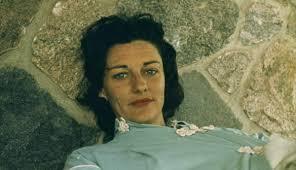
I’ve loved Sylvia Plath for years, so I was surprised to read, when attempting to dip my toes further into the world of confessional poetry, that she had a contemporary - another woman, only a few years older than her, whose life followed a similarly tragic trajectory.
I had to wonder why I had heard so much more about Plath than Sexton (I know Sexton is still well-acclaimed, but in my experience she hasn't penetrated popular culture in the same way). Perhaps the quality of the poetry had something to do with it, but after reading this collection, and seeing just how much acclaim Sexton gained during her lifetime, I can't say that this is the case. Her life, I suppose, was messier (to put it lightly), even more complicated than the legacy Plath left behind. Her poetry, too, seems to touch on even more taboo topics than Plath, topics which remain controversial even today - abortion, menstruation. And, as grim as it is to say, her method of suicide was less novel, less memorable; they both went out by way of carbon monoxide, but sitting in a parked car doesn’t conjure the same grotesque imagery as sticking your head in an oven, something repeated not as a tragic fact but instead as a morbid curiosity.
There are clear echoes of Plath and her poetry in Sexton's work here, most obviously in Sylvia's Death, an elegy for her friend. Cripples and Other Stories calls to mind Plath's most famous, Daddy, not only in the subject matter, but also in the rhyme and meter. Here the differences between them are most clear, however. Both use dark imagery, Plath invoking Nazism to illustrate her relationship with her father, but Sexton utilises more directly grotesque imagery, rather than relying on associations of atrocity - rats, enemas, deformity, maggots. The directness of much of Sexton's work in this collection reads not just as confessional but also confrontational: she challenges the reader with the full face of mental illness, not a sanitised image but instead a warts-and-all depiction of a series of mental breakdowns.
Considering Sexton's work on its own merits, then, separate from Plath - as she deserves - her standout images, for me, deal primarily with religion. I'm not educated in theology and thus probably can't do justice to her utilisation of biblical metaphors and Protestantism as metaphor, but The Legend of the One-Eyed Man is truly cutting as Sexton's narrator relates to (and draws comparisons to) Judas and Oedipus, a cutting remark on guilt, whilst the final stanza certainly can be read in tangent with Sexton's mediations on the subjugation of women (Her Kind, not in this collection, is perhaps my favourite of hers I've read so far).
Sexton also frequently refers to dolls in this collection; while I can't say whether or not she's read it, for me there are clear thematic parallels to Ibsen's The Doll House, particularly considering once more Sexton's writings on womanhood. Dolls represent an image of idealised femininity a young Sexton seems to fail to live up to in Those Times..., a chilling depiction of childhood, later, a kind of lobotomised housewife in Self in 1958. Her clearest writing on gender here, though, is of course Consorting With Angels, beginning with "I was tired of being a woman, / tired of the spoons and the pots, / tired of my mouth and my breasts, / tired of the cosmetics and the silks," and ending with the wonderfully provocative "I am no more a woman / than Christ was a man." Reading with the knowledge that Sexton was, at a time, diagnosed with hysteria, and, of course, the nature of the restrictions placed on women at the time she was writing, it's no wonder that Sexton was tired of being a woman, when her illness was labelled a problem of being female, when she would be labelled promiscuous, a drug addict, suggestible, developmentally immature, a liar, someone for whom suicide was a way of life, any potential trauma she may have suffered dismissed.
It's interesting that for a collection so often dark and death-occupied that it ends with Live, a fairly hopeful poem of Sexton's that seems to contradict both her earlier and later writings, the most notable parallel in this collection being with Wanting to Die. Read with the knowledge of Sexton's eventual fate, the hopefulness of the poem feels bittersweet at best, but it's difficult to imagine how else this collection would conclude. While not every poem in this collection engaged me totally, I fully intend to look into the rest of Sexton's poetry, as while I find the alleged abuse she perpetrated discomforting (to say the least), it's also difficult not to see her as an incredibly compelling, challenging, tragic figure, one who deserves more of my attention.